

Facebook Ads Best Practices: No More Wasted Ad Spend
29 July 2021
Carmen
9 minutes
If your goal is to increase traffic quality and turn it into revenue, Facebook ads remain one of the most powerful tools in your social media marketing arsenal — but only when you're applying the right Facebook ads strategy.
The platform has changed. Meta's ads ecosystem is now driven by two forces: AI-driven automation and a renewed emphasis on creative quality. Simpler in some ways. Fiercer in every way that counts.
In this guide we'll cover:
High-quality traffic and why it matters more than volume
Landing pages and why your homepage is the wrong destination
Why Meta ads are still the most efficient paid channel
Ad formats and creative strategies
Facebook ad copywriting and call to action
Mobile devices and placement
What happens after the click
High-Quality Traffic: Why Quantity Is the Wrong Goal
It's normal to want to drive as much attention as possible toward a new page. But attracting everyone at the cheapest possible price is one of the fastest ways to burn through ad spend without a single sale to show for it.
Quality over quantity isn't a cliché in Facebook ads best practices — it's the difference between traffic that converts and traffic that bounces off your landing page.
Traffic: visitors who will not necessarily lead to sales or meaningful engagement with your brand
High-quality traffic: visitors who match your ideal customer profile and are ready to take immediate action
The U.S. Small Business Administration recommends small to medium businesses invest 7–8% of gross revenue in advertising. Startups should start at 2–3%. The exact percentage matters less than the principle: your ad spend should target the right audience deliberately, not be scattered at anyone who clicks.
From every ad campaign, an average of 5% of leads become real customers. Successful campaigns reach around 28%. The difference isn't volume — it's audience alignment. Those customers return, repeat, and build lifetime value. Random traffic doesn't — and industry leaders know exactly which is which from their ads manager data.
Landing Pages: Use a Dedicated Page, Not Your Homepage
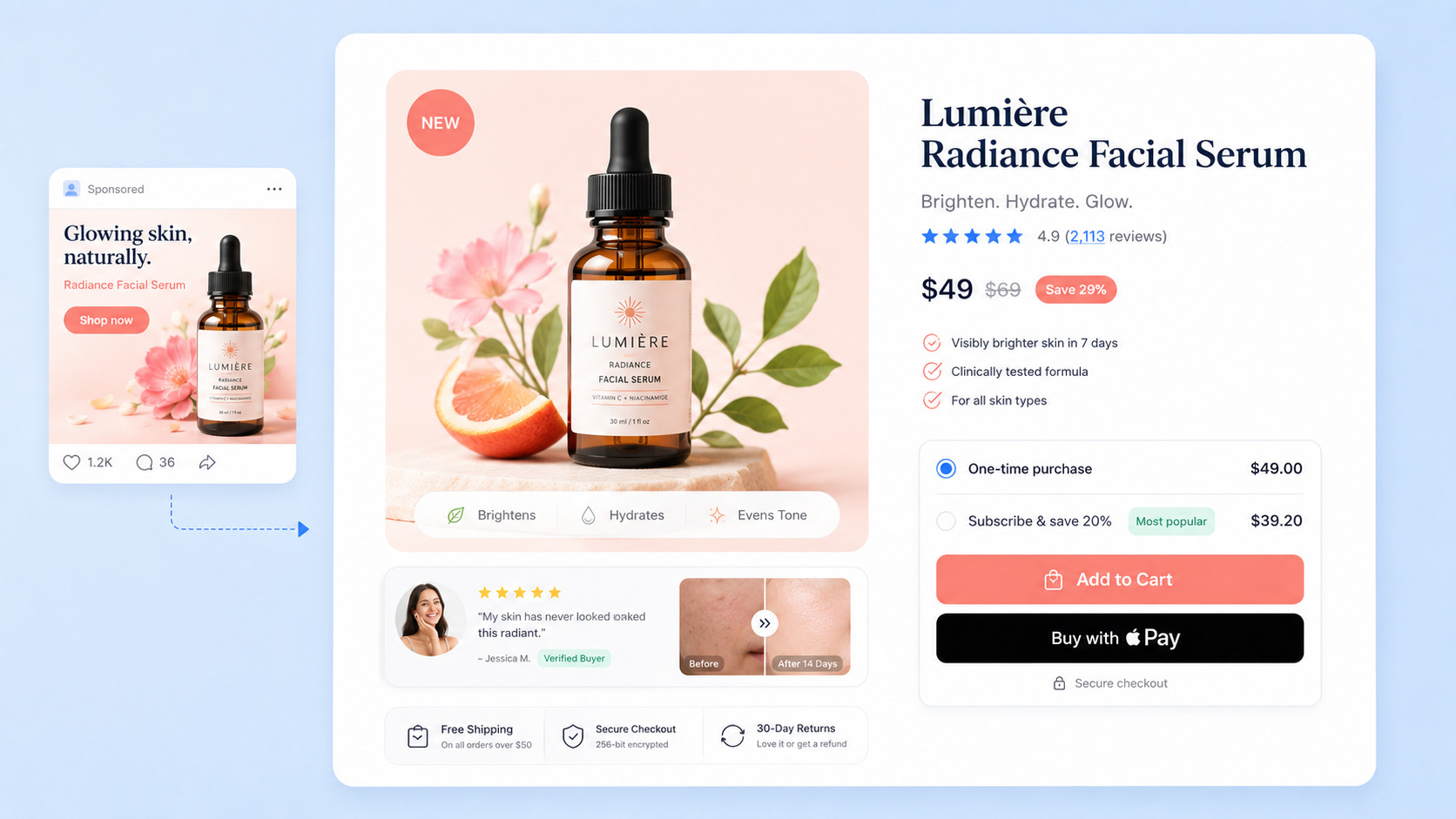
A landing page is where a potential customer ends up after clicking your Facebook ad — not your homepage, which is one of the most common and costly mistakes in Facebook advertising.
If your ad features a specific product and the visitor clicks expecting to see it — then lands on your homepage instead — most of them leave immediately. They won't dig around to find it themselves.
The golden rule of Facebook ads best practices: your landing page is a promise your ad made. Every mismatch between your ad creatives and your landing page is wasted ad spend — and a missed chance to connect emotionally with someone who was close to buying.
A landing page can be almost anything — as long as it delivers exactly what the ad promised. One message. One offer. One path to immediate action. That's it.
Funnelish lets you build dedicated landing pages that match any ad's specific message — no navigation menus, no competing products, one focused offer — with sub-second load times that don't let paid traffic bounce before the page loads.
Read more: One-Product Funnel: How to Build One That Turns Strangers into Loyal Customers
Why Meta Ads Are Still One of the Most Efficient Channel
Meta has over 3.27 billion daily active users across its family of apps as of 2025. (Meta Investor Relations) There is no larger addressable advertising audience on earth. The targeting options are unmatched — age, gender, location, interests, behaviors, lookalike audiences from your customer data, and custom audiences from your email list.
Meta ads deliver results fast. Start a Facebook ad campaign today, have data tomorrow. No other channel matches that speed at comparable cost.
Average ecommerce CPM sits at $8–$14 with CPC running $0.50–$1.50 in 2026 — competitive with any paid channel and far cheaper than comparable traditional media reach. (Stackmatix) And unlike those channels, you know exactly who's seeing your ads and what they did after clicking.
What makes Meta particularly powerful for sales funnel-driven ecommerce brands is its social mechanic. Shares, tags, and comments generate organic amplification beyond paid reach — word-of-mouth at a scale that no other advertising channel produces natively.
Ad Formats and Creative Strategies
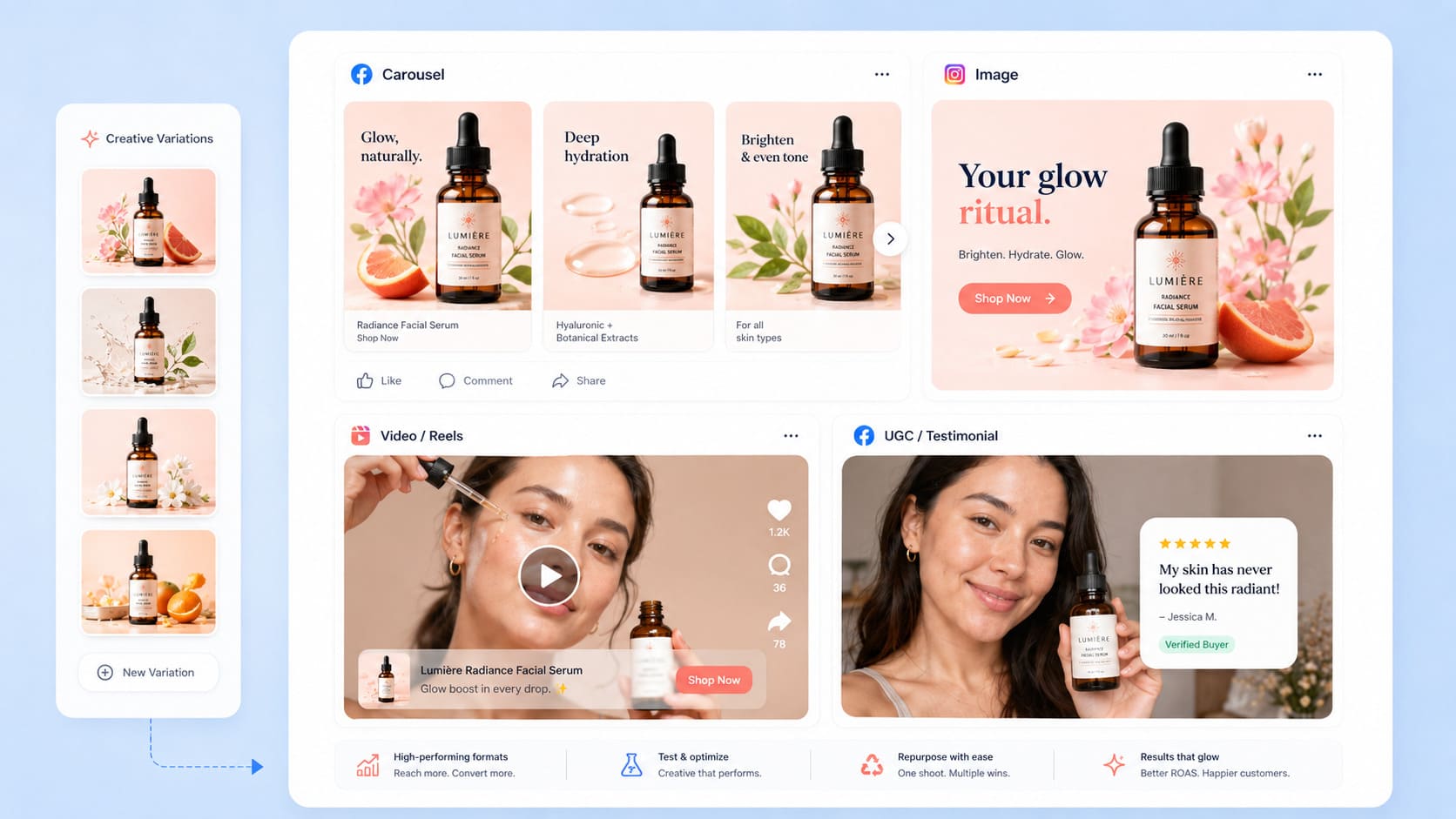
The best Facebook ads in 2026 aren't necessarily the most polished — they're the most relevant to the right audience at the right moment. Here's how the main ad formats perform and when to use each one.
Carousel ads are the top-performing format for ecommerce and product catalog campaigns in 2026. They let you showcase different aspects of a product or multiple products in a single ad — with each card linking to its own dedicated landing page. Great for defined audiences who respond to variety and comparison.
Static image ads still drive 60–70% of Meta conversions — proof that ad creation complexity doesn't equal performance. (Stackmatix) A single high resolution image with strong visual elements and a clear message often outperforms an elaborate video ad when the offer is right and the ad image speaks directly to the target audience.
Video ads should hook viewers in the first 3 seconds. Design every video ad for silent viewing on mobile devices — 85% of Facebook video is watched without sound. Add captions to every video ad, every single time. Don't add text that clutters the frame — add text that adds meaning.
Since Meta's Andromeda algorithm update, creative diversity matters more than creative volume. When you find a winning ad, don't produce 20 iterations of the same thing. Repurpose the winning message across new ad formats — extract the hook from a video ad, test it as an image ad, run it in a carousel.
Best practices for ad creation:
Use high resolution images and avoid generic stock photos that blend into the news feed
Test various images and different creatives across different audiences and ad sets
Real imagery outperforms AI-generated visuals for cold audiences consistently in 2026 (Wordstream)
Use a 70/20/10 lifetime budget split: proven winners, iterative variations, experimental creative
Refresh ad creatives every 3–6 weeks to prevent ad fatigue before it tanks performance
Use UGC and testimonials — real customers using real products capture users attention faster than branded content for cold audiences
Advantage+ Creative in Meta ads manager automatically adjusts your visuals and ad copy to match what your audience responds to best — without manually testing every small variation. Essential at scale.
Facebook Ad Copywriting and Call to Action
Your ad copy has one job: move the viewer from passive scrolling to clicking. Every word in your Facebook ad copywriting should serve that goal — nothing more.
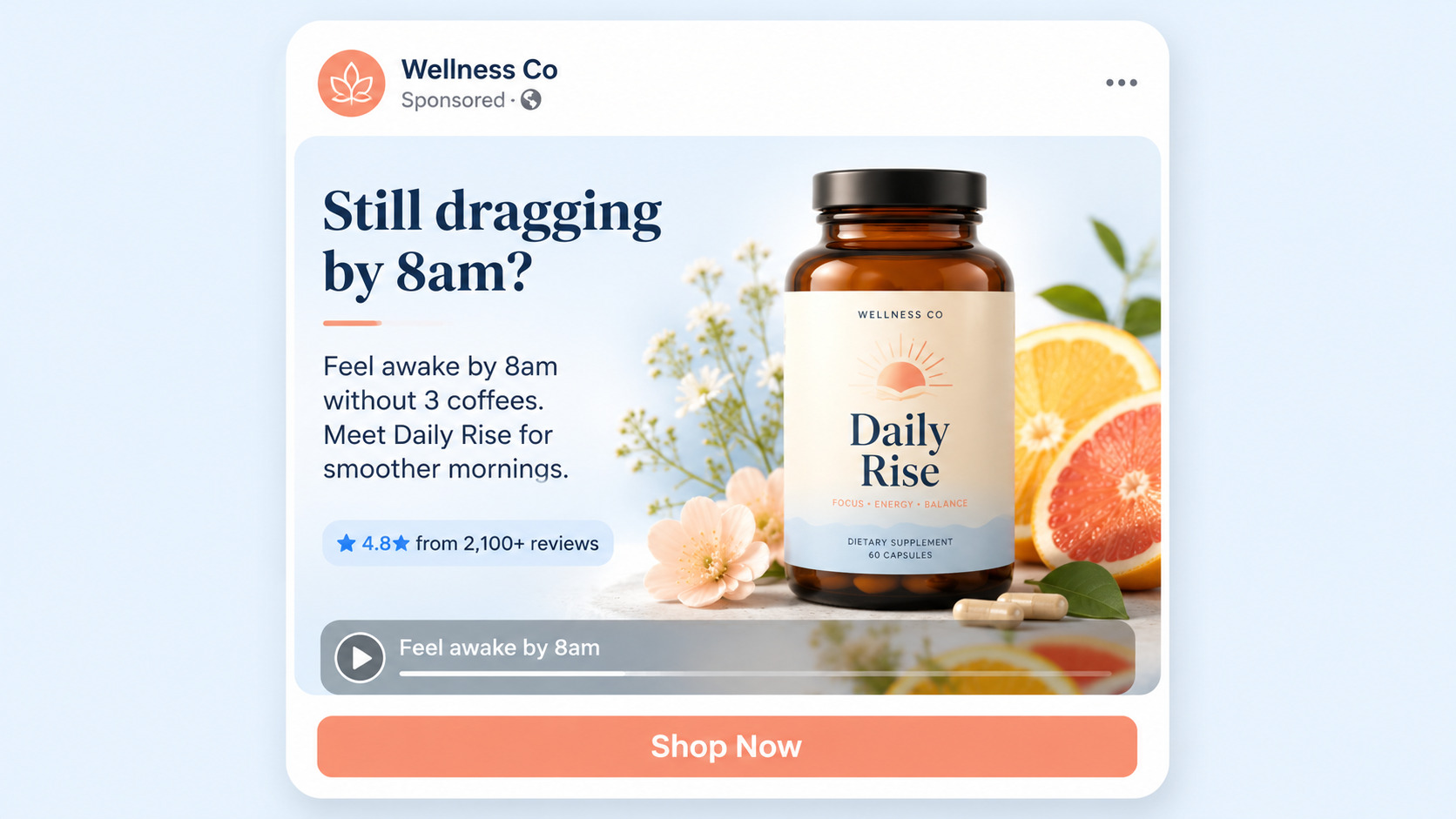
Lead with the problem, not the product. Cold audiences don't know yet why they need your product. Ad copy that opens by articulating the exact frustration your target audience has — before introducing the solution — makes the offer feel relevant before the ask even lands.
Be specific, not vague. "The best supplement for energy" is weak ad copy. "Feel awake by 8am without 3 coffees" is visual and immediate. Specificity builds credibility and drives better conversion rates. Vague messaging burns ad spend on an audience that never connects emotionally with your brand.
One clear call to action per ad. Ads with multiple CTA buttons — "Learn More, Shop Now, Sign Up" — typically convert worse than a single directive that matches the campaign objective. "Shop Now" for conversion campaigns. "Get the Free Guide" for lead generation. One path. One immediate action.
Add captions to every video ad. Most potential customers scroll the Facebook feed and Instagram feed on mobile devices with sound off — captions are a non-negotiable Facebook ads best practice for any video ad format.
Test ad copy variations as rigorously as creatives. Different angles — problem-focused, benefit-focused, social proof-led — produce materially different conversion rates with the same target audience and the same ad image. Your ads manager audience feedback tells you which message works. Let the data decide.
Audience Targeting: What's Working in 2026
The targeting approach has shifted significantly. Meta's AI is now better at finding buyers than most manually built audiences — pushing industry leaders toward broader targeting and Advantage+ campaigns over the tightly defined interest targeting that dominated a few years ago.
Lookalike audiences built from high-revenue customer lists remain one of the best strategies for reaching a defined audience that converts. Upload your customer data, segment high-revenue from low-revenue customers, and build separate lookalikes from each to hit the sweet spot between scale and relevance.
Upload your unsubscribers as exclusions in Meta ads manager. Stop burning ad spend on users who've already opted out — they drag down conversion rates and corrupt the audience feedback Meta uses to optimize your ad sets.
For newer brands without much customer data, broad targeting with strong ad creatives is the right starting point. Let Meta's algorithm find the right audience rather than constraining it with narrow interest targeting that limits scale before it even finds its sweet spot.
Mobile Devices and Placement
The biggest share of Facebook ad revenue is generated through mobile advertising. Every Facebook ad campaign you run will be seen primarily on a mobile device — your landing page must be fully optimized for mobile before a single dollar of ad spend goes live.
A page that fulfills the ad's promise but loads slowly on mobile kills the campaign regardless of how strong the ad creatives are. Mobile isn't a secondary consideration. It's the primary one.
Instagram Stories delivers a CPC 45% cheaper than Facebook feed placements — making it one of the most efficient placements in the entire Meta ecosystem and one of the most underused by ecommerce brands relative to its efficiency. (Sovran)
Automatic placements in ads manager outperform manual selection for many ad campaigns because Meta's algorithm knows where your specific audience converts best. (leadsbridge) Manual placement selection limits that optimization before it can find the sweet spot for your campaign objective.
What Happens After the Click
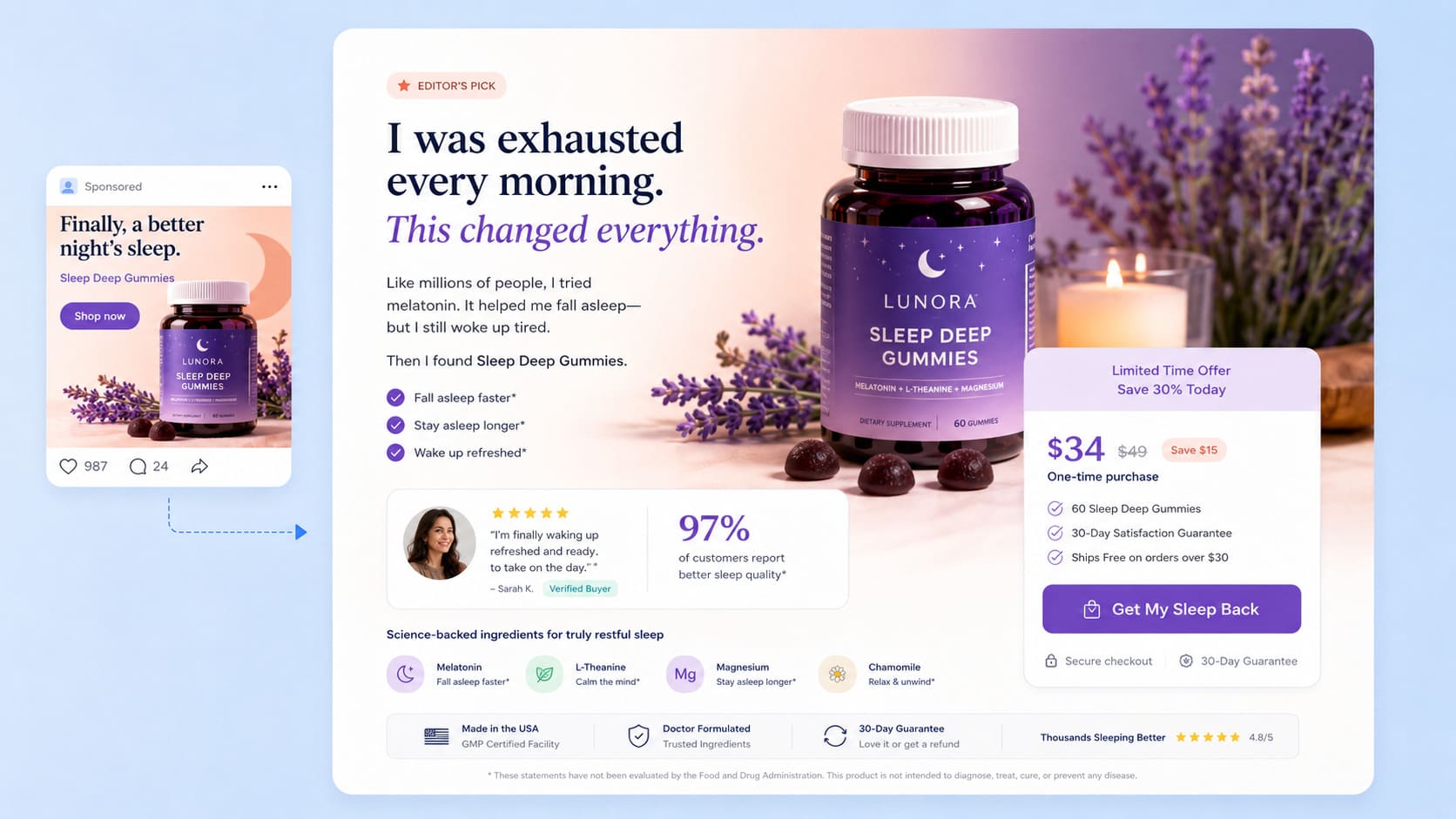
Driving high-quality traffic to a landing page is half the job. The landing page, checkout flow, and post-purchase sequence determine whether all that ad spend was profitable.
Sending Meta traffic to a slow page or a checkout with friction is one of the most common reasons Facebook ad campaigns fail — even with strong ad creatives, the right target audience, and solid bidding. An audience engaged enough to click is wasted the moment the post-click experience doesn't deliver.
Funnelish closes that gap. Purpose-built landing pages that continue the conversation the ad creative started — one offer, mobile-optimized, sub-second load. A customizable checkout supporting Stripe, PayPal, Klarna, Apple Pay, and more ensures no potential customer abandons because their preferred payment method isn't available.
Post-purchase one-click upsells capture additional revenue at peak buying intent without a new checkout flow. Geo-funnels automatically adjust pricing, language, and payment options by location — eliminating the conversion drop from international traffic hitting a checkout built for a different market.
For abandoned carts, Funnelish's automated recovery sequences fire within the hour — reaching the highest-intent lost customers before they've moved on.
To run Facebook ads that work end to end:
Target precisely — or let Meta's AI find buyers through broad targeting and Advantage+ ad campaigns
Offer something that solves a real problem or creates a genuine experience for your defined audience
Build ad creatives with strong visual elements that capture users attention and include one clear call to action
Send traffic to a dedicated landing page — never your homepage
Build a checkout and post-purchase experience that converts what the ads deliver into real revenue
Facebook ads work because of reach, targeting precision, and speed. But in 2026, the ecommerce brands winning are the ones with the best creative, the sharpest landing pages, and the infrastructure to turn traffic into customers.
Table of contents
Boost your eCommerce
sales today

24/7 support
No credit card required
Cancel anytime
24/7 support
No credit card required
Cancel anytime
