

Is Dropshipping Still Worth It in 2026?
15 January 2025
Anna
11 minutes
Dropshipping business model is dead.
Harsh, right?
You'll hear a lot of talk about dropshipping dying, whether it's from a "guru" using the phrase as clickbait, or other store owners venting their dismay at the rising costs and competition making it harder to get the profit that was once so easy in this industry. And in 2026 there's a genuinely new reason behind the talk: the tax loophole that made cheap imports profitable is gone.
We couldn't disagree with the "it's over" verdict more — but the old model really did lose the thing that powered it.
Yes — dropshipping the old way is dead, but we've figured out the trick to a profitable dropshipping business that generates more conversions and a much higher AOV (average order value).
Want to know how to do it yourself? Let's dive in
First, why the old way is dead
Throwing together an online store, finding a halfway decent product on AliExpress, and slapping on some paid ads used to be a pretty successful way of making money online… a few years ago. Three things changed that, and the third is what makes 2026 different from every "dropshipping is dead" article written before it.
First, ad costs. Facebook's average CPM sits around $8.77 in 2026, up from the $4–5 range just a few years ago.
Second, saturation. The dropshipping market has gained millions of new competitors selling the exact same products from the exact same dropshipping suppliers. When everyone sells generic products with no differentiation, the only lever left is price, and that's a race to the bottom that compresses already low profit margins.
Third — and this is the 2026 game-changer — the cheap-import loophole closed. For years, the real engine under old-school dropshipping was a tax exemption called de minimis: parcels valued under $800 entered the US duty-free. That is what let you ship a $6 product straight from China to a US customer with no import tax and still turn a profit. In 2025 that ended — duty-free treatment was suspended for all countries on 29 August 2025, and Congress repealed the exemption permanently in the One Big Beautiful Bill Act, effective 1 July 2027. A federal court upheld the change on 13 August 2026, so it is not a temporary policy likely to reverse.
What that means in plain terms: the direct-from-China parcel that used to be the whole business model now arrives with import duty attached — and for Chinese-origin goods those duties stack (Section 301, IEEPA, and Section 232 can apply together). One auto-parts seller that had built its entire operation around sub-$800 shipments faced duties above 52% once the exemption closed. Europe was never as generous here — its duty-free threshold sat at €150 and is now being phased out too. So the "$6 product, ship it from China, pocket the difference" model isn't just harder in 2026; its core economics are gone. (Full detail on the rules and the ruling.)
Here's the part the doom-and-gloom headlines miss, though. The numbers show why average no longer cuts it: only 10–20% of new dropshipping stores turn profitable in their first year, often because sellers chase quick wins instead of a solid business plan. But the global dropshipping market itself is booming, projected to grow at around 22% a year and to surpass $1.25 trillion by 2030. The demand is absolutely there. What died is the cheap-arbitrage shortcut — not the model. The opportunity didn't disappear; it just stopped rewarding lazy stores.
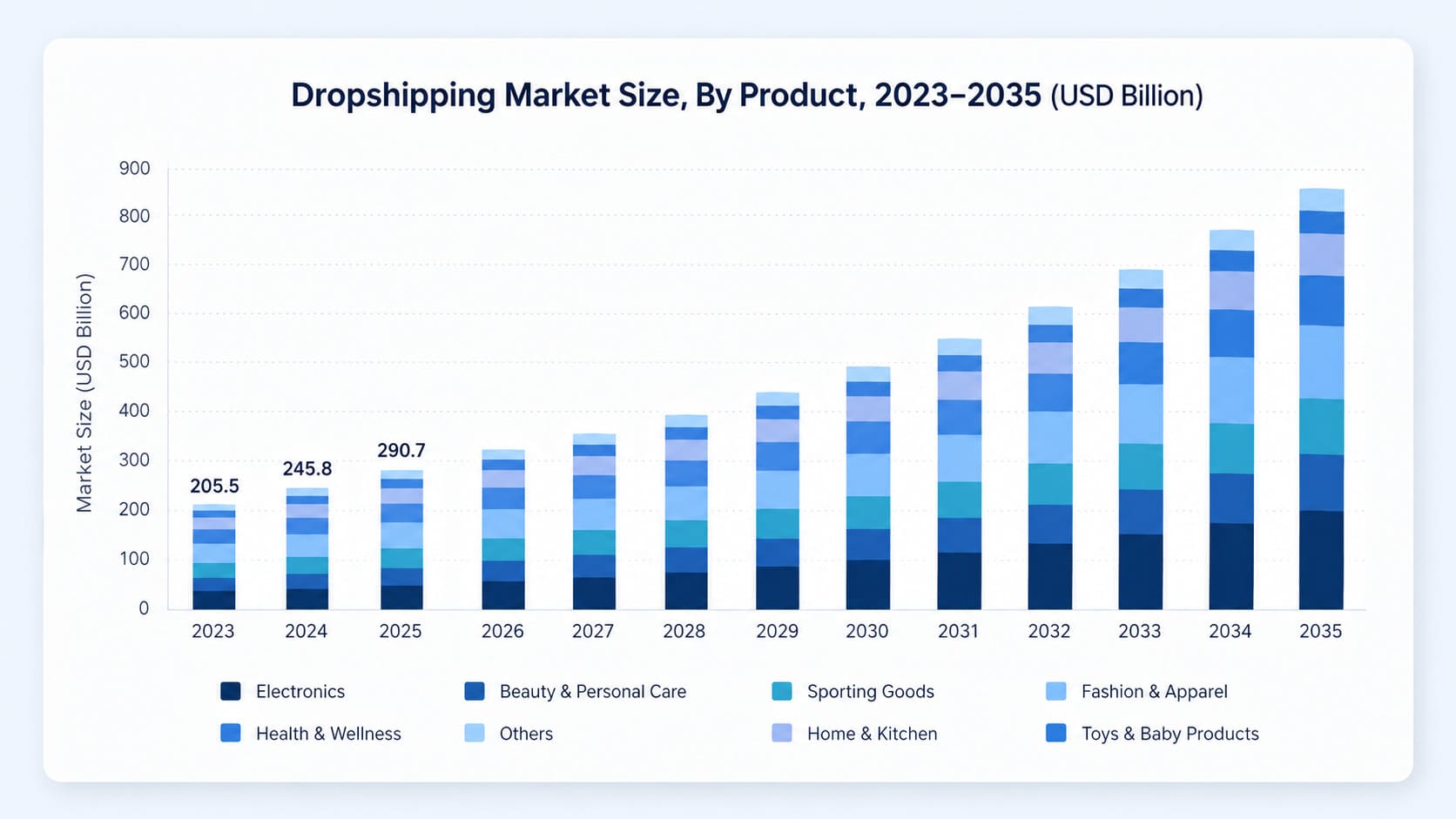
So this is still very much a legitimate ecommerce business model and a viable business model — for anyone willing to treat it as a real business rather than a get-rich-quick scheme. (And yes, for the record, dropshipping is perfectly legal as long as you handle sales tax and supplier agreements properly.)
The winners in 2026 adapt in two concrete ways: they move to higher-ticket products with enough margin to absorb duty, and — for the US market — they source from suppliers with US-based fulfillment so goods clear customs once in bulk instead of getting taxed parcel by parcel. That single sourcing shift is what separates the stores still profitable this year from the ones quietly closing.
Read more: Ecommerce Subscription Model Is the Last Unfair Advantage in D2C
Introducing the new way: Sales funnels
Drumroll, please… the new way of dropshipping (and selling anything online, for that matter) is focused around the customer experience — actually taking the time to teach shoppers about the product and why they'd want it first.
How do we do it? Funnels, funnels, funnels!
Sales funnels sell the product to your customers in a much more appealing way. Instead of a regular product page that's cluttered and pulls attention away from the actual product, a sales funnel focuses on one product, with a layout built to inform customers and convince them to purchase. It's the difference between how the dropshipping model works at its best versus other business models like traditional retail, where the shopper is left to figure things out alone.
There are a few key parts to this process, so let's go over them:
Choosing the right products (the "s" is important here!)
Building the funnel
Choosing the right digital marketing tools
Optimizing the experience (for the customer and for yourself)
Choosing the right products
Choosing dropshipping products for your funnel is basically the same process as choosing products for any online store — but with a twist.
When you use a funnel to sell products, you get the added benefit of being able to add an order bump, upsell, and downsell, all meant to increase your average order value! These upsell and downsell pages are basically secondary sales pages that you send your customer to after they've already purchased the main product. Your funnel saves their payment info, and if they want any of these complementary products, they just click "Yes" and it's automatically added to their order.
So why does this make choosing your products important?
First, make sure your main product is a good one — meaning you already know it's a strong seller because you've sold it before or have seen others succeed with it. Do your market research, check Google Trends for steady demand, and test products before you commit to a profitable niche. This validation step is where most product ideas live or die.
Then, when picking your upsell and downsell products, choose items that closely relate to the main product and actually make it better — products that basically upgrade the original. For example, if you're dropshipping an Airbrush hair styling tool, you could upsell a protective hairspray and the Airbrush attachments to give customers even more ability with the product they just bought!
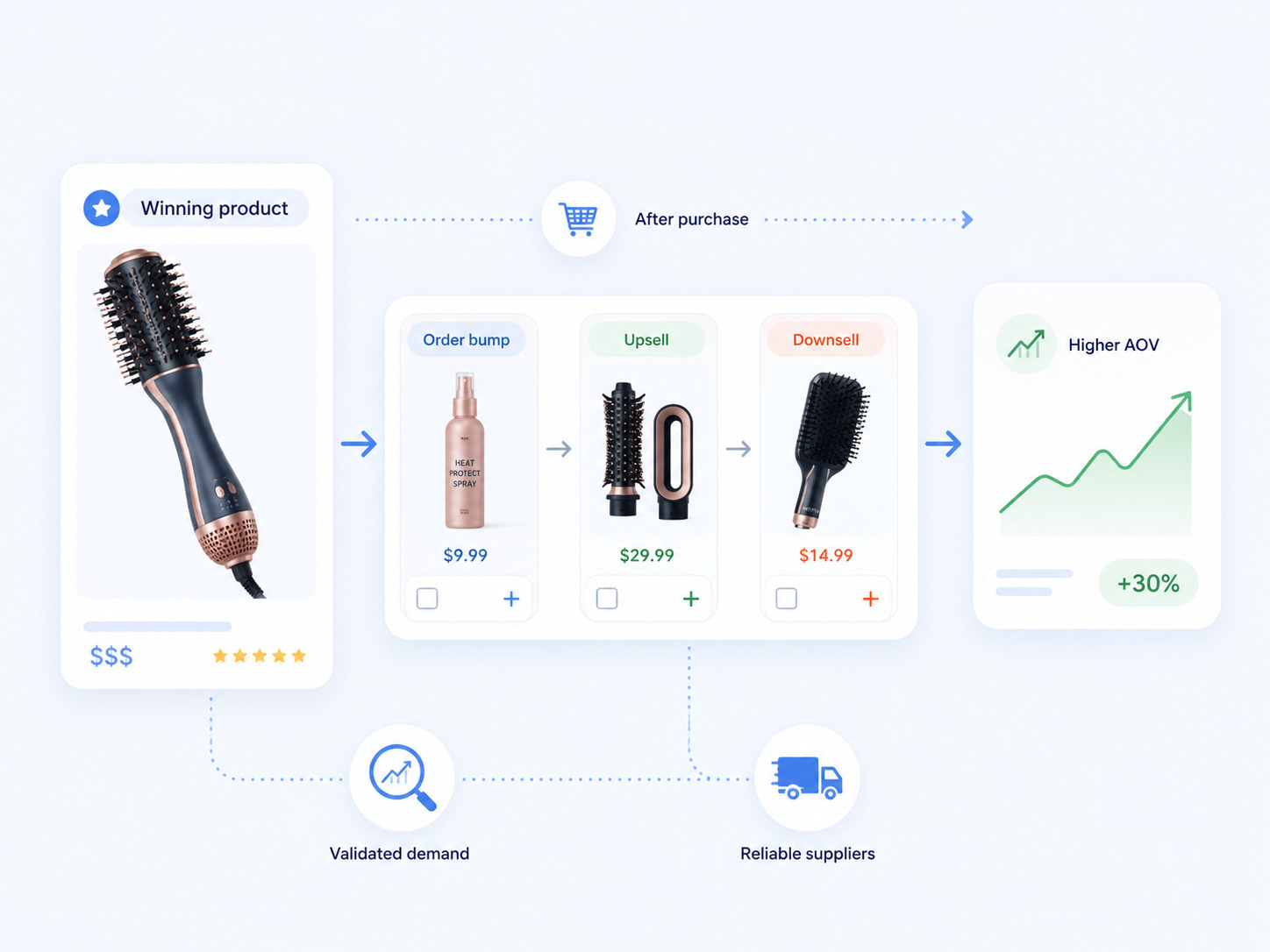
And of course, choose products you can mark up well for a healthy margin — try to stay within $30+, or lean into high-ticket dropshipping, which focuses on fewer, pricier items for higher profit margins. This matters more in 2026 than it used to: with import duty now landing on cross-border goods, a higher-ticket product has the margin room to absorb that duty where a $15 impulse item simply doesn't. With most dropshippers running net margins in the 15–30% range, that markup room is what keeps a dropshipping business profitable after ad costs and fees, and smart sellers constantly optimize pricing as they scale.
One more 2026 reality worth naming: 84% of sellers say finding reliable suppliers is their single biggest challenge, and 64% point to shipping delays as their top pain point. A core trait of the model is limited control — your third-party supplier handles order fulfillment, so when they slip, your customer blames you.
That's why vetting reputable suppliers (and lining up multiple suppliers as backup) is non-negotiable: reliable dropshipping suppliers with faster shipping, fair shipping costs, and consistent high quality products protect the customer satisfaction your reviews and customer loyalty depend on. In 2026, add one more supplier criterion to that list: where they fulfill from. A supplier with US-based fulfillment keeps import duties and customs delays out of every US order — which is now as important to your margin as their product quality. Finding the best dropshipping suppliers is genuinely half the battle.
Read more: Graypoplar Dropshipping: Trend Analysis, Logistics & Funnel Strategy
Now that you've selected your products, let's build your funnel!
Building the sales funnel for your products
Are you ready for the game-changing section? I hope so…
Watch how we took a product from our Shopify store and used a funnel to double the conversions:
Creating a funnel for your product is a very repeatable process — once you do it for one product, you'll never forget how to do it!
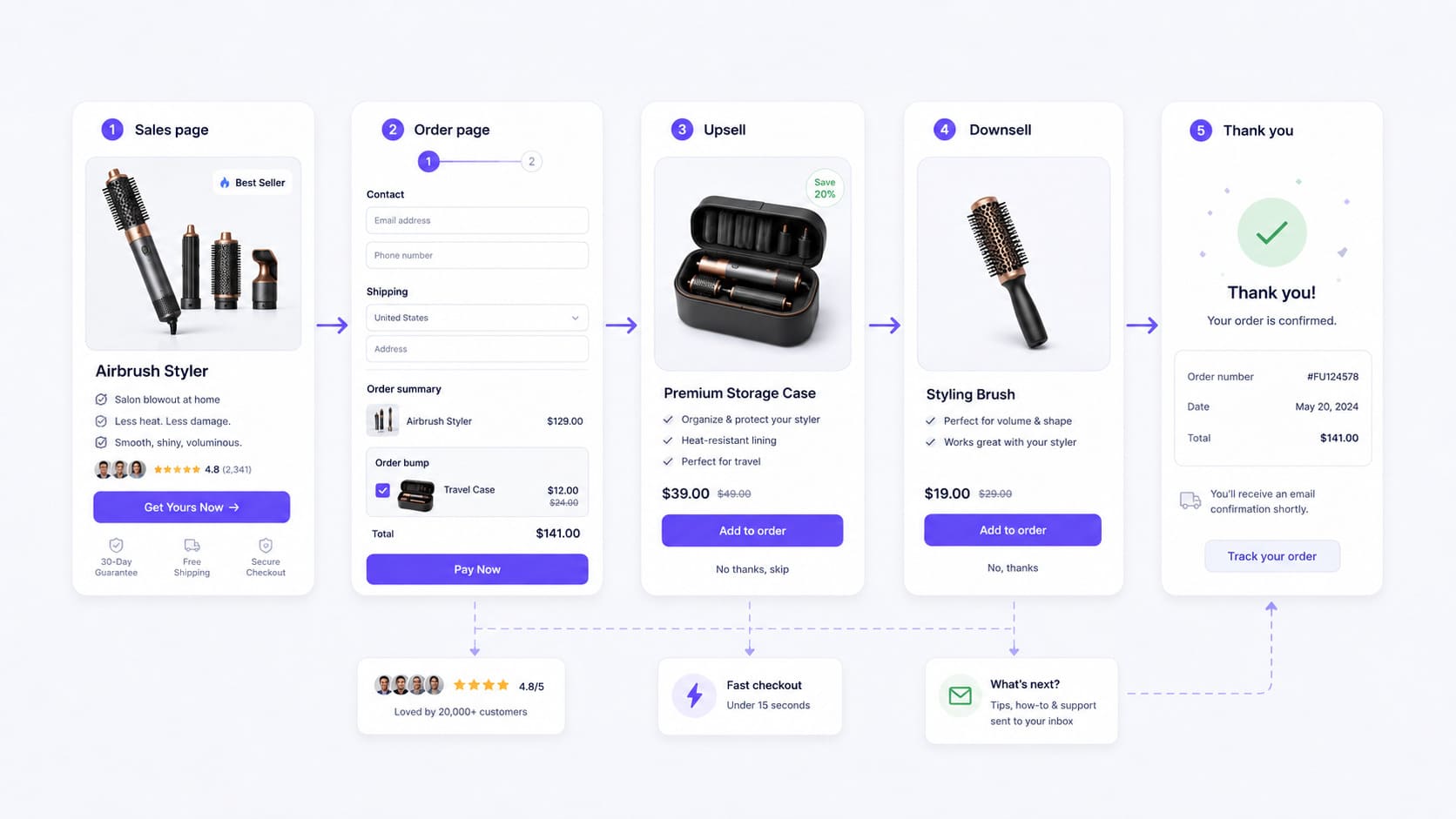
Here's how a basic product funnel works:
Sales page: where we're selling the main product
Order page: where the customer actually places their order
Upsell page: selling them on the first higher-ticket complementary product
Downsell page: selling them on another lower-ticket complementary product
Thank you page: confirming their order and providing their receipt
Sales page

On the sales page, focus on the product you're dropshipping and why your customer needs it. Start with a convincing headline, add great product images, write benefit-led product descriptions, and add as many reviews as you can — trust is everything when 70% of online shoppers say reviews and store design shape whether they'll buy from an unfamiliar brand. Nail those and you've got a solid sales page.
If you want the hard work done for you, you can clone any of our pre-built templates and just swap in your product info!
Order page
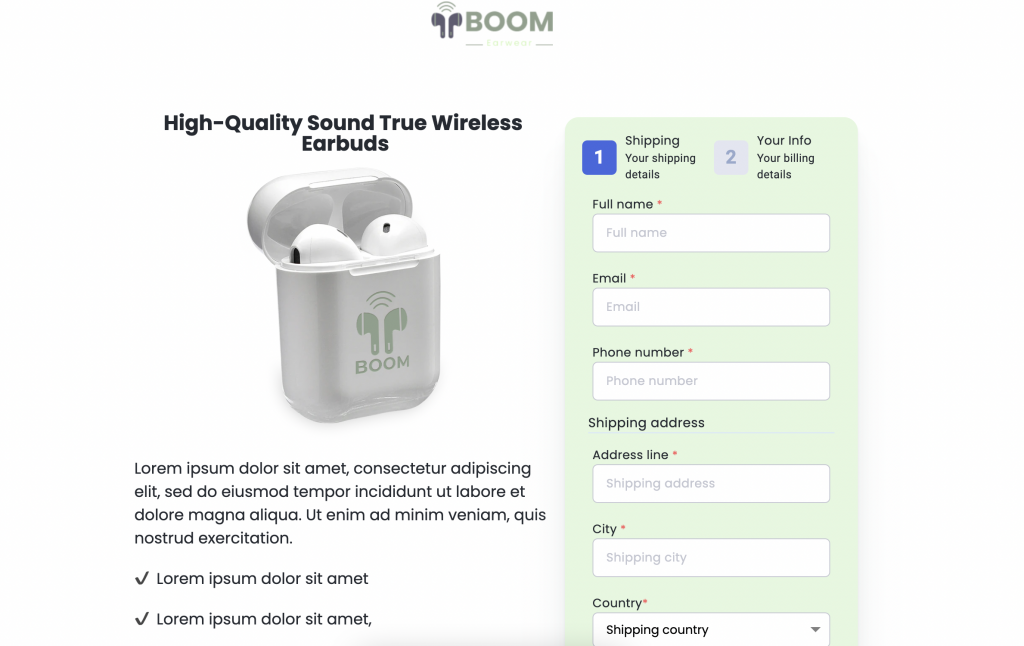
The order page is more straightforward, since your customer has already signaled they intend to buy — but don't be fooled, you still need to sell them! A simple 2-step order form, a few more testimonials, and a recap of the product and its benefits all make an order page shine. (If you don't have many reviews yet, grab some from wherever you're sourcing the product.)
You can also add an order bump here — a small, easy way to bump your AOV by promoting a "Super special one-time-only discount" on an additional product. And since this is where the sale actually happens, speed matters: more than half of online shoppers leave a page that takes over three seconds to load, so building on pages that load in under a second keeps the buyers you paid for from bouncing at the finish line.
Upsell and downsell pages
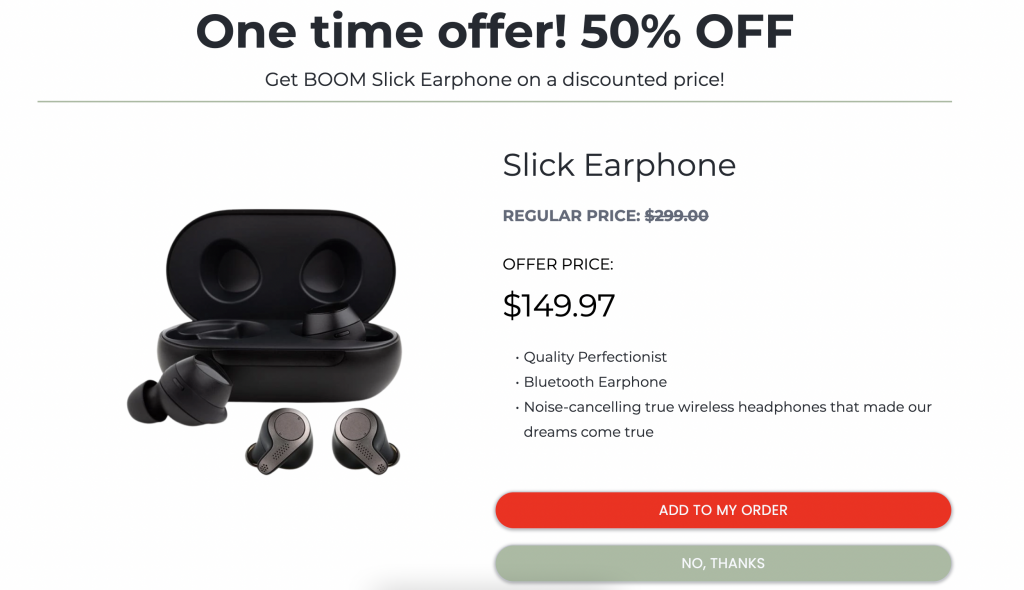
Now's the time for your AOV to climb! After your customer purchases, an upsell and downsell page give them the chance to buy more from you with a single click. These are just simpler versions of your main sales page, selling complementary products that make the main one even better. Product benefits, images, a convincing description, and more reviews make a good upsell or downsell page.
Thank you page
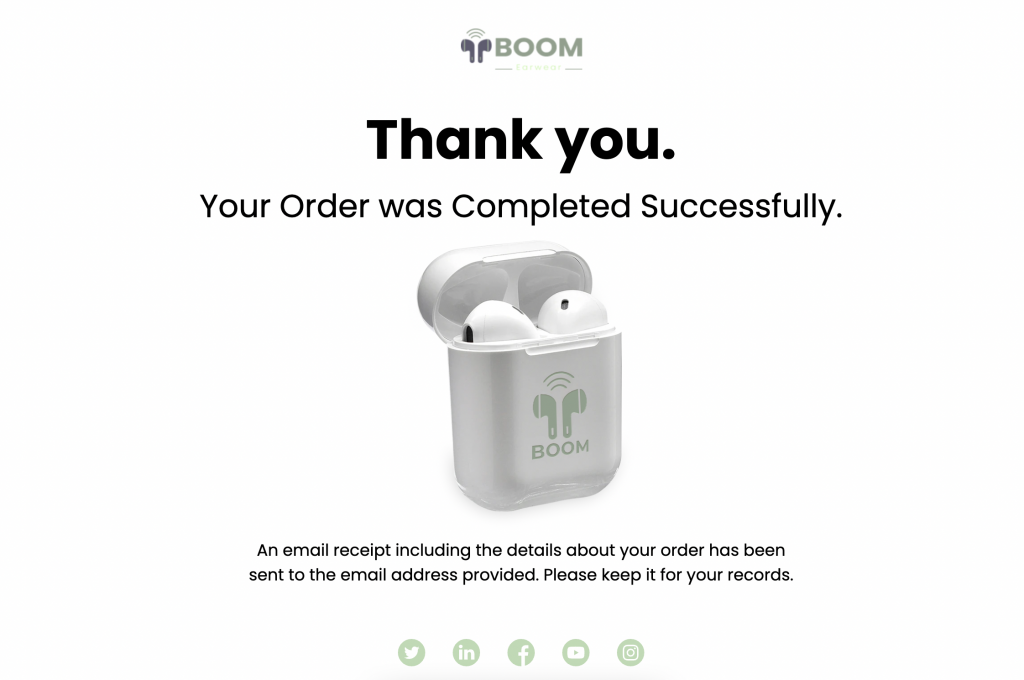
Finally, your customer reaches the thank you page! This simple page confirms the order and lays out the next steps. Straightforward — but done correctly, it instills more brand trust in your company and helps you earn repeat customers and consistent sales.
Optimize the experience — and let automation do the heavy lifting
Here's where working smarter beats working harder. The dropshippers who last in 2026 lean on automation tools, and the data shows it pays: stores that automate more than one task report higher profits, and email automation flows like abandoned-cart sequences alone drive 15–20% of total store revenue.
So set up automated abandoned-cart emails and SMS to win back the roughly 7 in 10 shoppers who leave without buying, and let order syncing push every sale to your supplier automatically so order fulfillment runs hands-off — no purchasing inventory upfront, no holding inventory, and minimal inventory risk, which is exactly what makes dropshipping so much leaner than traditional retail or inventory-heavy ecommerce business models in the first place.
Read more: Dropshipping vs Ecommerce: Which Business Model Wins in 2026?
It's also worth building an actual brand rather than another generic storefront. Brand building is the real moat now — branded stores command higher profit margins and stronger customer loyalty, and dropshipping stores that stay active on social media pull in about 32% more revenue than those that don't.
Pair a unique brand identity and a smart digital marketing strategy with a funnel that does the selling, back it with excellent customer service and responsive customer support, and you've separated your own store from the price-war crowd selling the exact same products. The right ecommerce platform makes all of this repeatable; unlike generic page builders on other ecommerce platforms, a funnel-first setup is built to convert and to attract customers profitably.
Sign up for Funnelish for FREE to get access to pre-built sales funnels just like these, with all the research, marketing materials, and design work already done for you! We have pre-built funnels for top-selling eCommerce dropshipping products, and we create new ones every single month to keep making it easy for you to sell products and make sales.
In conclusion… dropshipping is alive and well!
Yes, dropshipping the old way is now extremely difficult to make profitable — the cheap-import shortcut that powered it is genuinely gone — but a real business built on the model is far from impossible. The dropshipping market is bigger than ever; the easy money is what's gone. We just like to work smarter, not harder, and we imagine you want to do the same.
So, is dropshipping worth it in 2026? If you're chasing passive, overnight income off cheap parcels from overseas — no, and you'll likely end up losing money. If you're willing to treat it as a real ecommerce business with reliable suppliers (ideally with local fulfillment), a genuine brand, realistic expectations, and a funnel that does the selling for you — absolutely.
Is dropshipping profitable when done right? The data says yes: this remains a legitimate business model with real room for higher profit margins.
Selling your dropshipping products with sales funnels is like walking into a dealership and getting a really good salesperson who takes the time to help you make the decision — answering your questions before you ask them, handling objections, telling you about other happy customers. A funnel is your virtual salesperson, putting in the work to convince your customer that this product is right for them.
Start dropshipping the smart way, build funnels for your products, and watch your conversions increase, your average order value climb, and so much more!
Have questions about this process? Hesitant that it's right for your dropshipping store? Ask our support anything — we're happy to help you and your business.
You can reach us on Facebook, YouTube, our website, or our community.
Happy selling!
Table of contents
Boost your eCommerce
sales today

24/7 support
No credit card required
Cancel anytime
24/7 support
No credit card required
Cancel anytime
