

TikTok Ads for Ecommerce: Setup, Costs, and What Works
09 June 2022
Anna
12 minutes
TikTok isn't an emerging channel anymore. The platform reached 1.99 billion monthly active users worldwide as of January 2026 — growing 17% year-over-year, outpacing Instagram and LinkedIn. TikTok generated $33.1 billion in global advertising revenue in 2025, a 42.8% increase from 2024. (Printful) And TikTok Shop attracted 71.4 million shoppers in 2025 with a live shopping conversion rate of 7.4% — more than three times the traditional ecommerce average. (DigitalApplied)
If you run an ecommerce business and you're not running paid ads on TikTok, you're leaving a distribution channel largely uncontested. This guide covers everything: account setup, campaign structure, ad formats, costs, policies, tracking, and what the platform looks like for ecommerce in 2026.
How to Set Up TikTok Ads
To run paid ads on TikTok, you need a TikTok for Business account. Head there, sign up, verify your email with a verification code, and you'll land in TikTok Ads Manager — the central dashboard for creating and managing all your ad campaigns.
From Ads Manager you can manage multiple ad accounts, connect your TikTok Shop, install the TikTok Pixel or Events API on your website, and access your business center for team access and billing. If you already have a TikTok business account for organic content, you can link it here to run Spark Ads — more on that below.
Setting Up a TikTok Campaign
Once logged into Ads Manager, hit the Campaign button to start. The first decision is your campaign objective — which determines how TikTok optimizes your delivery and what actions you're paying for.
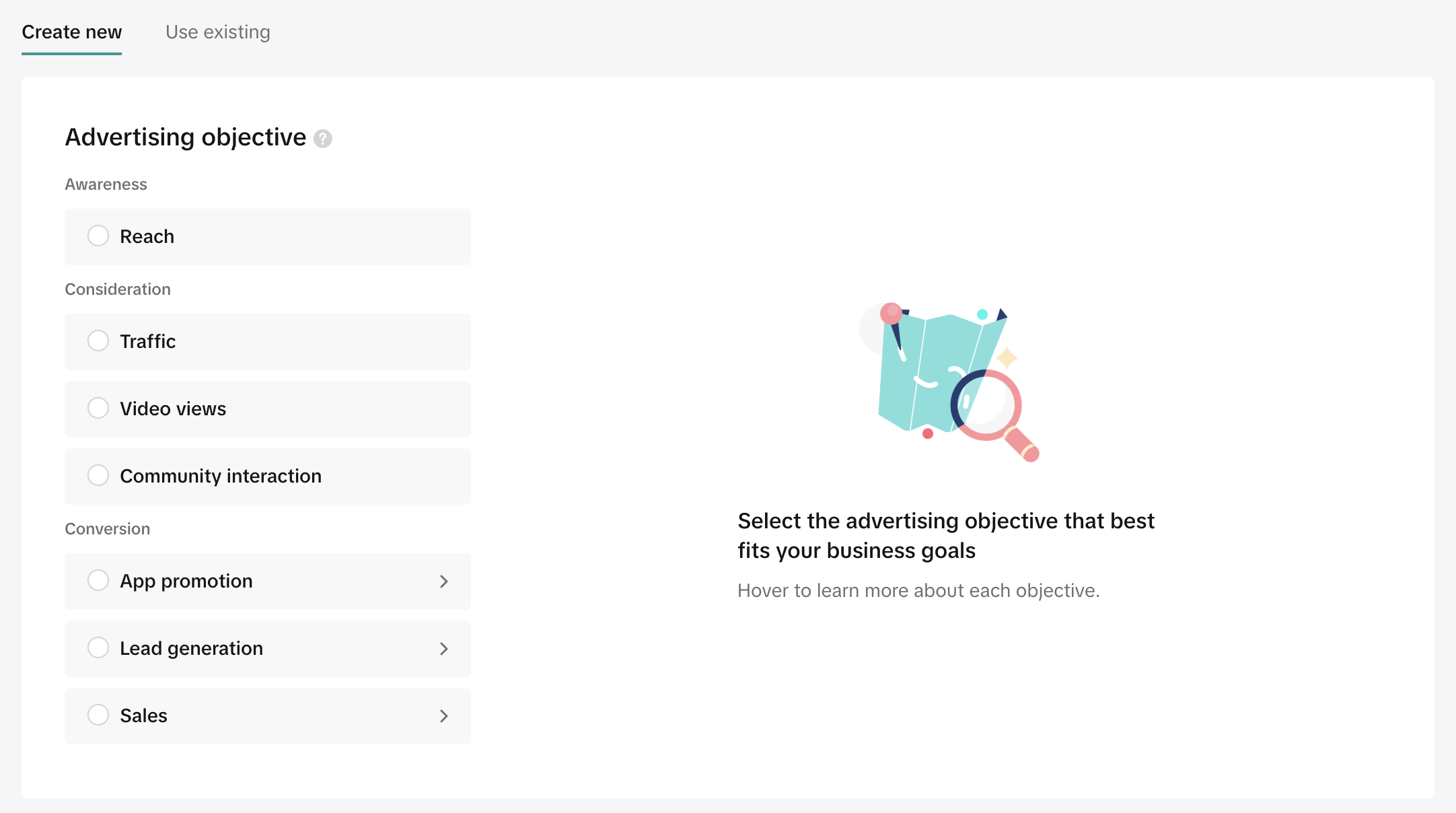
Awareness
Reach — shows your ad to the maximum number of people regardless of their behavior. Useful for brand visibility campaigns, not for direct ecommerce conversion.
Consideration
Traffic — sends viewers to a URL or app. Use this to drive visitors to a landing page or product page.
Video views — maximizes plays on your video ad. Good for product discovery campaigns where you want wide exposure.
Community interaction — grows TikTok profile followers and engagement. Useful for building an owned audience on the platform.
Conversion
App promotion — generates app installs or drives in-app actions. Relevant for brands with mobile apps.
Lead generation — collects leads natively inside TikTok through a form, without the user leaving the app. Works well for high-consideration products with longer purchase cycles.
Sales — drives traffic to take purchase actions on your website, online shop, or TikTok Shop. This is the primary objective for ecommerce brands running direct response campaigns.
For most ecommerce brands, Sales is the default starting objective for conversion campaigns. Traffic works for product discovery. Video views feeds the top of the funnel when you have a product that needs demonstration.
TikTok Ads Cost in 2026
TikTok operates on an auction system just like Google Ads — costs vary by objective, market, creative quality, and competition level. The mandatory minimum budget is $50/day at the campaign level and $20/day at the ad group level for self-serve advertisers.
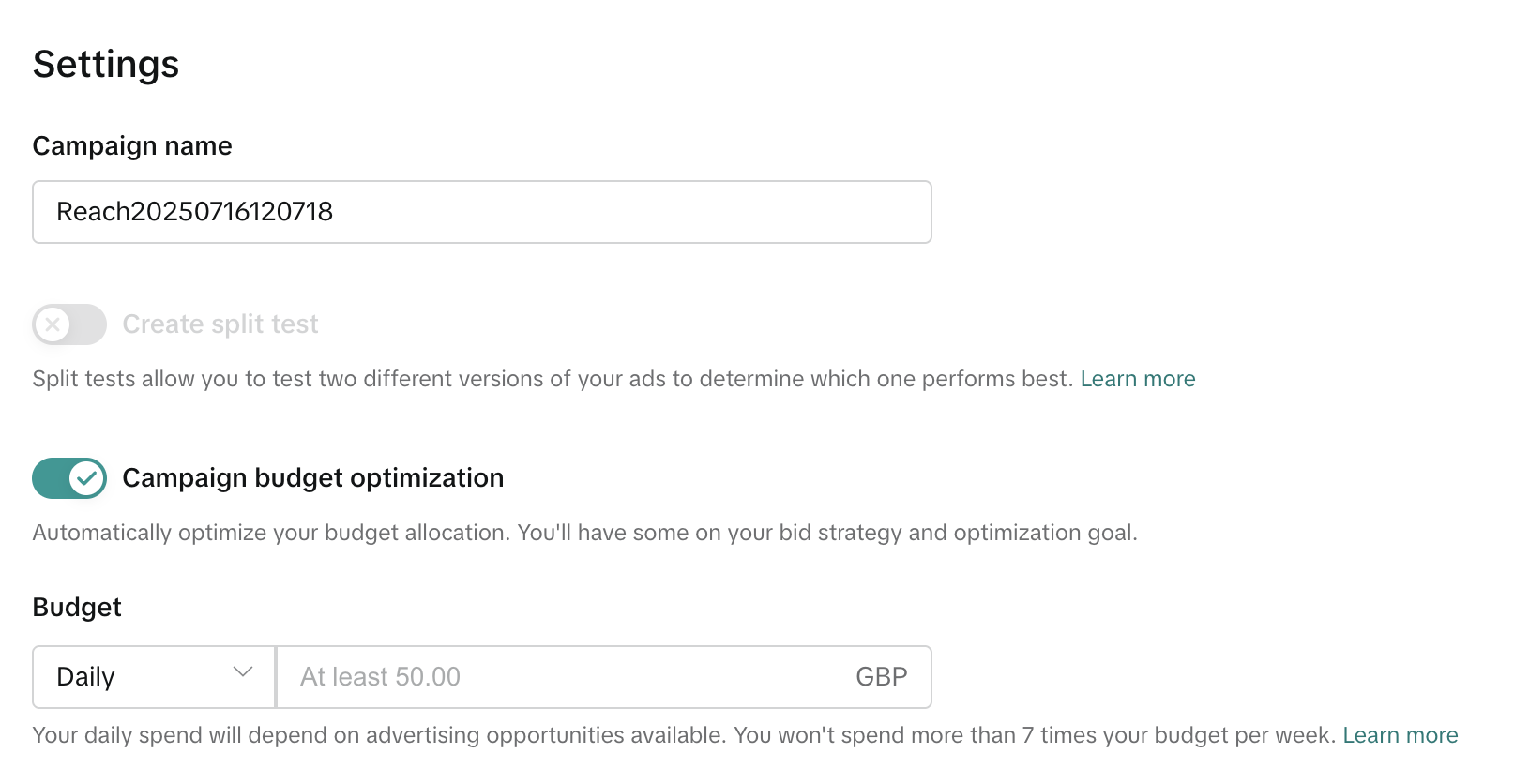
Current 2026 benchmark ranges from different sources:
CPM: $6–$12 on average, with US CPMs running higher at $10–$20 for competitive objectives
CPC: $0.30–$1.50, with a practical planning range of $0.50–$1.50 for most ecommerce campaigns
CPA: Median $32.74 for ecommerce based on Triple Whale's March 2026 data across brands on the platform
CTR: 0.5%–1.5% is typical; above 2% is considered excellent
TikTok CPMs are usually 20–40% lower than Meta for reach objectives — making it a more cost-efficient awareness and product discovery channel. However, Meta often delivers better CPA efficiency for direct response campaigns with established pixel data.
One significant cost advantage specific to TikTok Shop sales: advertisers using Shop-linked ads can sometimes see 15–25% lower CPAs than those driving to external sites — because the transaction happens inside TikTok, removing the landing page friction that kills conversion on external traffic. (Stackmatix)
For new campaigns, plan for at least $1,500–$3,000 in the first month to generate enough data for meaningful optimization. The $50 minimum can technically start a campaign — it can't give you enough volume to make decisions.
Seasonal note: Expect 40–60% cost increases during Q4 and major shopping events. January and February offer the lowest auction competition — the best months to test new creative and build learning history before costs rise.
TikTok Campaign Optimization
After setting your objective, you configure the ad group level — where placement, targeting, budget, and bid strategy live.
Placement
Where your ad appears. Options include TikTok in-feed, TikTok search results, Pangle (TikTok's audience network across third-party apps), and other placements depending on your market. For many ecommerce campaigns, automatic placements let TikTok optimize delivery across available inventory.
Creative Type
TikTok's Automated Creative Optimization combines your assets — videos, images, ad copy — in different configurations and optimizes toward the best-performing combinations automatically. Worth enabling when you have multiple creative assets to test.
Targeting
Set your audience by age, gender, location, language, device type, interests, and behaviors. TikTok also supports custom audiences built from your own data (customer lists, website visitors via TikTok Pixel or Events API) and lookalike audiences generated from those custom audiences. For cold traffic ecommerce campaigns, broad targeting can outperform narrow interest targeting as TikTok's algorithm becomes more capable of finding buyers independently.
Budget and Schedule
Set daily or lifetime budgets, schedule by date range, and use day-parting if your conversion data shows specific time windows performing better.
Bid Strategy
Lowest cost — maximizes results within your budget. Best starting point for most campaigns.
Bid cap — sets a maximum cost per result. Useful for controlling CPA once you have baseline data.
Cost cap — keeps average CPA near a target. More control than lowest cost, less restrictive than bid cap.
Delivery Type
Standard — budget is distributed evenly across the campaign schedule
Accelerated — budget is spent as fast as possible. Useful for flash sales or time-sensitive promotions where speed matters more than efficiency
TikTok Ad Formats in 2026
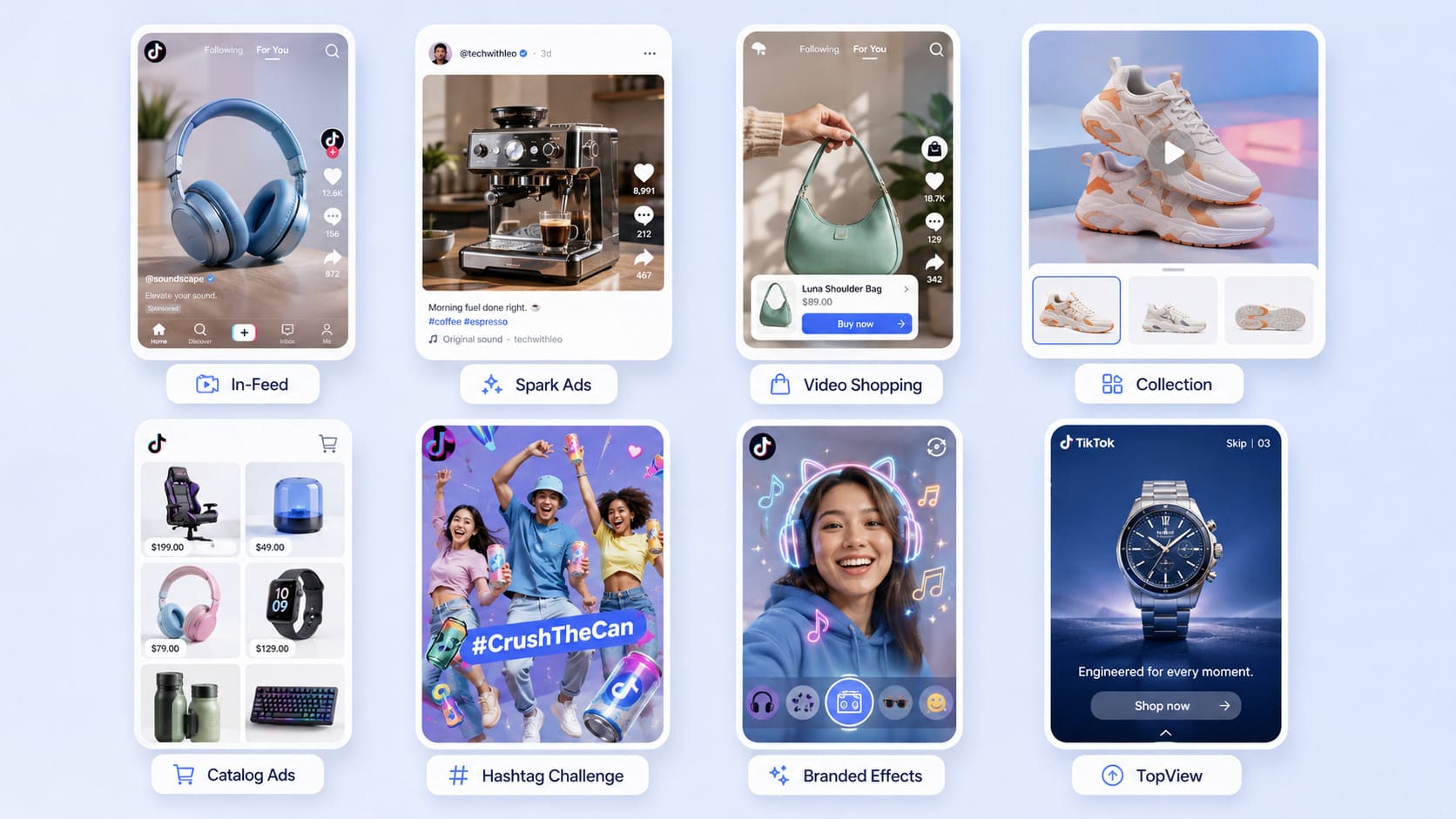
TikTok's ad format gallery has expanded significantly since 2020. Availability varies by market and account type.
In-feed ads are the core format — vertical video ads that appear natively in the For You Page feed, indistinguishable from organic content when done well. This is where most ecommerce budgets usually run.
Spark ads allow you to boost your own organic TikTok content or — with creator permission — boost a creator's content that features your product. Spark Ads can deliver 20–30% lower CPMs than standard in-feed ads and benefit from the social proof of existing organic engagement. For ecommerce brands working with UGC creators, Spark Ads are one of the most efficient formats available.
Video shopping ads are the primary format for TikTok Shop integration — shoppable in-feed videos that allow users to purchase directly within TikTok without leaving the app. TikTok Shop's live shopping conversion rate of 7.4% makes this format particularly powerful for products that benefit from demonstration.
Collection ads combine a video with a product catalog grid — users tap the video, see a full-screen product gallery, and can browse or purchase without leaving TikTok. Effective for brands with multiple SKUs in a category.
Catalog ads (dynamic product ads) pull automatically from your product feed and show each user the products most relevant to their behavior — similar to Meta's dynamic product ads. Strong for retargeting users who have visited product pages without purchasing.
Branded hashtag challenges are a high-cost, high-reach format where you create a challenge and pay for promotion at the top of TikTok's Discover page. Minimum spend runs $150,000+, making this a format for established brands rather than growth-stage ecommerce.
Branded effects let users interact with custom AR filters and effects tied to your brand. Works best as part of a broader awareness campaign rather than as a standalone direct response format.
Image ads are available in certain placements (notably through Pangle and Global App Bundle). Less commonly used for ecommerce but useful for catalog-style product promotion.
Top ads (TopView) are the first ad a user sees when they open TikTok — a 5–60 second full-screen video. High-impact, high-cost, and typically reserved for major brand campaigns.
TikTok Video Ad Specs
Your in-feed video ad should meet these specifications:
Aspect ratio: 9:16 (vertical) — this is the format TikTok is built around and the one that performs best. 1:1 is accepted but underperforms.
Resolution: Minimum 540 × 960px; 1080 × 1920px recommended
File type: .mp4, .mov, .mpeg, .3gp, .avi
Duration: 5–60 seconds; 15–30 seconds tends to perform best for ecommerce
File size: Up to 500MB
Brand name: 2–20 characters
Ad description: Up to 100 characters, no emojis
The most important spec isn't technical — it's creative. TikTok's algorithm rewards content that looks and feels native to the platform. Ads that look like ads perform worse than ads that look like organic TikTok content. Vertical video, fast cuts, on-screen text, trending audio, and authentic rather than polished production all signal native content to both the algorithm and the viewer.
NOTE: You can also check out this guide for detailed info on all TikTok ads specs.
TikTok Ads Policies
A few strict policies apply before you launch. Violating them means rejected ads or account suspension.
Landing Page Requirements
Must not be expired or under construction
Must be fully mobile-friendly — TikTok's audience is almost entirely mobile
Cannot require visitors to download software or input personal information to access the main content
Ads
Creatives and landing pages cannot promote prohibited products or services — this includes weapons, drugs, gambling, tobacco, and political content
Ads cannot make misleading claims or use deceptive creative tactics
Ecommerce-specific Policy
Your ecommerce landing pages must display correct business information (company name, address, contact details), show clear product pricing in the correct currency, and include privacy, refund, and shipping policies. This is strictly enforced and commonly the reason ecommerce ads get rejected on first submission.
Lead Generation Policy
Lead campaigns must include a privacy policy on the landing page explaining how data will be collected, shared, and handled
NOTE: For further detailed TikTok ads policies, please visit this guide.
Once you’ve followed all these steps above, you are now ready to launch your ad, and see it perform!
How to track your TikTok campaign
TikTok Ads Manager provides a campaign dashboard showing costs, impressions, clicks, conversions, CPM, CPC, and CTR in real time. You can build custom reports, filter by ad group or creative, and see audience breakdowns by gender, device type, placement, and time of day.
For ecommerce brands, the two tracking tools that matter most:
TikTok Pixel — the standard browser-based tracking tag installed on your website. Fires on key events (ViewContent, AddToCart, InitiateCheckout, Purchase) and feeds conversion data back to TikTok for campaign optimization. Required for conversion objective campaigns.
Events API — server-side event tracking that sends conversion data directly from your server to TikTok, bypassing browser-based limitations caused by ad blockers, iOS privacy restrictions, and cookie deprecation. Running both the Pixel and Events API together gives the algorithm more complete conversion signal and materially improves optimization — particularly important for purchase-objective campaigns where every missed conversion event degrades performance.
TikTok Ads for Ecommerce: What's Changed and What Works in 2026
The original case for TikTok ads was reach at low CPM. That case still holds — TikTok CPMs usually remain 20–40% lower than Meta for awareness objectives — but the more compelling case in 2026 is social commerce.
TikTok Shop GMV reached $33.1 billion in the trailing twelve months, with over 15 million active sellers and 70 million product listings. (SQ Magazine) The platform has built the infrastructure for product discovery, purchase, and post-purchase — all inside a single app session. For ecommerce brands that connect their catalog to TikTok Shop and run video shopping ads, the conversion path is shorter and the CPA is lower than driving external traffic.
The demographic picture has also changed. The old narrative was that TikTok is for teenagers. The 25–34 age group is now TikTok's largest single cohort at 40.3% of users, and the 35–44 bracket is the fastest-growing demographic on the platform. (SocialPilot) TikTok's audience is maturing. For ecommerce brands whose ideal customer is 25–45 with purchasing power, the demographic case for TikTok is now as strong as Meta.
What Performs for Ecommerce in 2026
Native-looking in-feed video ads that open with a strong hook in the first 2–3 seconds
Spark Ads boosting UGC creator content that features the product authentically
Video shopping ads with direct TikTok Shop checkout — particularly for products under $100 where impulse conversion is high
Catalog ads for retargeting visitors who have shown product interest
Live shopping events for brands comfortable with that format — the 7.4% live conversion rate is significantly higher than standard ad conversion
Post-click Experience Still Matters
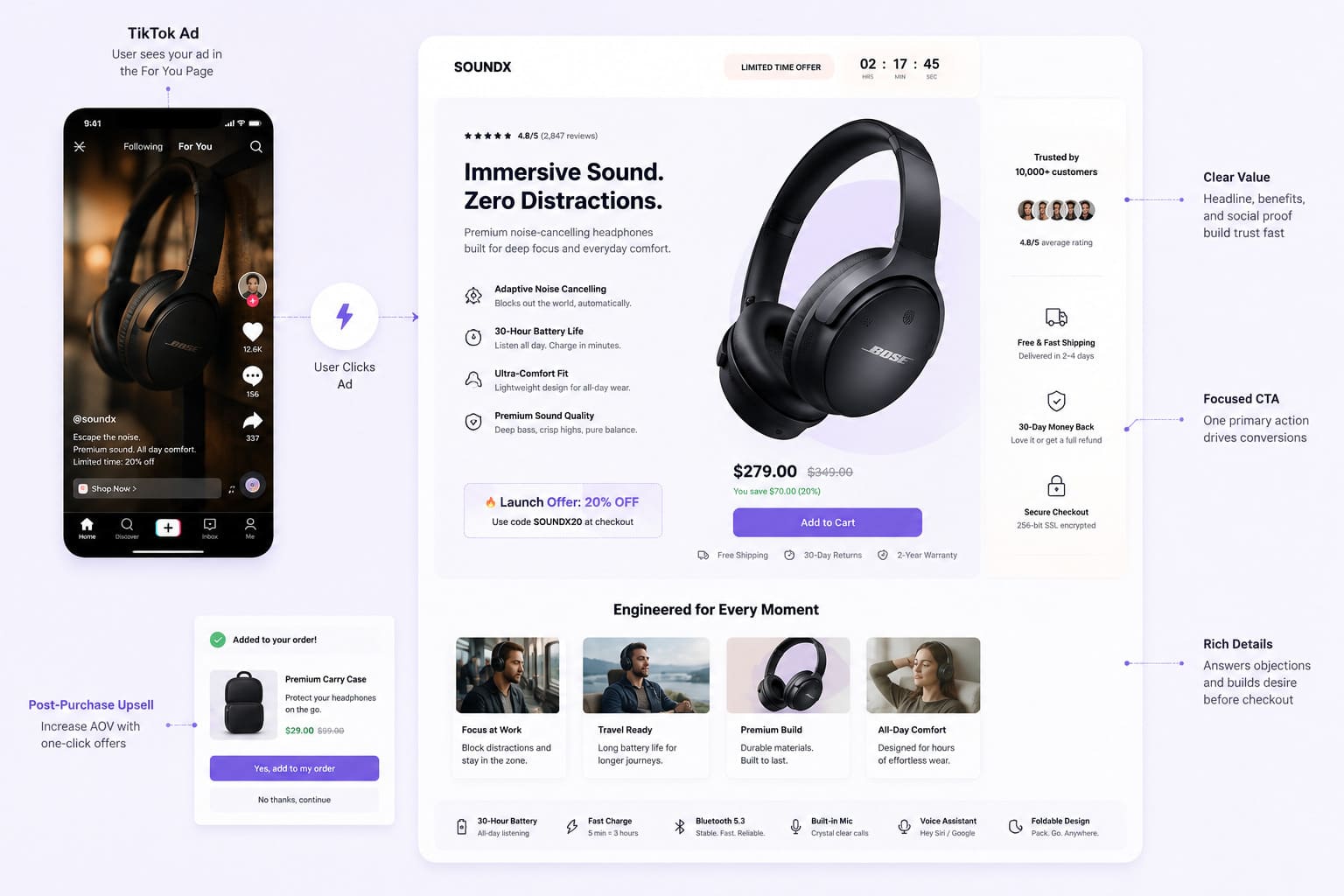
For brands driving traffic to external landing pages rather than TikTok Shop, the same conversion gap that applies to Meta traffic applies here. A TikTok ad that generates a click at $0.80 CPC delivers value only if the landing page and checkout convert that traffic.
Dedicated landing pages built for the specific offer with Funnelish — fast-loading, mobile-optimized, single focused message — convert TikTok's mobile-first audience better than standard product pages. Post-purchase upsells, geo-optimized pricing, and abandoned cart recovery all apply to TikTok traffic the same way they apply to Meta traffic.
Read more: Facebook Ads Best Practices: No More Wasted Ad Spend
TikTok Ads Pros and Cons
Pros
Highest average engagement rate of any major social platform at 3.70% — nearly 8x higher than Instagram
CPMs 20–40% lower than Meta for reach objectives
Users spend an average of 95 minutes per day on the platform — more daily time than any other social app
TikTok Shop's native commerce infrastructure can remove external landing page friction in some cases
Spark Ads let you amplify creator content with existing social proof
Product discovery happens organically — users encounter products while scrolling, not while searching
Cons
Minimum budgets ($50/day campaign, $20/day ad group) make very small test budgets impractical for meaningful data
Creative decay is fast — TikTok audiences see content at high frequency and creative fatigue sets in faster than on Meta
For direct response conversion campaigns, Meta's pixel maturity and CPA efficiency often still outperforms TikTok on cost-per-purchase
Branded hashtag challenges and TopView ads require significant minimum spend, limiting those formats to larger budgets
Policy enforcement is strict — ecommerce ads frequently get rejected for landing page compliance issues on first submission
TikTok Ads Pros and Cons for Ecommerce
If you run an ecommerce business, TikTok ads are now a serious part of the paid media mix — not an experimental channel. The combination of platform scale, engaged audience, maturing demographics, and TikTok Shop's native commerce infrastructure makes it one of the most significant product discovery channels available.
The brands performing best on TikTok in 2026 aren't running their Instagram creative in a vertical crop. They're making content that looks like TikTok, working with creators who understand the platform, and increasingly using TikTok Shop to remove every step between discovery and purchase. The ones still treating TikTok as a Meta alternative with shorter videos are leaving the platform's core advantage untouched.
Table of contents
Boost your eCommerce
sales today

24/7 support
No credit card required
Cancel anytime
24/7 support
No credit card required
Cancel anytime
