

What Is Shopify and How Does It Work? A 2026 Beginner's Guide
18 May 2021
Anna
8 minutes
Quick answer: Shopify is an all-in-one e-commerce platform that lets anyone build an online store and sell products online and in person — without writing code. You pay a monthly subscription, pick a theme, add your products, connect a payment method, and start selling, while Shopify handles the hosting, security, and checkout behind the scenes. As of 2026 it powers more than 4.6 million businesses across 175+ countries, making it one of the most popular e-commerce platforms in the world.
If you've explored online selling at all, you've bumped into Shopify. But what is Shopify really, and how does it work in practice? Let's break it down from the ground up.
What is Shopify?
Shopify is a subscription-based, cloud e-commerce platform — technically Software as a Service (SaaS) — that gives businesses everything they need to create, manage, and scale a Shopify online store from a single dashboard. Instead of stitching together separate hosting, a website builder, a payment processor, security tools, and analytics, Shopify consolidates the commerce stack into one unified system.
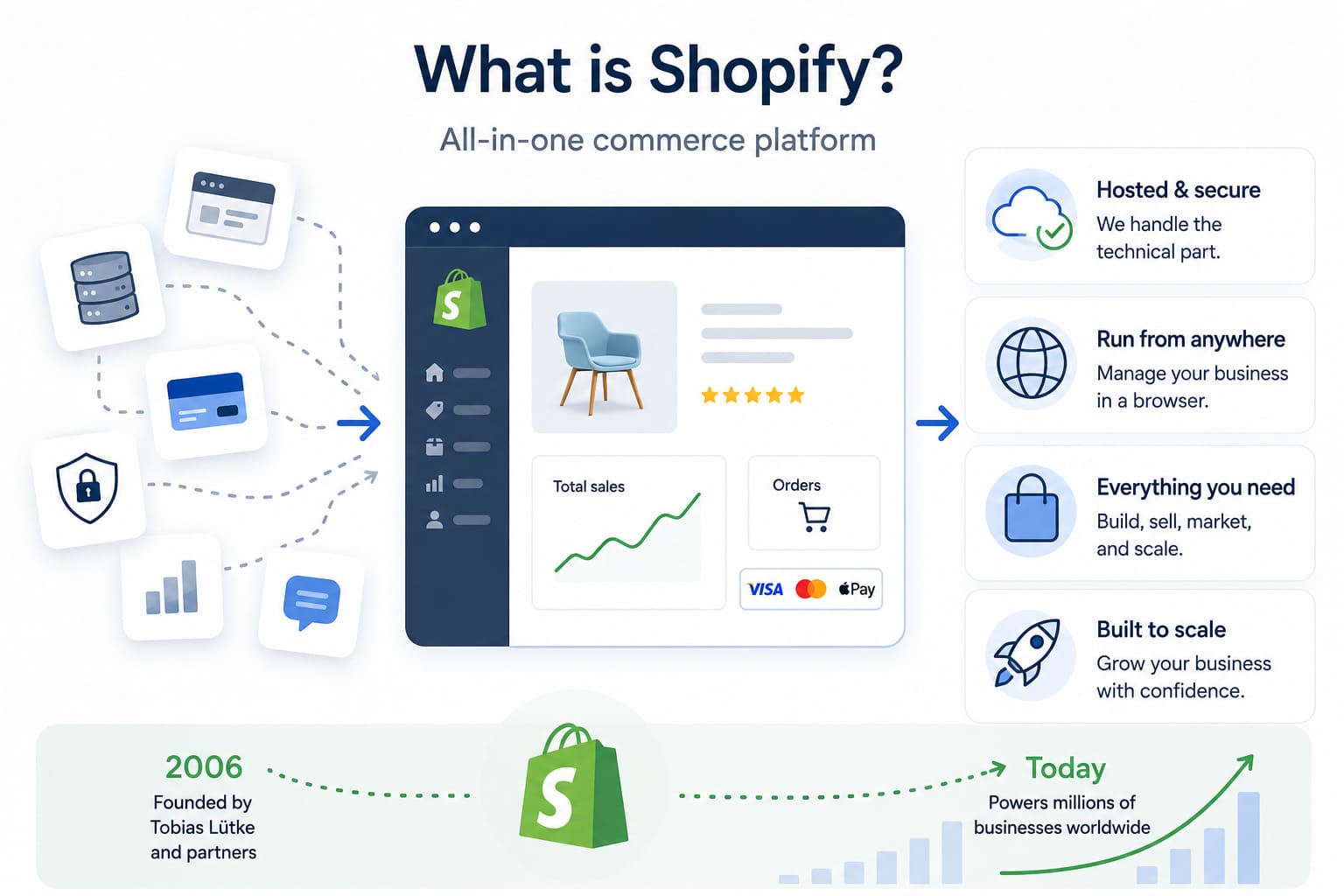
Because it's a hosted solution, Shopify runs on its own servers. You don't buy web hosting, install software, or patch a single security vulnerability. You build and run everything in a web browser, which means you can manage your business from anywhere with an internet connection. That "We handle the technical part, you focus on selling" model is the single biggest reason business owners choose a hosted platform over a self-hosted one.
Shopify was founded in 2006 by Tobias Lütke and partners, who set out to build their own e-commerce software after finding existing tools inadequate for selling snowboarding equipment. Two decades later it has grown into a complete commerce operating system processing hundreds of billions of dollars in sales.
Read more: Shopify Store: From Setup to Loyal Customers and Recurring Profits
How does Shopify work? Three layers
The easiest way to understand how Shopify works is to think of it in three layers.
Layer 1: Platform
This is everything Shopify owns and runs for you — hosting, the checkout, payment processing, the SSL security certificate, uptime, PCI compliance, and the servers powering every store. You never touch this layer; it just works.
Layer 2: Theme
This is the storefront your customers actually see. Shopify's templates control your store's design, layout, and navigation, and you customize them in a drag-and-drop editor without coding. You can start with a free theme, buy a premium one, or commission custom themes for a fully branded look. Every theme is mobile-responsive by default, which matters because most e-commerce traffic now comes from phones.
Layer 3: Apps
The Shopify App Store hosts thousands of third-party apps that bolt extra functionality onto your store — reviews, loyalty programs, subscriptions, buy-now-pay-later, advanced reporting, and much more. This is how you extend Shopify beyond its core features as your needs grow.
In practice, the flow looks like this: you set up your store and list products in the Shopify admin, a customer browses your site and places an order, Shopify processes the customer's payment securely, and you fulfill and ship it. Everything — orders, products, customers, and store data — lives in the central Shopify dashboard.
Read more: Shopify App-Purge: How to Consolidate 10 Subscriptions into One Dashboard
Shopify's core features
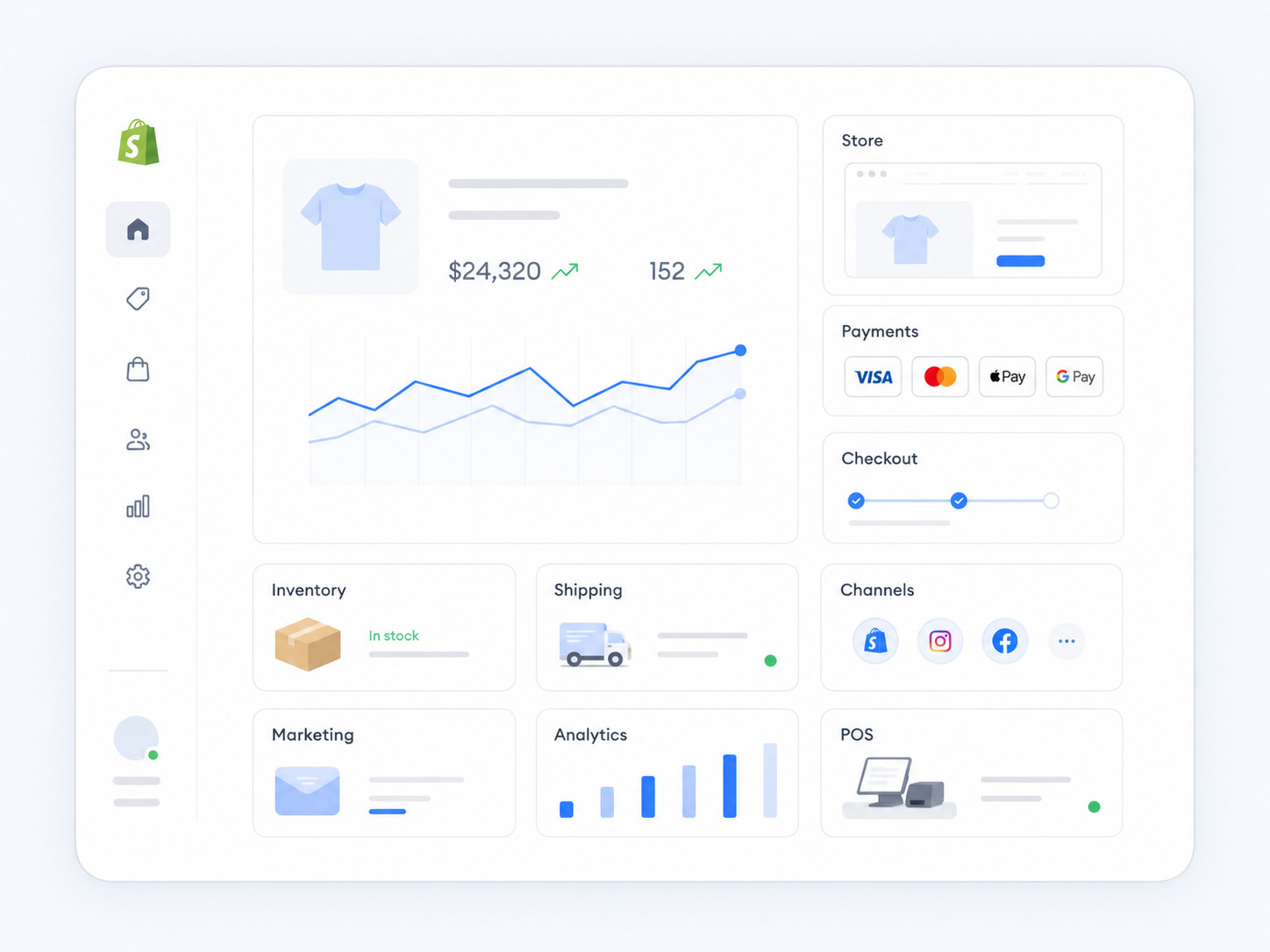
Many store owners use the same handful of tools every day. Here's what Shopify offers out of the box on most plans:
Online store builder. Drag-and-drop editing plus 900+ pre-built, industry-specific themes, all mobile-friendly and customizable without code.
Shopify Payments. The built-in payment processor lets you accept credit and debit cards, Apple Pay, Google Pay, and Shop Pay directly — no separate merchant account needed. Shop Pay's one-tap checkout is one of the highest-converting flows in e-commerce.
The world's best-converting checkout. Shopify's checkout is optimized for conversion, which is one of its biggest selling points.
Inventory management. Track stock across locations, organize your catalog, and manage product variants from one place.
Order fulfillment and shipping. Buy and print shipping labels at a discount, set up shipping zones, and offer local delivery. Shopify now also offers an integrated marketplace of vetted third-party logistics (3PL) fulfillment partners you can connect to without leaving the admin.
Multichannel sales channels. Sell beyond your own website — promote and sell on social media platforms like Facebook, Instagram, TikTok, and YouTube, and list on marketplaces such as Amazon, Walmart, eBay, and Etsy.
Shopify POS. For physical stores, Shopify POS syncs inventory across your online and in-person sales so everything stays in one system.
Built-in marketing tools. Email campaigns, abandoned cart emails, discount codes, audience lists, and Shopify search engine optimization features to drive traffic.
Analytics. The Shopify dashboard gives an at-a-glance view of sales, orders, traffic, and customer behavior, with detailed reports for data-driven decisions. It also integrates with tools like Google Analytics.
What's new in Shopify for 2026
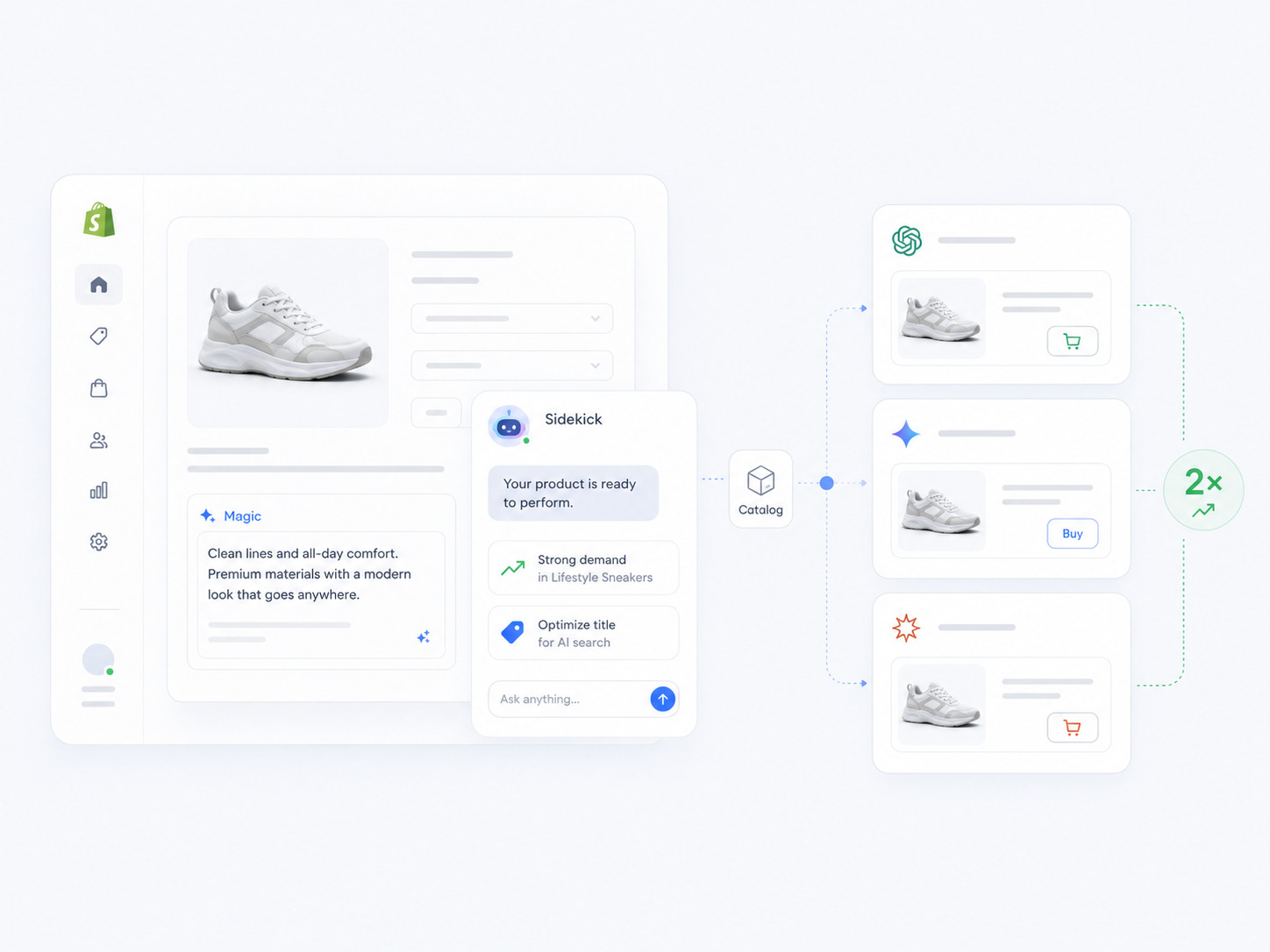
Shopify ships two major feature releases ("Editions") a year, and the defining theme of 2026 is AI.
Shopify Magic, the platform's native AI, now generates brand-aware product descriptions and content directly in the admin, while Sidekick acts as an AI assistant that automates time-consuming business operations and surfaces insights.
The bigger shift is agentic commerce: Shopify is making your products discoverable and buyable inside AI assistants like ChatGPT, Copilot, and Perplexity through Shopify Catalog — and Shopify reports that data syndicated this way drives roughly 2× more conversion in AI chats. For most stores, the practical takeaway is to structure your product data well so it can be syndicated to these new AI channels, which is increasingly where shopping behavior is heading.
How much does Shopify cost?
Shopify works on a subscription model with plans for every stage of business. As of 2026, pricing runs from the $5/month Starter plan up to Shopify Plus, which starts at $2,300/month. The main tiers are:
Starter ($5/mo): Not a full online store — you sell via a checkout link, social media, and messaging apps. Good for creators selling a few items.
Basic ($39/mo, or $29 billed annually): The standard starting point for new stores, with a full online store, unlimited products, and Shopify Payments included.
Grow ($105/mo): Adds more staff accounts, professional reports, and lower transaction fees.
Advanced ($399/mo): Built for scaling businesses, with the lowest standard transaction fees outside Plus and advanced reporting.
Shopify Plus (from $2,300/mo): An enterprise solution for high-growth and large business owners, with B2B tools, a fully customizable checkout, unlimited staff, and multi-location support.
Paying annually saves up to 25%, and there's a free trial (currently 3 days, then $1/month for the first 3 months on select plans) so you can test it before committing. Beyond the subscription, factor in payment processing fees (from 2.9% + 30¢ per transaction on Basic) and any paid apps.
Note that if you use a third-party payment provider instead of Shopify Payments, Shopify adds an extra transaction fee.
Read more: How Much Does Shopify Cost in 2026?
Who is Shopify for?
Shopify's flexibility is its superpower — it scales from a solo founder's first product to enterprise brands without forcing a costly migration. It fits new online sellers who want to launch without technical setup, growing brands that need strong checkout and inventory tools, omnichannel retailers using POS to connect in-person and online sales, dropshippers (thanks to its deep app ecosystem), and service-based businesses selling digital products or online courses.
Whether you're a small business owner or a scaling enterprise, there's a plan and a feature set to match.
Pros and cons of Shopify
Pros: It's genuinely beginner-friendly, removes all hosting and security headaches, has the best-converting checkout in the business, offers a vast app ecosystem, and scales reliably from startup to enterprise.
Cons: Costs can grow as you add apps and upgrade plans; design customization is more structured than fully open platforms; and getting the most out of SEO and advanced features can require deliberate work or technical help.
Getting the most out of your Shopify store
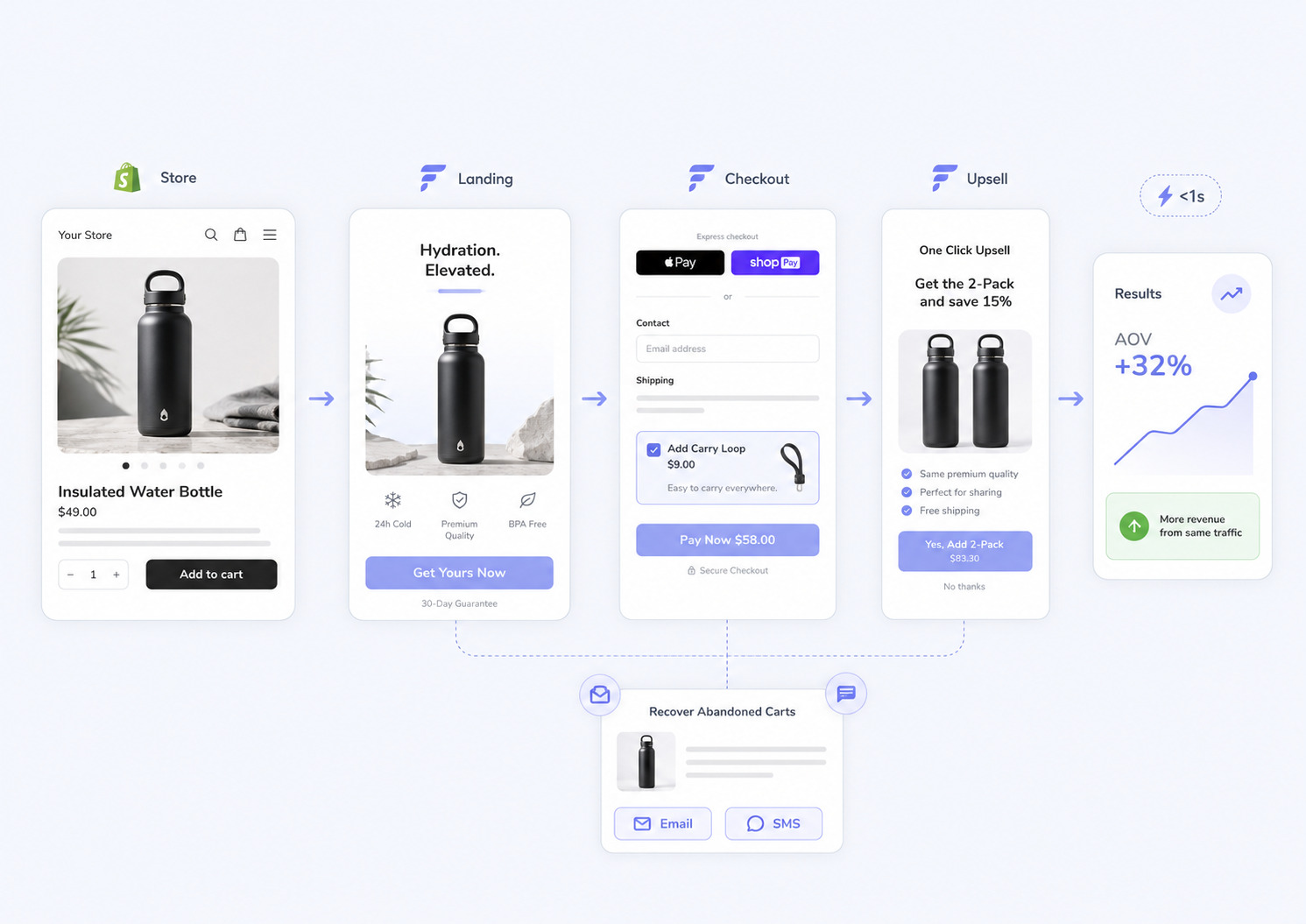
Shopify gives you a powerful storefront, but turning visitors into buyers is its own discipline — and it's where a lot of stores leave money on the table. A standard product page is built to display items; a focused sales funnel is built to convert one offer at a time.
You can rely on a tool like Funnelish that complements Shopify: it lets you build dedicated landing pages and high-converting checkout funnels with one-click upsells and order bumps that lift average order value, on pages engineered to load in under a second so you keep the traffic you worked to earn. Paired with Shopify's core platform, it's a practical way to squeeze more revenue from the same visitors as you scale.
Bottom line: what is Shopify?
Shopify is an all-in-one, hosted e-commerce platform that handles the hard technical parts of online selling — hosting, security, payments, and checkout — so you can focus on building your brand and making sales. It works as a centralized hub connecting your storefront, payment processing, inventory, and every sales channel from one dashboard, and it scales from a $5/month starter setup to enterprise-grade commerce.
For most people asking "what is Shopify," the simplest answer is this: it's the most complete, beginner-friendly way to start and grow an online business in 2026.
Frequently asked questions
What is Shopify in simple terms?
Shopify is a website and software service that lets you build an online store and sell products without coding. You pay a monthly fee, and Shopify provides the storefront, shopping cart, payment processing, and tools to manage orders and inventory — all in one place.
How does Shopify make money?
Shopify earns through monthly subscription fees across its plans and through payment processing fees when merchants use Shopify Payments. It also generates revenue from apps, themes, Shopify POS hardware, and add-on services.
Is Shopify good for beginners?
Yes. Shopify is widely considered one of the most beginner-friendly e-commerce platforms because it handles hosting and security for you, offers drag-and-drop store building with AI assistance, and lets you start accepting payments immediately.
Do you need a website to use Shopify?
No — Shopify is your website. When you sign up for a paid plan, you get a fully hosted online store with a custom domain. The $5 Starter plan is the exception: it provides a checkout link and social selling rather than a full standalone site.
Can you use Shopify to sell in person?
Yes. Shopify POS lets you sell at physical stores, pop-ups, and events, syncing inventory and sales between your in-person and online channels automatically.
Table of contents
Boost your eCommerce
sales today

24/7 support
No credit card required
Cancel anytime
24/7 support
No credit card required
Cancel anytime
