

Facebook Ads for Ecommerce in 2026: Why Most Campaigns Leak Money
18 February 2021
Anna
16 minutes
Every online business wishes for high organic numbers, free traffic, and basically — free money. However, that's usually not the reality for most ecommerce brands, and so we shouldn't neglect the power of ads — especially when running ecommerce Facebook ads at scale.
In 2020, a study showed that 46% of the most visited ecommerce websites spent up to $1,000 on advertising. (Statista) Five years later, the conversation has shifted: it's not whether you should run Facebook ads for ecommerce, but how to run them without bleeding ad spend on a strategy that hasn't kept up with how Meta ads work now.
Meta reported $200.97 billion in full-year 2025 ad revenue — 22% year-over-year growth, with advertising accounting for 97% of total revenue. (Sovran) The platform isn't going anywhere. But the mechanics of running ecommerce Facebook ads profitably have changed substantially. This guide covers what Facebook ads are, what you can expect to pay, and — most importantly — how to structure ad campaigns that convert in 2026.
What Are Facebook Ads?
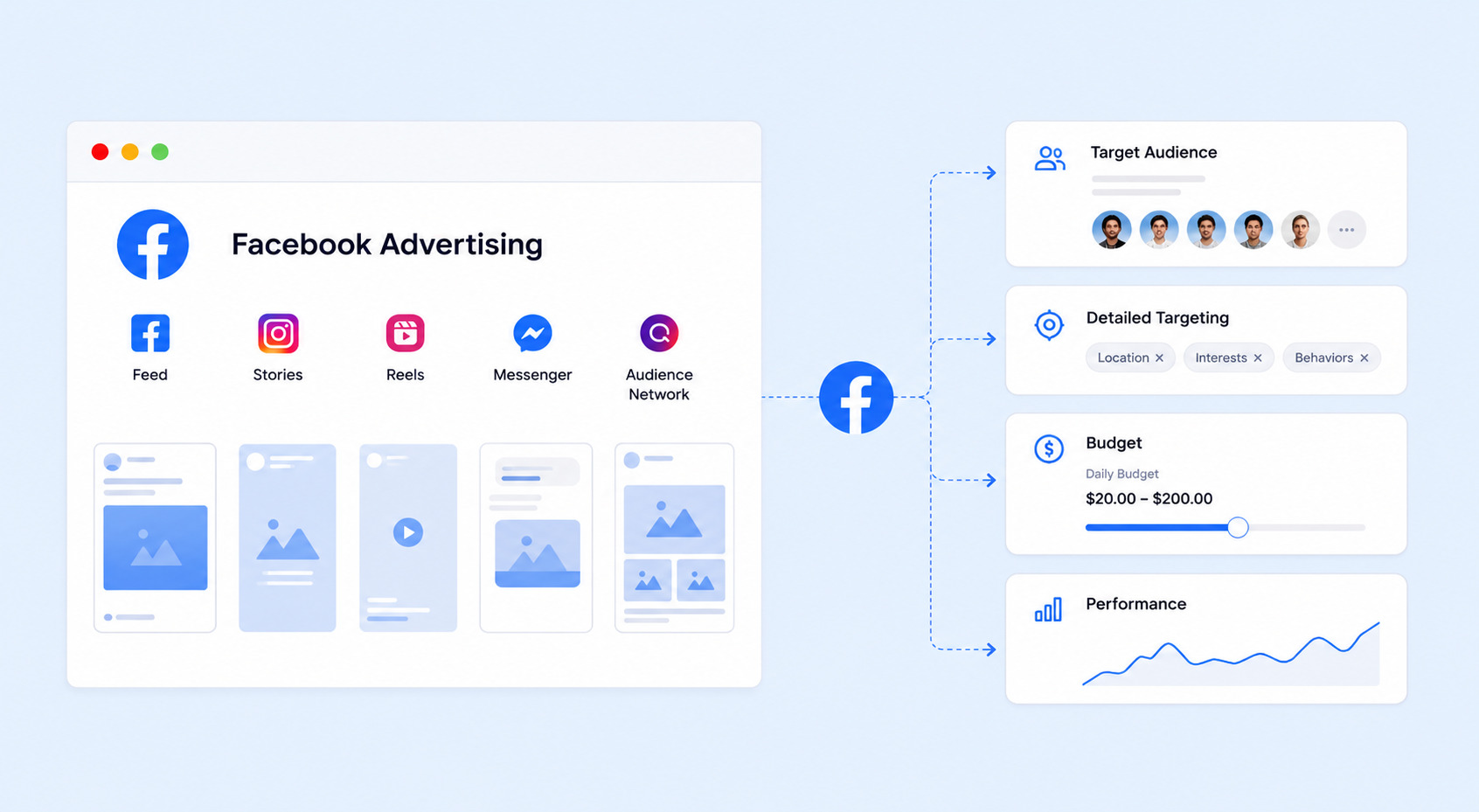
Facebook advertising gives you the opportunity to use a video ad, a single image, carousel images, or a collection ad to reach audiences across the platform in different placements — feed, story, Reels, Messenger, Audience Network, and more.
From your Facebook Business Manager account, you customize your target audience based on who you think would likely buy — targeting users by location, behaviors, interests, and much more through detailed targeting options. You can also exclude audiences you don't want to reach through custom audience exclusions.
After that, you set a daily ad budget (minimum and maximum), and Meta's ads manager shows your ecommerce ads to as many people as it can from your desired audience — or, increasingly, lets its Meta AI decide who to reach through broad targeting and automatic placements.
What's changed is the degree of control advertisers have in that process. In 2020, media buyers running ecommerce Facebook ads built highly structured campaigns with precise interest targeting, manual bid strategies, and tightly controlled ad sets. Today, Meta has shifted aggressively toward AI-driven automation — and for many ecommerce brands, that shift has improved results rather than hurt them.
What You Can Expect to Pay in 2026
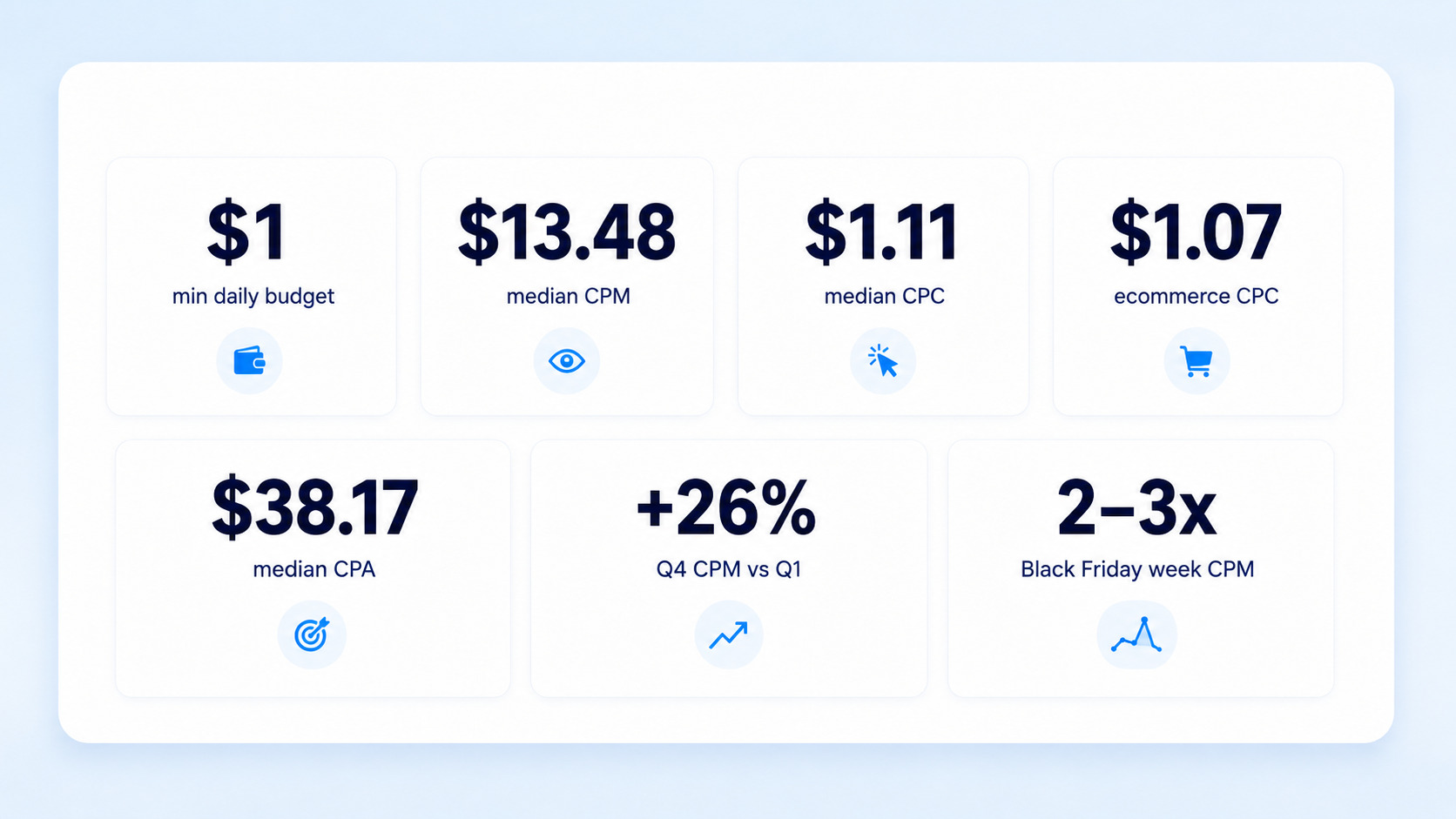
The minimum amount for a daily ad set budget remains $1. But a realistic ad budget for running ecommerce Facebook ads starts meaningfully higher.
The benchmarks have shifted considerably from 2020:
The global median CPM across all industries landed at $13.48 in 2025 — reflecting the premium brands pay to reach audiences in a crowded auction environment. The global median CPC averaged $1.11 across all industries from January 2025 to January 2026, peaking at $1.32 in November during holiday competition and resetting to $0.85 in January 2026. (R1)
For ecommerce specifically: ecommerce ads average about $1.07 CPC globally in 2025, roughly 5% below the overall industry average. (Uproas) The median CPA across all industries landed at $38.17 in 2025. (Triple Whale)
One tactical implication worth noting: Q4 CPMs average 26% higher than Q1, with Black Friday week seeing CPMs 2–3x normal levels. Ecommerce brands that front-load creative testing in Q1 and Q2 — when auction competition is lowest — have a library of proven ad creatives ready to scale in Q4 without paying premium prices to discover what works.
When setting up ad campaigns, use both campaign spending limits and account spending limits in ads manager to prevent going over budget during testing phases. Start with a small daily ad spend per ad set, identify what performs, then scale the winners.
Do Facebook Ads Work for Ecommerce?
Yes — but the success rate is directly tied to three variables that haven't changed: the quality of your ad creatives, the relevance of your offer to the target audience, and the strength of what happens after the click.
Meta commands 68.31% of total ecommerce advertising budgets, with a median CTR of 2.19% — signaling that Meta's visual ad formats continue to generate strong top-of-funnel engagement. The challenge lies in converting that engagement into purchases — and that's where many ecommerce advertisers running Facebook ads fail.
The median ecommerce conversion rate on Meta ads was 1.57% in 2025 — meaning roughly 98 of every 100 people who click your ecommerce ads don't buy. At a $1.07 CPC, that's $68 per conversion at the median rate. Whether that's profitable depends entirely on your average order value, gross margin, and what you do with that customer after the first sale.
The organic reach concern from 2020 has only deepened. Organic social reach has declined further across all platforms. Running ecommerce Facebook ads isn't optional if you need predictable customer acquisition — it remains the most controllable paid traffic source for many online stores.
Ad Formats That Matter Most for Ecommerce
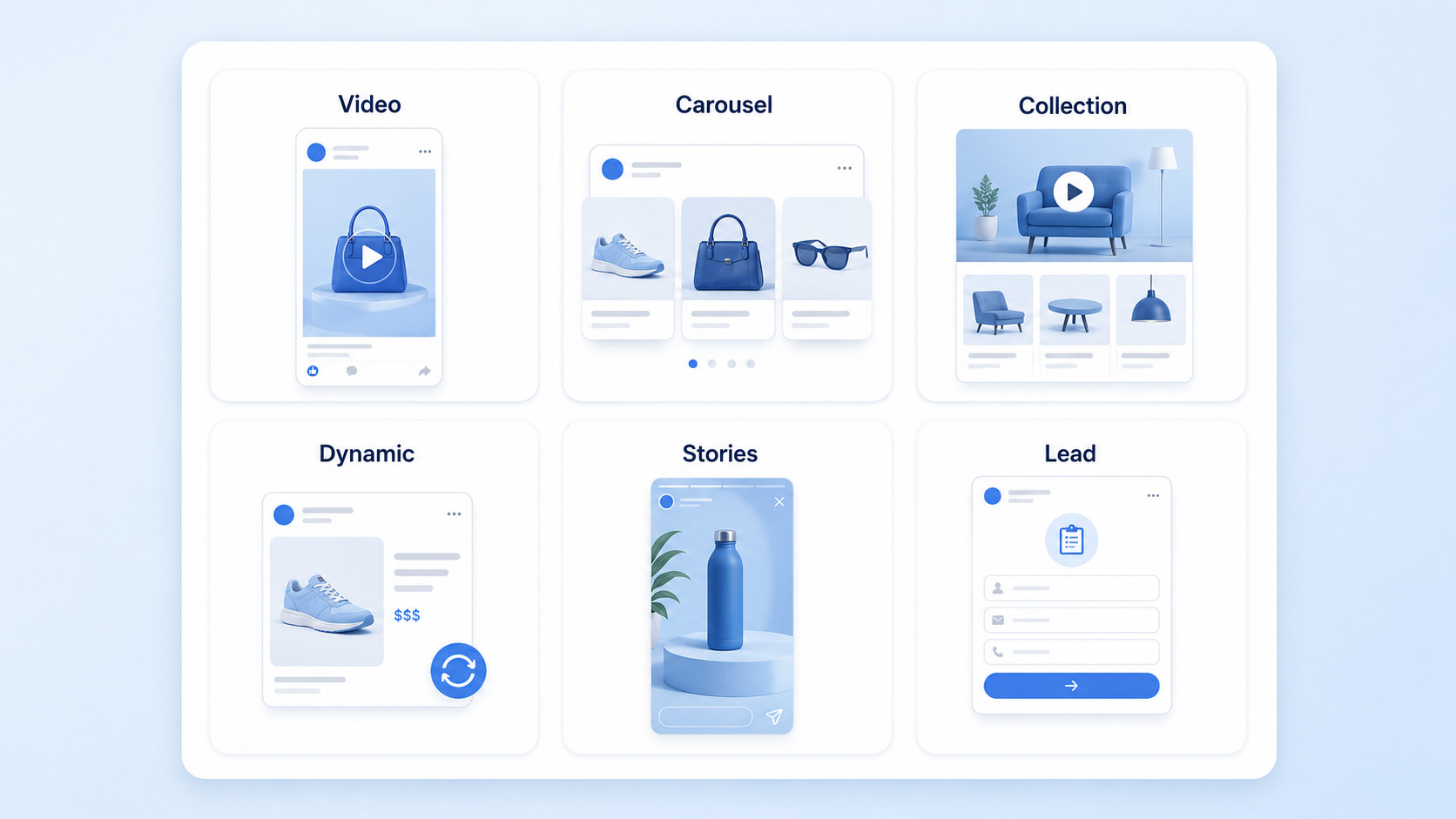
Video Ads
Video ads remain the dominant ad format by spend. Video ads account for over 37.5% of total ad spend on the platform in 2026. (SQ Magazine) Short-form video — particularly Reels — is where Meta has concentrated its algorithm weighting. Vertical video formats on mobile show 25% higher completion rates than horizontal formats. For ecommerce brands, video ads work best when they demonstrate the product in use and lead with a strong hook in the first two seconds.
Carousel Ads
These let you display multiple products or multiple angles of a single product using carousel images — each linking to its own landing page. For ecommerce stores with a catalog, carousel ads consistently outperform a single ad on click-through rate because they give the viewer more surface area to engage with.
Collection Ads
Collections combine a primary video or image with a product grid pulled from your catalog. They open into a full-screen Instant Experience on mobile devices — keeping prospective customers inside the Meta environment and reducing landing page load time friction.
Dynamic Product Ads
Dynamic ads are the catalog-driven ad type that automatically shows individual products from your feed based on user behavior. Dynamic ads are particularly powerful for retargeting — showing visitors the exact products they viewed or added to cart without any manual ad creatives required per product.
Stories Ads
Stories run in the Instagram feed Stories and Facebook Stories placements. Instagram Stories stands out as the most cost-efficient placement within Meta, with a CPC 45% cheaper than Feed placements. If you're trying to stretch ad spend, Stories ads are consistently underused relative to their efficiency.
Lead Ads
Lead ads use Meta's native lead form format to capture customer information — useful for ecommerce brands building email lists or running high-consideration product categories where the purchase cycle is longer. Lead ads with a coupon code offer or free sample incentive tend to perform well for list-building campaigns separate from direct sales campaigns.
Biggest Shift: Advantage+ Shopping Campaigns
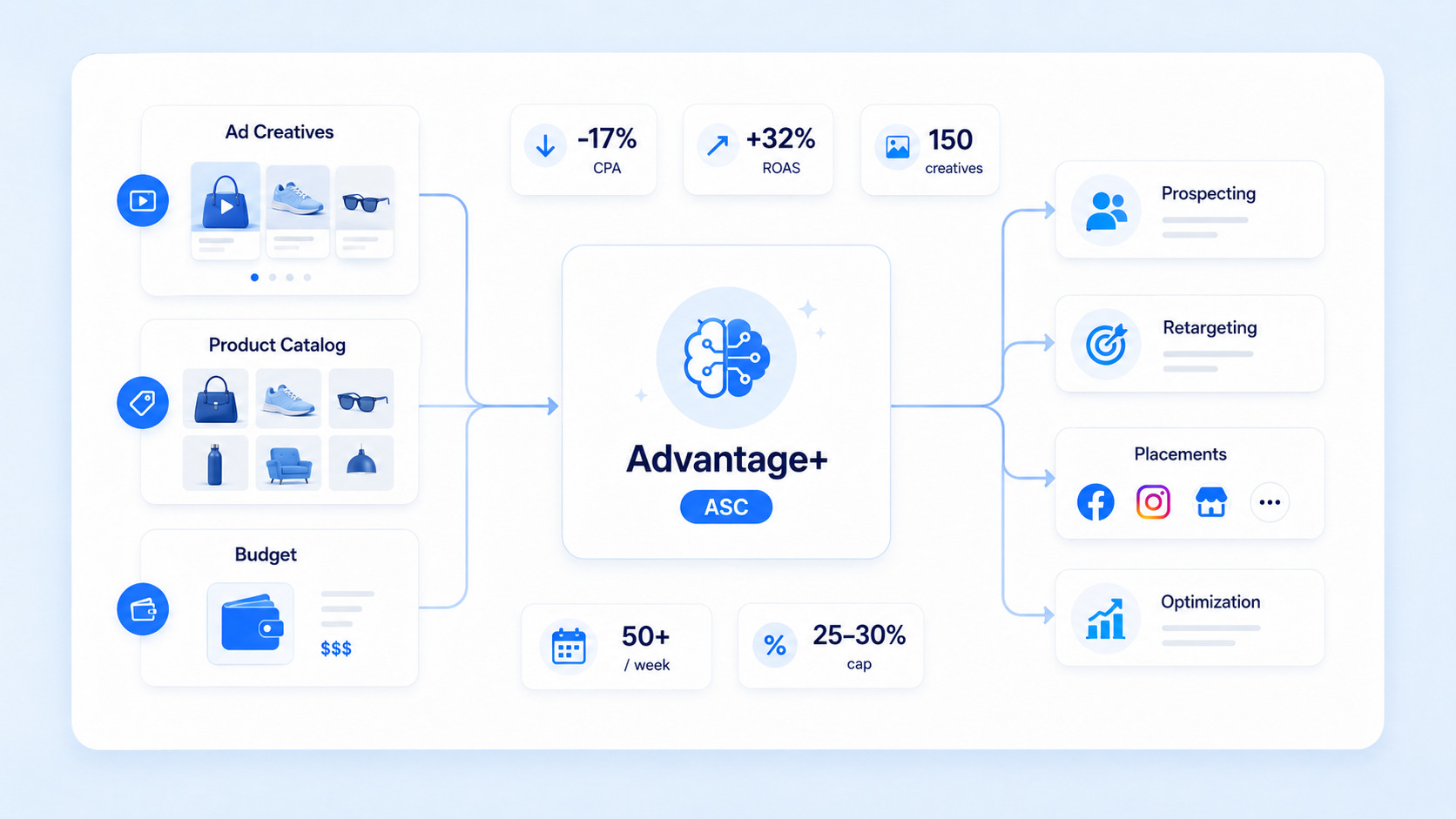
The most significant development in running ecommerce Facebook ads since 2020 isn't a new ad format — it's the shift toward AI-driven automation through the Advantage+ Shopping Campaign (ASC).
An ASC campaign is Meta's machine-learning campaign type that consolidates prospecting cold audiences, retargeting, creative testing, and budget allocation into a single ad account structure. Rather than building separate ad sets for different audiences with manually controlled bid strategies, you upload your ad creatives and product catalog, set a campaign objective of Sales, and let Meta's algorithm handle the rest — including audience targeting, automatic placements, and bid optimization.
The performance case for the ASC campaign is concrete. Meta claims Advantage+ Shopping Campaigns delivered a 17% lower cost per conversion on average compared to manual campaigns. (Needle) Real-world data shows businesses implementing ASC experience 17% lower CPA and 32% higher ROAS across various industry verticals. (Omni Funnel Marketing)
The tradeoff is control. An ASC campaign operates as a black box — you don't always know exactly who is seeing your ecommerce ads or which automatic placements are receiving your ad spend. Without an existing customer budget cap, the algorithm tends to over-index on retargeting existing customers because they convert more easily — inflating ROAS while limiting new customer acquisition. Setting a cost caps of 25–30% for existing customer spend is the recommended starting point.
An ASC campaign can test up to 150 creative combinations simultaneously, rotating ad budget toward top performers. Upload a minimum of 10 ad creatives — 20–50 is the recommended range for ASC to work effectively. (Adligator)
50+ weekly purchases is the conversion volume at which an ASC campaign consistently outperforms manual campaigns — because the algorithm has enough data to optimize efficiently. (Top Growth Marketing) For newer online stores still feeding the Facebook Pixel, manual prospecting campaigns with defined interest targeting or lookalike audiences typically perform better initially.
Ad Account Structure for Ecommerce Facebook Ads Funnel
The ad account structure determines how Meta allocates your ad spend, how quickly the algorithm exits the learning phase, and how effectively your campaigns separate new customer acquisition from retargeting.
Prospective Customers (Cold)
Here, you reach people who have never interacted with your ecommerce brand. This is where an ASC campaign or broad targeting campaigns run — letting Meta's algorithm find buyers rather than relying on manually defined interest targeting or lookalike audiences. The sales objective at this stage is efficient cost per new customer, not blended ROAS — blended ROAS that includes easy retargeting conversions masks true prospecting performance.
Warm Audience Retargeting
Next, you should reach visitors who've engaged with your content, watched your video ads, visited your online store, or added to cart without purchasing. These audiences are ready for a direct product offer, strong social proof, or a coupon code that reduces the last barrier to purchase. Dynamic product ads work particularly well here — showing each visitor the exact products they engaged with.
Abandoned Cart Retargeting
This is the highest-converting segment in your entire ad account. Prospective customers who reached checkout have already made a near-decision. Dynamic ads or a single ad with strong ad copy addressing the most likely reason they left — shipping cost, payment hesitation — often convert at 3–5x the rate of cold prospecting campaigns.
The Conversions API (CAPI) is the data infrastructure that makes this full-funnel ad account structure work accurately. Since Apple's iOS 14 update, browser-based Facebook Pixel tracking alone misses a significant percentage of conversions — typically 20–30%. Running Meta ads without CAPI configured means the algorithm is optimizing on incomplete data, which degrades performance across every campaign objective in the ad account.
Read more: WooCommerce Abandoned Cart: The Only Fix You Need Right Now
Creative Testing: Real Competitive Variable
If there's one reason ecommerce Facebook ad campaigns underperform despite adequate ad spend, it's creative. Specifically, running too few ad creatives for too long.
The brands absorbing CPM increases without ROAS declines are the ones with strong creative that takes advantage of Meta's improved audience matching. Meta's Andromeda delivery system is significantly better at matching ads to high-intent users than it was in 2020. That improved matching means your ad creatives are now being shown to more relevant prospective customers. If they're not converting, the creative is the variable — not the targeting or the ad budget.
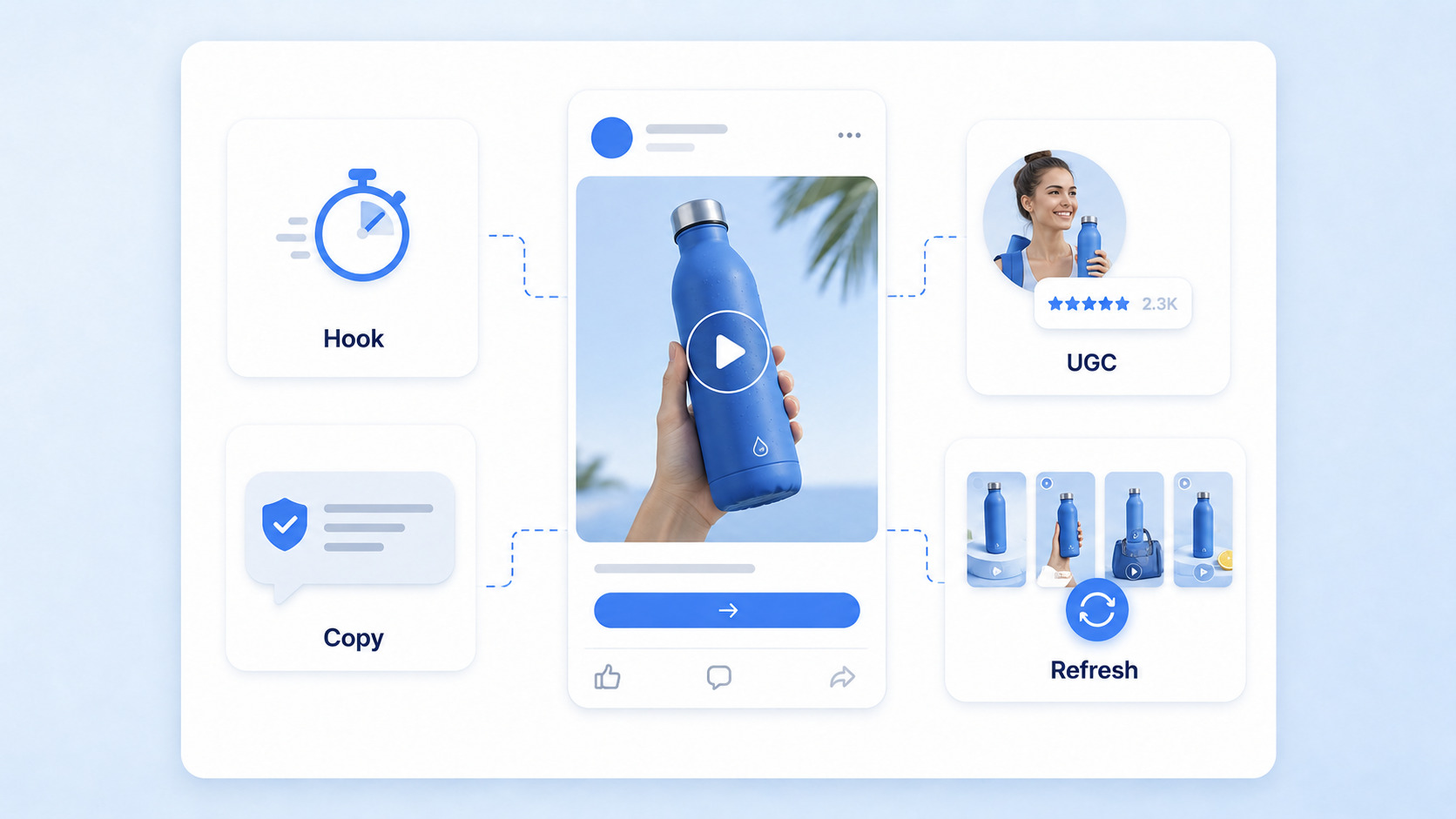
Effective ad creatives for ecommerce Facebook ads in 2026 follow a format shaped by mobile consumption patterns:
Hook rate is the leading indicator. On mobile devices — where 68.31% of ecommerce ad spend is consumed — your ad competes with everything else in the Instagram feed and Facebook feed for attention in the first 1–2 seconds. A video ad that doesn't stop the scroll in the first frame doesn't get watched, regardless of what comes after. Hook rate (the percentage of impressions that watch beyond 3 seconds) predicts creative performance better than any other early signal.
Social proof converts cold audiences. User-generated content — real customers using the product, unfiltered testimonials, before/after demonstrations where policy permits — consistently outperforms polished brand creative for prospecting cold audiences. Authenticity signals trust to someone encountering your ecommerce brand for the first time.
Ad copy should address the objection. The customer seeing your ecommerce Facebook ad for the first time has one question: "Why would I buy this from a store I've never heard of?" Your ad copy answers that question — with specificity, not generic product features. Social proof in the ad copy (review counts, star ratings, specific customer outcomes) does more work than descriptive product copy.
Rotate ad creatives frequently. Even strong performers fatigue. When frequency rises above 3 for cold audiences and ROAS begins declining, the ad creatives need refreshing — not the audience, the bid strategy, or the ad budget. The creative testing loop is continuous.
What Happens After the Click
This is what many ecommerce Facebook ads guides skip — and it's where most ad spend is wasted.
An ecommerce Facebook ad that generates a click has done its job. What happens after that click determines whether the campaign is profitable. Sending Meta traffic to a standard online store product page — with navigation menus, competing products, and a checkout not built for cold traffic on mobile devices — is one of the most common reasons ecommerce Facebook ad campaigns fail despite generating clicks at acceptable CPCs.
The median ecommerce conversion rate on Meta ads is 1.57%. The ecommerce stores operating at 3–4% on the same traffic aren't running better ads — they're running better post-click experiences. Dedicated landing pages built for the specific offer and target audience of the ad, with no navigation distractions, clear social proof, and a checkout flow optimized for mobile devices, can outperform standard product pages for paid traffic from Meta.
Funnelish is purpose-built for ecommerce brands running Meta ads. Rather than sending paid traffic to a standard online store product page, Funnelish's page builder lets you create dedicated landing pages — sub-second load times, single focused offer, checkout that accepts Stripe, PayPal, Klarna, Apple Pay, and more — designed to convert cold traffic from Facebook advertising.
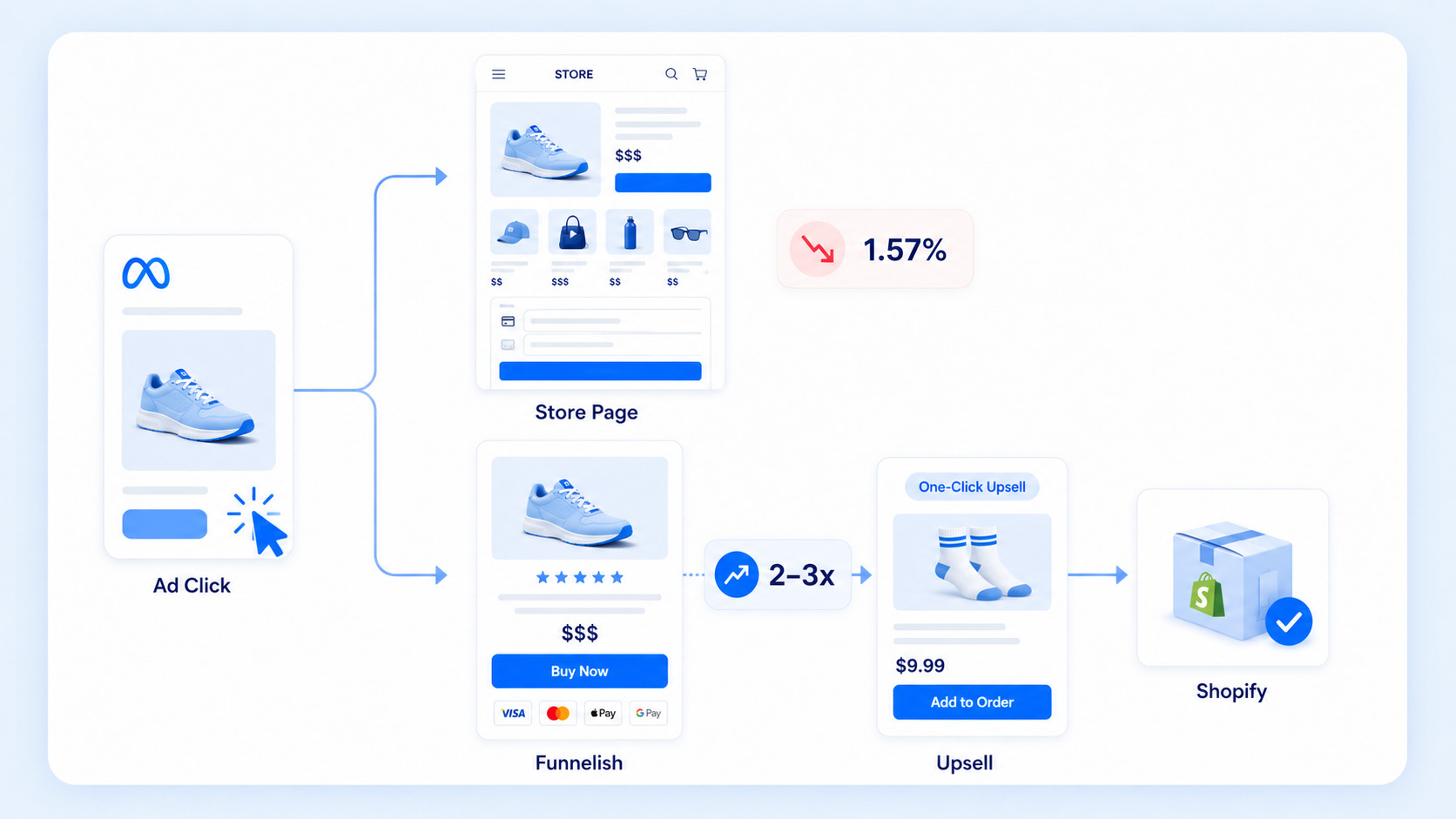
Post-purchase one-click upsells then capture additional revenue from each customer at peak buying intent, without requiring a new checkout flow or re-entering payment details. Every order syncs automatically to Shopify for fulfillment, so your operational backend stays intact while the sales funnel handles conversion. Funnelish users report 2–3x higher conversion rates compared to standard Shopify stores on the same Meta traffic.
At the median Meta conversion rate of 1.57%, a 2x improvement means the same ad spend produces twice the customers — which is often the difference between a profitable ecommerce Facebook ads strategy and one that doesn't break even.
Beware of Meta Ad Policies for Online Stores
One ongoing challenge of running ecommerce Facebook ads is Meta's Ad Policies — which have become more rigorous since 2020.
The longstanding restrictions remain: no illegal products or services, no tobacco, no drugs, no "before and after" imagery in health and fitness ecommerce ads implying weight loss, no unsafe supplements.
Health-related ads now require stricter compliance checks, limiting sensitive audience targeting. Meta has introduced mandatory AI disclosure tags for sponsored posts. Political ad regulations mandate advertiser verification in over 70 countries.
Alcohol advertising continues to be country-specific — prohibited in markets including Afghanistan, Saudi Arabia, the UAE, Pakistan, and others. For ecommerce brands running geo-targeted Meta ads internationally, the compliance burden scales with the number of markets you operate in.
The consequences of policy violations haven't changed: ecommerce ads shut off, campaigns paused, or entire ad accounts disabled without notice. Review the current Meta Ad Policies before launching any new ad campaigns in a sensitive category. If you operate in health, fitness, finances, or any regulated ecommerce niche, this review is non-negotiable before your first dollar of ad spend
Facebook Ads vs. Google Ads Campaigns for Ecommerce
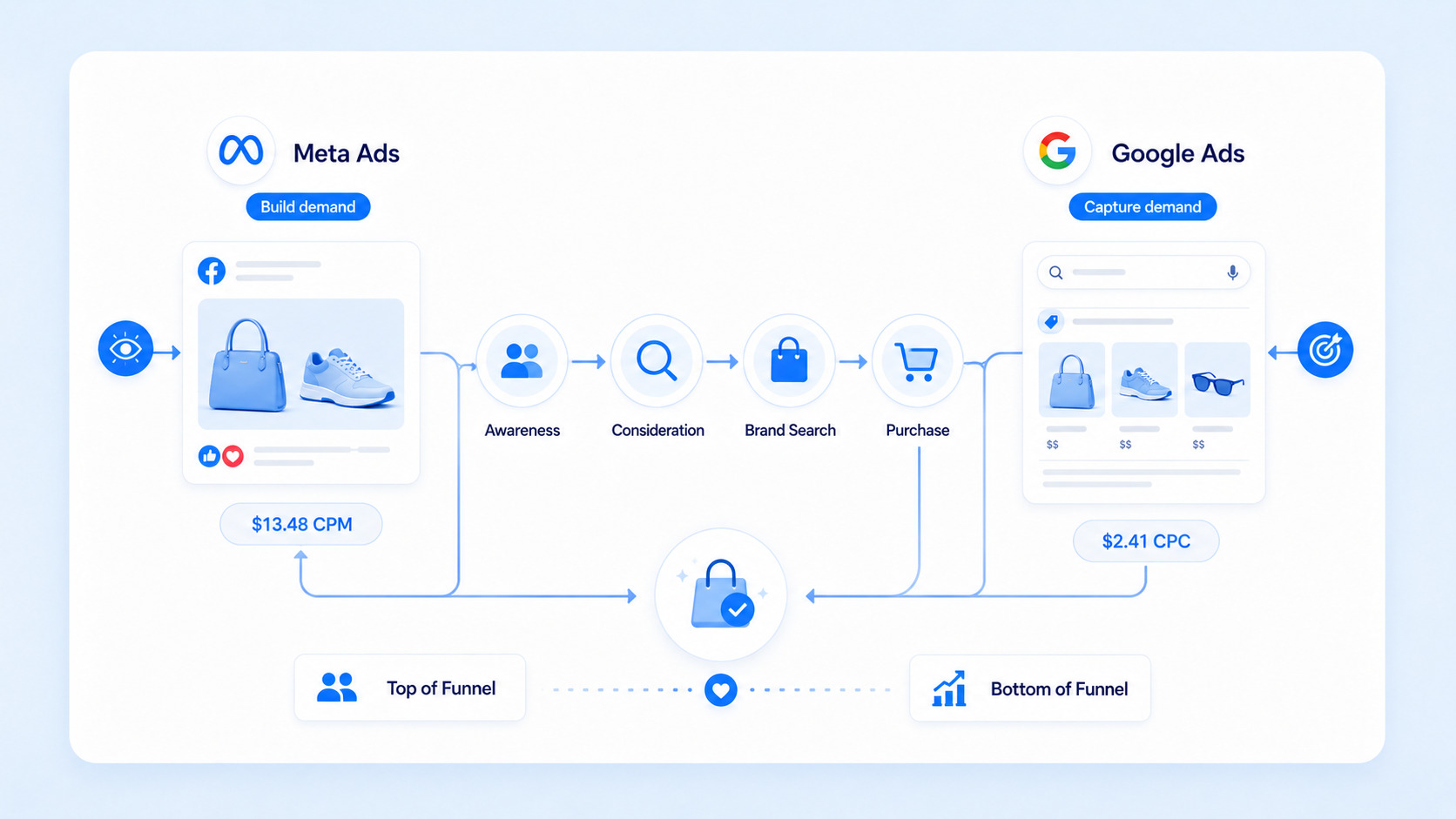
Both platforms remain the dominant paid channels for ecommerce — but they serve different roles in the customer journey, and that distinction matters for how you allocate ad budget.
Facebook advertising is an interruption channel. The customer wasn't searching for your product — your ecommerce ad found them based on audience signals. Meta excels at awareness and desire creation: introducing a product to a prospective customer who didn't know they wanted it. It's where ecommerce brands build demand.
Google Ads is an intent channel. The customer is actively searching — and your ad appears at the point of consideration. Google Shopping and Search campaigns convert at higher rates on average because purchase intent is already established before the ad is seen.
The median CPM across Meta sits at $13.48. (Visible Factors) Google Shopping CPMs typically run lower, but with higher CPC on competitive terms. The optimal ad account structure runs both: Meta for top-of-funnel customer acquisition and ecommerce brand building, Google for capturing high-intent search traffic and branded queries.
Treating them as competing channels and cutting one to fund the other is a common and costly mistake. A prospective customer who sees your Facebook ecommerce ad, doesn't buy immediately, and later searches your brand name on Google should be captured there too. Last-click attribution models consistently undervalue Meta's role in initiating the purchase journey — which is why Meta ads appear less efficient than they actually are in single-channel ROAS analysis.
Facebook Ads for Dropshipping
If you're running a dropshipping ecommerce business and want to scale, Meta ads remain one of the highest-leverage channels available — but the competitive environment has intensified significantly.
68% of dropshipping stores get most of their traffic from Meta. That concentration means most dropshipping brands are in the same auction, targeting the same broad audiences, with similar ad creatives. The online stores winning in this environment differentiate on three things: the specificity of their target audience, the quality of their Facebook ad creatives, and the conversion rate of the experience after the click.
Creative testing is still the key variable. What's changed is how fast Meta's algorithm generates usable data. An ASC campaign running with 20+ creative variants can identify winning ad creatives in days rather than weeks, compressing the testing timeline. The creative iteration speed — how quickly you can create, test, and rotate ad creatives — is now the primary competitive variable for dropshippers running ecommerce Facebook ads.
Read more: Dropshipping Products That Work in 2026
Start Converting Your Meta Traffic — Not Just Driving It
Running profitable Facebook ads for ecommerce comes down to one equation: the cost to acquire a click versus the revenue that click generates. Many brands obsess over the first half and ignore the second.
The ad gets someone to click. What happens after — the landing page, the checkout flow, the post-purchase sequence — is what determines whether that click becomes a customer, and whether that customer becomes more than a single transaction.
Funnelish is built for ecommerce brands running paid traffic on Meta. Dedicated landing pages that load in under a second, a fully customizable checkout supporting every major payment method, one-click post-purchase upsells, geo-funnels that adapt to every market, and direct Shopify sync — everything conversion needs, without stitching together ten separate apps.
The median Meta conversion rate is 1.57%. Funnelish users report 2–3x higher conversion rates on the same traffic. That gap is where profitable ecommerce Facebook ad campaigns are built.
Start your free 14-day Funnelish trial →
Facebook Ads for Ecommerce FAQs
Do Facebook ads work for ecommerce?
Yes. Meta commands 68.31% of total ecommerce advertising budgets among D2C brands — which reflects where the results are. Running ecommerce Facebook ads works when the ad creatives are strong, the target audience or AI targeting is well-configured, and the post-click experience converts the traffic the ad generates.
The most common failure point isn't the ad — it's the landing page and checkout flow after the click that leaks the ad spend.
Is $10 a day enough for Facebook ads?
At a median CPM of $13.48 and CPC of $1.11, a $10/day ad budget generates roughly 9 clicks per day — enough for initial creative testing but not enough to exit the learning phase quickly. Meta's algorithm needs approximately 50 conversions per ad set per week to optimize efficiently. A $10/day budget is a great starting point for testing ad creatives before scaling, not a sustainable ecommerce Facebook ads structure for driving meaningful sales.
How do I run Facebook ads for ecommerce?
Start by ensuring your Meta Pixel and Conversions API are correctly configured in your Facebook Business Manager account — without accurate tracking data, the algorithm can't optimize. Set a Sales campaign objective targeting Purchase events.
For ecommerce stores with 50+ weekly purchases, test an Advantage+ Shopping Campaign with 20+ ad creatives. For newer online stores, start with manual campaigns using broad targeting or interest targeting ad sets. Always send paid traffic to a dedicated landing page built for the specific offer — not your store homepage or a generic product page.
Measure success by cost per purchase against your margin, not click metrics alone.
Is $1,000 enough for Facebook ads?
$1,000 is a workable test ad budget for one month of ecommerce Facebook ads. At a median CPA of $38.17, $1,000 generates approximately 26 purchases — enough to validate whether a product and audience combination is profitable, but not enough to generate statistically significant data across multiple audiences and ad creatives simultaneously.
The goal with a $1,000 ad budget is to find one profitable creative and target audience combination, then scale from there — rather than spreading ad spend thin across multiple ad campaigns at once.
Table of contents
Boost your eCommerce
sales today

24/7 support
No credit card required
Cancel anytime
24/7 support
No credit card required
Cancel anytime
