

AI in Ecommerce: How It Stopped Being a Tool and Became a Channel
17 July 2026
Anna P.
11 minutes
AI used to help you run your store. Now it decides whether shoppers find your store at all. During the 2025 holiday season, traffic to US retail sites from generative AI sources jumped 693% year over year, according to Adobe Analytics — which tracks over a trillion visits to US retail sites, giving it one of the clearest views of the digital economy anywhere.
But raw traffic isn't the interesting part. Quality is. Those AI-referred shoppers converted 31% better than other traffic sources over the holidays — nearly double the year before — and were 33% less likely to bounce. On Thanksgiving, AI conversions ran 54% higher than non-AI traffic.
And it's accelerating. By March 2026, Adobe measured AI traffic converting 42% better than other sources — a new record — with revenue per visit from AI referrals 37% above non-AI. The kicker? Just a year earlier, ordinary human traffic was worth 128% more than AI traffic. That flip happened in twelve months.
Why does AI traffic convert so well? Because by the time an assistant sends someone to you, the research is done. The comparison shopping, the spec-checking, the "Is this legit?" anxiety — all handled upstream. What lands on your page is a decided buyer.
Salesforce puts a dollar figure on it: during the 2025 holiday season, AI influenced 20% of global online sales — worth $262 billion. And retailers running their own shopper agents grew sales 59% faster than the ones sitting it out.
If you take one thing from this guide: product discovery has moved, and AI-referred traffic is now the most valuable traffic on the internet.
Agentic commerce: when the AI does the buying
The next stage is already here and it has a name. Agentic commerce means AI systems that don't just answer questions — they act. They build carts, compare options against your constraints, authorize payments, and trigger post-purchase workflows.
Think about the difference. Old chatbot: "Here are some camping tents!" New agent: "I'm going camping in the northwest, suggest gear under $500 total" — and it assembles the whole kit, checks availability, and checks out.
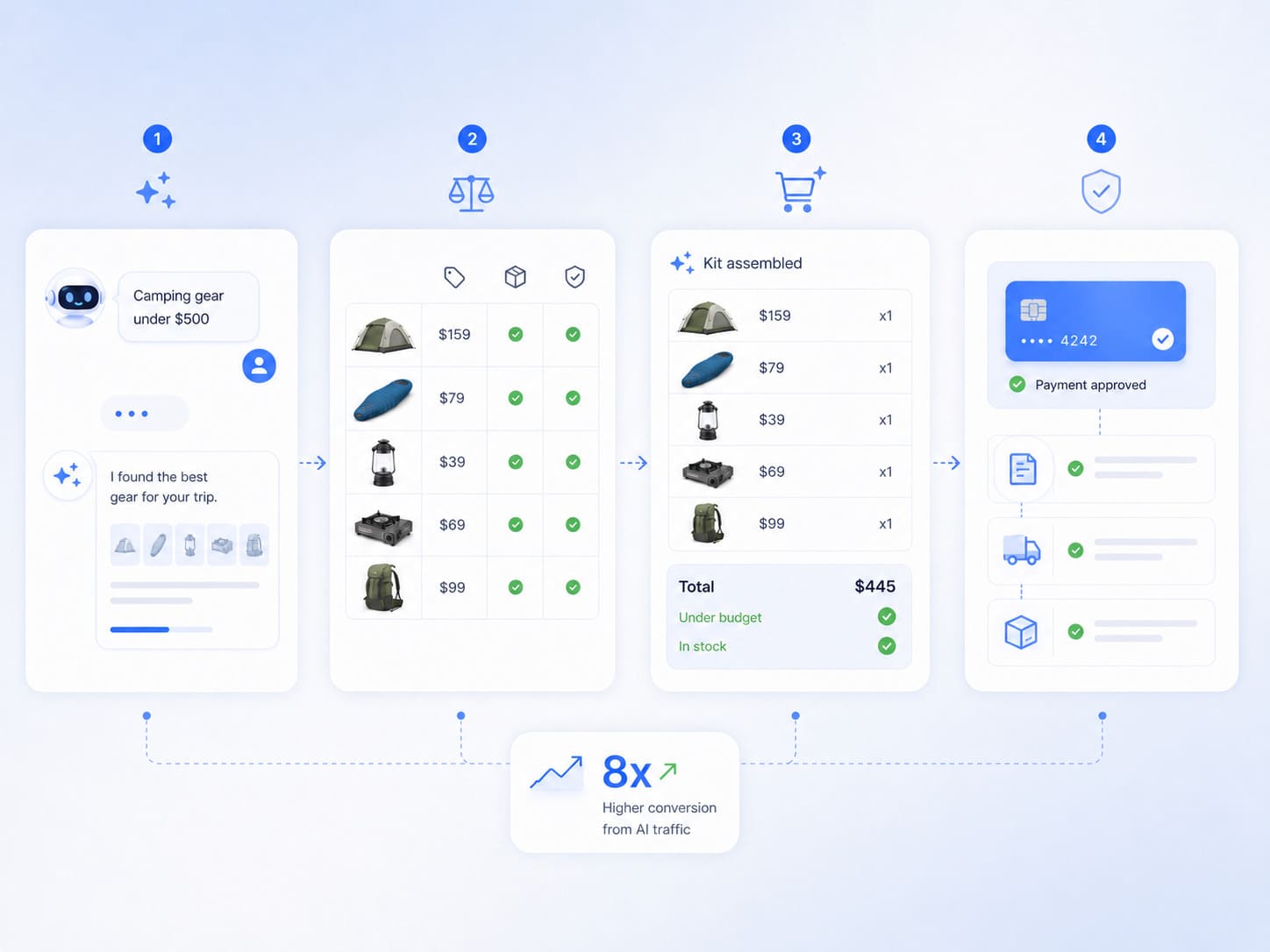
Salesforce made its shopper, buyer, and merchant agents generally available in July 2026, with native ChatGPT integration and Google Gemini arriving after. Shopify plugged its catalog into ChatGPT. Open protocol standards emerged to connect stores to AI channels without custom integrations for each one.
For ecommerce brands, this creates a blunt new reality: if an AI agent can't read your catalog, you don't exist. Structured product data, machine-readable pricing and availability, clean APIs — these are the new SEO. Product descriptions written purely for humans now actively limit your discoverability.
Salesforce's own framing is worth sitting with: AI-referred traffic converts at eight times the rate of social. Eight times. That's not a channel you experiment with next quarter.
Read more: 20+ Ways to Boost Conversions + Tools
Personalization: the original AI use case, finally grown up
Personalization is the oldest AI promise in ecommerce and still the most valuable one. The mechanics are straightforward: machine learning algorithms chew through customer data — browsing history, past purchases, customer purchase history, time on page, what got abandoned — to identify patterns and predict what someone actually wants.
What's changed is depth. Early recommendation engines did "customers who bought this also bought that." Modern AI systems build a live model of user behavior and adjust in real time as someone moves through the customer journey. Same shopper, different session, different mood — different store.
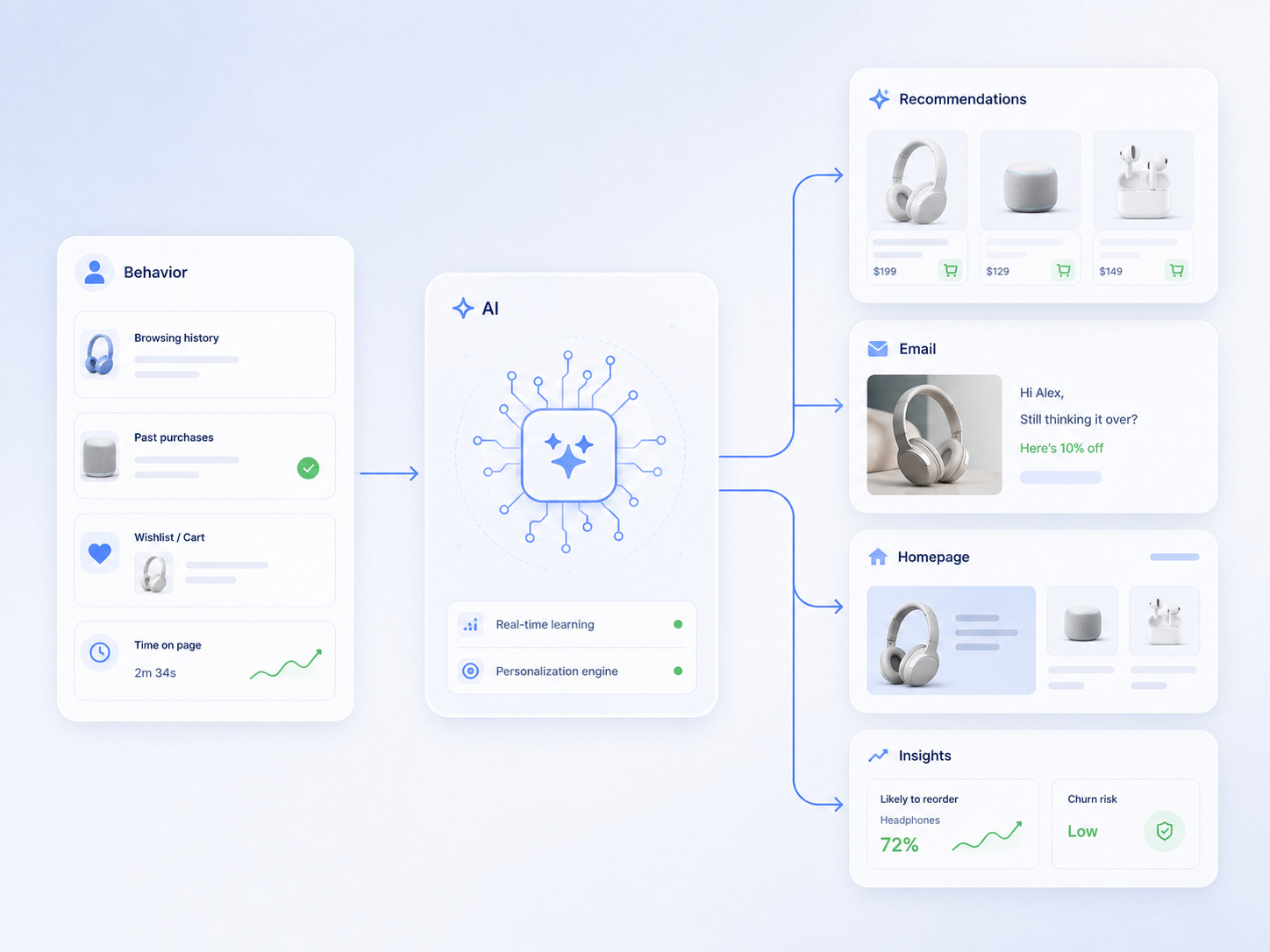
Your wins:
Product recommendations tuned to individual customer needs rather than crude customer segments
Personalized marketing campaigns that adapt messaging per person instead of per list
Dynamic homepages that reorder themselves based on real-time data
Predictive analytics that flag which customers are about to churn — and which are ready to buy again
Done well, personalization drives customer loyalty and enhanced customer satisfaction because it reduces effort. Done badly, it's creepy. The line is thinner than most teams think, and it runs straight through data privacy — which we'll get to.
Search that finally understands people
Search used to be keyword matching. Type "blue running shoe," get results containing "blue," "running," and "shoe." Type "shoes for my marathon that won't destroy my knees" and get nothing.
Natural language processing fixed that. Intelligent search now parses human language — intent, context, constraints — instead of matching strings. Smart search understands that "something warm for a rainy hike" means a waterproof insulated jacket, even if none of those words appear in the query.
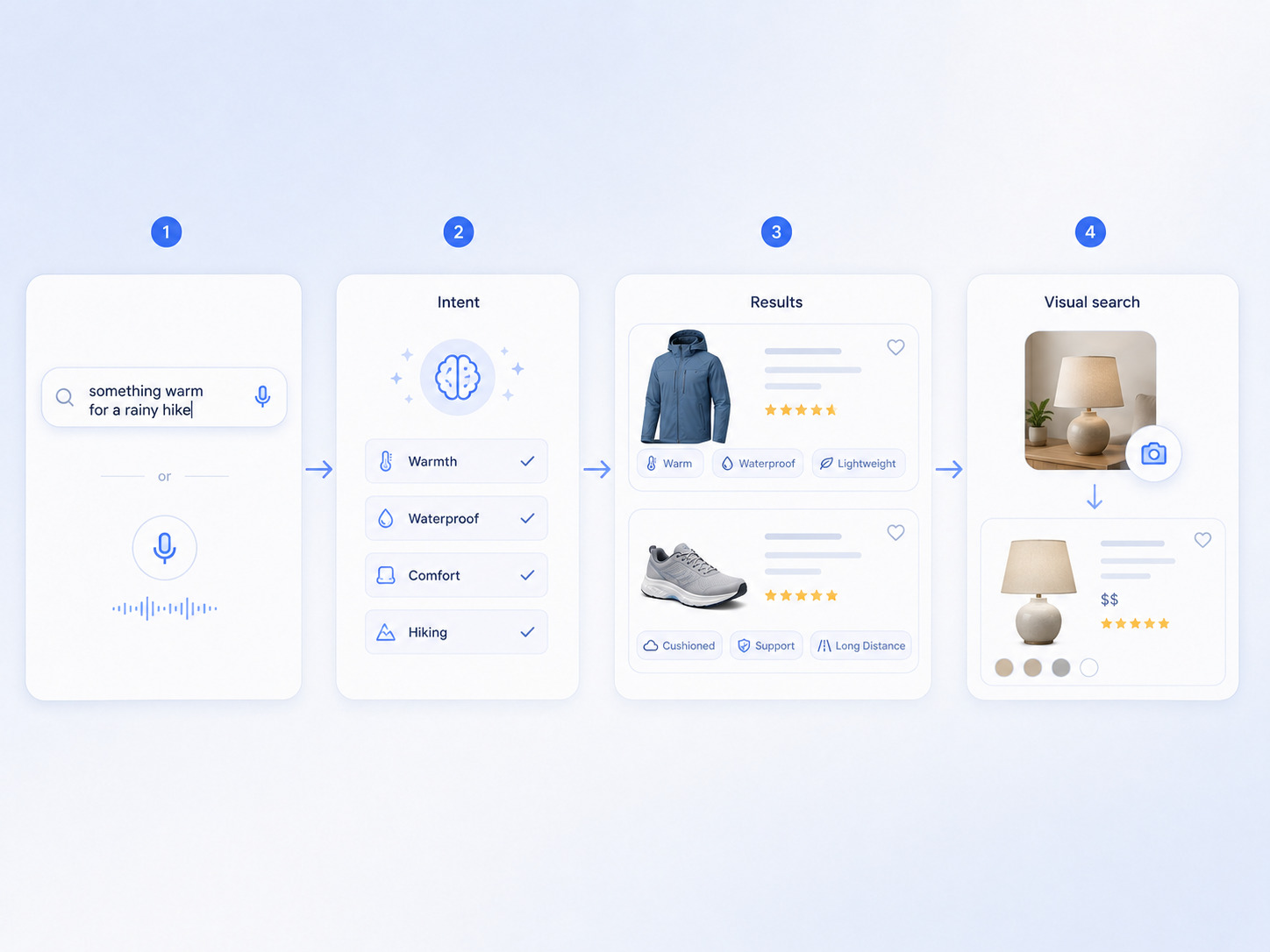
Then there's visual search, which is quietly one of the most underrated AI technologies in retail. A shopper photographs a lamp they saw in a café, and computer vision finds it (or its closest cousin) in your catalog. No words required. Combined with voice commands, the whole "describe the thing you want" bottleneck starts to dissolve.
For merchants, the takeaway is that your product data needs to support this. Rich attributes, good imagery, honest specs. AI can only find what it can understand.
Ecommerce customer service that actually stuck
If personalization is the most valuable AI use case, customer service is the most adopted one. There's a reason: it's a clean fit. High volume, repetitive queries, 24/7 demand, and a clear cost line to attack.
AI-powered shopping assistants and chatbots now handle a large majority of routine customer interactions autonomously — order status, returns policy, sizing, "where's my package." They run at 3am. They don't get tired. They escalate the genuinely hard cases to humans with full context attached.
The results are real: faster response times, lower operational costs, and improving customer satisfaction on the routine stuff. McKinsey's research finds customer satisfaction among the most commonly reported improvement areas from AI.
But here's the honest bit. Customers don't reward you for having a bot. When 88% of organizations already use AI in at least one function, "we use AI" isn't a competitive advantage — it's table stakes. What earns loyalty is resolving the issue on the first try, without making someone fight a menu to reach a human.
Dynamic pricing
AI-driven dynamic pricing is where the money hides in plain sight.
The idea: instead of setting a price and revisiting it quarterly, AI algorithms continuously analyze market trends, competitor moves, historical sales data, inventory levels, and customer demand — then adjust.
Trending item flying off shelves? Price firms up.
Winter stock still sitting in March? The system calculates the optimal discount level to clear it before it becomes dead weight.
Dynamic pricing strategies work best when they're solving two problems at once:
Capturing demand — charging what the market will bear when interest spikes
Preventing overstock — timely markdowns that protect margin instead of panic-slashing at the end of the season
The trap is trust. Prices that jump while a shopper watches feel like manipulation, and shoppers screenshot things. Dynamic pricing optimization works when it's applied to inventory and timing, not to individual desperation.
Inventory, demand forecasting, and smart logistics
This is where AI delivers its least glamorous and most reliable returns.
Predictive AI analyzes historical data and sales data to forecast what you'll need and when. Good demand forecasting means fewer stockouts (lost sales) and less overstock (dead capital). It catches seasonal spikes before they hit, spots slow decay in a category before your gut does, and adjusts stock levels across locations automatically.
Extend that into supply chain management and you get smart logistics: systems monitoring real-time inventory levels, routing shipments efficiently, optimizing warehouse operations, and flagging disruptions early. AI here doesn't dazzle anyone — it just quietly stops you from losing money.
The compounding benefit is that inventory management and demand forecasting feed everything else. Better stock data makes dynamic pricing smarter. It makes recommendations honest (nothing kills trust like recommending something out of stock). It makes agents able to answer "Can I get this by Friday?" reliably.
Fraud detection: pattern-matching at machine speed
Fraud is a pattern problem, and pattern problems are what machine learning is for.
AI systems analyze transaction patterns across millions of orders to identify patterns a human reviewer never could — velocity checks, device fingerprints, mismatched geography, subtle behavioral tells. Suspicious transactions get flagged in real time, high-risk orders get held for review, and the rest sail through.
The underrated benefit isn't catching more fraud. It's false positives. Traditional rule-based systems block legitimate customers constantly — the classic "Your card was declined." on a perfectly good order. Better AI fraud detection improves genuine customer approval rates, which means you stop insulting real buyers while catching the fake ones.
Generative AI: content at a scale humans can't match
Generative AI's ecommerce home turf is content. Specifically, the tedious kind:
Product descriptions — hundreds of SKUs, each needing unique, SEO-optimized copy that a human would rather die than write
Ad and email variations for personalized marketing campaigns
Category pages, FAQs, size guides — the connective tissue nobody has time for
Customer feedback synthesis — reading 4,000 reviews and extracting actionable insights in seconds
The efficiency case is obvious. The risk is that AI-generated content at scale produces a lot of forgettable sameness, and shoppers (and search engines) notice. The winning pattern is AI for the first draft and the volume, humans for the voice and the judgment.
Building the store itself with AI
Here's the frontier that's newest and, for a lot of merchants, the most immediately useful: AI that builds the storefront, not just the copy inside it.
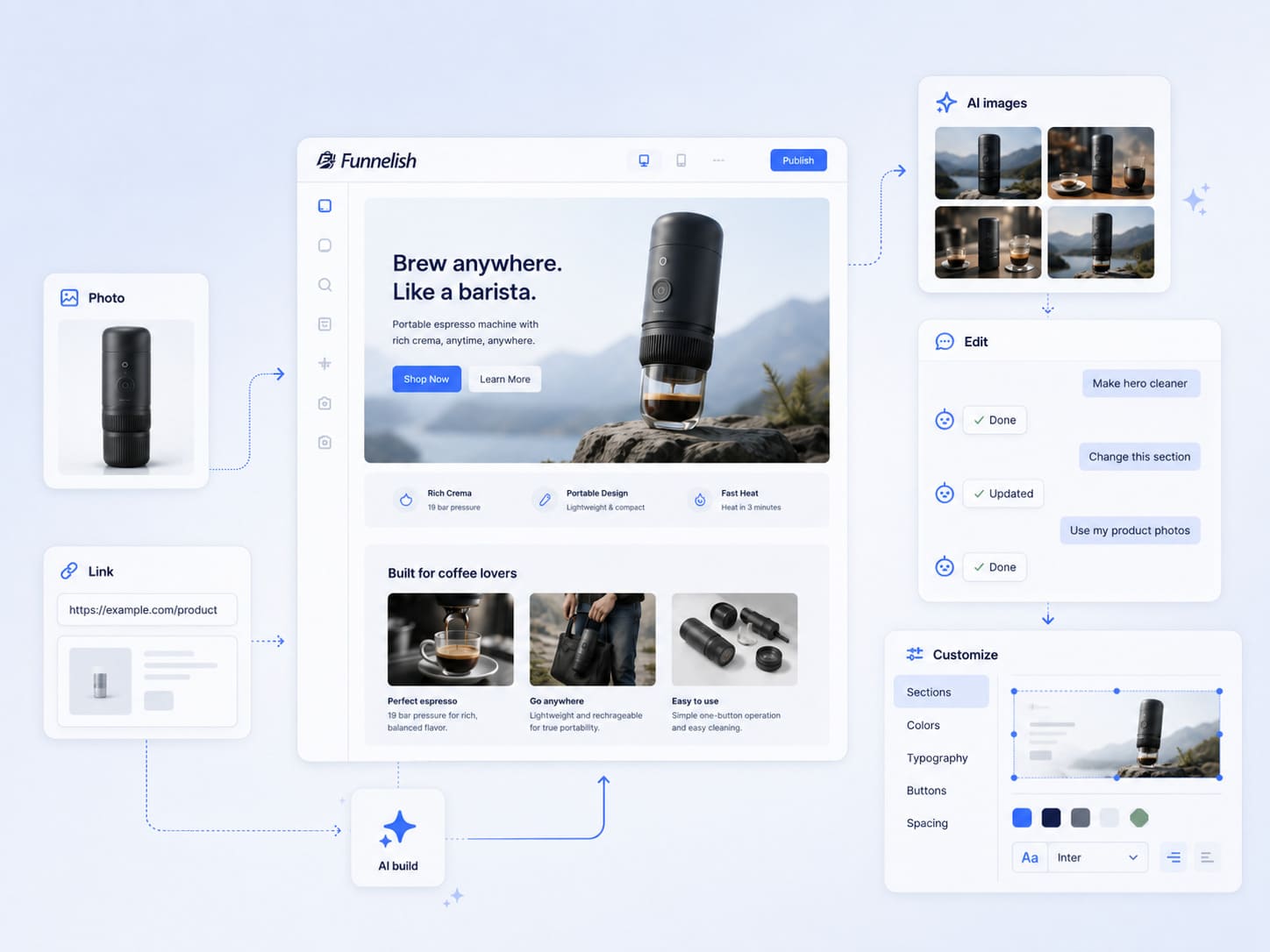
Funnelish's AI — coming soon — is our take on this. It's an interactive AI funnel builder, and the workflow is deliberately flexible:
Start however you want. From scratch, from a single product picture, or from a reference link.
Bring your own images or generate them. Upload real product shots, or let AI create them.
It builds the whole thing. Complete pages, not fragments — and then you talk to it. Don't like a section? Say so. Ask for edits section by section, conversationally, until it's right.
Then take the wheel. Pull the AI project into the Funnelish editor and customize it yourself, with full control.
The philosophy behind it matters more than the feature list: AI should get you to a strong first draft in minutes, not lock you into whatever it decided. Build fast, then own it.
Start with Funnelish for Free ->
The part nobody puts in the brochure
Now the honest section, because a one-stop guide that only lists benefits isn't a guide — it's an ad.
Most AI doesn't pay off. McKinsey's State of AI research is blunt about this: 88% of organizations use AI, but only 39% report any EBIT impact at the enterprise level, and nearly two-thirds haven't begun scaling it beyond pilots. A small group — roughly 6% — are true high performers attributing real profit to AI. Adoption is universal. Value is rare.
Poor data quality kills projects. This is the single most common failure. AI algorithms trained on messy, incomplete, or fragmented customer data produce confidently wrong answers. If your product, pricing, inventory, and customer records live in five systems in four formats, no AI solution will save you — it'll just fail faster.
Bias is real and it's expensive. AI systems trained on skewed historical data reproduce that skew, leading to incorrect product recommendations and unfair outcomes for whole customer segments. Your model doesn't know it's wrong. Your customers do.
Privacy is the constraint, not a footnote. Personalized shopping experiences run on significant customer data collection, and shoppers are increasingly uneasy about it. Privacy compliance isn't a legal chore to bolt on at the end — it shapes what you're allowed to build.
Accuracy is the top risk. McKinsey's 2026 research on AI trust finds 74% of respondents identify inaccuracy as a leading concern — and as AI systems gain autonomy and start acting rather than suggesting, the cost of getting it wrong climbs fast.
It takes real change. Implementing AI meaningfully requires investment, technical expertise, and organizational change — including training people who'd rather it went away.
So how do you start?
If you're an ecommerce business staring at all this, here's the pragmatic sequence:
1. Fix your data first.
Unglamorous? Yes. Necessary? Absolutely. Clean product data, unified customer records, accurate inventory. Everything downstream depends on it — including whether AI agents can find you at all.
2. Pick one problem.
The teams getting value chose a specific business objective — reduce response time, cut stockouts, lift AOV — and measured it. The teams getting nothing bought "an AI strategy."
3. Start where AI is boringly good.
Automate repetitive tasks. Let it handle routine tasks and the tedious content. Build confidence and free up hours before you attempt anything clever.
4. Get AI-discoverable.
Structure your catalog so agents can read it. This is the highest-leverage thing most brands aren't doing, and the traffic data says the window is now.
5. Then get ambitious.
Personalization, dynamic pricing optimization, predictive demand forecasting — once the foundation holds.
6. Keep humans in the loop.
Especially anywhere the AI touches money, pricing, or a customer's actual experience.
Bottom line
AI in ecommerce in 2026 isn't one thing — it's a stack. It's the fraud model catching a stolen card at 2am, the forecast that stopped you over-ordering, the agent that assembled a $400 camping kit inside ChatGPT and sent that shopper to your checkout already sold.
The strategic picture is simpler than the tech. Discovery is migrating to AI assistants, and the traffic they send is now the best traffic you'll get. Meanwhile, most companies are using AI without capturing value from it, because they skipped the boring parts — the data, the focus, the measurement.
The opportunity isn't in having AI. Everyone has AI. It's in being one of the few who make it pay.
Table of contents
Boost your eCommerce
sales today

24/7 support
No credit card required
Cancel anytime
24/7 support
No credit card required
Cancel anytime
