

Countdown Timers for Ecommerce in 2026
27 August 2021
Anna
7 minutes
Countdown timers are one of the oldest tricks in the ecommerce playbook, and for good reason — they add urgency and can genuinely influence a customer's buying decision and your conversions. A clock counting down to a deadline taps into something hardwired in us: the fear of missing out. But the tactic has evolved, and what worked a few years ago can now actively damage your brand if you get it wrong.
Let's look at how countdown timers work, why they still convert in 2026, and how to use them honestly.
Countdown timers for ecommerce – how do they work?
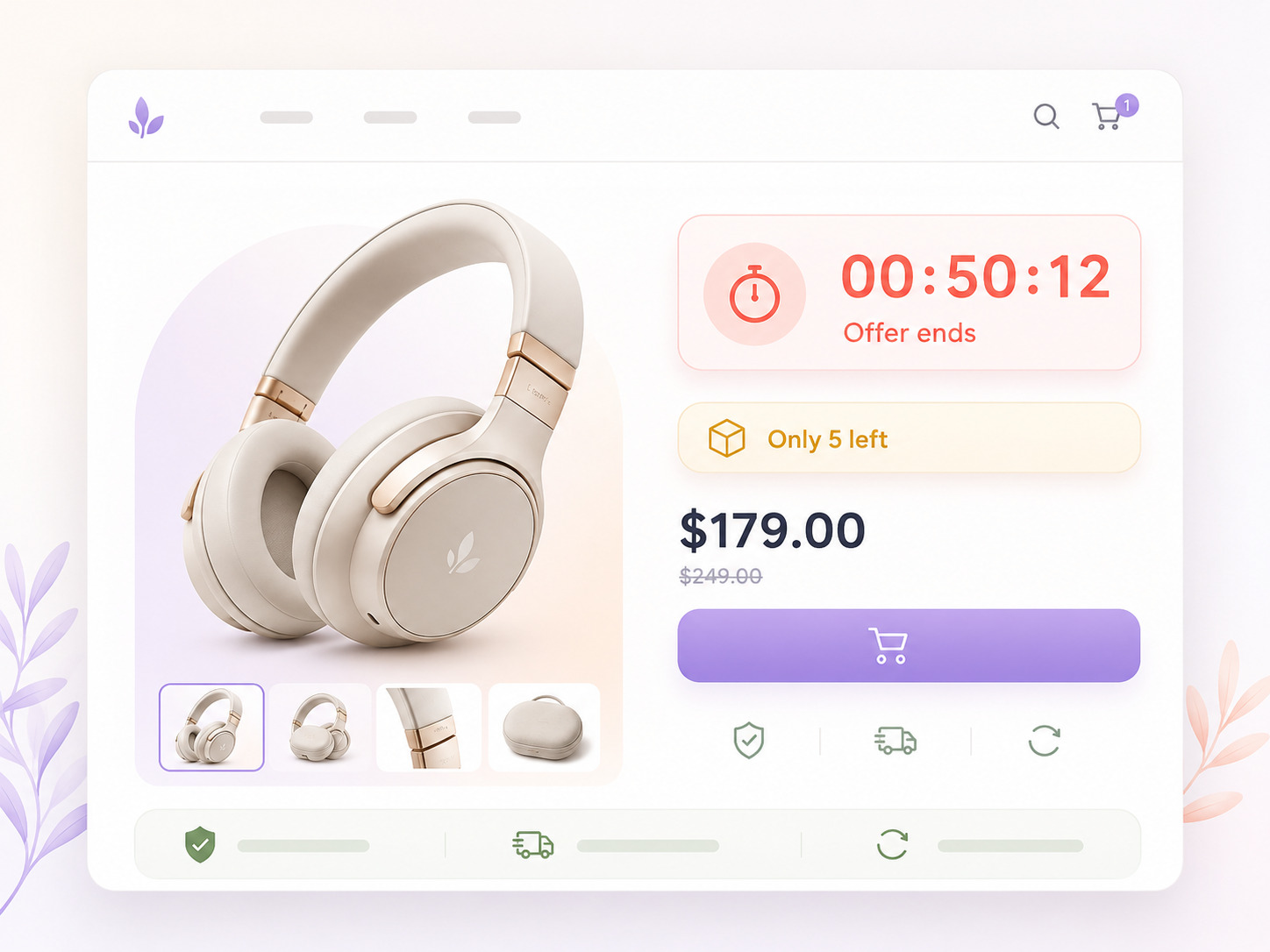
In ecommerce, a countdown timer is usually displayed as a clock running down in hours, minutes and seconds toward a set expiry date or moment. The idea is simple: show the shopper how much time is remaining to act, and the ticking number does the persuading. Most stores use this means of urgency in one of two ways.
The first is a time-based offer: "50 minutes until this offer expires." This tells your customers they need to rush the purchase, because once the timer hits zero the discount stops and the price goes back up.
The second is stock-based scarcity: "Only 50 left in stock!" This signals that a particular item is running out, pushing people to buy before someone else does.
Both lean on the same psychology, and both can be combined. In fact, pairing a ticking clock with a low-stock number creates a dual urgency signal that tends to outperform either one alone — the shopper feels pressure from two directions at once.
Why do countdown timers work?
There are a few clear reasons countdown timers have stayed a common fixture of ecommerce around the world for so long.
They create scarcity. A timer gives customers the sense that a shortage is coming — whether it's the product, the price, or the deal itself. Scarcity is one of Robert Cialdini's classic principles of persuasion: people place higher value on items that are scarce and lower value on what's abundant, and restricting a choice makes us want it more.
They create urgency. Beyond implying limited supply, a running clock compresses the decision. Instead of "I'll think about it" — which usually means never — the shopper feels they must act now. A peer-reviewed study in Frontiers in Psychology found that scarcity drives impulse buying by triggering fear of missing out, confirming FOMO as the psychological mechanism connecting a limited offer to a faster purchase.
They turn hesitant browsers into buyers. Research summarized by ecommerce platform Shoplazza notes that specific deadlines like "Ends in 02:15:30" outperform vague "limited-time" messaging, because a concrete clock removes the "I can buy this later" hesitation that kills conversions.
One important nuance: the deadline has to feel close. A countdown ending weeks or days away creates a plenty-of-time perception and does little — short, believable windows drive action.
The aggregate data backs this up. Analysis across thousands of Shopify stores found that a visible countdown timer paired with a genuine limited-time offer produces conversion lifts of 8–32%, with most well-run setups landing in the 10–25% range. Urgency, done right, is one of the most effective conversion levers available.
2026 catch: fake urgency now backfires
Here's what's changed, and it's the most important update to this whole tactic. Modern shoppers are sophisticated, and the ecommerce world has a documented problem with manufactured urgency — countdown timers that reset on every page refresh, stock counts that never move, and "limited time" offers that quietly run forever.
In 2026, shoppers notice. They screenshot timers and refresh the page to see if the clock resets. They check the Wayback Machine to find out whether a "flash sale" has been running for months. And when they catch a brand faking it, they tell their friends and post about it on Reddit and social media, where threads exposing deceptive urgency can go viral and generate real negative press. The short-term money from fake scarcity simply isn't worth the permanent trust damage and the stress of cleaning it up.
The line is straightforward: a countdown to a real sale deadline, or an "Only 3 left" message tied to your true inventory, is honest and genuinely useful to shoppers. A timer that resets the moment they reload the page is a lie they'll eventually catch. And ethical scarcity isn't just the moral choice — the same store analysis found timers tied to real deadlines outperform evergreen timers that reset on every visit, because authenticity builds the trust that repeat purchases depend on.
How to use countdown timers effectively
A few research-backed best practices for getting timers right in 2026.
Match the duration to the purchase
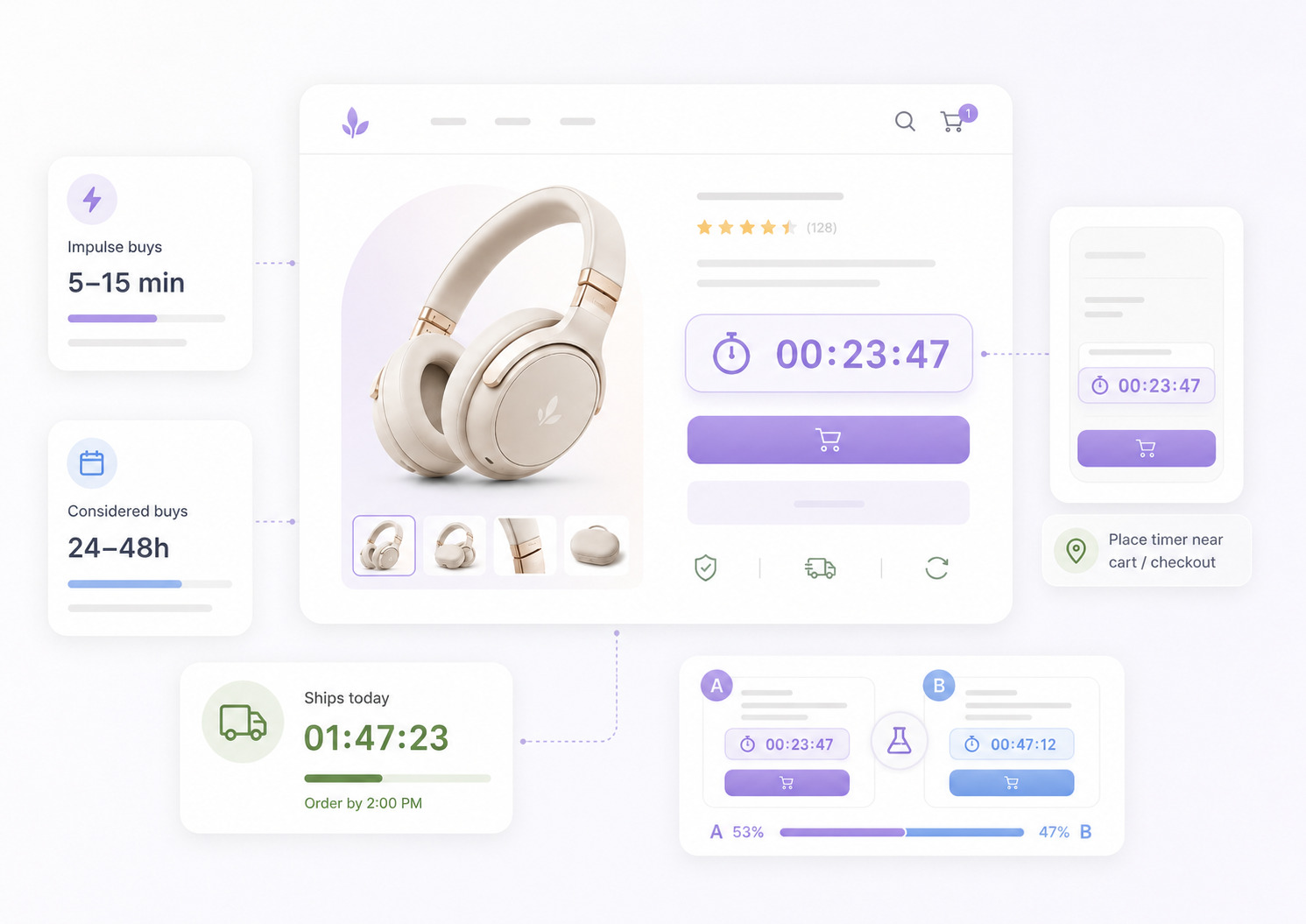
Guidance compiled from ecommerce UX research suggests impulse buys respond best to short timers of 5–15 minutes, while higher-value, considered purchases need longer 24–48 hour windows so shoppers don't feel cornered into a big decision. Too short on an expensive item reads as manipulative; too long on a cheap one removes all urgency.
Tie timers to real, external deadlines
The most authentic urgency comes from deadlines you don't control. Seasonal events work well because everyone can track when Black Friday ends and the holidays arrive on a fixed date. Shipping cutoffs are even more powerful: a message like "Order in the next 1:47:23 to ship today" gives a verifiable reason to buy now, with a tangible benefit and a clear consequence for waiting. (It's the same approach Amazon has used for years with its next-day delivery countdown.)
Place them where the decision happens
Timers earn attention on the home page for store-wide campaigns, on product pages for individual item urgency, and — most importantly — at the cart and checkout, where hesitation kills the order. A timer at checkout reminds the shopper that the deal they came for is still on the clock and nudges the final click.
Always test
Run the same page with and without the timer in a split test, and let the data decide. What lifts conversions for one audience can fall flat for another, so test before you commit, then keep what works.
A quick note for anyone who landed here from outside ecommerce: free countdown tools exist for all sorts of routines — counting down to an event, a school deadline, a watch party with friends, team meetings, or classroom activities. You can usually create one, set the date, edit the look, and share or embed the links so it stays in sync across devices for people in different locations.
Useful stuff, but a very different job from selling. The rest of this guide is about timers built to convert.
Where the timer lives: your page
A countdown timer is only as good as the page it sits on. The clock creates the urgency, but the page has to convert that urgency into a completed order — and here, many stores leak the sales they worked to create. Two things matter most:
Your timer needs to be accurate across every device.
The page around it needs to be fast and focused.
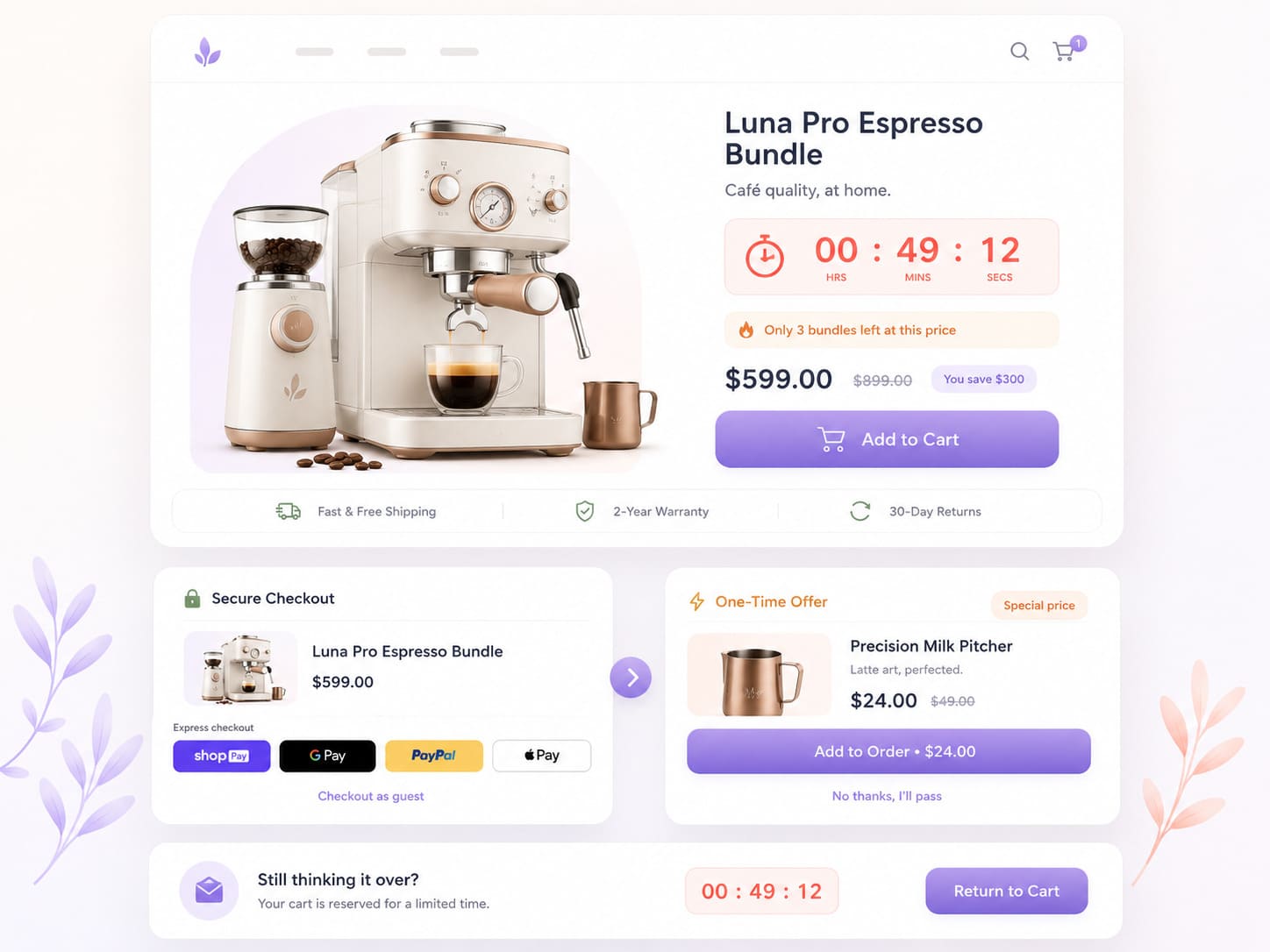
A purpose-built funnel beats a generic product page for this scenario. With a drag-and-drop page builder, you can place a genuine countdown timer right alongside your offer, headline, and checkout on a single focused page — no juggling separate apps that risk showing a different time on different devices.
And because urgency dies the instant a page stalls, speed is the priority: over half of visitors abandon a website that takes more than three seconds to load, so pages that load in under a second make sure the customer you just motivated actually reaches the buy button.
Once the timer pushes someone to act, you want to capture every bit of that momentum. An order bump or one-click upsell at checkout lets a shopper who's already in buy-now mode add to their order in a single click — the urgency you created works in your favor twice.
And for the people the clock doesn't quite convince, an automated abandoned-cart email or SMS can remind them the offer is ending, recovering sales from shoppers who left mid-decision. Pair an honest timer with a fast page and a smart checkout, and the whole system compounds.
Do countdown timers still work for boosting ecommerce sales?
Yes. Countdown timers remain one of the most well-documented and effective ways to convince people to make a purchase faster, by making them aware of a real limitation on the benefit they'll get by acting now. The difference in 2026 is that the bar for honesty has risen.
Timers tied to genuine deadlines — a true sale end time, a real shipping cutoff, an actual stock level — consistently outperform the fake and resetting kind, and they do it without putting your brand at risk. Use them to tell the truth about a real deadline, place them where decisions happen, keep your page fast, and the humble countdown clock is still one of the simplest yet highest-leverage tools you can add to your store.
Table of contents
Boost your eCommerce
sales today

24/7 support
No credit card required
Cancel anytime
24/7 support
No credit card required
Cancel anytime
