

Best Retargeting Strategies: How to Stop Losing the 98% of Visitors Who Leave Without Buying
08 June 2022
Anna
16 minutes
If you're operating an ecommerce business, you already know that clickbaity ads and one-shot campaigns are long gone. A strong retargeting strategy is the core of any digital marketing strategy that extracts full value from every visitor you paid to acquire, rather than writing off 98% of your traffic as wasted ad spend.
Retargeted website visitors are 70% more likely to convert than visitors who receive no retargeting ads — and effective retargeting campaigns can increase conversion rates by up to 150% compared with ad campaigns targeting cold audiences. (SQ Magazine) The math is straightforward: the average ecommerce store loses over 70% of all shoppers who add items to their cart — that's 7 out of every 10 potential customers abandoning before purchase, representing $18 billion in lost revenue annually across ecommerce. (Ringly) A well-executed retargeting campaign is how you recapture that investment.
Around 77% of marketers now use retargeting as part of their digital advertising strategy across platforms including Meta, Google Ads, and LinkedIn Ads, and 9 out of 10 advertisers consider retargeting effective for nurturing warm audiences. (Marketing LTB) This guide covers how retargeting works, which types of retargeting campaigns to run at which funnel stages, how to structure a successful retargeting strategy for a sales funnel, and how to recover the highest-intent site visitors your ecommerce store loses every day.
How retargeting works
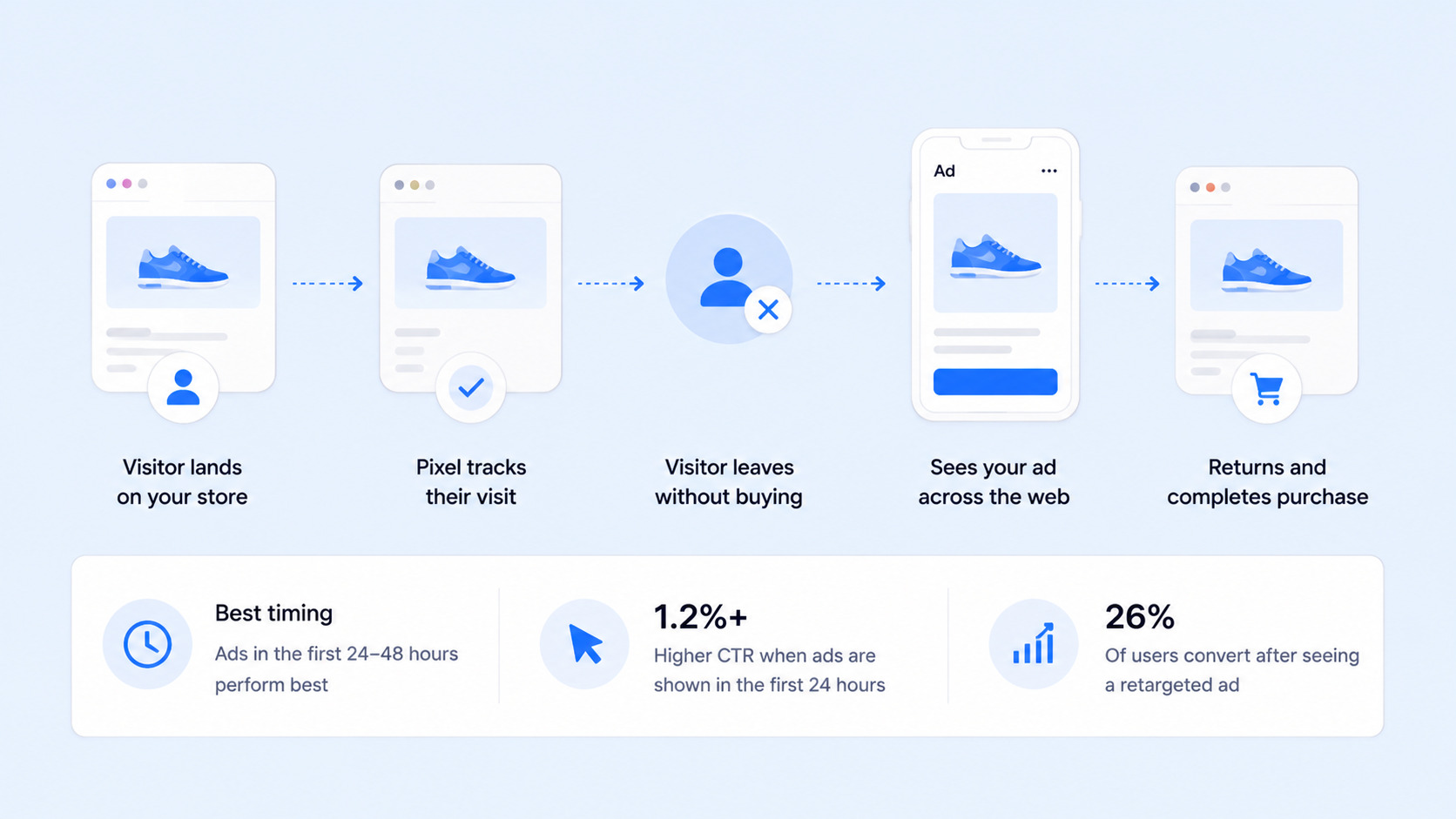
Retargeting allows you to re-engage website visitors who showed interest in your product or brand — serving ads to those users across social media platforms, the Google Display Network, the search network, and other digital advertising channels after they've left your online store.
The mechanism: when a site visitor lands on your store, tracking pixels — the Meta Pixel, Google tag, or platform equivalent — fire and add them to an audience segment. When they leave without completing a purchase, retargeting ads follow them across the web, displaying ads tailored to the specific pages they visited, products they viewed, or actions they took — a pricing page visit, an add-to-cart event, a checkout initiation, a form fill.
Display retargeting ads shown within the first 24 hours after a site visit generate the highest CTR, often exceeding 1.2%. Roughly 26% of users who abandon a purchase end up converting after seeing a retargeted ad — with timing being a key factor, as ads shown within 24–48 hours of abandonment perform best. (amra & elma)
To get these results and build a successful retargeting strategy, you first need to understand the complete customer journey from discovery to purchase — and identify where visitors are dropping off in your marketing funnel. Different drop-off points require different retargeting approaches, different ad creatives, and different offers. A visitor who bounced from the homepage needs a different retargeting advertisement than one who abandoned checkout mid-payment.
The core principle: retargeted users have already shown interest in your brand. Your retargeting ads don't need to introduce what you do — they need to answer the question the visitor had when they left. Why is your product worth buying? Why now? Why from you rather than a competitor? Generic ads that don't address that question are the primary cause of ineffective retargeting efforts and wasted ad spend.
Types of Retargeting
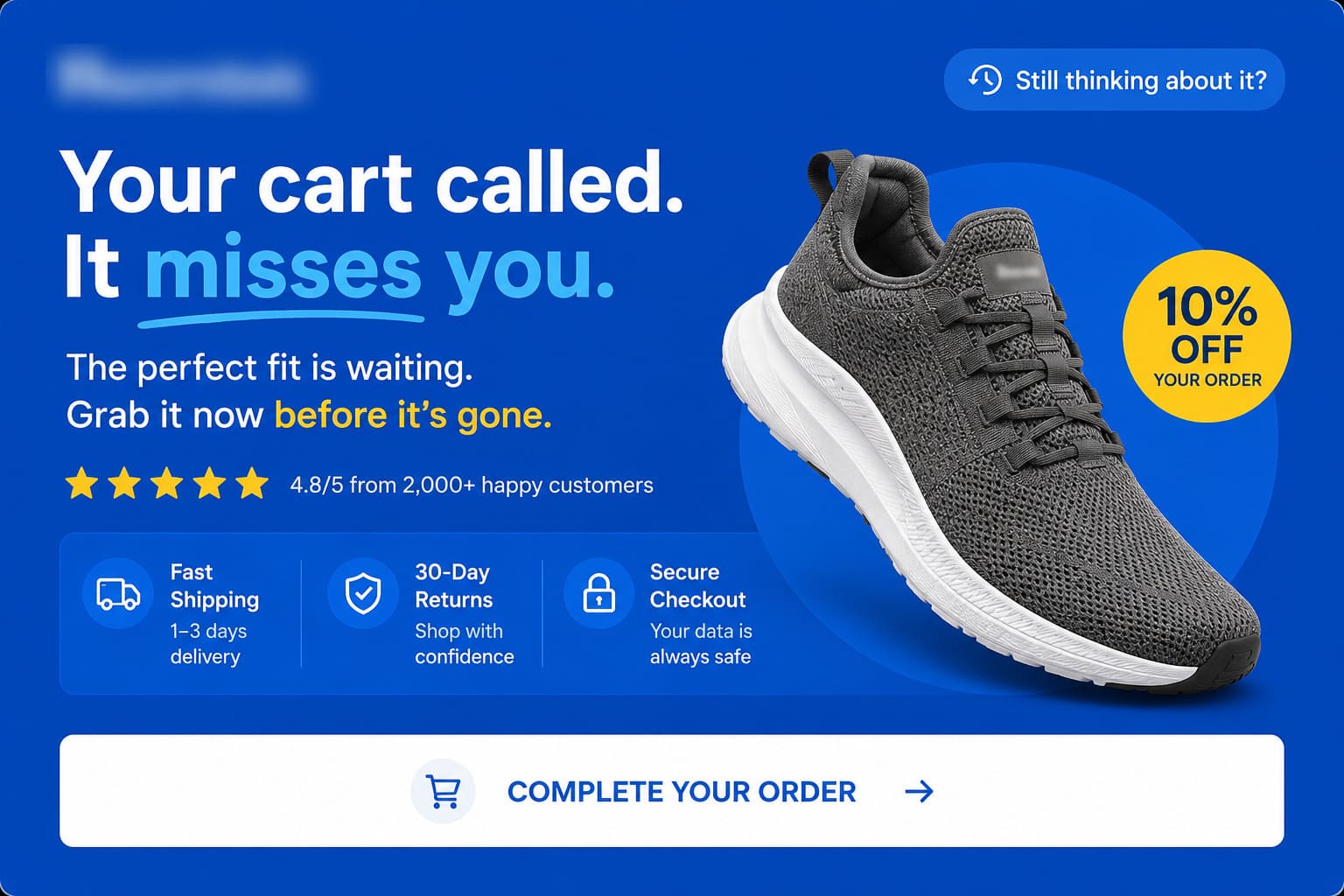
There are several types of retargeting strategies advertisers use across digital marketing channels. Understanding which type fits which situation will save you from wasted marketing budget. Most advertising platforms support the following:
1. Pixel-Based Retargeting (Website Retargeting)
Pixel-based retargeting is the foundation of most ecommerce retargeting strategies. It re-shows your ad to website visitors who interacted with your online store — browsed a product, visited a pricing page, added to cart, or initiated checkout — but didn't complete a purchase.
This audience has the highest purchase intent in your ad account. A visitor who reached the checkout stage is significantly closer to purchasing than one who only viewed the homepage. Audience segmentation by user behavior — product page visitors vs. add-to-cart events vs. checkout abandoners — lets you serve ads tailored to each group rather than generic ads to everyone who visited your site.
Segmenting audiences by behavior, such as product views or time spent on site, can increase CTR by over 70% compared with broad retargeting audiences.
2. List-Based Retargeting
List-based retargeting uses customer data — email addresses, phone numbers — uploaded to an ad platform to create a custom audience and serve targeted ads to people you already have a relationship with. This is how ecommerce brands re-engage existing customers with new product launches, seasonal campaigns, or loyalty programs — and how you reach email subscribers who haven't purchased yet with retargeting advertisements that reinforce the same message as your email campaigns.
Running email campaigns and list-based retargeting ads simultaneously to the same audience segment is one of the most underused tactics in ecommerce digital marketing. A subscriber who sees your email and your retargeting ad in the same week can convert at meaningfully higher rates than one who sees either channel alone — because the repetition across multiple channels builds brand recognition and trust faster than any single channel can.
3. Dynamic Retargeting Ads
Dynamic retargeting is the format most directly tied to ecommerce revenue. Rather than generic ads featuring a general brand message, dynamic retargeting ads automatically pull the exact products each visitor viewed from your catalog and display them — showing each user ads tailored precisely to their browsing behavior and purchase intent.
A visitor who spent three minutes on your leather wallet product page sees a dynamic ad featuring that exact wallet. A visitor who viewed running shoes sees running shoes. Using dynamic retargeting ads with personalized creatives can increase CTR by 27%. For ecommerce brands with large catalogs, dynamic ads eliminate the need to manually create individual ad creatives per product — the catalog feed does it automatically, and the algorithm matches each visitor to the products most likely to generate a conversion.
4. Impression Retargeting
Impression retargeting re-shows your retargeting advertisement to people who saw it previously but didn't engage with it in any way. Most commonly used for increasing brand awareness and building brand recognition through repeated exposure before a direct response ask. For ecommerce brands focused on conversion campaigns and boosting sales, impression retargeting is less critical than pixel-based and dynamic approaches — but it has value for higher-consideration products where brand loyalty needs to build before a purchase decision is made.
5. Views Retargeting
Views retargeting lets you retarget customers who watched a specific percentage of a video you promoted — for example, targeting everyone who watched at least 50% of your product demonstration video. These users have demonstrated meaningful engagement with your brand without taking a direct action, making them a strong audience for a follow-up retargeting campaign with a more direct offer or a coupon code.
This type of ad retargeting works particularly well on social media channels for video-first ecommerce brands where the product requires explanation before a visitor is ready to buy. Someone who watches 75% of your product video but doesn't click through is a warm lead — not a cold one — and should be treated as such in your marketing plan.
Ad Fatigue and Frequency: Retargeting Problems
Retargeting that runs without frequency management becomes an annoyance that erodes brand loyalty rather than building it. Overexposure — more than 15 impressions weekly — can increase ad fatigue by 40%. Only 18% of users find retargeting "annoying" when frequency is controlled — which means the other 82% respond positively to well-managed retargeting advertisements.
Frequency caps are the primary mechanism for managing ad fatigue. Set a maximum number of times any individual sees the same ad per week — typically 3–5 is the recommended range — and rotate ad creatives on a regular schedule to keep the campaign feeling relevant rather than repetitive. Leveraging data from your Google Analytics and ads manager to monitor frequency by audience segment lets you spot fatigue early, before ROAS begins declining.
Timing is key — retargeting ads shown within 24 to 48 hours of cart abandonment often perform best. Beyond 14 days, conversion intent drops significantly for many ecommerce product categories. Structure your retargeting campaign timeline accordingly: highest ad spend intensity within the first 72 hours, tapering down over the following two weeks, and either ending or switching to a brand awareness message after 30 days.
Successful Retargeting Strategies for Sales Funnels
Sales funnels already outperform traditional ecommerce stores due to their structure, offers, and optimized flow. But scaling a sales funnel requires a retargeting strategy built around the funnel's stages — not generic ads served to all site visitors. Here's a successful retargeting strategy adaptable to most ecommerce sales funnel structures.
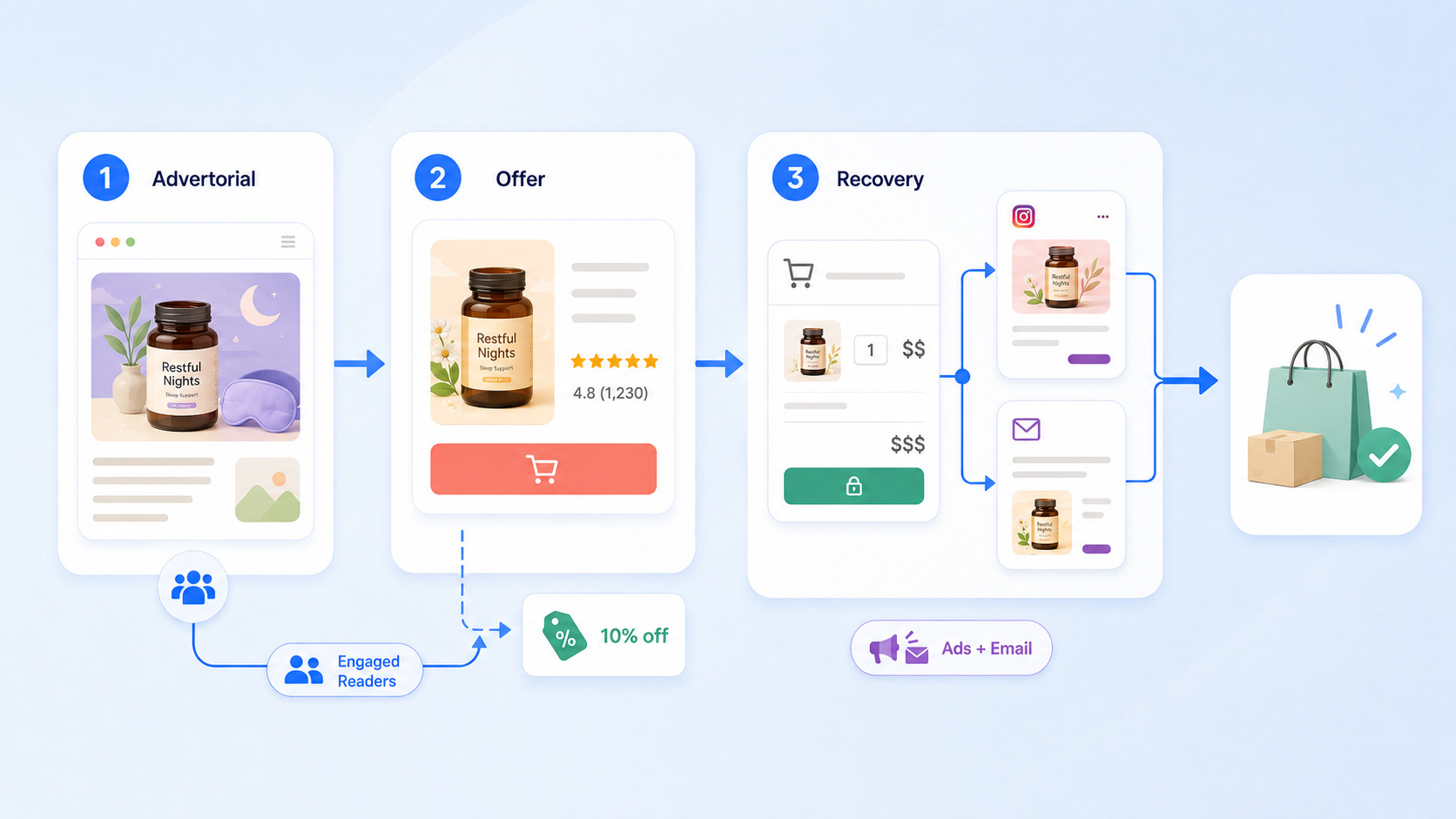
Stage 1 — Advertorial
Create a warm-up advertorial as the entry point of your digital marketing strategy. This piece should focus on educating your target audience about the problem your product solves — not leading with a direct sales pitch. For example, an advertorial for a sleep supplement might read as a first-person account of struggling with poor sleep, explaining the science behind the solution, and building desire before a direct offer appears.
Retarget the audience who engaged with your advertorial — those who read a significant portion of it or moved further into the sales funnel without purchasing. These retargeted users have demonstrated meaningful interest and are ready for a more direct offer. Use this audience segment as the basis for your next retargeting campaign stage.
Read more: Funnel Strategies from Top Brands to Scale Profitably
Stage 2 — Landing Page and Offer
Create a dedicated landing page for visitors who engaged with your advertorial. Showcase your main offer — one product, one message, one clear path to checkout. Optimize every element of the copy and flow to increase conversions: a benefit-focused headline, social proof above the fold, clear product value, and a checkout that removes friction.
Retarget anyone who dropped out of Stage 2 — but don't bring them back to the same landing page with the same message. Build a separate funnel with a discount applied to the main offer, different creative angles emphasizing more savings or a bonus addition, and ad copy that speaks to the hesitation a first-time visitor might have had.
Bringing someone back to the exact same page they already left signals that nothing has changed. The new funnel must be better optimized: more compelling offer, more specific social proof, stronger urgency. There is no point running conversion campaigns to the same destination that already failed to convert them.
Read more: One-Product Funnel: How to Build One That Turns Strangers into Loyal Customers
Stage 3 — Abandoned Cart and High-Intent Recovery
The highest-value audience in any ecommerce retargeting strategy is visitors who reached checkout and didn't complete the purchase. These prospective customers have already made a near-decision. Retargeting helps here through both ads and email — and both should fire simultaneously.
Retargeting is the #1 tactic used to reduce cart abandonment, and retargeting ads reduce cart abandonment by 6.5% on average — with the potential to increase sales by 20% for stores running active recovery campaigns. (MobiLoud) Abandoned cart emails sent within one hour of abandonment can boost conversions compared to emails sent later — making email marketing automation the fastest-response recovery tool in your marketing plan.
Retargeting for Sales Funnels with Funnelish
Beyond standard ad retargeting, Funnelish adds recovery mechanics that many retargeting strategies miss — capturing high-intent drop-offs that pixel-based retargeting and standard email campaigns alone can't reach.
Recovering abandoned carts with purchase attempt data. Funnelish collects what we call the purchase attempt — site visitors who dropped off mid-payment, either at the PayPal or Klarna redirect, or whose card payment failed at checkout. These are among the highest-intent users in your sales funnel: they were actively trying to pay. Standard pixel-based retargeting often misses this segment because the abandonment happens inside the payment flow rather than on a trackable landing page.
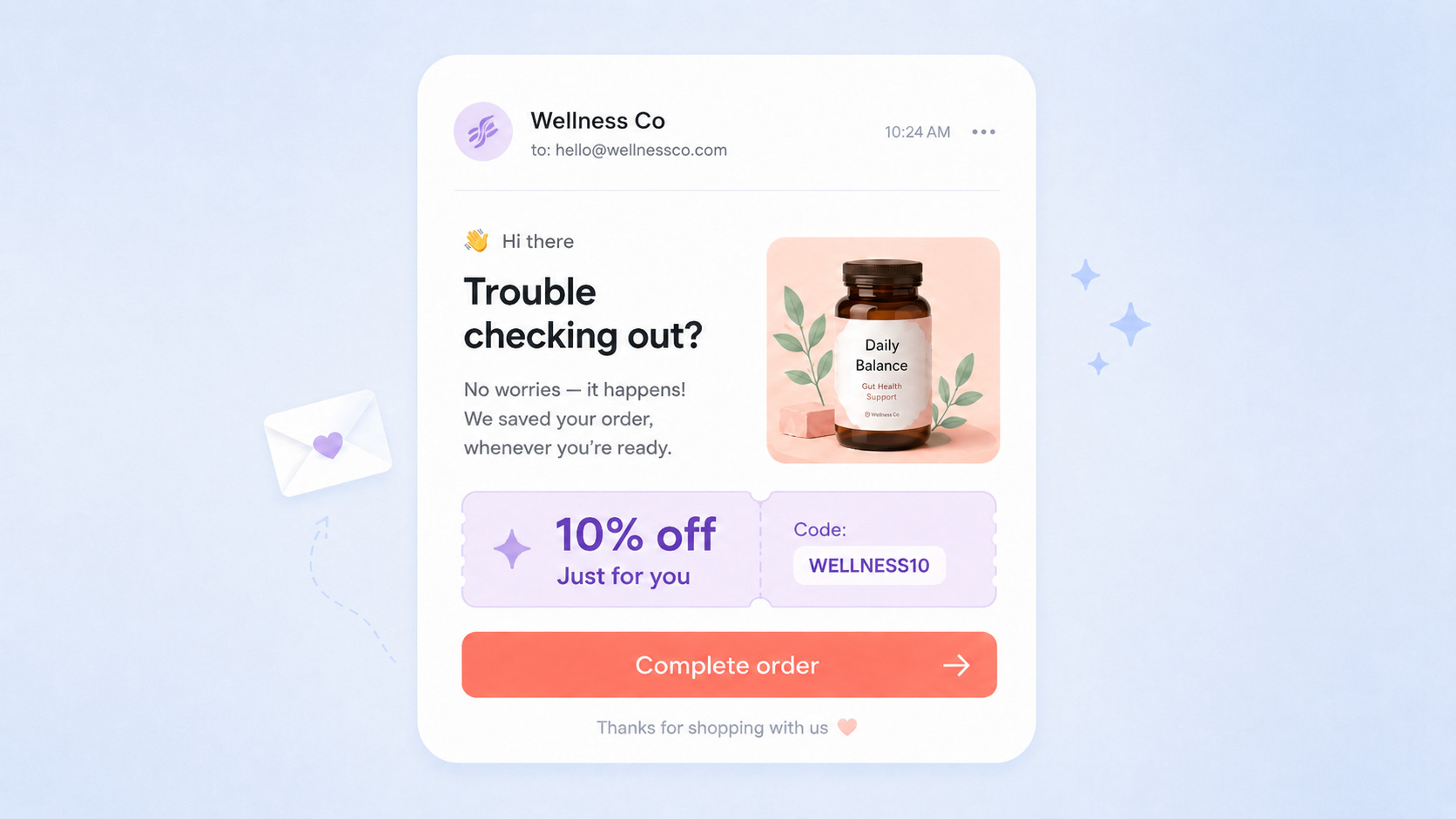
For this audience, Funnelish triggers a personalized email through an SMTP connection (such as Sendgrid) rather than a bulk marketing automation platform. The reasoning is deliberate: emails sent via SMTP feel individual and genuine rather than automated. The message doesn't need to be formal — something like "Hey, we noticed you had some trouble getting your order through. Here's 10% off as an apology for the inconvenience" can outperform a polished CRM email for this audience, because it mirrors how a real person would respond to a customer who had a problem.
The combination — retargeting ads reaching the audience across Meta and Google Ads, and a personal-feeling email arriving within the hour — creates two simultaneous recovery touchpoints for your highest-intent lost customers. The retargeting advertisement reminds them. The email gives them a reason to act now.
Retargeting Across Multiple Channels
A strong retargeting strategy doesn't rely on a single platform. Marketers report up to 4x better ROI when retargeting ads are used alongside standard prospecting ad campaigns across multiple channels. Running retargeting efforts across two or three platforms simultaneously reaches the same warm audience wherever they spend time online — and reinforces the message through repeated exposure without depending on any single channel's algorithm or audience size.
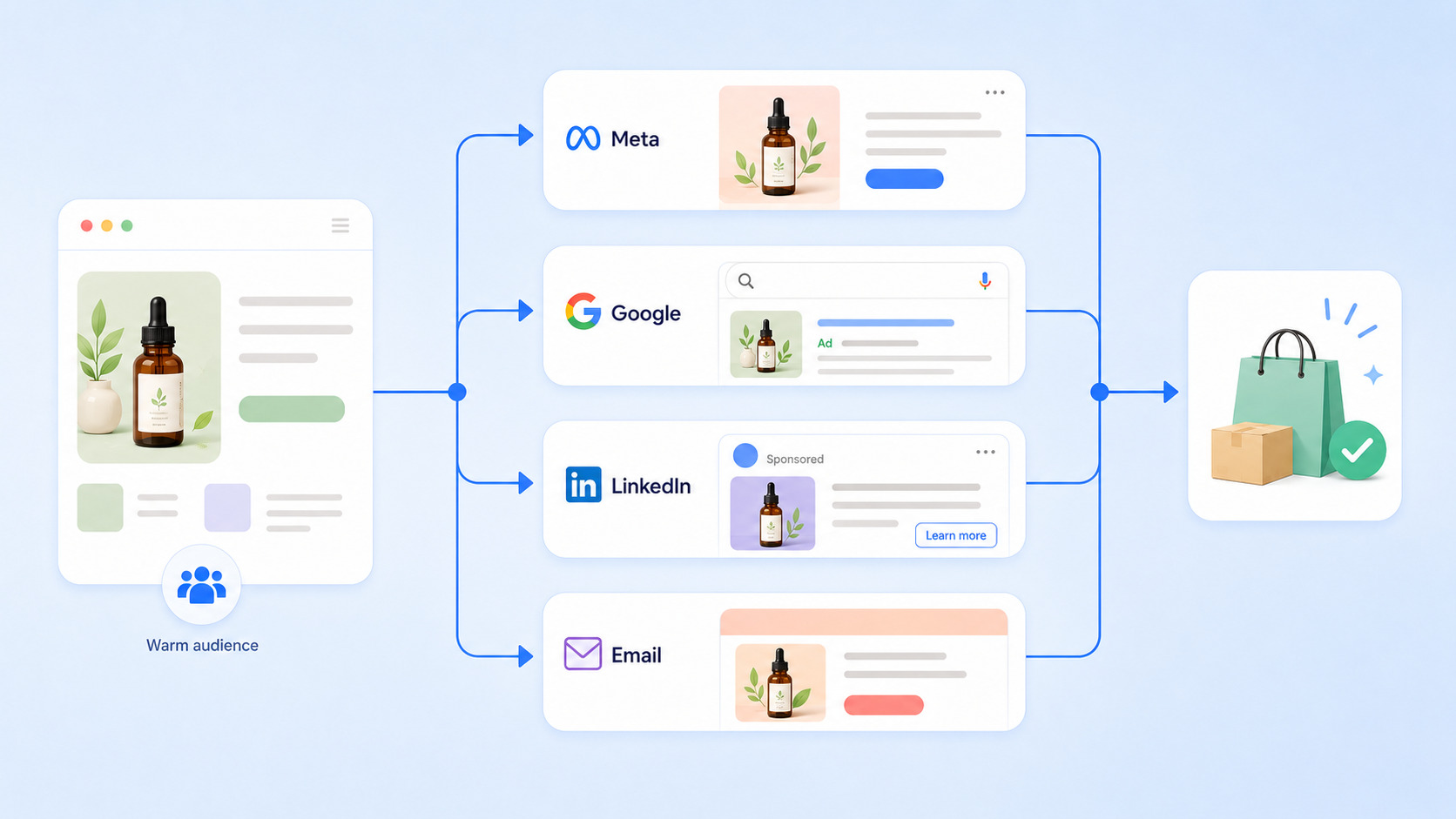
Meta (Facebook and Instagram)
The largest retargeting platform for ecommerce brands by ad spend. Custom audience segments built from your Meta Pixel — website visitors, add-to-cart events, checkout initiators — feed directly into social media retargeting campaigns. Dynamic retargeting ads pulling from your product catalog are particularly effective here. Facebook retargeting CPC averages $0.50–$1.20, and ecommerce retargeting campaigns see an average ROAS of 8:1.
Google Display Network and Search Network
The Google Display Network reaches site visitors across millions of websites after they leave your store — serving display ads in their browsing sessions across the broader web. Search engine marketing retargeting through RLSA (Remarketing Lists for Search Ads) adjusts your Google Ads bidding for users who have previously visited your online store, letting you bid more aggressively when a high-intent visitor searches for your product category again. The combination of display ad retargeting for brand recognition and search retargeting for intent capture covers the full buying process.
LinkedIn Ads
For B2B ecommerce brands or higher-consideration products, social media retargeting on LinkedIn Ads reaches a professional audience with retargeting advertisements that wouldn't be effective on consumer social platforms. 54% of B2B companies use retargeting in LinkedIn Ads — making it a significant channel for brands whose target audience skews toward business buyers.
Email Retargeting and Marketing Automation
Triggered email campaigns reaching audience segments based on specific user behavior — abandoned cart, post-purchase, browse abandonment — are among the most cost-effective retargeting efforts available to ecommerce brands. Email retargeting sequences can drive 18–25% more repeat visits from site visitors who engaged but didn't convert — making email marketing automation a non-negotiable component of any complete retargeting strategy.
Key Performance Indicators for Retargeting Campaigns
Running retargeting campaigns without tracking the right key performance indicators means optimizing for the wrong outcomes. The metrics that matter for ad retargeting are different from prospecting campaign metrics because the audience is fundamentally different — these are warm users who have already shown interest, not cold traffic.
KPI | What to look for | Warning sign | Benchmark |
Conversion rate | Significantly higher than cold traffic campaigns | Similar to prospecting rate = audience segmentation too broad | 2–4x higher than prospecting |
Frequency | 3–5 impressions per user per week | Above 15 impressions weekly = ad fatigue risk (+40%) | 3–5 per week |
Reach | Sufficient to sustain consistent delivery | Low reach = audience pool too small to scale | Depends on audience size |
ROAS | Materially higher than prospecting ROAS | Declining ROAS with stable frequency = creative fatigue | 6:1 retail, 8:1 ecommerce |
CPA | Significantly lower than cold acquisition CPA | CPA approaching prospecting CPA = retargeting not working | $15–$25 average across industries |
Conversion rate is the primary metric. Retargeting campaigns should convert at significantly higher rates than cold traffic ad campaigns. If your retargeting campaign conversion rate is similar to your prospecting rate, your audience segmentation isn't tight enough — you're retargeting too broadly across site visitors rather than targeting users by specific behavior and intent signals.
Frequency and reach tell you whether your retargeting ads are reaching the intended audience at the right cadence. High frequency with declining conversion rate signals ad fatigue — time to rotate ad creatives. Low reach signals the audience pool is too small to sustain the retargeting campaign efficiently.
Return on ad spend (ROAS) for retargeting campaigns should materially exceed prospecting ROAS. Retail brands average 6:1 ROAS with retargeting campaigns, and ecommerce retargeting campaigns average 8:1 ROAS — compare this to your prospecting ad campaigns to understand the relative efficiency of each funnel stage and how to allocate marketing budget accordingly.
CPA for retargeting should be significantly lower than cold traffic acquisition. Retargeting campaigns typically deliver CPA reductions of up to 50% compared with campaigns targeting cold audiences, with average CPA for retargeting ads across industries sitting at approximately $15–$25.
Track these key performance indicators by audience segment — don't aggregate across all retargeting audiences in your ads manager. A checkout abandoner who saw a coupon code and a product page visitor who saw a brand awareness display ad are completely different audience segments producing completely different results. Mixing them in the same reporting obscures what's working and makes it impossible to optimize your retargeting efforts intelligently.
Privacy Shift and What It Means for Retargeting in 2026
Ad retargeting in 2026 operates in a meaningfully different privacy environment than it did five years ago. Apple's iOS 14 and subsequent updates removed identifier-based tracking for opted-out users, third-party cookies are being phased out across major browsers, and GDPR and CCPA enforcement has tightened across markets — all shrinking the audience pools that pixel-based retargeting relies on.
The practical impact for ecommerce retargeting: audience segments are smaller than they used to be, and customer data gathered through third-party tracking is less complete. The solution is a shift toward first-party customer data — email lists, purchase history, loyalty programs, logged-in user behavior — as the foundation of retargeting strategy rather than relying on third-party tracking pixels.
Cookieless solutions including server-side tracking can increase attribution accuracy by 15–30%, and AI-driven audience modeling can improve ROAS by 15–50% by filling the gaps that cookie deprecation creates. Implementing the Conversions API (CAPI) for Meta and server-side Google Tag Manager configurations are now standard practice for any ecommerce brand running serious retargeting campaigns — they restore the signal quality that browser-based tracking has lost, and give the platform algorithms the data they need to serve ads to the right users.
The ecommerce brands that will struggle with retargeting over the next few years are those still dependent on third-party cookies and browser pixels. The ones that will thrive are those building first-party data assets — email lists, loyalty programs, customer accounts — that give them a direct relationship with their audience independent of any platform's tracking infrastructure.
Start Converting Your Traffic — Not Just Acquiring It
A retargeting strategy is only as effective as the destination it sends traffic back to. Re-engaging a visitor who abandoned checkout and sending them back to the same slow-loading product page they already left is wasted ad spend. The post-click experience has to be worth the retargeting effort.
Funnelish gives ecommerce brands the conversion infrastructure that makes retargeting campaigns actually pay off: dedicated landing pages with sub-second load times, a fully customizable checkout supporting every major payment method, geo-funnels that adapt pricing and payment options to each visitor's location, and built-in abandoned cart recovery that captures the highest-intent drop-offs before they even reach your retargeting audience pool.
When the sales funnel converts at 3–4% instead of the ecommerce median of 1.57%, every retargeted user is worth more — and every dollar of retargeting ad spend produces more revenue. That's the compounding effect of combining a strong retargeting strategy with a purpose-built conversion booster.
Start your free 14-day Funnelish trial →
Retargeting FAQs
What is a retargeting strategy?
Re-engaging site visitors who showed interest but didn't convert — using tracking pixels and behavioral data to serve them tailored ads across social media, Google Display, and other channels until they complete the purchase.
What is Criteo retargeting?
Criteo is a retargeting platform serving dynamic ads across the open web — outside Meta and Google — using retail partner data to match each user with the exact products they browsed.
What is an example of a remarketing strategy?
A visitor abandons checkout. Within an hour: a dynamic Facebook ad, a Google Display banner, and an abandoned cart email with a coupon code all fire simultaneously — each tailored to that specific drop-off point.
What is remarketing vs. retargeting?
Same goal, slightly different mechanics. Retargeting = pixel-based ads across Meta and Google. Remarketing = Google's term for the same, also used for email re-engagement sequences.
Table of contents
Boost your eCommerce
sales today

24/7 support
No credit card required
Cancel anytime
24/7 support
No credit card required
Cancel anytime
