

Discount Codes Marketing for Ecommerce: How to Use Them Without Killing Your Margins
16 March 2026
Anna
12 minutes
Discount codes are one of the oldest tools in ecommerce. They're also one of the most misused. Done right, a coupon marketing strategy drives new customer acquisition, boosts average order value, and builds brand loyalty that keeps customers coming back. Done wrong, they train your audience to wait for sales, compress your profit margins, and attract buyers who'll never pay full price.
38% of all online shopping transactions involve a coupon code or discount — making discount code marketing the norm rather than the exception in competitive ecommerce. Moderate discounts of 10–25% can increase conversion rates by 25–35% compared to non-discounted products. (Opensend) The data makes the case for using them. The strategy determines whether they help or hurt.
What Are Discount Codes for Ecommerce?
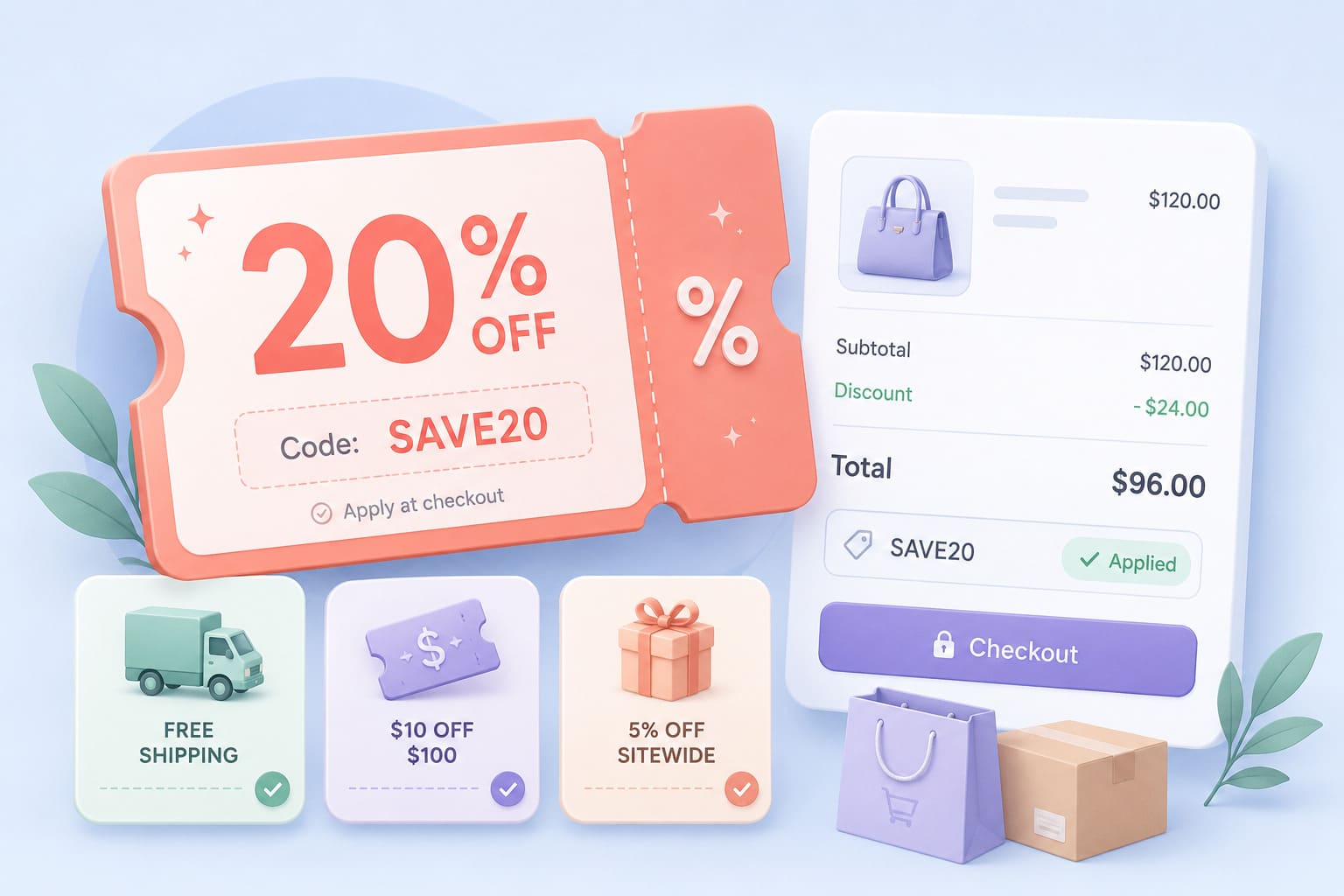
Discount codes are used in ecommerce to offer a particular customer or group of customers a benefit at purchase. These codes are usually a combination of letters and numbers applied during checkout to unlock a special offer. Online stores distribute them through email campaigns, loyalty programs, social media promotions, exit intent pop ups, or partnerships with influencers and affiliates.
When a customer applies a discount code, they receive a predefined benefit — a percentage discount, a fixed amount off the order, free shipping, or a special deal on selected products or categories. For example: 20% off a product, $10 off orders over $100, or free shipping on a first purchase.
These coupon offers encourage customers to complete their purchase and — when structured correctly — increase the average order value rather than simply reducing the margin on what they were already going to buy. Coupon codes offer an average price reduction of 19% — enough to move the needle on conversion without destroying profit margins, if the discount is targeted rather than broadcast.
Why Discount Codes Work — and Why They Sometimes Don't
Ecommerce is an oversaturated market. Customers need incentives to buy and to remain loyal — and research shows that receiving a discount code improves the overall shopping experience, reduces stress, and creates a positive emotional association similar to receiving a gift. That psychological effect is real and it's why coupon marketing strategies remain central to customer retention and new customer acquisition alike.
Coupon codes work differently at different stages of the customer relationship. For new customers, promo codes lower the barrier to a first purchase — particularly effective when combined with first time visitors pop ups or new customer acquisition campaigns. For returning customers and existing customers, exclusive discounts and loyalty program rewards build brand loyalty and encourage repeat purchases without requiring new ad spend.
The problem is overuse. Customers abandon carts specifically to search for promo codes, disrupting checkout and reducing conversion rates — a direct result of conditioning buyers to expect discount coupons before completing any purchase. Brands that offer coupon codes too freely train their audience to never pay full price, compressing profit margins over time.
Strategic coupon marketing solves real problems — abandoned carts, low first-purchase conversion, stagnant customer loyalty — rather than substituting for an offer that doesn't resonate.
Types of Discount Codes That Drive Sales
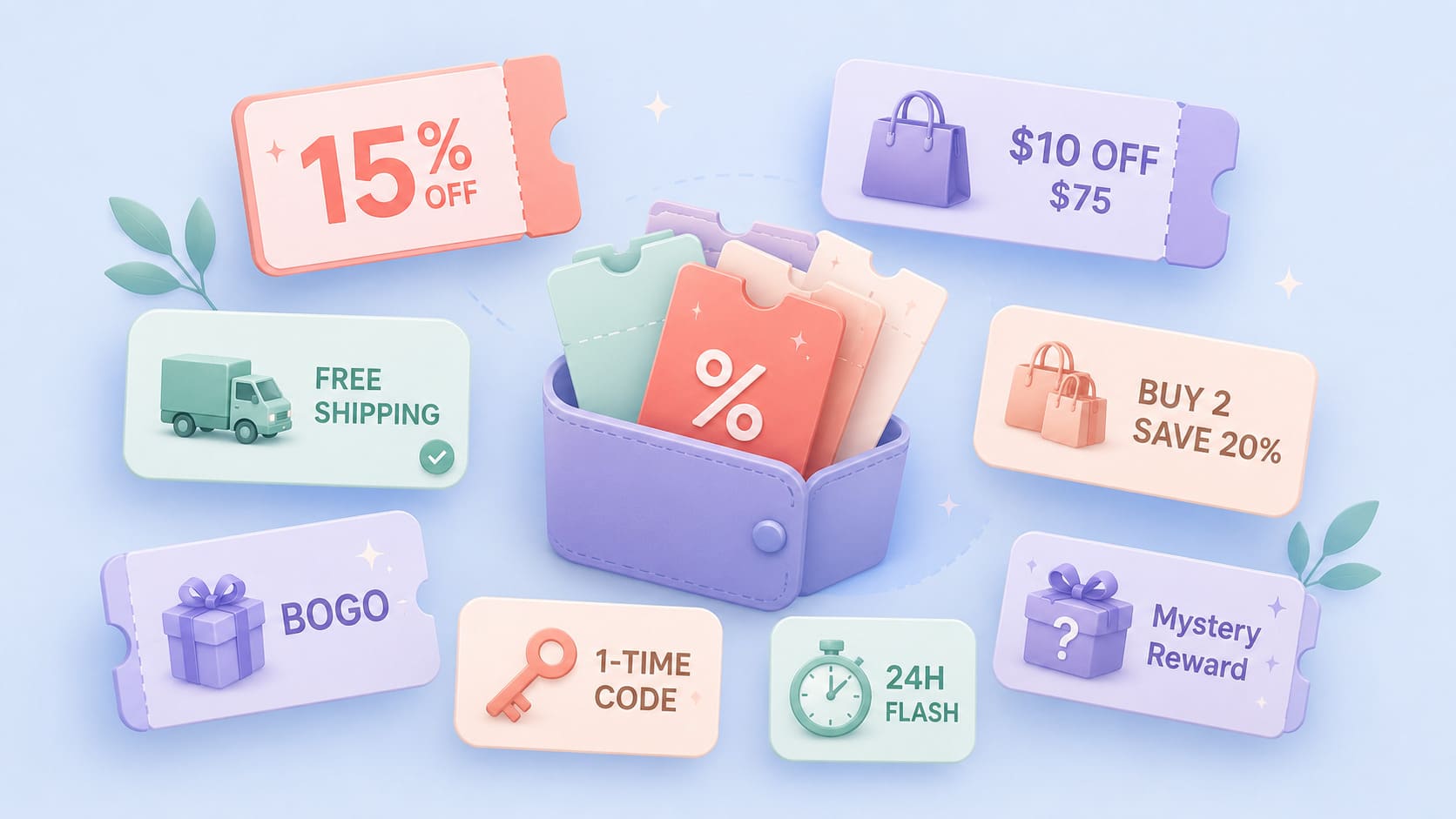
Not all coupon campaigns work equally well. Here are the types worth building into your ecommerce marketing efforts:
Percentage discounts are the most common. A 15% off coupon code is simple to communicate and universally applicable. They work best for new customer acquisition campaigns and flash sales where a sense of urgency drives immediate purchases. Keep percentage discounts in the 10–25% range — enough to boost sales without the profit margin damage that deeper discounts cause.
Fixed amount off coupons — "$10 off orders over $75" — are more powerful for increasing average order value because they prompt customers to spend more to qualify. They also feel more concrete than a percentage, making them compelling at the decision point.
Free shipping coupons are consistently among the highest-converting coupon offers in ecommerce. Shipping costs are the number one reason customers abandon carts — up to 47% of shoppers leave because of high or unexpected charges at checkout. (Bitly) Free shipping coupons remove that friction without discounting the product itself, protecting profit margins while addressing the abandonment trigger. For mobile apps and mobile checkouts especially, visible free shipping messaging drives meaningful uplift in completed purchases.
Bundle discounts encourage customers to increase their order size by making combinations more attractive than individual purchases. "Buy two, get 20% off" pushes average order value up while the discount is funded by additional volume — one of the most margin-friendly coupon strategies available. Bundle discounts work well for consumables and complementary products where customers feel valued for getting more for their spend.
BOGO deals — buy one get one — are psychologically compelling even when the effective discount is modest. For products with meaningful gross margins, BOGO offers drive significant sales lift without the negative margin impact of a straight percentage discount.
Single use coupon codes are the most controllable format. Unlike broadcast promo codes that get shared across deal sites and discount aggregators, unique codes — generated per customer or per campaign — give you precise control over who redeems what and let analytics tools track performance at the individual campaign level. Single use coupon codes also prevent the brand visibility damage that comes from your offer appearing on coupon aggregator sites where deal-seekers strip away your margin without becoming loyal customers.
Flash sales with an expiration date create urgency that drives immediate purchases from customers who might otherwise defer. A 24-hour coupon code sent to a warm audience of past visitors who haven't converted in 30 days creates a sense of urgency that a generic evergreen discount doesn't — prompting customers to act now rather than bookmark and forget.
Mystery rewards — "Click to reveal your discount" — generate engagement and curiosity while giving you control over the actual offer. They work particularly well in loyalty programs and follow up emails where you want customers to feel valued and personally surprised rather than marketed to at scale.
Coupon Marketing Strategies That Work in 2026
Coupon marketing has evolved. The blanket "20% off everything" approach that worked a decade ago now trains customers to wait, reduces perceived value, and attracts deal-seekers who don't become repeat customers or loyal customers. The brands using discount codes effectively are doing something fundamentally different.
Targeted discounts based on customer behavior and purchase history
Rather than offering discount coupons to everyone, segment your customer data and match the offer to the behavior. A customer who has visited a product page three times without buying gets a personalized first-time offer. A returning customer who hasn't purchased in 90 days gets a re-engagement promo code. A customer who just completed their third order gets access to exclusive deals through the loyalty program.
Valuable insights from your analytics tools and purchase history data make these targeted discounts possible — each offer designed around a specific behavior and a specific goal, not broadcast to your entire list.
Abandoned cart recovery with time-sensitive promo codes
Abandoned cart emails can reclaim around 10% of lost revenue — and including a discount code or free shipping incentive meaningfully increases that rate. (Moosend) The key is timing: send the first email within 30–60 minutes of abandonment — conversion can drop fast after that window closes. The first email in a sequence usually drives 20–25% of all recoveries. Follow up emails in the sequence can escalate the offer — a free shipping coupon in email one, a 10% discount code in email two if the customer still hasn't converted — nudging customers back without overcommitting margin upfront.
Funnelish's abandoned cart recovery sequences fire automatically at the right moment — capturing the highest-intent drop-offs before they've moved on, and delivering personalized follow up emails with the right coupon offer at the right time. For stores using Funnelish funnels, creating a discount code takes seconds: settings → discounts, generate the code, then enable it in the funnel editor under the order summary element.
Exclusive coupon codes for your most loyal customers
Your most loyal customers already buy from you — they don't need a discount to convert. What they do need is to feel valued. Exclusive deals and early access offers through your loyalty program reinforce brand loyalty and encourage repeat purchases without cannibalizing full-price sales from your broader audience. 48% of U.S. shoppers actively search for digital coupons — giving your most loyal customers exclusive coupon codes they can't find elsewhere creates a personal connection that makes them feel recognized rather than just targeted.
Exit intent pop ups with first-time visitor offers
A pop up triggered when a first time visitor moves to leave the page — offering 10% off their next purchase in exchange for an email address — simultaneously reduces bounce rate, captures customer data for future coupon campaigns, and creates the first conversion at a modest margin cost. The email address captured is worth more than the discount given, because it enables every subsequent campaign and builds the customer data foundation that makes targeted discounts possible.
Referral program coupon codes
A well-structured referral program gives both the referrer and the new customer a discount code — creating a word-of-mouth acquisition channel that costs less than paid advertising and produces higher-quality new customers because they arrive with social proof already established. Shoppers can save approximately $1,465 annually through coupon usage — which means they're actively motivated to share good coupon offers with their networks. (Opensend)
QR code coupons for cross-channel campaigns
For brands with any physical presence — pop-up events, product packaging, print materials — QR code coupons bridge the offline and online experience and give you trackable attribution for channels that are otherwise difficult to measure through analytics tools alone.
Protecting Profit Margins While Running Coupon Campaigns
The risk with any coupon marketing strategy is eroding the margins that make the business viable. Before deploying any discount code campaign, know your numbers. Calculate your minimum viable margin after the discount, shipping costs, fulfillment costs, and payment processing fees. Build coupon campaigns around offers that are sustainable at volume — not just effective for a one-time sales lift.
The most margin-protective coupon strategies are:
Free shipping coupons — remove a friction point without discounting the product itself
Bundle discounts — funded by additional volume rather than reduced per-unit margin
Loyalty program rewards — applied to existing customers who would have bought anyway, reducing the incremental margin cost
Single use coupon codes — prevent deal-site leakage that extends discounts to customers who weren't the target audience
The average ecommerce discount rate ranges from 10% to 30% depending on category. Luxury and high-ticket items generally stay under 15% to preserve brand visibility and perceived value. Fast fashion and consumer electronics push higher. Knowing your category benchmark helps you set discount levels that attract customers and stay competitive without being destructive to lifetime value.
Do Discount Codes Still Work in 2026?
Yes — but the way businesses use them has evolved. Instead of offering large discounts to everyone, the brands seeing results from coupon marketing use targeted and personalized discount strategies:
exclusive discounts for loyal customers
limited-time promo codes for abandoned carts
first-time purchase codes for new customers
behavior-triggered coupon codes that fire at the right moment in the customer journey based on purchase history and customer behavior data
With rising advertising costs and increased competition, discount codes also play a direct role in conversion rate optimization. Moderate discounts of 10–25% increase conversion rates by 25–35% — which means a well-timed coupon code can be more efficient than spending additional budget on paid traffic to generate the same immediate sales from potential customers.
Modern ecommerce tools allow businesses to automatically trigger targeted discounts based on customer behavior — a shopper who spends time on a product page, a first time visitor about to exit, a repeat customer who hasn't purchased in 60 days. When the trigger is behavior-based and the offer is relevant, discount codes feel like a service that makes customers feel valued rather than a sales tactic.
When used strategically, coupon marketing strategies help ecommerce businesses:
Increase conversion rates and drive sales without additional ad spend
Boost average order value through bundle discounts and threshold offers
Encourage repeat purchases and improve customer retention
Reward loyal customers in ways that reinforce brand loyalty
Improve new customer acquisition campaign efficiency and reduce cost per acquisition
How to Create Discount Codes in Funnelish
Funnelish has discount code functionality built natively into the platform — no third-party app, no workaround. Here's exactly how to set one up.
Creating a Discount Code
Click the Settings icon in the top right of the header menu
Select Discounts from the dropdown
Click Create discount in the top right corner
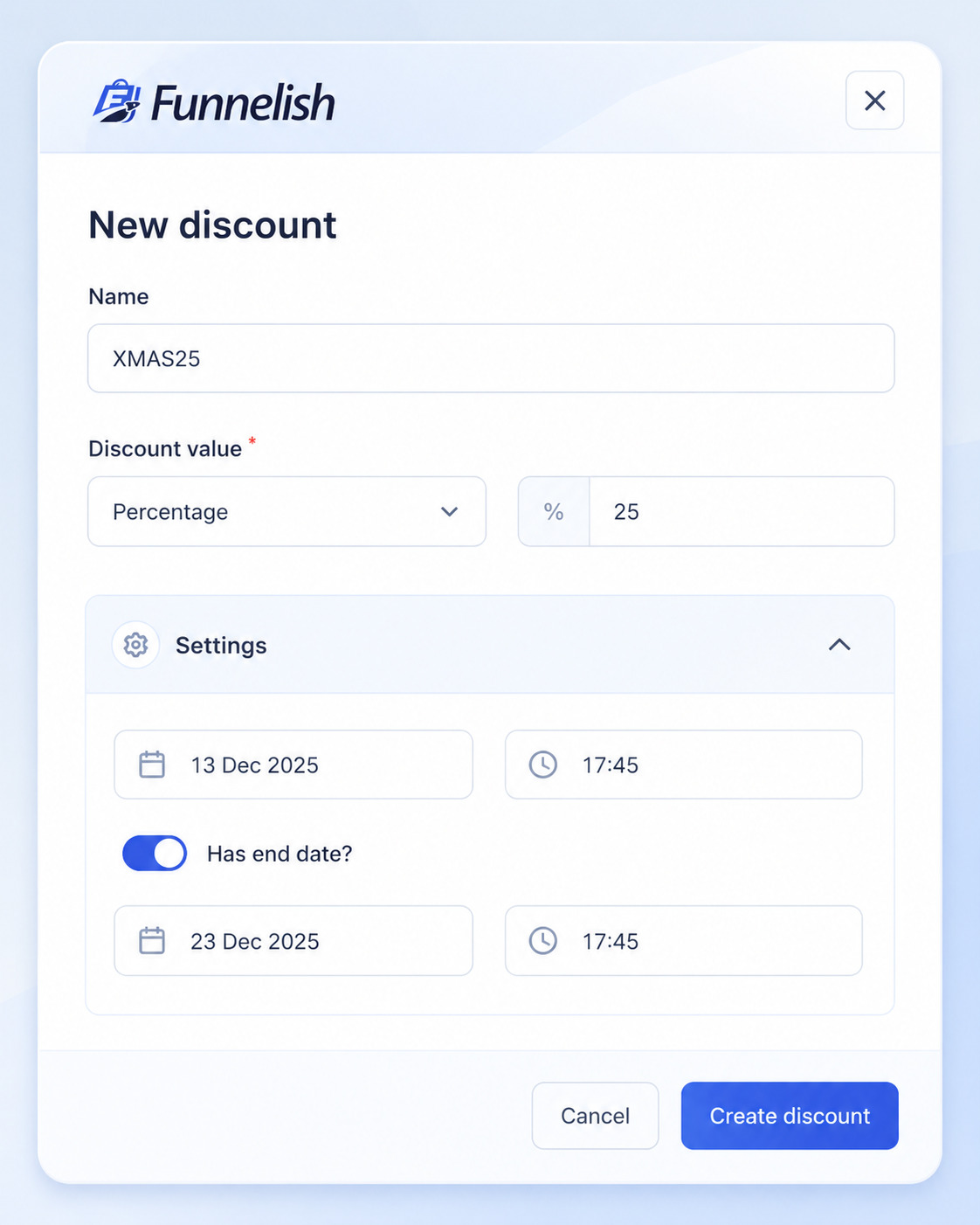
Enter a name for the discount code — this is what customers type at checkout (e.g. "SAVE20")
Choose between a Percentage discount or a Fixed discount — fixed discounts automatically adjust to your funnel's currency
That's it. Once created, customers can apply the code at checkout immediately.
Optional Settings Worth Using
Scheduled start date. Planning a flash sale or coupon campaign in advance? Set a Start date and Start time so the code only becomes active when your promotion goes live — not before.
Expiration date. To create urgency and run limited-time discount campaigns, enable the Has end date? toggle and set an End date and End time. Once that window closes, the code stops working automatically. No manual deactivation needed.
Adding the Discount Code to Your URL
One of the most useful features for marketing: you can pre-apply a discount code by appending it directly to your funnel URL:
https://yourfunnel.com/page?discount=SAVE20
When a customer clicks that link, the discount code is applied automatically at checkout — no need for them to type anything. This makes it ideal for:
Marketing emails and SMS sequences where you want the discount to apply on click
Influencer or affiliate links with unique codes per partner
Abandoned cart recovery follow up emails where the offer should be frictionless
Social media campaigns where every click lands with the discount pre-loaded
Managing Your Discount Codes
All discount codes are listed in the Discounts section of settings. To deactivate or delete a code, click the three dots next to it in the list. Deactivating keeps the code on record without making it redeemable — useful if you want to reuse the same code in a future campaign. Deleting removes it permanently.
Where Discounts Appear in the Funnel
Once you've created the code, go into your funnel editor → order summary element and make sure discount codes are enabled. This is what surfaces the discount field at checkout where customers can enter their promo code manually — separate from the URL pre-apply method above.
Between the URL pre-apply and the manual checkout field, you have two distinct use cases covered: frictionless redemption for warm audiences you're emailing directly, and self-serve redemption for customers who arrive through organic or paid traffic and have a code from another source.
Final Thoughts
Discount codes continue to be one of the most effective tools in ecommerce — when used correctly. The key is strategy over frequency. Combine discount codes with smart marketing efforts — email campaigns, exit intent pop ups, abandoned cart recovery, influencer promotions, and loyalty programs — and they become a consistent way to boost sales and drive customer retention rather than a margin leak. Use them reactively or indiscriminately, and they become a cost rather than an investment.
Table of contents
Boost your eCommerce
sales today

24/7 support
No credit card required
Cancel anytime
24/7 support
No credit card required
Cancel anytime
