

9 Trigger Words: Research-Backed Power Words That Convert in 2026
16 August 2021
Anna
9 minutes
It's already well known how much power words hold in our lives, and the same is true in e-commerce. The copywriting on your pages should be done to perfection and completely aligned with your audience's interests and wishes, because the right words and phrases are what turn a visitor into a customer.
But even though words are powerful, not all of them carry the same weight. Some emotionally charged words evoke emotion and drive action instantly; others fall flat. This article is meant as a step-by-step, well-referenced ultimate guide to trigger words: what they are, why trigger words work on the brain, and how to use trigger words across your pages, pop-ups, and email subject lines to drive more sales in 2026 — with the actual research behind each one, and without accidentally hurting yourself in the process.
What are emotional trigger words, and why do they work?
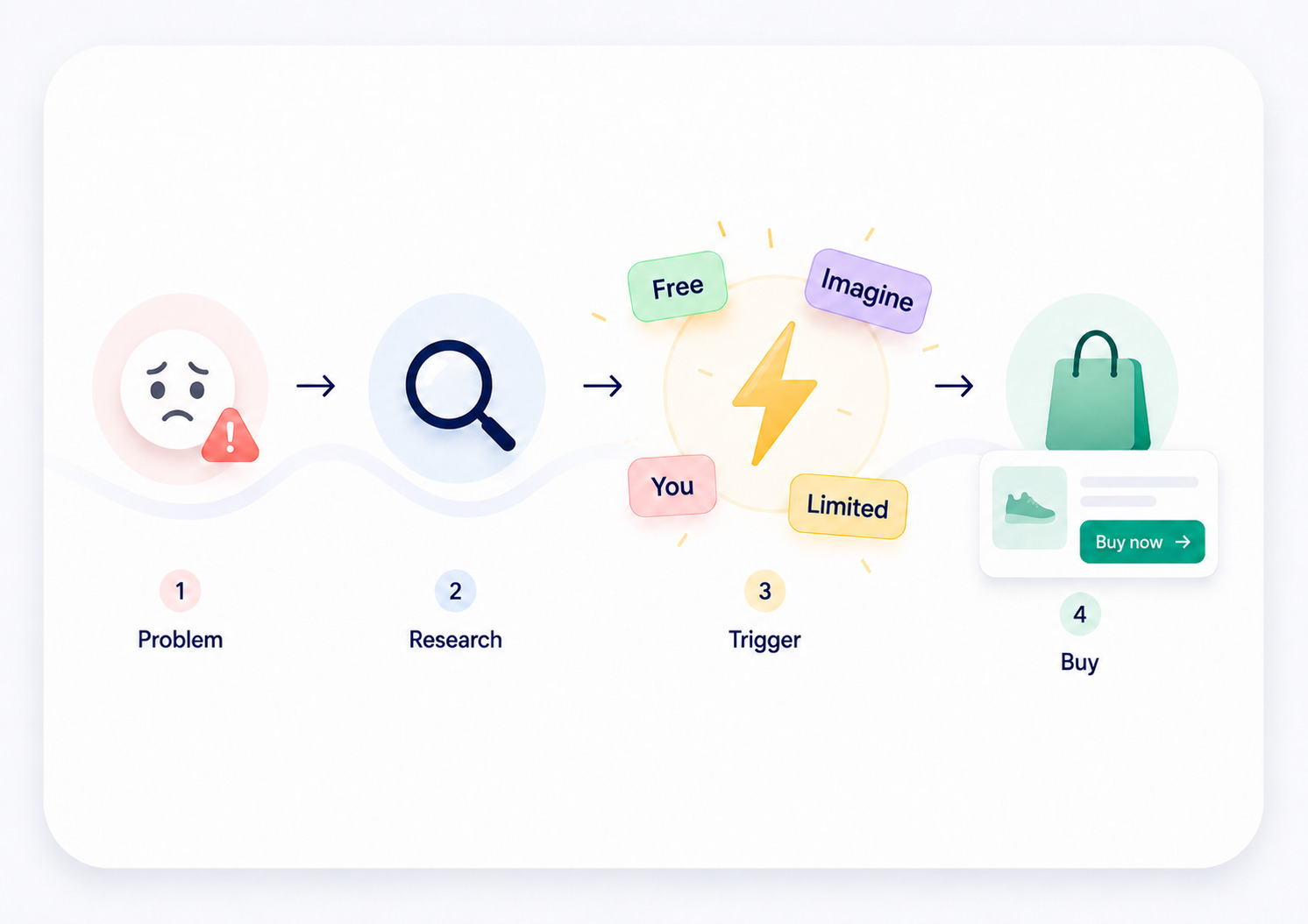
Trigger words are usually single words or short phrases — like free or buy now — that nudge a reader toward a decision or a specific action. These power words show up everywhere in e-commerce because they speak to the emotional side of humans rather than to slow, rational thinking.
There's real neuroscience behind that. Emotionally charged language is processed largely by the limbic system, the part of the emotional brain that governs feeling and memory, and emotion turns out to be essential — not optional — to how we decide.
Neuroscientist Antonio Damasio's work on patients with damage to emotion-processing regions of the brain showed that, stripped of emotional response, people become almost unable to make even simple decisions, despite intact reasoning. In other words, the right trigger word doesn't bypass logic so much as supply the emotional signal a buying decision actually needs. That can be all the difference between a message people act on and one nobody notices.
The customer journey usually moves through four steps:
Problem recognition (someone identifies a need)
Research (they come across your product)
Trigger (where strong words and CTAs tip them over)
Buying decision (they convert)
The sections below break down the highest-leverage trigger words and phrases one by one — each with the study or principle that backs it up, and examples you can drop straight into your copy.
You — the most personal trigger word
If there's a single word every great headline and CTA should lean on, it's you. Decades ago in How to Win Friends and Influence People, Dale Carnegie observed that a person's own name is the sweetest sound in any language — and you is the next best thing, because it shifts the focus from your brand to the reader. Customers don't care about you or how amazing your product is; they care whether the offer is for them. Writing in second person makes the message feel like a one-on-one conversation, which is exactly the sense most listeners and readers respond to.
In practice: "You'll save three hours a week with this" beats "Our tool saves time." Same fact, but one talks at the reader and the other talks to them.
Free — the word that rewires value
Free is one of the strongest positive emotional words in commerce, and it's not just folklore. Research popularized in Dan Ariely's behavioral economics work found that when a product is offered free, people don't treat it as merely very cheap — they respond to it as a different category altogether, often choosing the free option even when a paid alternative is objectively the better deal. The word removes the perceived risk and triggers a near-irresistible pull toward "I'm gaining something."
Use it cleanly: "Get this gift for free!" or "Try it free — no card required." Just know that free is also the word most likely to cause you trouble in email, which we'll cover below.
Save — and the pain of paying
Save is over-used across retail for a reason. Research from Carnegie Mellon University, led by George Loewenstein, found that the brain is wired to "spend till it hurts" — spending money activates the same regions associated with physical pain. Framing your offer around saving rather than spending directly soothes that pain point, which is why discount language converts so reliably. It reframes the transaction from losing money to gaining a deal.
Build CTAs around it: "Save $50 with this one-time offer!", "Save $25 on your first order," or "Buy 3, save 1!" The same principle is why showing a crossed-out original price next to the new one works: you're making the saving visible.
Because — the word that justifies action
One of the best-documented trigger words in all of psychology is because. In a now-famous 1978 study published in the Journal of Personality and Social Psychology, Harvard psychologist Ellen Langer had researchers try to cut a line for a copy machine. With no reason given, about 60% complied. When the request added "because I'm in a rush," compliance jumped to 94% — and astonishingly, even a meaningless reason ("because I have to make copies") still got 93%. The word because seems to flip an automatic favor + reason → comply switch in the brain.
For copy, this means never asking for the click bare. "Sign up now because spots close Friday" outperforms "Sign up now." Give people a reason — and make sure yours is a real one.
Imagine — selling the future
Imagine is powerful because it puts the customer inside the outcome before they've bought anything. Asking readers to picture themselves using your product engages mental simulation, and the desire that creates is a strong driver of action. It moves the reader from evaluating a product to experiencing a life with it.
Variations work beautifully: "Imagine never struggling with hair loss again — it's here," or "Imagine how much easier cooking is with this pan. Get it now."
New — novelty that grabs attention
New taps into a basic feature of the brain's reward system: novelty itself is rewarding, and the anticipation of something new releases dopamine, priming us to pay attention and explore. That's why "new arrival," "new formula," and "just launched" reliably lift engagement — the word signals there's something worth investigating that wasn't there before.
It pairs especially well with returning customers who've seen your other messaging: "Something new just dropped for you."
Guaranteed — removing the risk
Trust is the silent gatekeeper of every sale, and guaranteed is one of the fastest ways to lower a buyer's defenses. It works by reducing perceived risk — the fear of making a bad choice. Reinforcing a customer's sense of safety (money-back guarantee, free returns, "cancel anytime") consistently nudges hesitant prospects over the line, because you've quietly transferred the risk from them to you.
Use it concretely: "Love it or your money back — guaranteed," not a vague "best quality guaranteed."
Limited / Limited time — scarcity and urgency
Scarcity is one of Robert Cialdini's six classic principles of persuasion: people assign more value to things that are scarce or time-bound, partly driven by fear of missing out. Phrases like limited time, today only, while stocks last, and only 3 left create urgency that converts prospects who'd otherwise think about it — which usually means never.
A word of caution: scarcity only works when it's true. Fake countdown timers that reset on refresh destroy trust the moment a customer notices, and once trust is gone the same urgency reads as manipulation.
Yes — agreement that builds momentum
Yes is a quietly powerful trigger because it signals you understand and agree with the reader, and it builds the psychological momentum of consistency — once someone starts saying yes, they're more inclined to keep going. Affirmative framing makes the customer feel heard: "Yes, we do offer free delivery."
It's especially strong in first-person CTAs, which research on button copy has repeatedly found outperform generic ones: "Yes, I want this offer!" or "Yes, I need this!"
Negative trigger words to avoid
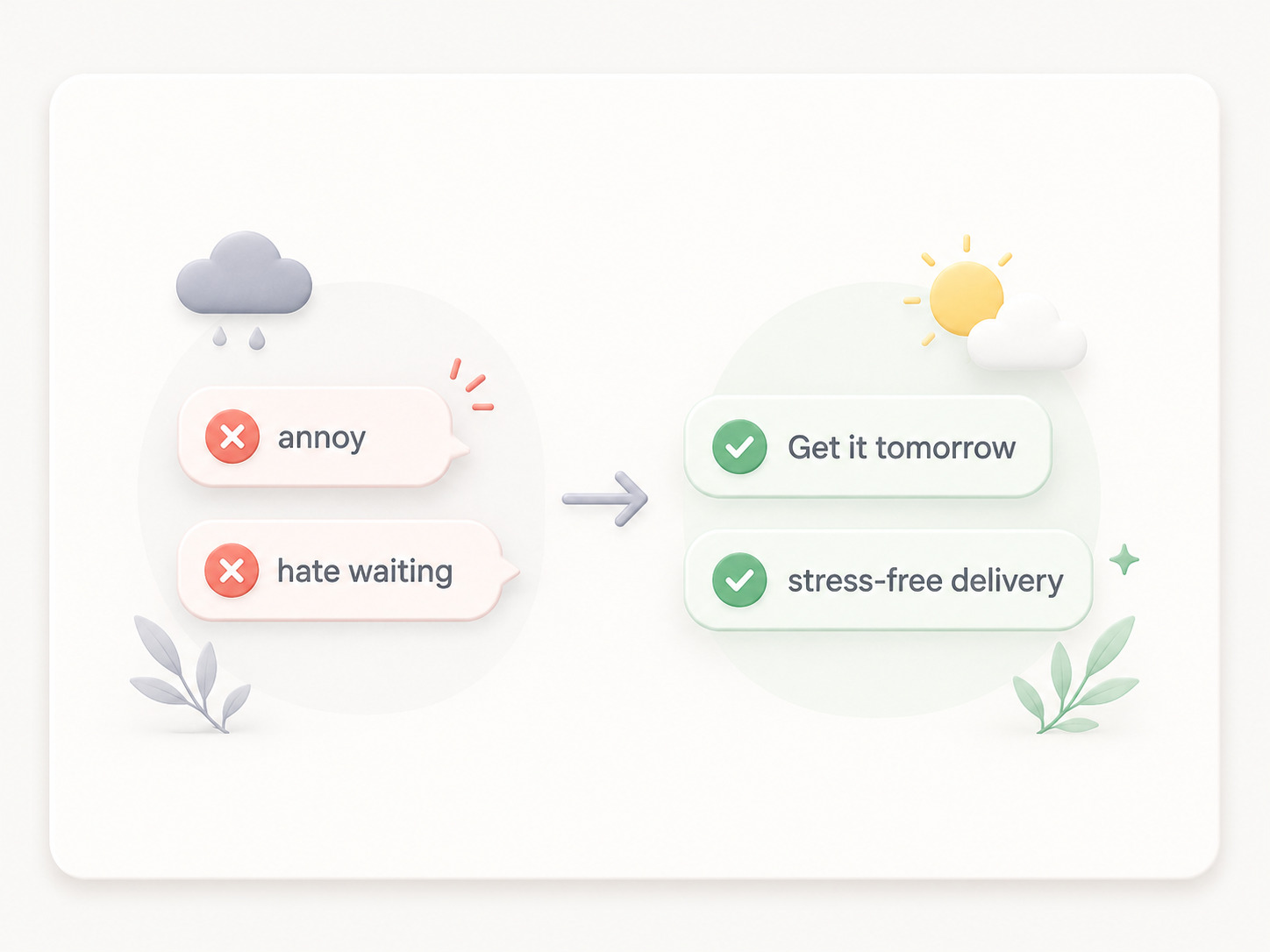
Words can drive consumers toward buying — but choose carefully, because some evoke negative emotions instead of good ones. Consider: "Don't let muscle pains annoy you any longer!" You'd think it lands, since you're clearly selling the solution. But annoy triggers a sour feeling and makes the customer more likely to leave your shop.
Here's another: "Hate waiting? Buy the express delivery!" Hate is one of the strongest negative feelings, sitting right next to anger and fear, and you don't want to evoke that emotion in a potential customer. The fix is to lead with the positive outcome rather than the pain — "Get it tomorrow with express delivery" sells the same thing without the sting. The rule of thumb: name the pain point gently, then point straight at relief and a stress-free result.
2026 twist: the same trigger words can sink your emails
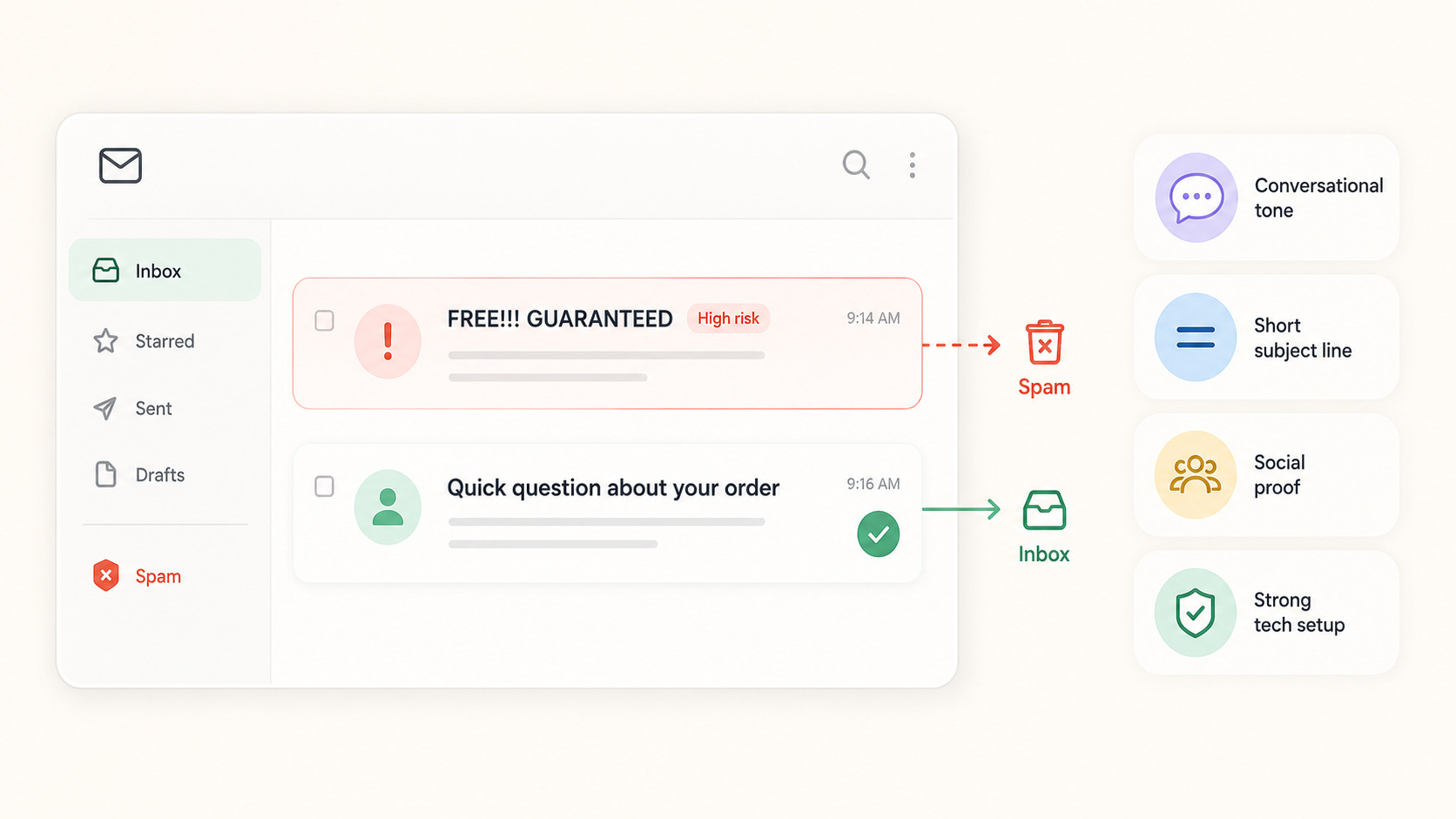
Here's the update that catches a lot of marketers off guard. The emotionally charged words that convert beautifully on a landing page can quietly destroy your email marketing. In 2026, spam filters from the major inbox providers use AI and machine learning to judge the full context of a message — sender reputation, engagement history, formatting, and content patterns — not just a static blacklist of words.
That means email subject lines stuffed with free, guaranteed, act now, or 100% free — especially paired with ALL CAPS or excessive punctuation — can push your spam score into dangerous territory and bury your message in the junk folder. And because engagement signals like opens, clicks, replies, and spam complaints now feed back into whether your future emails land, a single "mind-blowing, insane deal" blast can damage your deliverability and tank your cold email reply rates for weeks.
So how do you keep the persuasive power without the penalty? A few practical rules:
Write like a one-on-one conversation. Emails that sound human and helpful outperform hype-heavy sales copy and read as more trustworthy to both readers and filters.
Craft a great headline, honestly. Keep subject lines under about 60 characters, front-load the key idea, and tell the reader exactly what's inside instead of sensationalizing.
Use your strongest trigger words sparingly. One well-placed power word in context is fine; five in one subject line is a red flag. Save the heavy hitters for the email body and the landing page.
Lean on social proof instead of superlatives. "Loved by 10,000 customers" builds desire without tripping spam filters the way an over-the-top adjective does.
Get the technical side right. Sender authentication and verified emails matter as much as your words, and a clean list protects your sender reputation.
The smart move is to save your most aggressive trigger words for the destination, not the inbox. Keep the subject line restrained to earn the open, then let the landing page do the heavy emotional lifting once the reader clicks through. When your email automation and your pages live in one place — as they do inside Funnelish's built-in email and SMS automations — that division of labor is easy to keep clean: measured copy to reach the inbox, full-power CTAs on the page that converts.
Bringing it together
Trigger words and phrases are among the highest-leverage tools in your copywriting kit, but power without aim backfires. Lead with positive, research-backed words like you, free, save, because, imagine, and new, pair them with sharp transactional CTAs, steer clear of language that evokes anger or annoyance, and respect the line between what converts on a page and what survives a spam filter.
And remember that the word only writes a check your page has to cash. A trigger like save or limited time falls flat if the offer is clunky or the page is slow — so build pages that deliver on the promise. With a fast page builder that loads in under a second, plus one-click upsells and order bumps that make a "Yes, add this!" moment frictionless, Funnelish lets your strongest words land on a page engineered to convert.
Test relentlessly — swap one word and watch the difference in your numbers — and the right trigger word at the right moment becomes the quiet difference between a visitor who leaves and a customer who buys.
Table of contents
Boost your eCommerce
sales today

24/7 support
No credit card required
Cancel anytime
24/7 support
No credit card required
Cancel anytime
