

Benefits of Artificial Intelligence in Ecommerce
24 July 2026
Anna P.
10 minutes
A woman buys a pair of hiking boots on a Tuesday night. Total elapsed time: eleven minutes. She thinks she made one decision.
She actually made about six, and artificial intelligence shaped nearly every one of them.
It suggested her the brand before she'd heard of it.
It understood her oddly-worded search.
It surfaced the boots she'd have scrolled past.
It answered her question about sizing at 11:40pm.
It approved her card in under a second while quietly rejecting three fraudulent orders behind hers.
And it had already told the warehouse, six weeks earlier, to stock her size.
That's the honest way to understand the benefits of artificial intelligence in ecommerce. Not as a feature list, but as a series of invisible interventions across a single purchase — some the customer feels, most she never sees.
Let's trace them, then talk about what it takes to actually get them.
Part one: what your customer experiences
She found you before she was looking (AI as a discovery channel)
The first benefit is the newest, and it happens before your site is ever loaded.
Shoppers increasingly start with an AI assistant rather than a search bar — "best waterproof hiking boots for wide feet under $200" — and the assistant does the research, comparison and shortlisting on their behalf. During the 2025 holiday season, Adobe Analytics recorded traffic to US retail sites from generative AI sources rising 693% year over year.
The volume is striking, but the quality is the actual benefit. Those visitors converted 31% more than other traffic and were 33% less likely to bounce. By March 2026, Adobe measured AI traffic converting 42% better than other sources, with revenue per visit running 37% higher — a complete reversal from a year prior, when ordinary human traffic was worth more than double.
Salesforce sizes the shift bluntly: over the 2025 holidays, AI influenced 20% of global online sales, worth $262 billion, and ecommerce retailers deploying their own shopper agents grew sales 59% faster than those that didn't.
Benefit: clean, structured product data now functions as a growth channel. AI systems that can read your catalog put you in the conversation where the decision gets made — and the buyers they send arrive pre-qualified.
Read more: AI in Ecommerce: How It Stopped Being a Tool and Became a Channel
She found the right boot despite describing it badly
Our shopper didn't type "waterproof mid-cut leather hiking boot." She typed "boots that won't soak through on wet trails."
Ten years ago that query returned nothing. Ecommerce natural language processing fixed it — AI search now reads intent and context rather than matching keywords, so human language gets translated into the right search results. Add AI powered visual search and she could have skipped words entirely: photograph a boot she saw on a trail, and AI models analyze the image to retrieve similar products from your catalog.
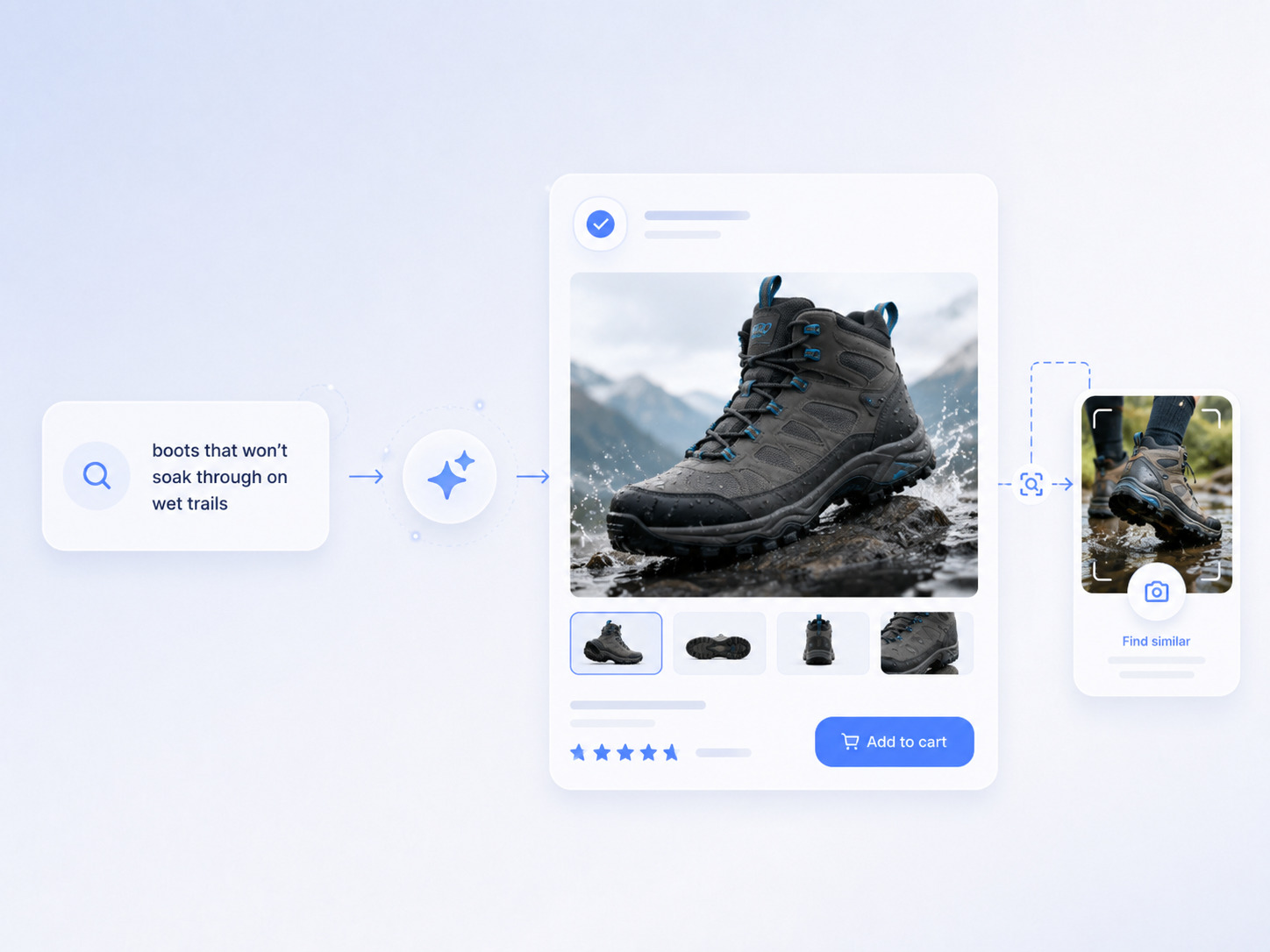
Benefit: shoppers find things. Every failed search is a customer who leaves, and every rescued one is revenue you'd otherwise never see.
Store rearranged itself for her
Once she landed, AI algorithms went to work on customer data — browsing behavior, customer purchase history, dwell time, what got abandoned — to predict customer preferences and surface relevant products. Not the store's bestsellers. Hers.
This is the most documented benefit in ecommerce, and the numbers are worth memorizing. McKinsey's personalization research puts the typical revenue lift from personalization at 10–15% (spanning 5–25% by sector and execution quality), and found that faster-growing companies draw 40% more of their revenue from personalization than slower-growing peers. Moving to top-quartile personalization across US industries would unlock over $1 trillion in value.
The same research reframes personalization as an obligation rather than an edge: 71% of consumers expect personalized interactions and 76% get frustrated without them. Personalized shopping experiences aren't a differentiator anymore — their absence is a defect.
Benefit: higher conversion in the moment, and enhanced customer loyalty over time, because relevance lowers effort and shoppers return to stores that seem to know them.
Read more: Sales Funnel Optimization: 20+ Ways to Boost Conversions + Tools
She got an answer at 11:40pm
Her question — do these run narrow? — arrived long after your support team logged off. An AI chatbot handled it in nine seconds.
Virtual shopping assistants now resolve the bulk of routine customer queries autonomously: sizing, order status, returns, shipping windows. They deliver 24/7 availability, collapse response times, and hand genuinely difficult cases to humans with the full conversation attached. Behind the scenes, AI systems analyze customer interactions at scale to surface customer sentiment and recurring friction points no one would catch reading tickets one at a time.
Benefit: improved customer service and lower operational costs simultaneously — an unusual pairing. Worth noting, though: when every store has a bot, owning one wins nothing. Resolution on the first attempt is what customers truly reward.
Her card went through (and three fraudsters' didn't)
The least visible customer-facing benefit is the one she'd have noticed most in its absence.
Machine learning algorithms analyzed her transaction against millions of others — device fingerprint, velocity, geographic consistency, behavioral fit — and cleared it instantly. Three orders behind hers, using stolen cards, got flagged for review.
The overlooked half of this benefit isn't catching fraud. It's not blocking real people. Rule-based systems decline legitimate buyers constantly, and few things kill customer trust faster than an unexplained decline at checkout. Better AI fraud detection raises genuine approval rates while tightening the net on suspicious transactions.
Benefit: less fraud loss and fewer insulted customers — with ecommerce fraud losses running into the tens of billions industry-wide, both sides carry real money.
Part two: what your business banks
The customer never sees the next four. They're where a lot of the margin lives.
Her size was in stock because AI predicted it in August
Predictive analytics chewed through historical sales data, seasonality and sales velocity to forecast consumer demand — telling you how much inventory to hold, in which sizes, at which locations. That's the difference between a sale and a "Notify me when available."
Good demand forecasting cuts both failure modes at once: stockouts (lost revenue) and overstock (dead capital). AI predicts seasonal spikes before they land, flags a category quietly dying before instinct does, and optimizes stock levels automatically. Extended into the supply chain, it becomes real-time inventory visibility, smarter routing and early warning on disruption — with industry estimates commonly placing AI-driven logistics savings in the mid-teens.
Benefit: inventory management stops being a guessing game, and the data quality improvement feeds everything else on this list.
Price she paid was calculated
Dynamic pricing is the quietest margin lever in ecommerce. Instead of fixing prices and revisiting them quarterly, AI models continuously weigh consumer demand, competitor activity, inventory depth and historical data — then adjust.
Dynamic pricing strategies do two jobs at once: capture revenue when demand peaks, and clear excess stock through timely, calculated discounts rather than a panicked end-of-season fire sale. Pricing optimization that runs continuously beats pricing that runs never.
One guardrail: prices that visibly shift while someone watches read as manipulation, and shoppers screenshot things. Apply it to inventory and timing, not to individual desperation.
Her product page was written in four seconds
Generative AI's most practical ecommerce benefit is volume. Product descriptions across hundreds of SKUs, each unique and SEO-optimized. Email and ad variations tuned per customer segment. Category pages, FAQs, size guides — the connective tissue nobody has time for. AI-generated content can compress weeks of copywriting into an afternoon, and generative AI can synthesize 4,000 pieces of customer feedback into actionable insights faster than a human can read fifty.
The trap is sameness. Content produced at volume without judgment reads like it, and both shoppers and search engines notice. Use AI for the draft and the scale; keep humans on voice and accuracy.
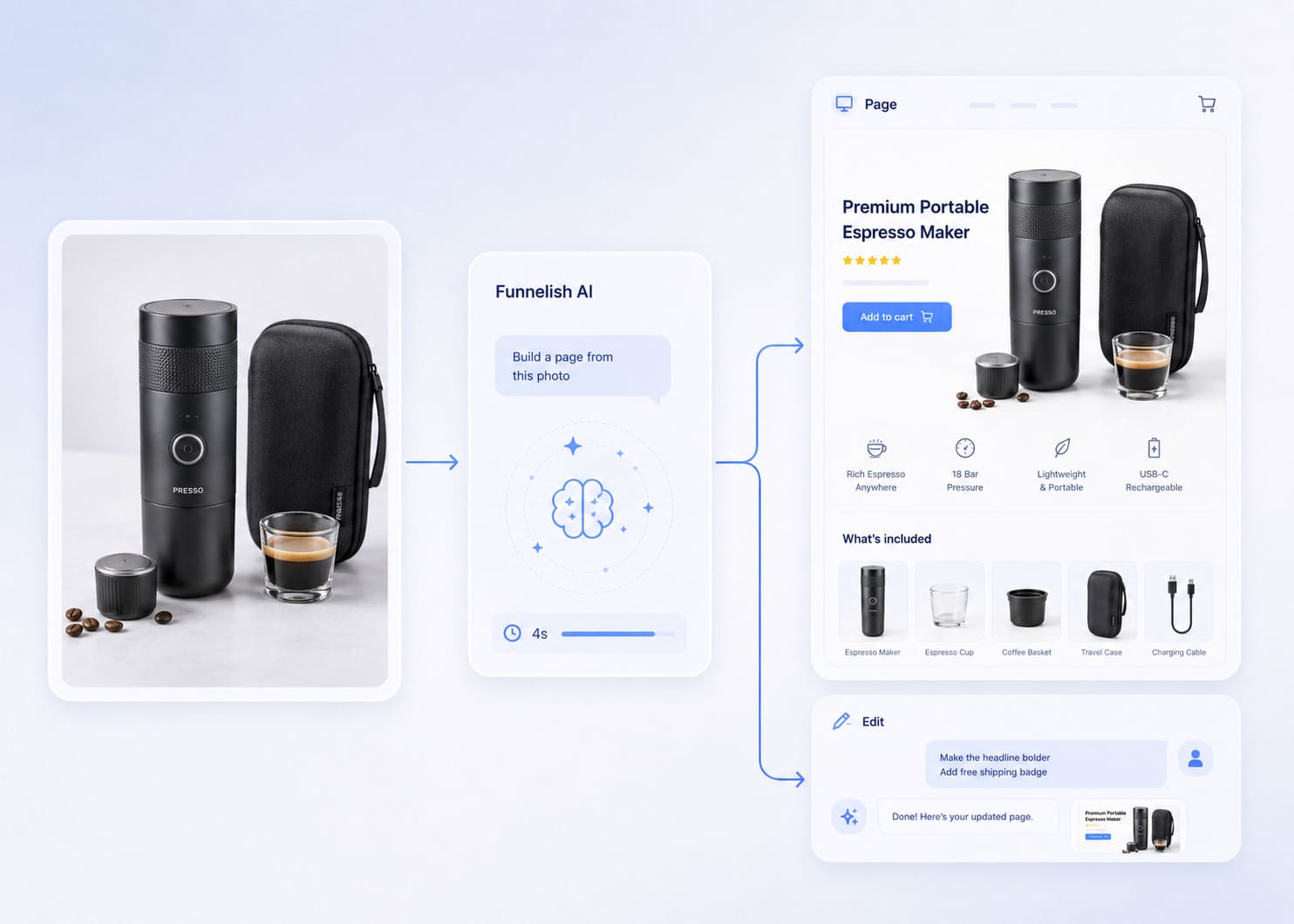
Funnelish AI — in beta now — is an interactive AI funnel builder: start from scratch, a product photo, or a reference link, and it generates the full pages, which you then refine conversationally, section by section, before pulling the project into the editor for hands-on control. It's a small illustration of a bigger trend — AI moving from "writes your copy" to "builds your store," with you still holding the wheel.
Read more: Best AI Photo Editor for Ecommerce Images in 2026
Your team stopped doing work a machine should do
The last benefit is structural. AI automates repetitive tasks across business operations — tagging, reconciliation, reporting, data entry — reducing human error and freeing people for work requiring judgment. AI powered data analytics then turn scattered consumer data into decisions: which customer segments repay acquisition cost, which products are quietly dying, where marketing efforts leak.
Benefit: operational efficiency plus data-driven decisions — which is where the durable competitive edge sits. Not in any single tool, but in deciding faster and more accurately than competitors still exporting spreadsheets.
Why these benefits compound
Here's the insight most benefit lists miss: none of these work in isolation, and that's the point.
Accurate inventory data makes recommendations honest — recommending an out-of-stock item burns trust you spent months building. Clean product data makes AI search work and makes you discoverable to external AI assistants. Personalization data sharpens demand forecasting, which sharpens pricing. Fraud detection that stops declining real customers protects the retention that personalization generates.
Get two of these right and you'll see modest gains. Get six right and they multiply, because each one improves the data feeding the others. That's why AI integration tends to produce disappointing results in year one and disproportionate ones in year three.
What separates the businesses getting these benefits
Now the uncomfortable context. Per McKinsey's State of AI research, 88% of organizations use AI in at least one function — but only 39% report any EBIT impact at the enterprise level, and nearly two-thirds haven't scaled beyond pilots.
Nearly everyone has AI powered solutions. Very few are being paid for them. Four things separate the two groups:
Data quality. AI algorithms trained on fragmented or messy customer data produce confidently wrong answers. If your product, pricing, inventory and customer records live across five systems in four formats, no AI tool rescues you — it just fails faster and more expensively.
A defined problem. Businesses capturing value picked one thing to fix — response time, stockouts, average order value — and measured it. The ones with nothing to show bought "an AI strategy."
Privacy discipline. Personalized experiences require substantial consumer data, and shoppers are increasingly alert to how sensitive data gets handled. Data privacy isn't a compliance task bolted on at launch; it defines what you can responsibly build, and mishandling it destroys customer trust faster than personalization creates it.
Realism about accuracy. McKinsey's 2026 research on AI trust found 74% of respondents naming inaccuracy as a leading risk — and as AI systems move from suggesting to acting, the cost of being wrong rises fast. Keep humans in the loop wherever AI touches money, pricing or a customer's actual experience.
Bottom line
Our shopper spent eleven minutes buying boots. AI shaped how she found the store, what she saw, what she asked, whether her card cleared, and whether her size existed at all — and she'd describe the whole thing as "I bought some boots."
That's what the benefits of artificial intelligence in ecommerce look like when they're working: invisible to the customer, compounding for the business, and concentrated in the places where friction used to live.
The tools are available to any ecommerce business now, at any size. What's scarce isn't access. It's the discipline to fix your data, pick one problem, measure it honestly, and only then expand.
Frequently asked questions
What is the biggest benefit of AI in ecommerce?
Personalization has the most consistent measurable return — McKinsey puts the typical revenue lift at 10–15%, with faster-growing companies drawing 40% more of their revenue from it. The fastest-growing benefit, though, is AI-driven discovery: AI-referred traffic now converts substantially better than any other channel.
Does AI actually increase ecommerce sales?
Yes, when aimed at a specific goal. Adobe measured AI-referred retail traffic converting 42% better than other sources by March 2026, and Salesforce found retailers running shopper agents grew sales 59% faster. But most companies using AI still report no enterprise profit impact — results come from focused execution, not adoption.
How does AI improve the customer experience?
Across the whole customer journey: helping shoppers discover brands through AI assistants, understanding poorly-worded queries via natural language processing and visual search, surfacing relevant products based on customer preferences, answering questions instantly at any hour, approving legitimate payments without false declines, and ensuring the item is actually in stock.
What are the risks of using AI in ecommerce?
Poor data quality producing wrong outputs, algorithmic bias creating irrelevant or unfair recommendations, data privacy exposure from heavy reliance on consumer data, and inaccuracy — which grows more costly as AI systems gain autonomy and begin acting rather than recommending.
Can small ecommerce businesses benefit from AI?
Yes, often more than large ones proportionally, since many AI powered tools now require no technical team and cost very little. Chatbots, description generators, recommendation engines and forecasting tools are all accessible at small-business pricing. The approach is identical at any size: one clear problem first, then expand.
Table of contents
Boost your eCommerce
sales today

24/7 support
No credit card required
Cancel anytime
24/7 support
No credit card required
Cancel anytime
