

Shopify App-Purge: How to Consolidate 10 Subscriptions into One Dashboard
06 March 2026
Anna P.
11 minutes
There's a moment most Shopify store owners recognize. You're reviewing your monthly expenses, and somewhere between ad spend and shipping costs, you notice a line item that shouldn't be that large. Subscriptions. Not your customers' subscriptions — yours. The eight, ten, sometimes twelve Shopify apps silently billing you every month for doing things your online store can't survive without:
Email marketing app
Upsell app
Loyalty program app
Subscription management app
Post-purchase survey tool
Review collector
SMS marketing tool
Page builder for custom landing pages
Each one solving a real problem. Each one, individually, defensible. Together, they are quietly eating margins that were already under pressure from rising ad costs and carrier rate increases.
This isn't a niche problem. It's the default operating model for eCommerce brands on Shopify — and it's worth examining exactly why it happens, what it costs, and what a more rational alternative looks like.
Why Shopify Stores End Up With So Many Apps
Shopify's core product is excellent at what it was designed to do: manage inventory, process orders, handle taxes, and sync fulfillment. What it was not designed to do is maximize revenue per visitor, run sophisticated email and SMS campaigns, drive sales through post-purchase flows, or build high-converting landing pages for paid traffic.
So Shopify built an app store. And the Shopify App Store model, for all its convenience, creates a specific kind of problem: it optimizes for the app developer's revenue, not the store owner's margins. Each app solves one problem. Each app charges a monthly fee. Each app has its own dashboard, its own login, its own data model — and critically, its own definition of what a "customer" looks like, which means they rarely talk to each other cleanly.
The result is a stack that looks something like this for a mid-size Shopify brand running paid traffic:
A page builder for creating landing pages outside the standard Shopify theme ($39–$99/month).
An email marketing app for automated sequences and campaigns ($30–$300/month depending on list size).
An SMS marketing platform for cart abandonment and flash sales ($20–$150/month).
An upsell and cross-sell app for post-purchase offers ($30–$100/month).
A loyalty and rewards program to reward customers and drive repeat purchases ($50–$300/month).
A subscription app for recurring billing ($50–$200/month depending on volume).
A review collection app to collect reviews and build social proof ($15–$100/month).
A post-purchase survey tool for customer feedback ($25–$100/month).
That's a conservative $259 to $1,349 per month before you've sold a single unit. For an eCommerce store doing $30,000/month in revenue at a 15% net margin, the app stack alone can represent 5–30% of your actual profit. And that's before accounting for the hidden cost nobody puts in a spreadsheet: the hours spent managing eight different dashboards, troubleshooting integration conflicts, and onboarding new team members across tools that were never designed to work together.
Most eCommerce merchants don't realize how much this fragmentation costs until they sit down and add it up. By then, the subscriptions have become infrastructure — painful to audit, harder to cut.
Integration Tax
Here's what the Shopify App Store doesn't advertise. When you build a stack of specialized apps, you don't just pay subscription fees — you pay an integration tax.
Customer data lives in silos. Your email marketing app knows who opened a campaign. Your upsell app knows who accepted a post-purchase offer. Your loyalty program knows who has points. None of them share a unified view of your customer. When you want to send a personalized email to customers who bought a specific product and have more than 200 loyalty points but haven't purchased in 90 days — the kind of targeted flow that actually drives repeat sales and builds loyal customers — you're either doing manual CSV exports or paying for a middleware tool to stitch the data together.
Shopify merchants also run into the transaction fee problem on third-party apps. Many upsell and subscription apps charge a percentage of revenue processed through their system — on top of Shopify's own transaction fees for non-Shopify Payments users. On a store doing $50,000/month, a 1% app transaction fee is $500/month in pure margin erosion.
Then there are the conflicts. Two apps trying to modify the same checkout element. A page builder that slows your theme load time because it injects scripts that weren't built to coexist with your other plugins. A loyalty app that breaks when you update your Shopify theme. The Shopify community forums are full of these failure modes, and they're not edge cases — they're the predictable result of building revenue infrastructure from components that weren't designed as a system.
And there's a subtler cost too: lost sales. When store visitors land on a slow product page because two conflicting apps are fighting over the same script, you lose conversions you'll never be able to attribute. The analytics show a drop; the root cause stays invisible. Customer engagement flows misfire. Customer retention suffers. And you have no clean way to track performance across the full journey because every app is reporting from its own silo.
Read more: 20+ Ways to Boost Conversions + Tools
What Most "Best Shopify Apps" Lists Get Wrong
Every few months, a new roundup of the best Shopify apps gets published. They list the top Shopify apps by category — best email marketing apps, best SMS marketing tool, best loyalty programs — and the implicit advice is: install the winner in each category, and you'll have a great stack.
The problem is that optimizing each category in isolation doesn't optimize the system. You can have the best email marketing app, the best SMS platform, and the best loyalty program on the market — and still have an online store where those three tools barely communicate with each other. Customer engagement stays fractured. Tracking performance across the full customer journey becomes an exercise in reconciling three different dashboards with three different definitions of the same events.
The "best app per category" approach also ignores the compounding cost. Many of the most capable apps don't offer a generous free plan — or their free plan available tier is so limited that it functions as a free trial leading to paid plans that start at $50–$100/month per tool. By the time you've installed four or five must-have Shopify apps, you're committed to a monthly spend that would cover an all-in-one solution with room to spare.
Some eCommerce store owners do find free Shopify apps or free apps that solve narrow problems reasonably well. But free apps carry their own cost: limited features, inconsistent support, and frequent compatibility issues with the paid apps in the same stack. Other apps they install to compensate.
So, the question isn't whether an app is free — it's whether your entire stack is functioning as a coherent system to boost sales, engage customers, and build customer loyalty at scale.
What Consolidation Looks Like
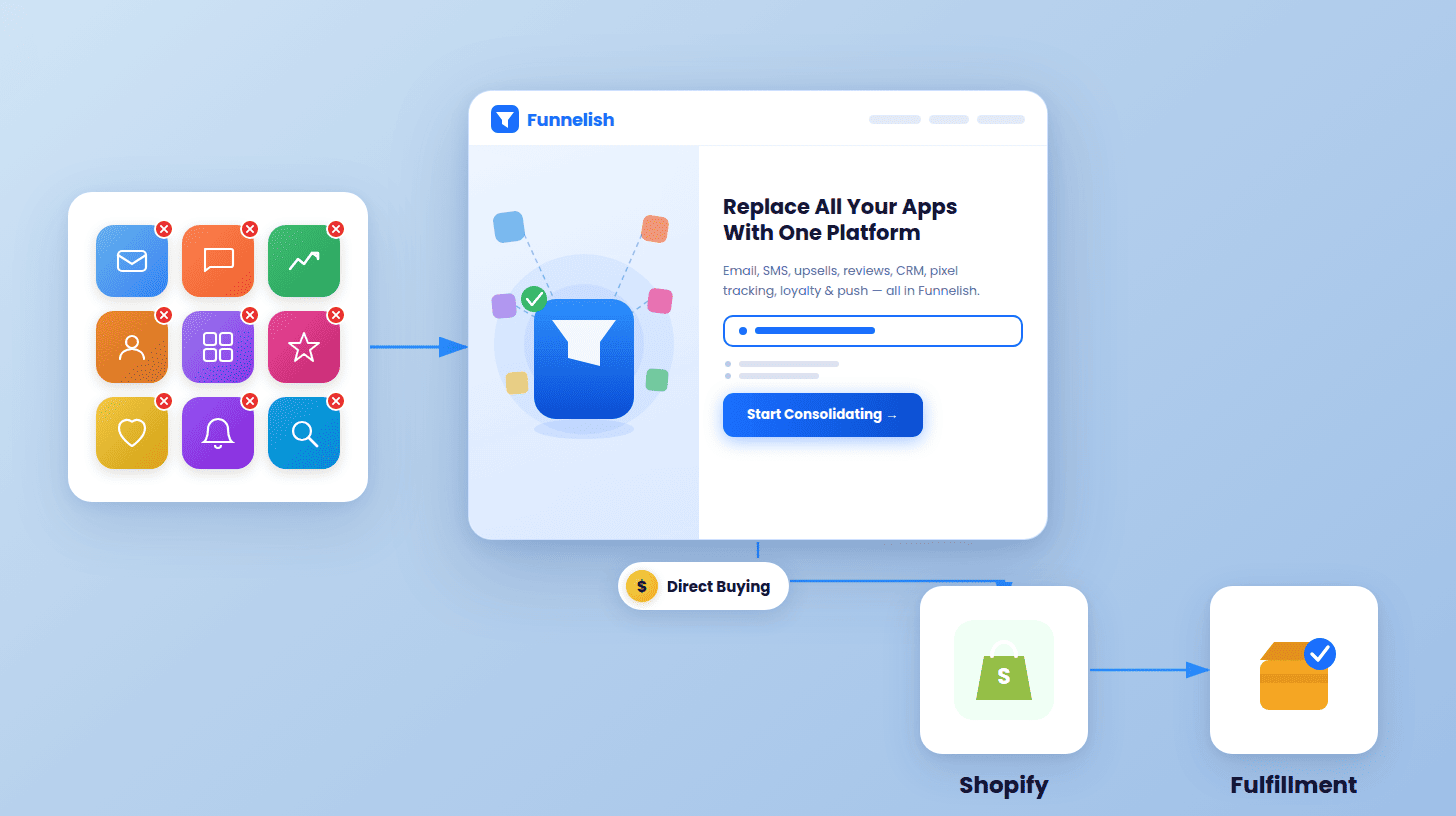
The alternative to the app stack model is a platform built as a system from the start — where email marketing, SMS marketing campaigns, upsells, landing pages, subscriptions, and analytics share a single data layer and a single dashboard.
Funnelish for Shopify is one such tool built around this model. Rather than solving one problem per product, it replaces the revenue-generation layer of your stack with one product: the parts of your eCommerce business responsible for converting site visitors into paying customers, increasing average order value, and retaining customers long-term. It functions as an all-in-one solution for Shopify brands that want to increase sales without adding complexity.
What That Means Practically for Your eCommerce Store
You build your landing pages and funnel pages in the same drag-and-drop editor you use to configure your upsells. The customer who purchases through your funnel is automatically available in your email and SMS marketing sequences — no export, no import, no middleware. Your subscription offers, order bumps, and post-purchase upsell flows are all configured in the same interface, with the same customer data available to all of them. And because Funnelish charges no transaction fees, the economics improve as your volume grows, rather than degrading.
Shopify brands that consolidate also gain something less obvious: the ability to track performance across the full customer journey in one place. When your email marketing, SMS marketing campaigns, upsells, and subscriptions all generate events in the same system, you can identify where customers find friction, where store visitors become new customers, and where loyal customers come from — without stitching together three separate reports.
Orders sync directly to Shopify, so your fulfillment operation sees no change. Your 3PL, your warehouse team, your shipping carrier integrations — none of that moves. What moves is the front-end revenue layer: the part of your business that touches potential customers before and immediately after they convert.
For eCommerce brands already using Klaviyo or ActiveCampaign, Funnelish supports those integrations too — so you're not forced to migrate if your existing email and SMS campaigns are working. You consolidate what makes sense and keep what doesn't need changing. That also means you can incorporate social media marketing flows, search engine optimization for your blog content, and user-generated content collection — all from the same platform.
Practical Purge: Where to Start
The goal isn't to cancel every app immediately. It's to identify which apps are solving problems that belong in a unified revenue platform — and which ones are genuinely specialized tools worth keeping.
Start with the revenue-touching apps: your page builder, your upsell tool, and your email/SMS platform. These three categories create the most integration friction, cost the most in combined subscriptions, and benefit most from sharing a single customer data model. If you're paying separately for all three, you're almost certainly paying more than a consolidated platform costs — and getting less coherent data in return.
Next, look at your loyalty and subscription apps. These are often the highest monthly cost in the stack after email, and the most painful to manage in isolation because they require persistent customer state — points balances, subscription cycles, billing history — that needs to be visible across your entire customer experience, not locked in a siloed app. A loyalty program that can't see purchase history from your upsell flows can't reward customers meaningfully. It can only reward the transactions it knows about. That means more customers falling through the cracks of your retention strategy than you realize.
Finally, audit what you're actually using. Most eCommerce store owners who do this exercise honestly find two or three apps they're paying for that aren't actively configured or are duplicating functionality they're getting elsewhere. A user-generated content tool nobody has logged into in months. An in-app chat that's been disabled. A social media marketing integration that was set up once and never revisited. A Google search optimization plugin that duplicates what another app handles. These aren't assets — they're overhead that inflates your costs and clutters your Shopify admin.
The Shopify App Store will always have new apps. It will always have free plans that convert to paid plans, free trials that auto-charge, and apps that solve narrow problems elegantly. But the eCommerce brands building durable, profitable businesses in 2026 are the ones who treat their tech stack as a strategic decision — not a collection of individual subscriptions that accumulated over time without anyone asking whether they still made sense together.
The purge isn't about going minimal for its own sake. It's about paying for coherence instead of paying for chaos.
FAQ
What apps should I get on Shopify?
The honest answer depends on what your store actually needs right now — not what a "must-have Shopify apps" listicle from 2023 recommends. For most eCommerce brands running paid traffic, the highest-priority capabilities are: landing pages that convert store visitors efficiently, post-purchase upsells to increase average order value, and an email sequence to drive repeat sales and boost customer retention.
If you can get those from one platform, like Funnelish, instead of three separate paid plans, do that first. Beyond that, look at what's genuinely driving customer engagement and what's sitting idle. The idle stuff costs you money and adds noise to your data, making it harder to identify what's actually working.
Does Shopify provide apps?
Shopify provides the App Store — a marketplace of third-party tools built by independent app developers. Some are built by Shopify itself (like Shopify Email and Shopify Flow), but the vast majority are third-party products with their own pricing, support, and data models. Shopify's native tools are optimized for store management, not revenue optimization.
The gap between what Shopify provides natively and what a high-converting eCommerce operation needs — to engage customers, boost sales, collect reviews, run SMS marketing campaigns, and build customer loyalty — is where most app spend happens, and where the fragmentation problem begins.
Why do so many Shopify stores fail?
The most common failure modes aren't about the platform — they're about unit economics and attention. Shopify stores fail because they scale ad spend before their funnel is profitable, because their average order value can't absorb rising customer acquisition costs, or because they have no customer retention mechanism and depend entirely on new customers for every dollar of revenue.
A bloated app stack makes all of these problems worse: it increases fixed costs, fragments customer data, and consumes time that should go toward offer development and creative testing. The eCommerce brands that succeed long-term are the ones that can drive repeat sales from their existing customer base — through loyalty programs, subscriptions, and re-engagement campaigns — rather than depending on paid acquisition to boost sales month after month.
Are people leaving Shopify?
Some Shopify brands are particularly well-suited as alternative eCommerce platforms, and headless commerce setups have matured. But the more common trend in the Shopify community is brands staying on Shopify for inventory and fulfillment — where it genuinely excels — while building their revenue-generation layer outside of Shopify's native theme and app ecosystem.
Funnelish syncs with Shopify rather than replacing it, which is the model most high-volume eCommerce merchants are moving toward: Shopify as the operational backbone, a dedicated funnel platform as the customer-facing revenue layer that converts site visitors, drives sales, and builds loyal customers without the app stack overhead.
Table of contents
Boost your eCommerce
sales today

24/7 support
No credit card required
Cancel anytime
24/7 support
No credit card required
Cancel anytime
