

Ad Costs Are Rising & Consumer Spending Is Tighter. The Only Lever Left Is Your AOV.
09 March 2026
Anna P.
11 minutes
Publicis Sapient's February 2026 eCommerce outlook called it directly: significant economic headwinds are continuing to drive consumers toward value-seeking behavior, with reduced disposable income, mounting consumer debt, and still-elevated interest rates shaped by monetary policy keeping shoppers from spending freely.
The latest data from the Bureau of Labor Statistics — including consumer expenditure surveys and labor statistics on household income — confirms that US consumers are allocating more of their total annual expenditures toward essentials like housing, food, utilities, and transportation, leaving less room for discretionary spending on categories like entertainment, electronics, restaurants, and gardening supplies.
At the same time, the cost of reaching those shoppers through paid advertising continues to climb. (Search Engine Land) Whether measured quarterly or week over week, the trends are consistent: personal consumption expenditures are shifting, retail sales growth is slowing, and the economic analysis points to a market where American consumers are simply more cautious with every purchase.
This is the margin squeeze that every eCommerce operator running paid traffic is living through right now. Customer acquisition costs have risen materially across Meta and Google over the past three years. Carrier rates have adjusted upward. And now, the consumer sitting at the other end of all that spend is measurably more deliberate about how they part with money — a reality that economists and managing directors at major research firms have reported across quarterly forecasts this year.
The response most brands reach for in this environment is to spend smarter on acquisition — better creative, better targeting, more disciplined bidding. All of those strategies matter. But they optimize the input side of the equation. The output side — how much revenue you actually extract from each customer you do acquire — is where the largest untapped leverage lives for most eCommerce businesses.
Average order value is the number that changes the economics of everything else.
Math That Changes Your Business
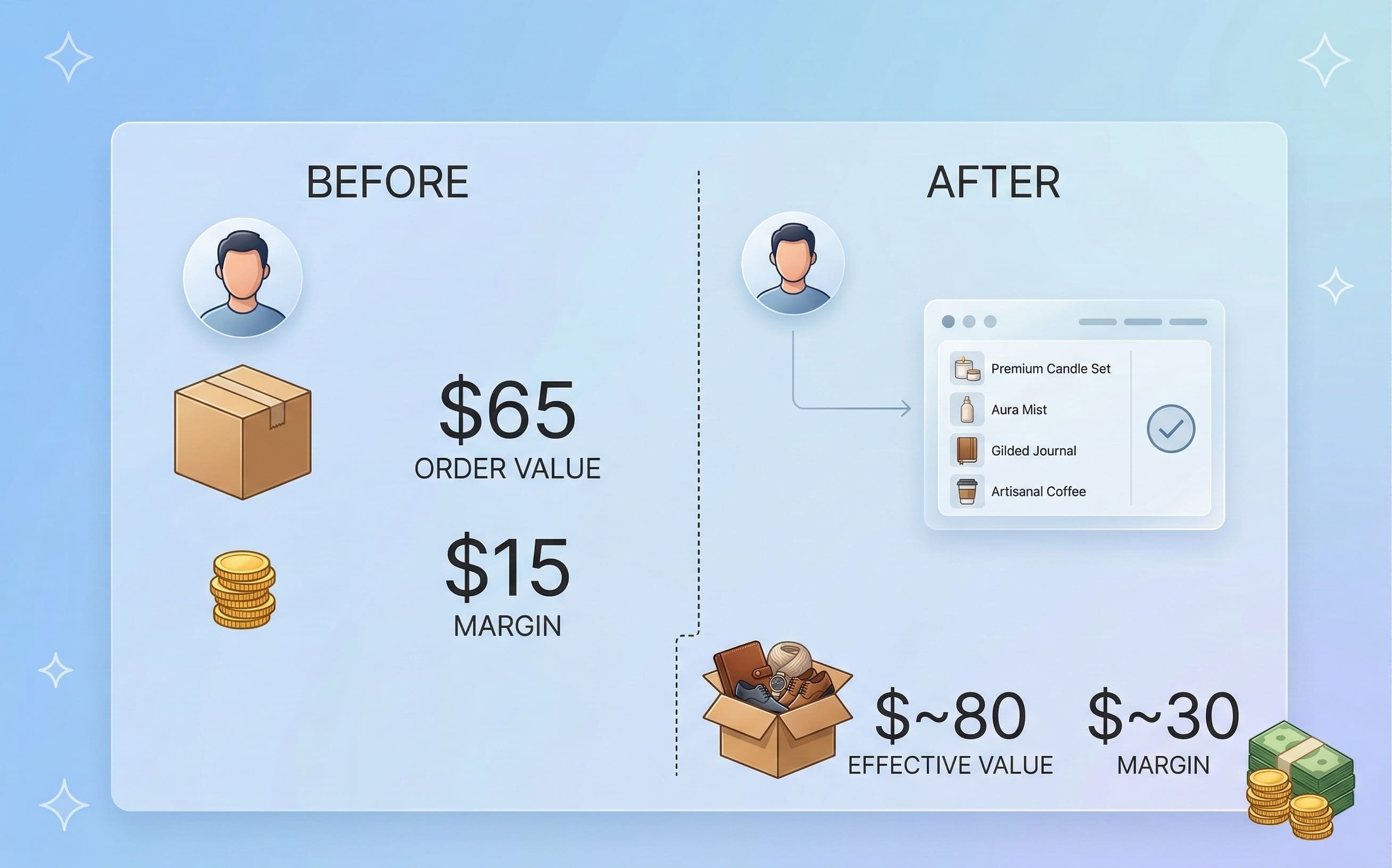
Here's why AOV deserves more attention than most growth teams give it. Consider a business spending $40 to acquire each customer, with an average order value of $65. Their margin on that $65 purchase — after cost of goods, shipping, and transaction fees — is approximately $15. They're profitable, but barely, and any increase in CPM or reduction in conversion rate tips them into negative territory.
Now add a $27 order bump on the checkout page and a $35 post-purchase upsell. Assume the order bump converts at 30% and the post-purchase upsell converts at 20%. On 1,000 orders:
300 customers add the order bump: $8,100 in additional revenue at near-100% margin
200 customers take the post-purchase upsell: $7,000 in additional revenue at near-100% margin
Total additional revenue: $15,100, spread across 1,000 customers — an effective AOV increase of $15.10
The customer acquisition cost didn't change. The traffic didn't change. The core product didn't change. The only thing that changed was what happened at checkout and in the 90 seconds after purchase — and the result is that the business's effective margin per customer roughly doubled.
This is why AOV optimization is the most defensible growth lever in an economy where acquisition costs are rising, and inflation continues to shape consumer behavior. It doesn't compete with CPMs. It compounds on every order, regardless of where the traffic came from — whether shoppers arrived through paid search, social, or organic indicators.
Read more: 10 D2C Marketing Trends in 2026
Three AOV Levers and How to Think About Each
Order bumps are small, relevant additions presented on the checkout page before the transaction completes. They work because the customer is already in purchase mode, their payment details are already entered, and adding a check-box item requires almost no additional cognitive effort.
The best order bumps are genuinely complementary to the primary product — a carrying case for a product that needs one, a travel-size version of a consumable like groceries or personal care items, a protective case for an electronic device — and priced low enough relative to the primary order that the decision feels effortless. A $12 add-on on a $90 primary order has a very different psychological weight than the same $12 add-on on a $25 primary order. Calibrate accordingly.
Post-purchase upsells operate in a different window: the moment after the transaction is confirmed but before the customer reaches the thank-you page. This is the highest-trust moment in the customer relationship. The objection layer that existed before purchase — "Is this worth the money?", "Do I trust this brand?", "Will it arrive as described?" — has been resolved by the act of buying. The customer is now open to additional offers in a way they weren't 60 seconds earlier.
One-click post-purchase upsells, where the charge is applied to the already-authorized payment method without re-entering card details, convert dramatically better than offers that require a second checkout. Funnelish is one of the tools that help build a flexible post-purchase upsell flow for this window — single-click, no re-entry, a relevant offer presented at the right moment.
Subscription upsells are the AOV lever with the longest-term compounding effect. Converting a one-time buyer to a subscriber at checkout — "Get this automatically every 30 days and save 15%" — increases the first order's effective value only marginally, but it changes the customer's lifetime revenue profile entirely. A subscriber who stays for 12 months at $65/month is worth $780. The same customer who buys once and never returns is worth $65.
For products with natural repurchase cycles — personal care, groceries, supplements, and other consumable components — the subscription conversion at checkout is the highest-return optimization available. Subscription models often play an outsized role in stabilizing revenue forecasts for retailers navigating volatile quarters.
Read more: Sales Funnel Optimization: 20+ Ways to Boost Conversions + Tools
What Rising CPMs Actually Tell You
The pressure of rising acquisition costs is real, but it's worth reframing what it actually signals. When CPMs go up and competition for paid traffic increases, it means your competitors are willing to pay more for the same customer than they were before. The question is why. In most cases, it's because they've found a way to make that customer more valuable — higher AOV, better retention, subscription revenue on the backend — that justifies a higher acquisition cost.
The brands that can profitably spend $60 to acquire a customer with a $90 average order value will outbid the brands spending $40 to acquire a customer with a $55 average order value. They'll consistently win the auction, get more impressions, and grow faster. Not because they have a better ad strategy, but because their unit economics allow them to be more aggressive.
This is the compounding advantage of AOV optimization: it doesn't just improve current margins. It raises the ceiling on how much you can afford to spend to acquire new customers, which means you can access traffic that your competitors can't profitably reach. Over time, that structural advantage — much like the interest rate advantage that shapes broader GDP growth — is more durable than any creative edge.
In a market where higher prices on media and services are squeezing every eCommerce operator, the ability to extract more value from each transaction is the major component that separates brands that scale from brands that stall.
Economic Headwind Is an Opportunity in Disguise
Publicis Sapient's report noted something that's easy to read as purely negative but contains a strategic signal: consumers in 2026 are more value-conscious. Bureau estimates and detailed-level estimates from national-level surveys show that households are reallocating budgets — shifting spending toward essentials and away from discretionary categories. Respondents across income brackets have reported tighter control over purchases, especially beginning in the fourth quarter of last year and accelerating into the holiday season.
But American consumers are not necessarily spending less in absolute terms. They're being more deliberate about what they buy and from whom. They're looking for purchases that feel complete, well-considered, and worth the price. Economic analysis of personal consumption patterns — measured across food, housing, transportation, entertainment, and technology — confirms that shoppers are still willing to spend when they perceive genuine value.
This is actually good news for brands that structure their offers thoughtfully. An order bump that genuinely adds value to the primary purchase doesn't feel like an aggressive add-on to a value-conscious buyer — it feels like the online store thought ahead and anticipated what they'd need. A post-purchase upsell that's clearly relevant to what they just bought isn't experienced as a revenue grab — it's experienced as a useful suggestion from a brand that understands them.
The brands that will navigate the current economic environment best are not the ones that strip everything down and compete on price. They're the ones that increase perceived value at every touchpoint — presenting complementary products at the right moment, at the right price, through a checkout experience that makes saying yes feel effortless.
Even amid global uncertainty — from supply-chain tensions to shifting monetary-policy target rates — the retailers who focus on per-customer economics will be best positioned to weather whatever comes next.
Ready to optimize your average order value from checkout to post-purchase? Start your free trial with Funnelish.
FAQs about Consumer Spending
What is consumer spending?
Consumer spending refers to the total amount of money households spend on goods and services over a given period. It's tracked at the national level using measures such as personal consumption expenditures (in the US, reported by the Bureau of Economic Analysis) and consumer expenditure surveys conducted by the Bureau of Labor Statistics.
For eCommerce operators, consumer spending data matters because it tells you how freely your customers are willing to part with money — and when spending tightens, as it has through 2025 and into 2026, the brands that survive are the ones extracting more revenue per transaction rather than chasing more transactions at shrinking margins.
Is consumer spending falling?
Not in absolute terms — but it's shifting. Latest data shows that total annual expenditures have continued to rise nominally, driven largely by higher prices on essentials like housing, food, transportation, and utilities. What's actually falling is discretionary spending power. American consumers are allocating more of their income toward non-negotiable costs and less toward discretionary categories like entertainment, electronics, restaurants, and personal care.
For eCommerce brands, this means the customers you acquire are spending more carefully, not less overall — which makes optimizing what happens at checkout (order bumps, post-purchase upsells, subscription offers) far more impactful than simply driving more traffic.
How much is consumer spending?
Personal consumption expenditures in the United States account for roughly 68% of GDP, making it the largest component of economic output. In dollar terms, US consumers spend over $19 trillion annually across goods and services. But the number that matters to eCommerce operators isn't the macro figure — it's how that spend is distributed.
Bureau of Labor Statistics estimates show that the average household allocates the majority of total expenditures to housing, transportation, food, and insurance before a single discretionary dollar is spent. Understanding this breakdown helps you price offers, structure bundles, and position upsells in a way that fits how your customers actually budget.
Is CPI the same as consumer spending?
No. CPI (Consumer Price Index) measures how prices change over time — it tracks inflation. Consumer spending measures how much money households actually spend. They're related but tell you different things. CPI going up doesn't necessarily mean consumers are spending more; it means they're getting less for the same money.
When it comes to eCommerce strategy, this distinction matters: when CPI rises, but real income stays flat, your customers feel squeezed even if their nominal spending looks stable. That's exactly the environment where increasing average order value through complementary add-ons beats raising base prices — you're adding perceived value rather than asking shoppers to absorb higher costs on the same product.
Is Gen Z less consumerist?
Gen Z spends differently, not necessarily less. Research consistently shows that this demographic prioritizes experiences, values-aligned brands, and perceived authenticity over traditional status purchases. They're also more likely to comparison-shop, wait for deals, and abandon carts that feel transactional rather than curated.
When targeting Gen Z, this has direct AOV implications: generic "You might also like" upsells underperform, while thoughtfully bundled offers that feel like genuine recommendations convert well. The checkout experience matters more to this cohort than almost any other — they'll spend freely when the purchase feels intentional, and bounce the moment it feels like extraction.
Which country has the highest consumer spending?
The United States leads global consumer spending by a wide margin, with personal consumption expenditures exceeding $19 trillion annually. China ranks second, followed by Germany, India, and the United Kingdom. (World Population Review)
What makes the US market unique for eCommerce isn't just the volume — it's the infrastructure. American consumers have high digital payment adoption, established expectations around fast shipping, and a comfort level with online checkout flows that make post-purchase upsells and subscription conversions viable at scale. Brands selling into the US market have more AOV-optimization levers than in almost any other economy.
What are the two types of consumer spending?
Consumer spending breaks down into two broad categories:
Spending on goods (both durable goods like electronics, furniture, and appliances, and non-durable goods like groceries, personal care products, and clothing)
Spending on services (healthcare, housing, transportation, entertainment, restaurants, and utilities)
In eCommerce, this distinction shapes your upsell strategy. If you sell durable goods, your order bumps should focus on accessories, protection plans, or complementary components that extend the product's value. If you sell consumables or non-durable goods, subscription upsells are your highest-leverage play — converting a one-time groceries or personal care buyer into a recurring subscriber changes their lifetime value entirely.
What are 5 examples of a consumer?
A consumer is anyone who purchases goods or services for personal use. Five practical examples:
A homeowner buying gardening supplies online.
A parent purchasing electronics for a student heading back to school.
A professional subscribing to a personal care delivery service.
A household restocking groceries through a weekly delivery app.
A traveler booking restaurant reservations and entertainment experiences in a new city.
What connects all five from an eCommerce perspective is that each one represents a moment where a well-timed order bump or post-purchase offer could increase the transaction's value — the gardening shopper adding soil with their tools, the electronics buyer adding a protective case, the grocery subscriber upgrading to a premium tier. Every consumer is an AOV opportunity if the offer is relevant and the timing is right.
Table of contents
Boost your eCommerce
sales today

24/7 support
No credit card required
Cancel anytime
24/7 support
No credit card required
Cancel anytime
