

Upselling Techniques: Digital Upsells + Physical Products for Margins You Actually Keep
06 March 2026
Anna P.
If you sell a physical product, your margin story probably looks something like this: you buy or manufacture at one price, sell at another, and watch the gap between these two numbers slowly compress as ad costs rise, shipping rates adjust annually, and return rates eat into whatever's left.
The brands quietly solving this problem aren't necessarily finding cheaper manufacturers or cracking some new ad platform. Many of them are solving it in the two seconds between a customer clicking Complete order and landing on the thank you page — by upselling something that costs almost nothing to deliver.
A recipe eBook. A video training series. A printable care guide. A digital template. A members-only community. These are not afterthoughts. For the eCommerce brands using them intentionally, digital upselling techniques attached to physical products represent some of the highest-margin revenue in the entire business — often 80–95% margin on the upsell itself — because there is no inventory, no packaging, no carrier, and no return logistics.
This is the hybrid model: physical products as the core offer, digital products as the margin expander. It's not complicated. But most eCommerce businesses aren't doing it, which means the ones that are have a meaningful structural advantage.
Why Margin Gap Matters More Than Ever
The economics of running a physical products eCommerce business have shifted materially. Meta CPMs have increased significantly over recent years for most categories. Shopify's transaction infrastructure has added layers of app costs. Carrier rates for small parcels have increased annually. Return rates — especially in apparel and electronics — have climbed as customer expectations around free returns have been set by Amazon.
The response most brands reach for is to optimize their ad spend: better creative, better targeting, better landing pages. Those things matter. But they optimize the top of the funnel. The hybrid model optimizes the bottom — the moment of purchase — where a customer has already made a buying decision and is psychologically the most open to an additional offer.
The math is straightforward. If your physical product has a 35% profit margin and your digital upsell has a 90% margin, and 25% of your customers take the upsell at $27, you've added meaningful high-margin revenue to every cohort without changing your marketing efforts, your creative, or your fulfillment operation. Over thousands of orders, the compounding effect on overall profitability is significant — and it happens without acquiring a single additional customer.
That's the core logic of eCommerce upselling: maximize revenue from customers who are already in the buying moment, rather than spending more to bring in new customers who still need to be convinced.
Cross-Selling and Upselling: Distinction That Changes Your Strategy
Upselling and cross-selling are often used interchangeably, but the mechanics are different — and for the hybrid model, the distinction matters for how you structure your upselling strategy.
Upselling focuses on encouraging the customer to buy a higher-value version of what they're already purchasing. A customer buying a 30-day supplement supply is upsold to a 90-day supply at a per-unit discount. The product is the same; the quantity and price point change. Upselling increases revenue per transaction because it extends an established intent — you're not introducing a new decision, you're deepening an existing one.
Cross-selling introduces a complementary product. A customer buying a yoga mat is cross-sold a yoga block set or, in the hybrid model, a digital 30-day yoga program. The products are different but contextually related. Successful upselling and cross-selling share the same underlying principle: the offer must feel like a natural continuation of the original purchase decision, not a detour.
In the hybrid model, digital offers function best as cross-sells. They're complementary add-ons — they extend the value of the physical product rather than replacing it with a more expensive version. The customer who just bought a cold plunge tub isn't being asked to buy a bigger tub. They're being offered a digital breathwork and recovery protocol that makes the tub they just bought more effective.
That framing — "Get more from what you just bought" — is why hybrid cross-sells convert at higher rates than generic digital upsells that feel disconnected from the original purchase.
Understanding upselling vs cross-selling also shapes how you price. An upsell to a premium version or larger quantity typically carries a slightly higher price anchored to the original SKU. A cross-sell to a complementary digital product is often priced lower in absolute terms but feels like pure added value because the customer wasn't expecting it. Both approaches increase average order and contribute to increasing revenue — they just work through different psychological mechanisms.
Read more: 20+ Ways to Boost Conversions + Tools
Real eCommerce Upselling Techniques: Examples
Let's look at what digital upselling efforts you can make now, breaking down a few sector-specific examples.
Kitchen Tools + Digital Recipes
A brand selling a high-end chef's knife might offer a post-purchase upsell: a digital cookbook with knife skills recipes, a video series on professional cutting techniques, and a printable knife care guide — bundled for $19. The production cost is near zero once created. The perceived value is high because it's relevant to what the customer just bought. A customer who accepts this offer is also more likely to become a loyal customer who actually uses the product correctly, generates better outcomes, and comes back for repeat business.
Read more: Digital Dropshipping: How to Sell High-Margin Products with Zero Inventory
Fitness Equipment + Programming
A brand selling resistance bands or adjustable dumbbells might upsell a 12-week digital training program at checkout. The profit margin on the physical product might be 40%. The margin on the digital program is effectively 100% after the one-time production cost is amortized. The customer's average order increases by $29–$49 on the upsell, without a single additional unit of inventory being moved.
This is one of the cleaner upselling examples of the hybrid model: same customer, same transaction, meaningfully higher revenue.
Skincare + Personalized Routine Guide
A skincare brand sells a starter set and can upsell a digital skin assessment and personalized routine PDF — generated dynamically based on quiz data already collected in the funnel. The personalization increases perceived value; customers are paying for relevant suggestions tailored to their concerns, not a generic guide.
This kind of offer also feeds customer data back into the business: you now know your customer's skin type, goals, and pain points, which makes every future email marketing campaign and re-engagement flow more relevant to their customer's needs.
Pet Food + Training Content
A premium pet food brand might upsell a digital puppy training program to new dog owners. The logic is simple: a puppy owner who just invested in quality food is clearly invested in their dog's well-being. A digital training program extends that investment into behavior — and creates a touchpoint that keeps the brand present in the customer's life every day, not just at re-order time. This is the kind of offer that builds customer relationships beyond the transaction.
Coffee + Brewing Masterclass
A specialty coffee roaster might sell a digital espresso brewing masterclass alongside their beans. The customer who buys the masterclass is more likely to take brewing seriously, which means they're more likely to notice the quality difference in the coffee, which means they're more likely to develop repeat purchases with a high customer lifetime value. The digital product isn't just a margin — it's a retention mechanism disguised as an upsell.
Laptop Bag Example
A brand selling premium laptop bags might increase the sale's value with a digital "Remote Work Setup" guide — covering ergonomics, cable management, and productivity workflows — for $12. The bag buyer is a professional who works on the go; the guide speaks to their current customers' needs. The upsell offer has near-zero delivery cost, increases average order meaningfully, and positions the brand as part of the customer's professional identity, not just a product purchase.
Start Upselling with a Ready Template
How to Structure a Hybrid Upsell That Converts
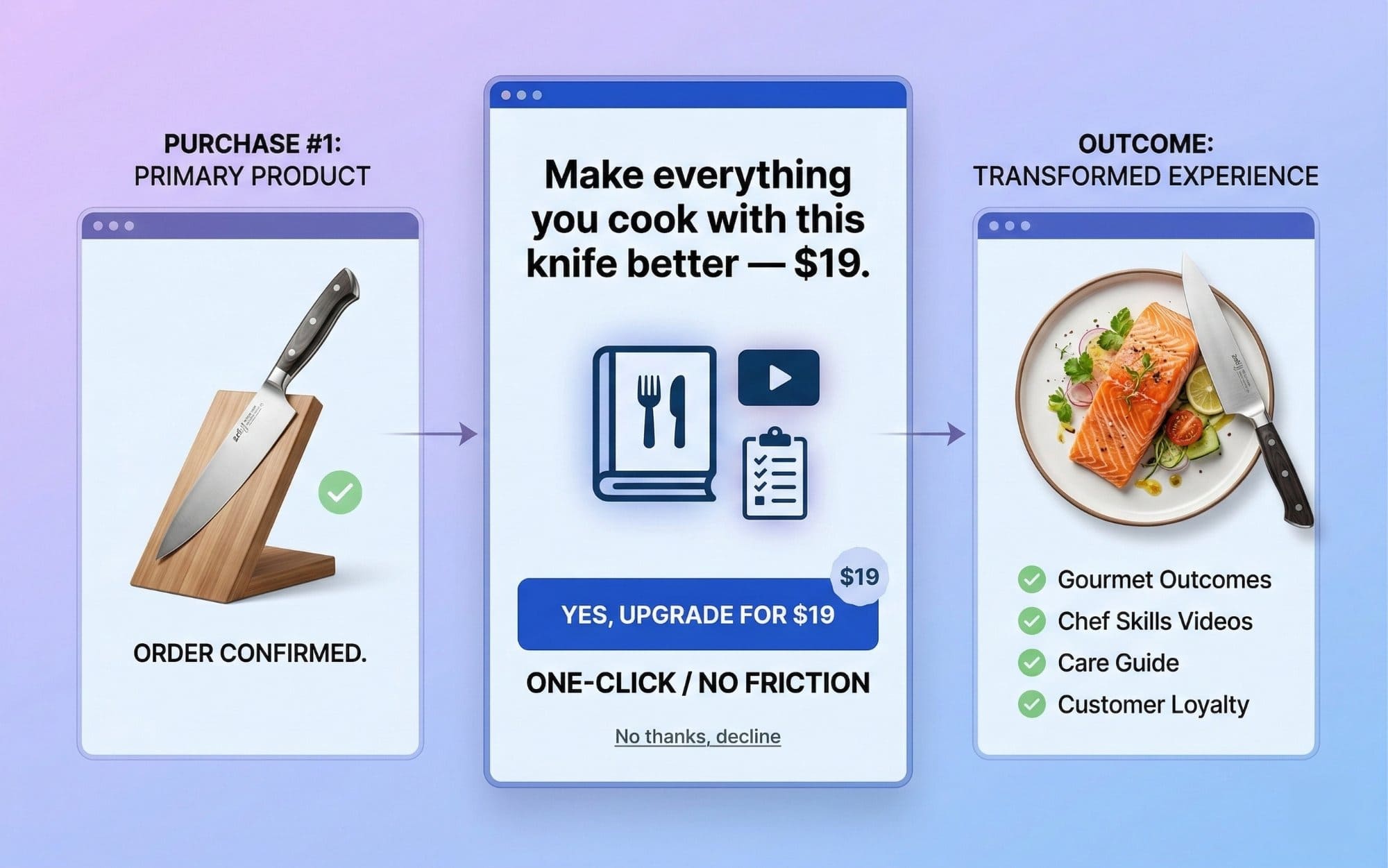
Successful upselling comes down to execution as much as concept. A digital upsell that feels like an afterthought will underperform regardless of how relevant the content is. A few structural principles that separate hybrid upselling offers that work from the ones that don't:
Position the digital offer as an outcome, not a product. Don't say "Digital Recipe eBook — $19." Say "Make everything you cook with this knife taste better — $19." The customer isn't buying a PDF. They're buying a result. Frame accordingly, and make sure the outcome speaks to their customer's experience — not a generic benefit, but the transformation they were seeking when they made the original purchase.
One-click is non-negotiable. A post-purchase upsell that requires the customer to re-enter payment information is not a post-purchase upsell — it's a second checkout, with all the friction and drop-off that comes with it. Conversion rates on multi-step post-purchase offers drop dramatically compared to one-click upsells where the payment is already authorized.
Funnelish's post-purchase upsell flow handles this natively, so the customer accepts or declines with a single click and no additional cost in friction.
Read more: One-Product Funnel: How to Build One
Price the digital offer relative to the physical product, not to its production cost. A $9 digital upsell on a $150 product feels almost free — which means it converts well but adds less to average order value than it could. A $29 digital upsell on the same $150 product is still only 19% of the original purchase price, but meaningfully moves the AOV. The production cost of the digital product is irrelevant to the customer; what matters is whether the price feels proportionate to the added value and to the original purchase.
Test bundle products as well as standalone digital offers. For some categories, bundling the digital product into a higher-tier physical package converts better than presenting it as a separate upsell. A Pro Bundle that includes the physical product plus digital content as a single SKU removes the post-purchase decision and can increase average order value up front. Testing both approaches with your customer base is the only way to know which performs better for your customer behavior and shopping journey.
Use customer data to personalize upselling offers. The more you know about what the customer just bought and why — from quiz data, from browsing behavior, from past purchase history — the more relevant your upselling strategy can be. Relevant suggestions outperform generic offers many times. Entice customers with something that feels made for them, not something that feels like a promotional add-on attached to every order indiscriminately.
Retention Angle Nobody Talks About
The hybrid model has a secondary benefit that's easy to miss: it changes the customer's relationship with your brand in a way that drives customer lifetime value beyond the initial transaction.
A customer who buys a physical product and uses it without guidance has a certain outcome. A customer who buys the same product and uses it with a structured digital guide, a training program, or a recipe collection has a materially better outcome — and they associate that better outcome with your brand, not just with the product category.
This matters for repeat purchases, customer lifetime value, and word of mouth referrals in a way that's hard to assign a number to but genuinely significant. Happy customers who got more than they expected from a purchase tell people about it. They come back. They leave reviews that reference the complete experience — not just the physical product — which becomes social proof that persuades customers further down the buyer's journey.
Upselling opportunities increase revenue in the short term. But the hybrid model — digital add-ons that improve outcomes for physical product buyers — builds customer satisfaction and customer loyalty in a way that compounds over time. The digital component becomes a hidden driver of repeat business, not just a margin expander on a single transaction.
If you're running a physical products eCommerce store and you don't have at least one digital upsell in your post-purchase flow, you are leaving high-margin revenue on the table on every single order. The creation cost for most digital products is one-time. The infrastructure to deliver them is already there if you're on a platform that supports digital delivery natively. The only remaining question is what knowledge, guidance, or content would make your physical product more valuable — and then building that once and attaching it to every order going forward.
Start Upselling with a Ready Template
FAQ
What is an upselling technique?
An upselling technique is any mechanism that increases the revenue from a customer who has already made a buying decision. The buying decision is the hard part — an upsell works with existing momentum rather than creating new intent from scratch.
In eCommerce, the most effective upselling techniques are post-purchase one-click offers (presented immediately after checkout when buying intent is highest), order bumps (small add-ons presented on the checkout page before the transaction completes), and tiered product packaging (where a higher-priced bundle is presented as the default or recommended option).
Each technique works differently depending on where in the customer journey it appears and what the upselling offer actually is.
What are the different types of upselling?
The main categories are:
Quantity upsells (more of the same product at a better per-unit price)
Version upsells (a premium product version of the product with advanced features or quality improvements)
Subscription upsells (converting a one-time purchase into a recurring order)
Bundle products upsells (combining complementary products into a higher-value package)
Service upsells (adding installation, warranty, personalization, or support to a physical product)
The hybrid model described here is a variant of the bundle approach — combining a physical product with a digital product to increase profit margin without increasing fulfillment complexity.
What are some good upselling examples?
Beyond the upselling examples in this post, consider how Peloton upsells the membership alongside the bike — the hardware and software are priced and marketed together because one without the other is significantly less valuable to existing customers.
Or how Vitamix includes recipe books and video content with their blenders, increasing customer satisfaction and reducing buyer's remorse on a high-ticket purchase. In each case, the digital or service component increases the perceived value of the physical product, justifies the price point, and creates post-purchase engagement that drives customer loyalty and repeat business.
What are common upselling mistakes?
The most expensive mistake is presenting upselling offers that feel disconnected from the original purchase — they require new motivation rather than riding existing momentum.
The second common mistake is poor timing: showing upsells before the original transaction is confirmed creates anxiety and can increase cart abandonment. Post-purchase is almost always the highest-converting moment for additional purchases.
The third mistake is friction: any upsell that requires re-entering payment details will underperform a one-click alternative significantly. And the fourth — often overlooked — is pricing the digital upsell based on what it costs to produce rather than on the added value it delivers. Customers aren't buying your production costs; they're buying outcomes. Price for the outcome.
Table of contents
Boost your eCommerce
sales today

24/7 support
No credit card required
Cancel anytime
24/7 support
No credit card required
Cancel anytime
