

Digital Dropshipping: How to Sell High-Margin Products with Zero Inventory
18 December 2025
Anna P.
11 minutes
It’s 2026. The golden era of selling cheap plastic trinkets from overseas is fading.
If you’ve run a traditional dropshipping store recently, you know what we are talking about. You sell a gadget for $30, pay the supplier $15, and spend $10 on ads. That leaves you with $5 — before refunds, chargebacks, and the inevitable "Where is my order?" emails.
Logistics are the silent killer of e-commerce profits. With global shipping costs rising and delivery expectations shrinking to "yesterday," the physical dropshipping model is facing a squeeze.
But a quieter and more profitable revolution is happening: digital dropshipping.
Imagine a business model where the product never runs out of stock, shipping costs $0, and delivery happens in milliseconds. No warehouses, no customs delays, and, most importantly, gross margins that often hover near 100% before ad spend and tax.
This is the reality of selling digital products, and it is arguably the smartest pivot for online entrepreneurs this year.
What is Digital Dropshipping?
Digital dropshipping means selling intangible assets — files, licenses, or content — that customers receive right after the purchase.
Unlike traditional dropshipping, where you are a middleman for a physical item, a digital dropshipping business focuses on delivering value through information or utility. You are selling the outcome (organization, skills, entertainment) rather than the vehicle (a planner, a DVD, a book).
Common digital dropshipping products include:
Ebooks and guides
Software licenses or plugins
Digital art and prints
Online courses and workshops
Design templates (Canva, Notion, Excel)
The dropshipping part of the name is slightly misleading, though effective. You don't hold physical inventory, but you also don't always create the product from scratch (more on that later). The core appeal remains the same: low overhead, high scalability.
Physical vs. Digital Dropshipping Store: Reality Check
Let’s look at the math. Why are veteran e-com pros switching to digital goods?
In a physical dropshipping business, you wake up worrying about a supplier in a different time zone. In a successful digital dropshipping business, you wake up to notifications that downloadable files were delivered while you slept.
One caveat before you celebrate the margin column: "no shipping, no customs" is true, but it does not mean "no tax." Selling digital goods to customers abroad triggers VAT obligations that eat into that near-100% figure — the section below covers exactly how, because it is the part most beginners miss.
Top Niches for Digital Dropshipping Business in 2026
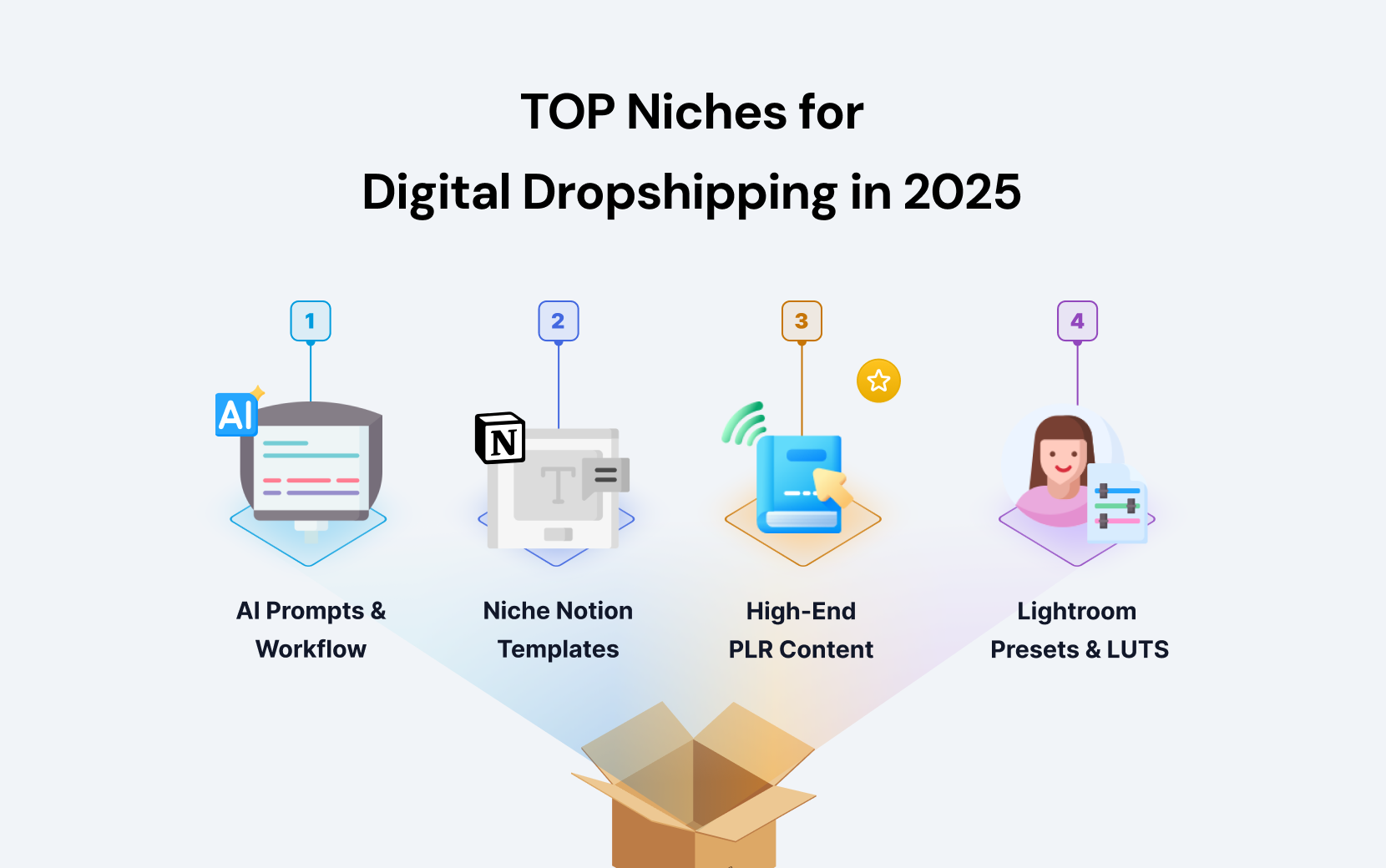
If you want to start digital dropshipping, you need to sell what people are desperate to buy right now. For 2026, we are seeing a shift toward productivity and AI-assisted tools.
AI Prompts & Workflows
As AI tools become complex, small business owners and creators will pay for pre-engineered prompt libraries that save them time.
Niche Notion Templates
Generic planners are out. Specialized second-brain systems for students, ADHD management, or content creators are in high demand.
High-End PLR Content
Private label rights (PLR) allow you to license content and resell it. We aren't talking about low-quality junk; these are high-quality digital goods like expert-written reports or video courses.
Lightroom Presets & LUTS
With video content exploding on social media, video editors and influencers need digital tools to color grade footage in the shortest time possible.
Read more: Most Profitable Dropshipping Niches to Dominate in 2026
How to Source Digital Products
You might be thinking, "I'm not a writer or a coder. How can I sell these?"
You have two main paths to products to sell:
1. Creator Route (High Effort + High Value)
You create the digital offerings yourself. You write the ebook, design the digital artwork, or record the course. This builds a strong brand identity and ensures your product is unique.
2. PLR/Licensing Route (Fast Start)
This is closer to traditional dropshipping. You buy licensing agreements from reliable digital product suppliers or PLR marketplaces. You pay a one-time fee for the rights to rebrand and resell the product as your own.
Note: Always check the license. You want master resell rights or private label rights to support the digital dropshipping model, where you sell the asset repeatedly without paying the original creator per sale.
What Beginners Miss: VAT on Digital Goods
Digital products skip shipping and customs entirely — but they do not skip tax. This is the digital equivalent of the import-duty problem that hit physical dropshipping, and it is the single obligation new sellers most often overlook.
Here is what actually applies when you sell across borders:
European Union — no seller threshold: If you sell to a consumer in the EU, you owe VAT from your very first sale. There is no minimum turnover, no grace period, and no small-seller exemption for businesses based outside the EU. The €10,000 threshold you may read about applies only to sellers already established inside the EU.
You charge the customer's rate, not your own: A template sold to a buyer in the Netherlands is taxed at the Dutch rate (21%); the same file sold to Sweden is taxed at 25%. You need to know each customer's country before you can apply the correct rate.
One registration covers the EU (Non-Union OSS): Rather than registering in 27 countries, a non-EU seller registers for the Non-Union One Stop Shop in a single member state, then files one quarterly return covering all EU B2C sales and makes one payment. A nil return is still required in quarters with no sales once you are registered.
The old MOSS route is dead: If you find guidance telling UK sellers to register for VAT MOSS through HMRC, it predates 2021. Post-Brexit, UK sellers use the Non-Union OSS (registered with an EU member state) for EU customers — the same position as US or Australian sellers.
The UK is now its own track: UK consumers pay 20% VAT on digital products, and a non-UK seller must register for UK VAT from the first B2C sale. Selling into both markets means two compliance tracks — EU OSS for EU customers, UK VAT registration for UK customers.
Keep location evidence: The EU expects two non-contradictory pieces of evidence of where the customer belongs (for example, billing address and IP address), kept on file. Your checkout and payment tooling should capture this automatically.
The takeaway is not "digital is a bad model" — it is still one of the highest-margin models available. The point is that "near 100% margin" is a gross figure. Price your product and pick a checkout or tax tool that handles destination VAT so the tax comes out of the customer's payment, not your profit.
Note: VAT rates, thresholds, and registration schemes change and vary by country. The figures above reflect rules as of August 2026. Confirm your position with a tax professional, a VAT-compliance tool, or a Merchant-of-Record service before you rely on it — a Merchant of Record can take on the VAT obligation entirely, which many small digital sellers prefer to managing it themselves.
Online Store Problem: Why Shopify Themes Might Kill Digital Sales
Here is where most beginners fail. They open a standard online store using a generic theme and list a $20 ebook like it’s a t-shirt. The customer lands on the page, sees an Add to Cart button, then a View Cart page, then a Checkout page.
This is friction.
When selling digital items, impulse is everything, which is why you need a direct path to the solution (not a shopping cart). Furthermore, selling a $20 digital product with a standard checkout is a math problem. If your cost per acquisition on ads is $15, you only make a $5 profit. You cannot scale a business on $5 margins.
You need a higher average order value.
Solution: Digital Funnels for High-Quality Products
To make digital dropshipping profitable, you must move away from stores and toward sales funnels. A funnel focuses the visitor on one outcome. It sells the dream, not the file type. Plus, funnels open up amazing opportunities for the upsell.
Math Behind the Funnel
Main offer: $17 ebook on "Cracking the Harvard Essay."
Order bump: $9 "Alumni Interview Cheat Sheet" (tick a box to add).
One-click upsell: $37 "Common App Video Walkthrough" (added instantly after checkout).
Suddenly, that $17 customer is worth $63. Your ad costs stay the same, and your profit triples.
Funnelish: How to Build Funnels That Sell Digital Products
While standard platforms like Shopify are undeniably powerful, they often restrict you to rigid checkout flows with fewer opportunities for flexible one-page purchase success or upsells. Funnelish solves this by integrating with your Shopify store, giving you the freedom to craft a high-converting customer journey for digital goods.
Total Control of the Customer Flow
Design every touchpoint exactly as you envision it. Instead of forcing your product into a standard template, you can craft the whole journey — from the first headline to the final Thank You screen. Funnelish gives you the tools to fully control the experience and ensure it aligns perfectly with your brand identity.
Deep Focus & Higher Average Order Value
Traditional stores are quick to distract customers with hundreds of SKUs. Funnels allow you to focus on a single offer and give you the space to explain the benefits of your digital product in depth. Once the customer is sold on the core value, you can maximize your revenue through strategic order bumps and upsells right within the flow.
All-in-One Delivery & Automation
You don’t need a complex stack of third-party apps to send your digital orders. Funnelish keeps everything under one roof. You can automatically deliver your downloadable files and trigger emails from the platform, so your customers get instant access without you lifting a finger.
Step-by-Step Launch Guide
Ready to start a digital dropshipping venture? We've made up an easy-to-follow roadmap for beginners:
Identify the pain: Don't start with the product. Start with the problem. (e.g., "People want to edit videos for TikTok but don't know color theory.")
Source the solution: Create the presets yourself or buy a high-quality pack from digital dropshipping suppliers.
Build the funnel: Use Funnelish to create a landing page.
Headline: Focus on the result ("Get Cinematic Color in One Click").
Order Bump: Add a small, relevant tool (e.g., a framing cheat sheet).
Drive traffic: Run marketing campaigns on TikTok or Instagram Reels using the product (show the before and after of the preset).
Automate: Set up email automation tools to get the files delivered electronically and follow up with more value.
Set up tax handling: Before you scale ad spend, configure your checkout or a tax tool to charge destination VAT on cross-border sales, so compliance is automatic rather than a year-end surprise.
So, is it Easier Than Traditional Dropshipping?
Yes and no.
It is logistically easier. You will never deal with a lost container ship, shipping delays, or a broken product. The hassle-free experience of fulfillment is unmatched. You do, however, trade physical logistics for tax admin — no customs forms, but VAT registration and reporting instead.
However, your marketing strategies must be sharper for this type of digital target audience. Because the customer can't touch the product, your copy and visuals must convey high perceived value. You are selling trust in the first place.
If you can master the funnel, digital dropshipping offers the holy grail of business: passive income potential with high profit margins that physical products cannot compete with.
Digital Dropshipping FAQs
Is digital dropshipping real?
Yes, it is a legitimate business model. It involves selling digital goods (like files, templates, or licenses) where the product is delivered automatically. It is called selling digital products, but dropshipping refers to the hands-off fulfillment nature.
How much do I need to start digital dropshipping?
You can start with very little capital and business skills. You need a domain, a funnel builder (like Funnelish), and the product. If you create the product yourself, your cost is time. If you license PLR content, it might cost $50–$100 upfront.
What to sell on digital dropshipping?
The best products to sell are those that solve immediate problems. Think e-books, stock photos, audio files, video editors' assets (LUTs, effects), and productivity tools (Notion templates).
Is digital dropshipping profitable?
It can be a highly profitable venture due to the lack of shipping costs and COGS (cost of goods sold). Once a digital product is created, selling it 1,000 times costs roughly the same as selling it once. Just remember that "no production cost" is not "no cost per sale" — payment fees and destination VAT still apply, so build those into your pricing.
Can you dropship digital products?
Yes. You can resell products you have licensed rights to or act as an affiliate for software. However, the most successful digital dropshipping business usually involves selling private-label digital goods where you control the brand.
How to start digital dropshipping?
Choose a niche.
Source from third-party suppliers or create a digital asset.
Set up a sales funnel (storefronts convert less).
Run traffic to the funnel.
Automate the file delivery.
Set up VAT/tax handling for cross-border sales.
Can you dropship digital products for free?
You can start with free tools to create products (like Canva), but you will likely need a budget for a website/funnel builder and ads to get traffic. Selling digital downloads purely for free (organic traffic only) takes much longer to scale.
Get Your Free Digital Dropshipping Template
We want to see you succeed, so we’ve built a proven digital dropshipping funnel template to fast-track your setup. Use this as your foundation to create a sales-ready flow today!
Start with a Template for Free
Table of contents
Boost your eCommerce
sales today

24/7 support
No credit card required
Cancel anytime
24/7 support
No credit card required
Cancel anytime
