

How to Start Dropshipping Business in 2026: Practical Guide
30 January 2026
Anna P.
24 minutes
The year 2026 marks a mature era for electronic commerce. The wild west days of 2017 — where you could throw a generic fidget spinner on a slow website and accidentally become a millionaire overnight — are firmly in the rearview mirror.
But here is the good news: the industry has stabilized. The get-rich-quick scammers have mostly moved on to the next shiny object, meaning dropshipping success is now about building a sustainable business rather than chasing a fleeting glitch in the Instagram algorithm.
If you are looking to start a dropshipping business today, you have better tools, smarter software, and more access to global markets than ever before. The barrier to entry remains low, but the barrier to profitability has risen. It requires strategy, speed, and a customer-first approach.
One shift defines 2026 more than any other: the era of duty-free imports is ending. The United States has removed its $800 "de minimis" exemption that once let low-value parcels enter tax-free, and the European Union is phasing out its own €150 threshold. Import taxes now apply to the small cross-border parcels that the old dropshipping playbook was built on. This guide reflects that new reality — the winning model in 2026 is built on smart sourcing and local fulfillment, not cheap parcels slipping through customs.
Let’s walk through how to start dropshipping, moving from the messy napkin idea stage to scaling a global empire using advanced tools like geo-funnels and high-speed landing pages.
Dropshipping Business Structure Foundation
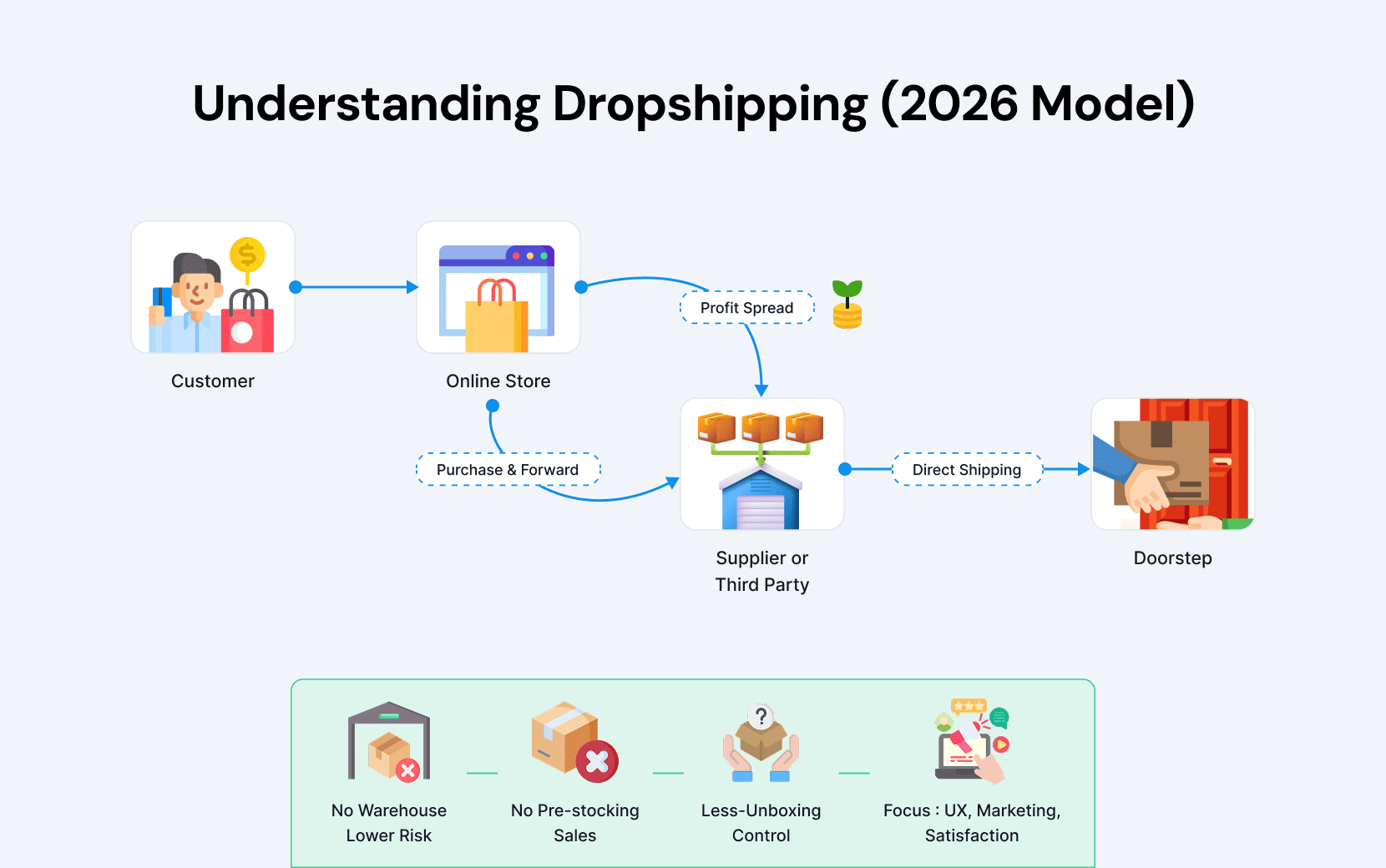
Before you go hunting for products or scrolling TikTok for trends, you must treat this venture with the seriousness of a traditional retail business. Many beginners fail because they treat it like a weekend hobby; the tax authorities, however, will treat you like a business regardless.
Understanding Dropshipping Business Model
Let us clarify how dropshipping works in 2026. The core concept remains the same: you sell products online, but you never touch the inventory. When a customer places an order on your online store, you purchase that item from a third party, and the supplier ships it to the customer's doorstep.
Your profit is the spread — the difference between the retail price you set and the wholesale cost plus shipping. In 2026, that spread also has to absorb import duties on any goods crossing a border, so landed cost — product plus shipping plus duty — is the number that matters, not the sticker price from your supplier. This model eliminates the need for a warehouse, lowering your upfront risk. However, there is no such thing as a free lunch. Because you are not managing inventory, you lose control over the unboxing experience. To compensate, you must excel in the areas you do control: marketing, elite user experience, and customer satisfaction.
Read more: Dropshipping vs Ecommerce: Which Business Model Wins in 2026?
Structuring Your Business
You need a legal entity. While you can technically start as a sole proprietor, forming a Limited Liability Company is the smarter move to protect your personal assets (like your car or house) from business liabilities. Stripe Atlas or ZenBusiness can handle this paperwork for you remotely. This separates your personal and business finances, which is critical when you start scaling.
Once your entity is registered, open a dedicated business bank account. Mixing your grocery money with your Facebook Ad spend is a recipe for disaster and a nightmare for your accountant. You need a clean paper trail. Speaking of taxes, understanding sales tax laws — like economic nexus laws in the United States or Value Added Tax One Stop Shop in Europe — is non-negotiable for anything sustainable.
On top of sales tax and VAT, cross-border sellers now deal with import duties on inbound parcels as well — a genuinely new compliance layer in 2026. TaxJar or Avalara can automate this now, but you need to set it up correctly from day one to avoid penalties later.
Counting the Costs
How much money do you really need to start a dropshipping business? In 2026, you can start lean, but the start for zero-dollar gurus is lying to you. You need a realistic budget for:
Technology stack: Electronic commerce platform or sales funnel builder subscriptions (for example, Shopify for the backend, Funnelish for the frontend).
Identity: Domain name registration.
Product validation: Sample products (never, ever sell what you have not held in your own hands).
Fuel: Marketing budget. Paid ads usually require 500 to 1,000 dollars upfront just to gather meaningful data before you make a profit.
Import duties (new for 2026): If you source from overseas, build the applicable duty into your cost of goods from the start. This is the line that quietly erased margins for sellers who kept pricing as though imports were still duty-free.
Can you start dropshipping with less? Yes, if you rely on organic content (TikTok or Instagram Reels), but paid traffic is faster. Money buys speed; time buys organic growth. Pick your currency.
Finding a Winning Product in 2026
The days of selling general stores with everything from dog leashes to iPhone cables are long gone. Amazon already does that better than you ever will. To build a successful dropshipping business, you need a sniper-focused niche.
Niche Down to Scale Up
A product category like Fitness is too broad; you will get crushed by Nike and Gymshark. Home Workout Equipment for Seniors is better. Yoga Gear for Pregnant Women is even stronger. You want a target audience that is passionate, underserved, and maybe, a little too excited about their spending.
Look for products that solve a painful problem or feed a passion. Pet accessories are a classic example, but instead of a generic leash, look for an anxiety-calming bed for large breed dogs with hip dysplasia. The specificity allows you to target your marketing efforts effectively and achieve higher conversion rates because the customer feels you made the product just for them.
Read more: Digital Dropshipping: How to Sell High-Margin Products with Zero Inventory
Validating Your Dropshipping Business Ideas with Real-Time Data
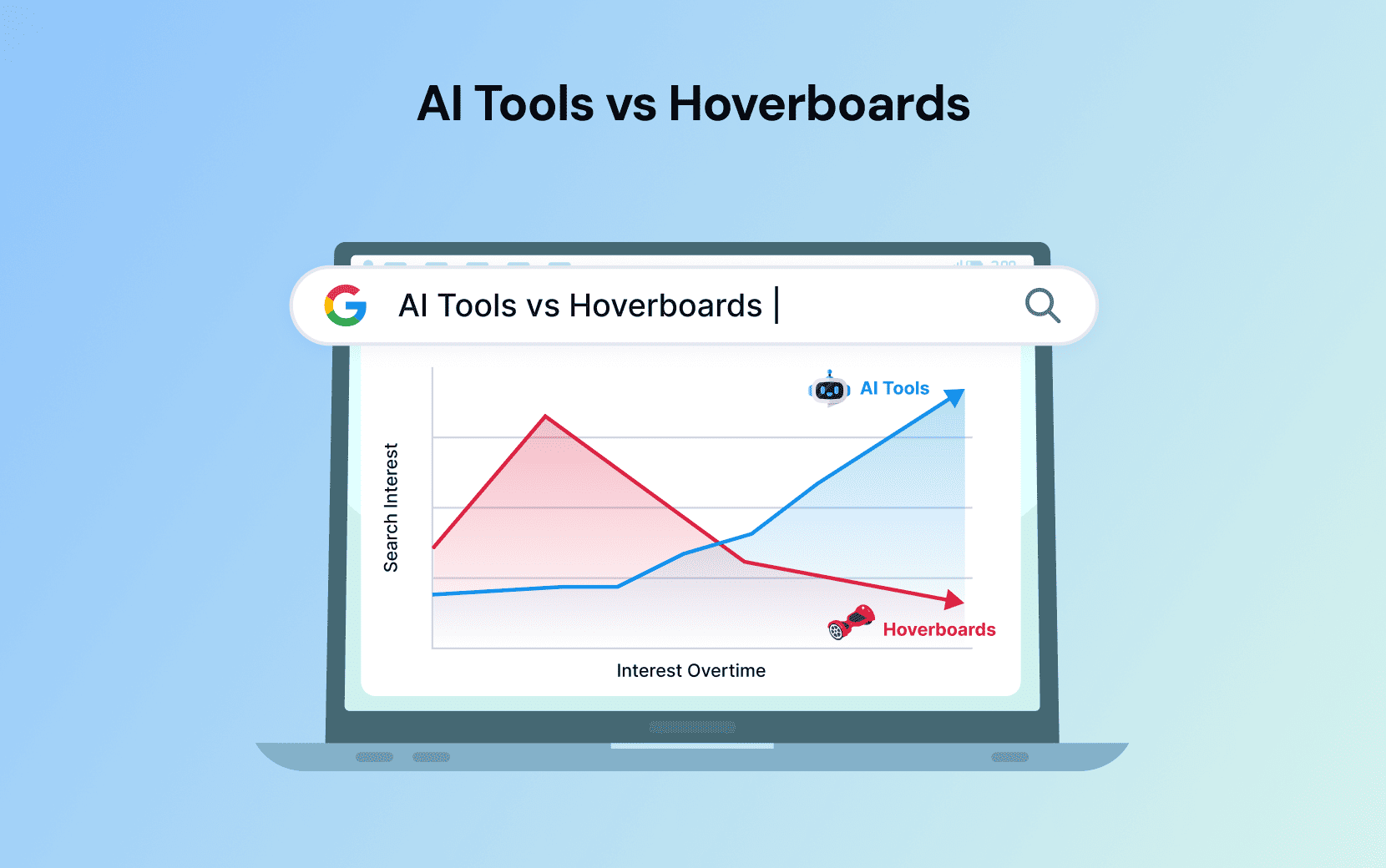
Once you have shortlisted the niches, do not guess. Your intuition is often wrong. Use hard data to validate demand:
Google Trends: Check the interest over time. Is the trend rising (like artificial intelligence tools) or dying (like hoverboards)?
Social listening: Go to TikTok and Instagram. Search for hashtags related to your niche. Look at the comments. What are potential customers complaining about? Comments saying "I wish this came in pink" or "This broke after two days" are goldmines for product improvement.
Competitor spy tools: Use software like Minea, AdSpy, or Foreplay to see what ads are currently running successfully. If a competitor has been running the same product ad for six months, they are not losing money — they are printing it.
High Ticket vs Low Ticket
In 2026, profit margins matter more than volume. Selling a 10 dollar phone case with a 2 dollar margin requires thousands of sales to pay your rent. It is a customer service nightmare. It is also the category hit hardest by the end of duty-free imports: when a small margin has to absorb a new import duty on every unit, the math often stops working entirely.
Conversely, selling a 200 dollar specialized device (like a red-light therapy lamp) with a 60 dollar margin requires far fewer sales to hit your goals. High-ticket dropshipping allows you to spend more on customer acquisition while maintaining healthy margins. It is much easier to manage 5 customers a day than 500.
Sourcing and Supply Chain
Your dropshipping supplier is your silent business partner. If they fail — by shipping late or sending broken items — you take the blame, not them. In 2026, your supplier's location is no longer just a shipping-speed decision — it is the single biggest factor in whether your unit economics survive.
2026 Import-Tax Reality (Read This First)
This is the change that reshaped dropshipping, and it is why the sourcing advice below looks different from older guides.
United States
The $800 de minimis exemption — which let parcels under $800 enter duty-free — is gone. It was suspended for China and Hong Kong on 2 May 2025, then for all countries on 29 August 2025, and it is permanently repealed by law (the One Big Beautiful Bill Act) effective 1 July 2027. A federal trade court upheld the suspension in August 2026, so this is settled. Every inbound parcel now pays applicable duties.
Duties Stack on Chinese-origin Goods
For products made in China, Section 301, IEEPA, and Section 232 tariffs can apply on top of one another, producing high effective rates on items that used to enter at zero. This is why direct-from-China-to-US-consumer dropshipping is no longer viable at the old margins.
No Parcel-splitting Workaround
Since 3 August 2025, splitting an order into many sub-$800 parcels or understating value carries civil penalties (up to $5,000 for a first violation, $10,000 after). The old evasion tricks are now an enforcement target.
European Union
The €150 duty-free exemption is being phased out, with an interim €3-per-parcel customs duty from 1 July 2026 until the permanent system arrives. VAT still applies from the first sale. The United Kingdom is phasing out its own de minimis by 2029.
Note: Duty rates, tariff codes, and effective dates change frequently and vary by product and country of origin. Confirm the current rate for your specific goods with a customs broker before you price a product.
Finding Reliable Dropshipping Suppliers
Because of the changes above, the sourcing hierarchy has flipped. Local fulfillment is no longer just a "faster shipping" upgrade — for the US market it is the survival path. AliExpress is good for testing an idea over the weekend, but factor in that a direct-from-China parcel to a US customer now arrives with stacked duties, so treat those test numbers as a floor, not your real margin.
For a successful dropshipping business in 2026, you need faster shipping, better product quality, and predictable landed costs.
Local fulfillment (now the priority): Suppliers with warehouses inside your target market — the United States or Europe — let you avoid per-parcel import duties, clear customs once in bulk, and ship domestically. This is what keeps US-facing dropshipping profitable in 2026. Zendrop is a great filter for this. Local fulfillment also reduces shipping times from 2 weeks to 3 days, which can improve customer satisfaction.
Private agents: Once you have consistent daily orders (usually 10 to 20 per day), hire a private sourcing agent in the export country. They can source high-quality products, negotiate better prices than public marketplaces, help you consolidate shipments to manage duty efficiently, and offer faster shipping lines.
Quality Control
It's never enough to mention: Always order samples. You need to check the packaging, the build quality, and the smell test (literally — some cheap manufacturing smells like chemicals). You are building a brand reputation, and if the product feels cheap, your customer loyalty will vanish in no time.
Unit Economics: Before and After the Import-Tax Change
Abstract advice only goes so far. The clearest way to see why sourcing strategy now decides survival is to run the actual per-order math. Below are three simplified scenarios for a US-facing store. The numbers are illustrative and rounded to make the mechanics obvious — your real figures depend on your product, supplier, ad efficiency, and the specific duty rate for your goods.
Note: The duty percentages below are illustrative examples, not current published rates. Effective tariffs on Chinese-origin goods stack (Section 301 + IEEPA + Section 232) and vary widely by product category. Confirm the real rate for your HTS code with a customs broker before pricing anything.
Scenario 1: Low-Ticket Item That Breaks
A $25 phone accessory, shipped direct from China to the US customer. This is the classic old-playbook product — and the one the import-tax change hits hardest.
Per-order line | Before (duty-free) | After (duty now applies) |
Retail price | $25.00 | $25.00 |
Product + shipping cost | $8.00 | $8.00 |
Import duty (illustrative ~40%) | $0.00 | $3.20 |
Payment processing (~3%) | $0.75 | $0.75 |
Ad cost per order (CPA) | $12.00 | $12.00 |
Net profit per order | $4.25 | $1.05 |
The retail price and ad cost did not move — but profit per order fell by roughly 75%. On a low-margin item, the new duty is the difference between a viable product and one that cannot absorb a single refund, chargeback, or ad-cost spike. This is why "just test it on AliExpress and scale" no longer works for the US market.
Scenario 2: High-Ticket Item That Survives
A $200 specialized device (for example, a red-light therapy lamp), also shipped direct from China. Same duty rate — very different outcome.
Per-order line | Before (duty-free) | After (duty now applies) |
Retail price | $200.00 | $200.00 |
Product + shipping cost | $70.00 | $70.00 |
Import duty (illustrative ~40%) | $0.00 | $28.00 |
Payment processing (~3%) | $6.00 | $6.00 |
Ad cost per order (CPA) | $45.00 | $45.00 |
Net profit per order | $79.00 | $51.00 |
The duty still stings — profit drops from $79 to $51 — but the order stays firmly profitable. A high-ticket product has enough margin to absorb the new cost and keep spending on customer acquisition. This is the reason we push high-ticket over low-ticket in 2026.
Scenario 3: Fix — China-Direct vs US Local Fulfillment
Take the same $200 device and change one thing: instead of shipping each unit from China, you import in bulk (paying duty once, at a better per-unit rate) and fulfill domestically from a US supplier or warehouse.
Per-order line | China-direct, per parcel | US local fulfillment |
Retail price | $200.00 | $200.00 |
Product cost (bulk import, duty amortized) | $70.00 + $28.00 duty | $82.00 all-in |
Shipping to customer | (included above) | $7.00 domestic |
Payment processing (~3%) | $6.00 | $6.00 |
Ad cost per order (CPA) | $45.00 | $45.00 |
Net profit per order | $51.00 | $60.00 |
Delivery time | ~2 weeks | ~3 days |
Bulk-importing and fulfilling locally recovers margin (duty is paid once at a negotiated rate rather than per parcel at the retail-parcel rate) and cuts delivery from two weeks to three days. Better economics and a better customer experience at the same time — which is exactly why local fulfillment is the strategic answer to the end of duty-free imports.
The takeaway across all three: the import-tax change does not kill dropshipping. It kills thin-margin, ship-every-parcel-from-China dropshipping. Higher-ticket products and local fulfillment are how a serious store stays profitable.
Find Your Own Duty Rate
Do not price a product off the illustrative percentages above — look up the real rate for your specific goods. Duty depends on your product's classification code and its country of origin. Here is where to find the official numbers:
United States — USITC Harmonized Tariff Schedule: Search by product description or HTS code to find the base (MFN) duty rate for your item. This is the official schedule that U.S. Customs uses.
United States — CBP: Determining Duty Rates: Explains how the base rate combines with additional tariff layers. For Chinese-origin goods, remember that Section 301, IEEPA, and Section 232 tariffs can stack on top of the base HTS rate — the schedule shows the base, not the total.
European Union — TARIC (Integrated Tariff of the EU): Search by product code and country of origin for the duty applicable to imports into any EU member state. Note that TARIC shows customs duty only, not national VAT rates.
United Kingdom — UK Integrated Online Tariff: Look up commodity codes, duty rates, and import VAT for goods entering the UK.
Note: These government tools give you the classification and base duty. For a binding classification or the full landed-cost picture on a product you are about to commit to, use a licensed customs broker — misclassification carries penalties, and the broker will also account for the additional tariff layers that a base-rate lookup does not show.
Building a High-Conversion Funnel

To truly succeed in dropshipping, you have to look at the math. The reality of the business involves navigating high advertising costs, potential refund charges, import duties, and fluctuating shipping rates. If you only rely on a standard retail margin, these costs will eat you alive.
That is why a thoughtfully-designed digital sales funnel has become necessity. Unlike a standard product page, a funnel is engineered to increase your average order value through upsells and bundles, which ultimately secures the higher profit margins required to scale.
Most successful dropshippers follow a specific workflow:
Test broadly: They use a standard eCommerce store (like Shopify) with a large catalog to test multiple products quickly.
Scale precisely: Once a winning product is identified, they migrate it to a dedicated sales funnel. This isolates the product to maximize its conversion rate and unlock its full potential.
This is where most beginners lose the game. They try to scale that winning product on a standard, slow online store that looks like a generic template. In 2026, where attention spans are getting shorter (around 76 seconds), you cannot afford distractions. You do not just need a store; you need a focused sales funnel.
Why Speed Kills (the Competition)
Speed is a feature. Google's Core Web Vitals metrics clearly state that if your mobile page takes 3 seconds to load, you lose up to 53 percent of your traffic. That is half your ad budget wasted before the customer sees the product.
Fast page speed is essential, and the best dropshipping sales platforms have it built in. For example, Funnelish offers pages that can load in less than 1 second. When your page is instant, your bounce rate drops, and your marketing efforts yield a higher return on investment.
Power of Geo-Funnels
One of the massive opportunities in 2026 is global selling. But showing a United States Dollar checkout to a customer in Berlin can kill conversion. It might feel foreign and untrustworthy.
Geo-funnels allow you to customize the experience based on where the visitor is located physically.
Dynamic multi-currency checkout: A customer in Paris sees Euros; a customer in Tokyo sees Yen.
Localized payment methods: In the Netherlands, people rely on iDEAL. In Brazil, they use Pix. If you only offer credit cards, you lose the sales. Funnelish handles this dynamic switching automatically.
Targeted content: You can even change the headlines or images based on the region. Winter coats sell in Canada, while you sell swimsuits to Australia on the same day.
When you sell into multiple countries, remember that duties and taxes are assessed at the destination. Be transparent about any import charges, or price them in, so customers are not surprised at the door — the fastest way to lose a cross-border sale is a fee the buyer did not expect.
No-Code Building
You do not need to be a developer or know how to code. A robust page builder lets you drag and drop elements to create a high-converting landing page. You need a headline that hooks, benefits (not just features), social proof (reviews), and a clear, singular call to action.
Scaling with Shared Components
As you grow, you might launch multiple funnels for different products. Shared components allow you to update a header, footer, or testimonial block once, and it updates across all your funnels instantly. This saves hours of busy work, letting you focus on marketing strategies rather than pixel-pushing.
Maximizing Average Order Value
Finally, a high-converting funnel is not just about the first sale; it is about the total sale.
Customizable checkout: Add order bumps (for example, "Add batteries for 5 dollars") and one-click upsells right in the checkout flow.
A/B testing: Scientifically test headlines, images, and offers to see what generates the most profit.
All this is possible without coding on Funnelish. Start your free 14-day trial today without credit card to see what it looks like inside and how easy it is to launch with a pre-built template.
Read more: Sales Funnel Template: Free Ecommerce Download
Driving Traffic and Marketing
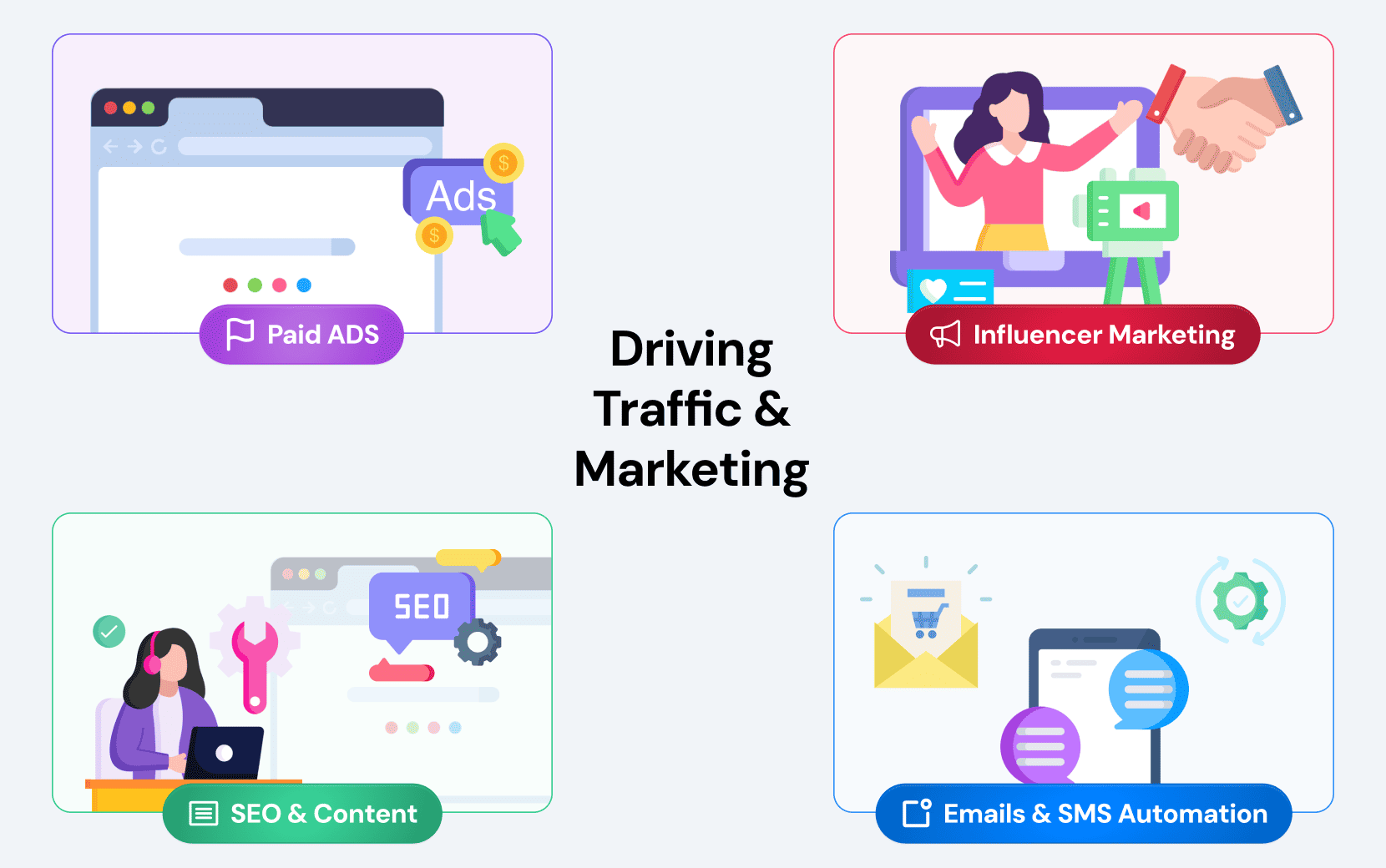
So, you have the shop; now you need the people. Smart marketing is the fuel of your electronic commerce business.
Paid Ads
Paid ads on Meta (Facebook and Instagram) and TikTok remain the dominant way to generate sales quickly.
Hook: The first 3 seconds of your video must stop the scroll. It needs to be visually jarring or emotionally resonant.
Offer: Bundle items together to increase the average order value. Buy one, get one 50 percent off works wonders for profit margins compared to selling a single unit.
Testing: Test different creatives (User Generated Content style videos versus polished ads) and headlines. The market decides what wins, not your personal taste.
Read more: 10 D2C Marketing Trends from Top Brands to Scale Profitably
Influencer Marketing
People trust people. Sending your high-quality products to micro-influencers in your niche can generate authentic content and sales. You will likely see better Return on Investment than cold ads because the trust is already established. Use Insense or Billow to connect with creators who can make user generated content for you.
Search Engine Optimization and Content
For long-term growth, search engine optimization is nearly the only sustainable sales channel in the digital landscape. Write blog posts answering customer questions related to your niche. If you sell coffee makers, write guides on how to brew the perfect pour-over to bring in free traffic over time. This is the slow burn strategy that pays off dividends years later, unlike other channels.
Email and SMS Automation
Do not let leads vanish. If someone adds to cart but does not buy, an automated email sequence can recover that sale. Email marketing has the highest return on investment of any channel because you own the list — Mark Zuckerberg cannot take it away from you. Use it to announce new drops, sales, and build customer loyalty.
Operations and Customer Experience
Excellent customer service is what separates the successful dropshipping business from the fly-by-night failures.
Managing Expectations
Be transparent about shipping times. If it takes 10 days, say 10 days. Customers appreciate honesty more than speed. Set up a clear Frequently Asked Questions page addressing shipping costs, any import duties or customs charges, returns, and tracking. In some countries, if you don't fulfill the orders in the promised timeline, you risk getting strict penalties and losing your dropshipping business.
Handling Issues
Eventually, problems will happen. A package will get lost; a product will arrive broken. How you handle it defines your brand. Use a helpdesk tools to centralize tickets. Offer a refund or a replacement immediately — no questions asked. Exceptional customer service turns an angry customer into a loyal advocate. Your timely, sincere care is a powerful tool that can make people forget they ever had issues with your store.
Financial Health
Like in any serious business, you need to monitor your finances weekly. Track your profit margins after ad spend and product costs. Include duty and customs fees in that calculation — for cross-border goods they are now a core line item, not an afterthought. It is easy to move a lot of revenue but make zero profit if you are not watching the numbers. Keep your personal and business finances strictly separate to make tax season manageable. Read the book Profit First — it is a bible for electronic commerce entrepreneurs.
Scaling and Automation in 2026
Once you have a winner, it is time to pour gasoline on the fire.
Horizontal vs Vertical Scaling
These are two paths you can follow to make your new venture even more fruitful:
Vertical: Increasing the budget on your winning ads.
Horizontal: Launching the same product in new countries. Here, geo-funnels become your best friend. You can take a winning United States offer, translate the copy using Gemini, switch the currency, and launch in Germany, France, or Brazil overnight. Just re-run your landed-cost math for each new market first — duty and tax rules differ by country, and a winner in one market can be a loser in another once local import charges are applied.
The best news: you can do both.
Team Building
The challenging news, however, is that you cannot do it all forever alone. Hire virtual assistants from platforms on Upwork to handle customer service and order fulfillment. This way, you can free yourself up to focus on high-level strategy and finding the next business idea.
Tech Stack Optimization
On the tech side of things, you need to ensure your electronic commerce platform talks to your fulfillment software. Automation rules can automatically send orders to your dropshipping supplier and upload tracking numbers back to the customer. Having a streamlined flow allows you to handle 50 orders a day or 5,000 without breaking a sweat.
What is Next?
Building a successful dropshipping business in 2026 is a journey of adaptation. The market rewards those who prioritize the customer experience and treat this like a real profession, not a slot machine. By choosing the right business structure, sourcing in a way that keeps your landed costs predictable, partnering with a reliable supplier, and utilizing powerful technology like Funnelish to deliver fast and localized experiences, you set yourself up for victory.
Do not wait for the perfect time — it does not exist. The data is there. The tools are ready. The sales channels are open.
Ready to build a store that actually converts?
Try Funnelish for free today. Your global empire starts with a fast-loading page!
FAQs
How do I start dropshipping for beginners?
Start by researching a profitable niche and validating demand using Google Trends and social media. Form a legal entity (like an LLC), open a business bank account, and find a reliable dropshipping supplier — ideally one with local fulfillment in your target market, so you are not paying import duty on every parcel. Build a fast, mobile-optimized funnel using a Funnelish, then drive traffic using paid ads or organic content.
Start with a Free Funnel Template
How much does it cost to start a dropshipping business?
Realistically, you should have between $500 and $1,000. This covers your e-commerce platform subscription, domain, sample products, and an initial testing budget for ads. If you source from overseas, remember that import duties are now part of your cost of goods, so price them in from the first sale. While you can start with less, having this cushion increases your chances of dropshipping success.
Can I dropship with $0?
Technically, yes, but it is much harder. You can use Funnelish free trial and rely 100% on organic social media (posting TikToks/Reels) to attract customers. However, you will eventually need money to fulfill the first few orders — including any import duties on inbound goods — before the payment processor releases your funds.
Is 500 enough to start dropshipping?
Yes, $500 is a viable starting point. Allocate $100 for platform fees/domain, $50 for samples, and $350 for testing marketing strategies. You will need to be disciplined with your ad spend and quick to cut losing ads.
Who is the richest dropshipper?
It is hard to pinpoint a single richest individual as many have transitioned into building private equity firms or massive brands. However, figures like Andreas Koenig and others in the space have generated 8-figures. The richest are usually those who evolved their dropshipping business model into a full brand.
Can you be a millionaire doing dropshipping?
Yes. Many entrepreneurs have made millions. However, they didn't do it by staying small. They treated it as a real e-commerce business, focused on customer satisfaction, scaled aggressively into international markets, and eventually built a brand asset they could sell.
Can I dropship for free?
You can start dropshipping processes for free (research, finding suppliers), but operating a business has costs. You need to pay for your domain and your hosting. You can minimize costs, but a purely free business usually lacks the professionalism to convert high-value customers.
How to start dropshipping on Amazon?
Amazon dropshipping has strict rules. You must be the seller of record on all invoices. Generally, you list products on Amazon, and when they sell, you buy from a supplier who ships to the customer. However, Amazon prefers the FBA (Fulfillment by Amazon) model. Dropshipping on your own site (via Funnelish or Shopify) gives you more control over the customer places and the data.
How much money do you need to start a dropshipping business?
To do it comfortably in 2026, aim for $1,000–$2,000. This gives you enough runway to test multiple products, absorb some initial losses on ads, and cover shipping costs and import duties while waiting for payouts. It allows you to invest in better creative assets and marketing materials from day one.
Is dropshipping legal?
Yes, absolutely. Dropshipping is simply a supply chain management method — a fulfillment model used by everyone from small startups to major retailers like Wayfair and Home Depot. You are the retailer; the supplier is your warehouse. However, while the model is legal, how you operate can get you into trouble if you ignore local laws.
Here is what you need to know, broken down by region:
United States: The model is fully recognized, but the IRS and FTC are watching. You need a valid business entity (like an LLC) and an EIN. The biggest change in 2026 is import duty: the $800 de minimis exemption that let low-value parcels enter duty-free has been removed (suspended across all countries on 29 August 2025 and repealed by law effective 1 July 2027), so nearly every inbound parcel now owes duty. For Chinese-origin goods, Section 301, IEEPA, and Section 232 tariffs can stack. You also still need to handle Sales Tax Nexus — most states require you to collect and remit sales tax once you hit a certain revenue threshold (often $100k) or transaction count in that state. Also, the Federal Trade Commission mandates that if you promise 3-day shipping, you must deliver in 3 days. Truth in advertising is a fundamental principle. One narrow exception remains: genuine personal gifts under $100 (or $200 from Mexico, Canada, and Caribbean territories) — but this does not cover commercial orders, so it is not a dropshipping workaround.
European Union & UK: The laws here focus on consumer protection and taxes.
VAT and duty: Unlike the US sales tax, VAT often applies from the first sale. The Import One-Stop Shop system still lets you collect VAT at checkout, which streamlines the tax side. What changed in 2026 is duty: the EU is phasing out its €150 duty-free threshold, with an interim €3-per-parcel customs duty from 1 July 2026 until a permanent system is in place — so goods under €150 are no longer duty-free, only VAT-simplified. If you skip collecting these charges up front, your customer gets hit with surprise fees at the door — and you lose a customer for life.
GDPR: You must handle customer data (emails, addresses) with extreme care. You cannot sell their data or spam them without consent.
Returns: European customers generally have a Right of Withdrawal, allowing them to return products within 14 days for any reason. Your store policy cannot override this law.
Global rule (Intellectual Property): The biggest legal trap is copyright infringement. Selling a generic building block set is legal. Selling a set with Harry Potter on the box without a license is illegal everywhere. If you sell counterfeit goods (fake Nike, Gucci, Disney), you aren't dropshipping; you are trafficking counterfeit goods, which leads to payment bans and potential lawsuits.
Dropshipping is 100% legal, provided you pay your taxes and duties, protect consumer data, and sell legitimate products.
More about this: Is Dropshipping Legal in 2026?
Note: The duty thresholds, dates, and tariff rates above reflect rules as of August 2026 and are changing quickly. Confirm the current position for your products and markets with a customs broker or the relevant customs authority before relying on it.
Table of contents
Boost your eCommerce
sales today

24/7 support
No credit card required
Cancel anytime
24/7 support
No credit card required
Cancel anytime
