

Dropshipping vs Ecommerce: Which Business Model Wins in 2026?
05 December 2025
Anna P.
16 minutes
If you are stepping into the world of online business in 2026, you have likely hit a common roadblock: the confusion between dropshipping vs ecommerce.
Most beginners confuse the two terms, using them interchangeably. It is an easy mistake to make because:
Both involve selling products online
Both require a digital storefront
Both rely on getting customers to click Buy Now
Yet under the hood, they are two completely different engines. One runs on speed and low risk; the other runs on control and brand equity. Choosing the wrong model for your budget and goals is the fastest way to burn through your startup capital.
In this guide, we are going to strip away the hype and look at the hard facts. We will compare the dropshipping business model against the traditional ecommerce business model, look at the real costs involved, and explain why the smartest players in 2026 are actually using a hybrid of both – powered by high-converting sales funnels.
One 2026 development shapes this whole comparison, so it is worth naming up front. The US ended its $800 de minimis exemption, which means low-value parcels imported from overseas now carry import duty. This used to be a cost that mainly affected bulk-importing ecommerce businesses. It now reaches dropshippers too, and as you will see below, it quietly narrows one of dropshipping's historical advantages and strengthens the case for the hybrid model this guide recommends.
What is Dropshipping?
Dropshipping is a retail fulfillment method where a store doesn't keep the products it sells in stock. Instead, when a store sells a product using the dropshipping model, it purchases the item from a third party and has it shipped directly to the customer. As a result, the seller never sees or handles the product.
In this model, you are the definition of a middleman. You handle the marketing and the online store, while a third-party supplier handles the manufacturing, warehousing, and shipping. This model allows you to start an online business with very little upfront capital because you aren’t purchasing inventory until you have already made a sale.
Read more: 10 dropshipping mistakes to avoid when starting your business
What is Traditional Ecommerce?
Traditional ecommerce is the digital version of a physical retailer. You buy stock in bulk from a manufacturer, store it in a warehouse (or your garage), and when a customer places an order, you pick, pack, and ship it yourself.
In this ecommerce business model, you own the inventory. You also have complete control over the packaging, the shipping speed, and the unboxing experience. It is a higher risk because you have to buy products before you sell them, but it also offers higher profit margins and better opportunities for customer loyalty because you control the whole supply chain.
Key Differences: Ecommerce vs Dropshipping
To make the right choice, you need to see where exactly these models diverge. Let's take a look at the breakdown of their key differences in 2026.
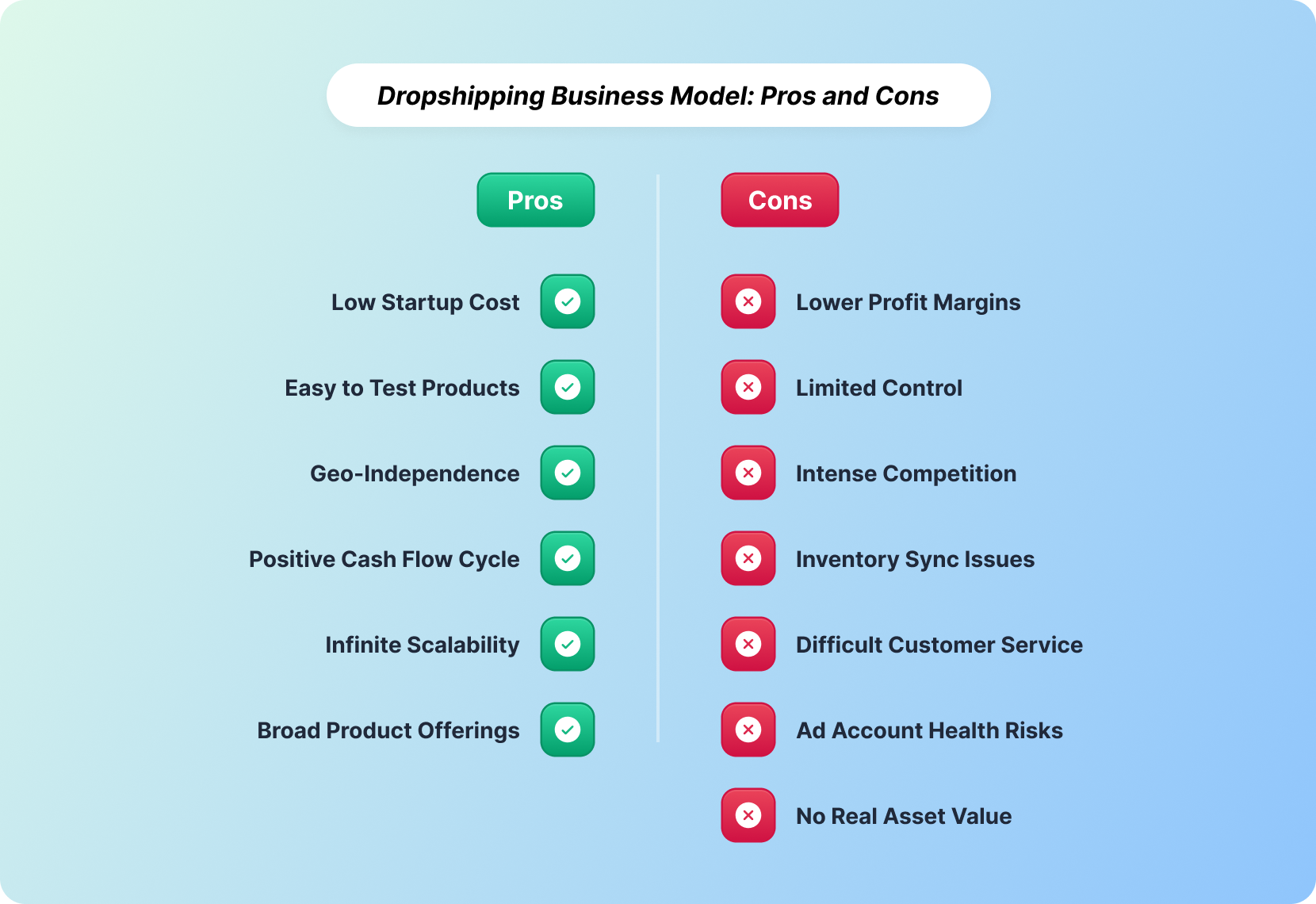
Pros
1. Low Initial Investment
The biggest barrier to entry for most businesses is capital. With dropshipping, you don't need thousands of dollars to fill a warehouse. You can launch a dropshipping store for the cost of a domain, a hosting plan, and some ad spend; that is why it is the most accessible online business model for beginners.
2. Easy to Test Products
Since you don't buy inventory upfront, you can test hundreds of products to see what sells. If a product flops, you delete it from your site with no harm. If it wins, you scale your ads. Such flexibility is impossible in traditional ecommerce, where you are stuck with the stock you bought.
3. Location Independence
You can run a dropshipping empire from a laptop in a coffee shop in Bali or a home office in London. Since you don't touch the product, you don't need to be near a warehouse.
4. Positive Cash Flow Cycle
This is a financial advantage that is often ignored. In dropshipping, the customer pays you before you pay the supplier, which creates a negative cash conversion cycle. You are essentially using the customer's money to fund your business operations.
Compare this to traditional retail, where you might spend $10,000 on stock and wait three months to earn that money back. For entrepreneurs without deep pockets, this cash flow structure is the only way to survive.
5. Infinite Scalability
In a traditional setup, if you suddenly receive 10,000 orders overnight due to a viral TikTok video, your business might actually collapse. You would need to hire emergency staff, rent more space, and work 24 hours a day to pack boxes.
On the other hand, in the dropshipping business model, a spike in sales is purely a digital event. You simply forward more orders to your supplier. Their infrastructure handles the heavy lifting, allowing you to scale from 10 to 10,000 orders without a corresponding increase in your manual labor.
6. Broad Product Offerings
Because you aren't pre-purchasing stock, you aren't limited to a specific niche or a small catalog. You can pivot your strategy in real-time. If winter is approaching, add heated jackets and scarves to your store. If a new fidget toy becomes popular, add it the next day.
The agility of the model allows you to capitalize on micro-trends faster than major retailers, who are bogged down by supply chain logistics.
Cons
1. Lower Profit Margins
Because you are buying one unit at a time rather than 1,000, your cost per goods is higher. After paying the supplier and your ad costs, your net profit is razor-thin. You need to push high volumes to make significant money. In 2026 this con carries extra weight for overseas-sourced products. With the $800 de minimis exemption gone, import duty now lands on top of that already-high per-unit cost, and for Chinese-origin goods the duties can stack. The thin margin got thinner, which is the single biggest reason the old ship-cheap-from-China dropshipping math no longer works. Sourcing from suppliers with local fulfillment is how many dropshippers keep this con manageable.
2. Limited Control
You have less control over the fulfillment process. If your supplier ships a broken item or sends it three weeks late, the customer blames you, not the supplier. This can severely affect customer satisfaction. Couple this with slow shipping, and you’ve lost that customer for life.
3. Intense Competition
Low barriers to entry mean everyone is doing it. You will likely be selling the exact same product as fifty other stores. To win, your marketing and your sales funnel need to be superior (more on that later).
4. Inventory Sync Issues
One of the most frustrating aspects of relying on third-party suppliers is the out-of-stock nightmare. You might spend $500 on ads to drive traffic to a specific product, only to find out — after the orders come in — that your supplier ran out of stock two hours ago. You are then forced to refund customers, losing the sale and the ad money, and damaging your reputation.
5. Difficult Customer Service
When a customer asks specific questions like "Does this clothing run small?", you might not have the answer because you have never seen the product in person. You become a relay station, emailing your supplier in China and waiting 24 hours for a reply. This delay can kill customer satisfaction, too.
6. Ad Account Health Risks
Facebook, Google, and other ad providers are becoming increasingly strict. If your shipping times are long (common in dropshipping) or your product quality is inconsistent, customers will leave negative feedback on post-purchase surveys.
Thus, if your Feedback Score drops below a certain threshold on Meta, your advertising costs will skyrocket, or your ad account will be banned.
7. No Real Asset Value
Because you don't own the product, the contracts, or the inventory, dropshipping stores are harder to sell for a high multiple. Investors view them as risky cash-flow streams rather than stable businesses. You are building income, but not necessarily long-term equity.
Read more: Why dropshippers fail and why are they losing money?
Traditional Ecommerce Model: Pros and Cons
While dropshipping is about speed and agility, traditional electronic commerce is about building an asset.
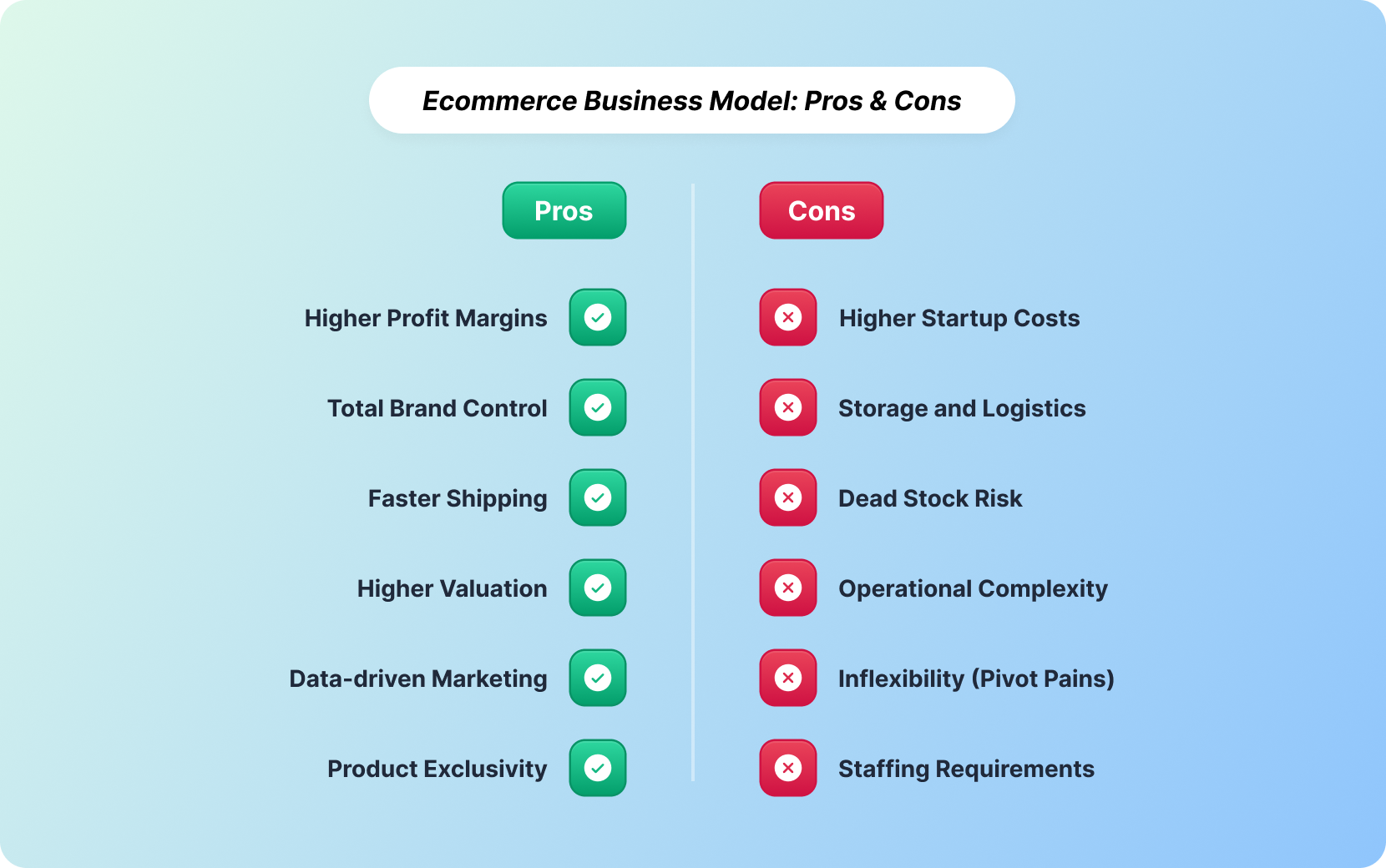
Pros
1. Higher Profit Margins
When you buy in bulk, you get wholesale pricing. This way, you lower your cost per unit and get significantly higher profit margins. The extra cash flow allows you to reinvest in better marketing or faster shipping. In 2026 there is a second margin advantage worth naming. When you import inventory in bulk, you clear customs and pay duty once on the whole shipment, rather than paying duty parcel by parcel the way a dropshipper now does on every overseas order. Since the end of de minimis, that difference is a real and growing edge for the inventory model.
2. Complete Brand Control
You control the customer experience from start to finish. You can use branded boxes, include thank-you notes, and ensure the product is perfect before it ships. It is much easier to build customer loyalty and increase the lifetime value of every buyer.
3. Faster Shipping
In 2026, customers expect Amazon-level speed. With your own inventory, you can offer 2-day shipping to dramatically increase conversion rates compared to the 2-week wait times seen in dropshipping.
4. Higher Business Valuation (Exit Strategy)
If your end goal is to sell your company, traditional ecommerce is the superior vehicle. Investors pay much higher multiples for brands that own their inventory and have exclusive supplier contracts. A dropshipping store is more of a cash-flow asset, whereas a traditional brand is seen as a capital asset.
5. Data Ownership and Marketing Efficiency
When you ship the product, you can put physical marketing materials inside the box — flyers, QR codes, samples of other products. Such inbox marketing has a 100% open rate. You can effectively drive customers back to your online store for a second purchase, for free.
6. Product Exclusivity
With the traditional ecommerce model, you can work with manufacturers to create custom formulations, unique designs, or proprietary features. You don't have to sell the same generic item as everyone else. You are free to experiment with exclusivity to create a moat around your business.
Cons
1. Higher Startup Costs
You absolutely need cash to buy physical products. If you want to sell branded hoodies, you might need to buy 500 of them before you sell a single one. So, launching an ecommerce store is a significant investment and financial risk.
2. Storage and Shipping Logistics
You are responsible for the warehousing and shipping process. As you scale, you will eventually outgrow your garage and need to rent space or hire a third-party logistics (3PL) provider, which adds to your operational costs.
3. Dead Stock Risk
If you buy $10,000 worth of inventory and trends change, you are stuck with dead stock that you can't sell (the nightmare scenario for e-commerce businesses).
4. Operational Complexity
Running a traditional ecommerce business involves a lot of strict administration. You have to deal with import duties, freight forwarders, commercial insurance, and payroll. The complexity of the operation is significantly higher than that of dropshipping.
A 2026 clarification on this point: import duties are no longer a purely ecommerce-side burden. Since the $800 de minimis exemption ended, dropshippers pay duty on overseas parcels too, so this con is now less of a clean dividing line between the two models than it used to be. What remains genuinely heavier on the ecommerce side is the freight-forwarding, customs-clearance, and commercial-insurance administration that comes with moving inventory in bulk.
5. Inflexibility (Pivot Pains)
If you invest heavily in a niche — say, hiking gear — and the market crashes, you can't just switch to selling pet supplies tomorrow. Your capital and brand development are tied up in hiking inventory. Your online retail store is married to your niche until you sell through your stock.
6. Staffing Requirements
You cannot do it all alone forever, either. Once you pass a certain order volume (e.g., 50 orders a day), you physically cannot pack that many boxes while also running ads and answering emails. You will need to hire help for managing online stores, adding a layer of stress, legal responsibility, and fixed costs that dropshippers generally don't have to worry about.
Costs Breakdown: Startup vs. Operational
Let's also look at the numbers. While every business is different, here are realistic estimates for 2026.
Dropshipping Costs
Initial investment: $500 - $2,000.
This covers your funnel software (like Funnelish), domain, and initial test budget for ads.
Operational costs: Variable.
You mostly pay for the product only after you get paid by the customer. Your main ongoing cost is advertising and software subscriptions. For overseas-sourced products, factor import duty into per-order product cost as well, since it now applies to parcels that previously entered duty-free.
Ecommerce Costs
Initial investment: $5,000 - $50,000+.
Covers bulk inventory orders, warehousing setup, packaging design, website build, and marketing.
Operational costs: High and fixed.
Warehouse rent, insurance, packaging materials, marketing, and shipping software are monthly realities regardless of your sales volume.
Who Should Choose Dropshipping?
Dropshipping stores are the ideal starting point for:
Bootstrapped entrepreneurs: If you have less than $2,000 to invest, dropshipping is your only safe route.
Trend hunters: If you want to sell viral TikTok products that might be out of style in three months, dropshipping allows you to ride the wave without risk.
Marketing-first founders: If you are great at Facebook Ads or content creation but hate the idea of packing boxes, this model suits your skillset.
Who Should Choose Traditional Ecommerce?
Traditional ecommerce is better for:
Brand-building visionaries: If your goal is to build a long-term brand that you can eventually sell for millions, you need the asset value of inventory and a customer base that loves your product.
Niche experts: If you are selling specialized products (like custom mechanical keyboards or organic skincare) where product quality is paramount, you cannot trust a random supplier.
Founders with сapital: If you have funding and want to maximize profit margins immediately, skipping dropshipping and going straight to stock is the smarter financial move.
Hybrid Model: What Winning Brands Do in 2026
The secret is: You don't have to choose just one. The most successful ecommerce businesses in 2026 use a hybrid model. They use dropshipping for R&D and inventory for their best sellers.
How it works:
Test with dropshipping: You find a new product potential and launch it on your store using a dropshipping supplier.
Validate the winner: You run ads. If the product sells 50 units a day, you know you have a winner.
Transition to stock: Once the product is proven, you order 1,000 units in bulk to your local warehouse.
Maximize margin: Now, for that winning product, you have higher profit margins and 2-day shipping. Meanwhile, you continue dropshipping new test products on the side.
The hybrid strategy minimizes financial risk and maximizes potential growth. It gives you the low startup costs of dropshipping with the brand control of traditional retail.
The end of de minimis makes this hybrid path more compelling than it was, not less. Step 3 now does double duty. Moving a proven winner to bulk local inventory means you import once and clear duty on the whole shipment, instead of paying duty on every individual overseas parcel the way you do while dropshipping that product. In 2026 the smart move is to run the same test-then-transition play, and to make the jump to local stock sooner for any winner you are sourcing from abroad, because that is where the duty savings and the faster shipping both live.
Funnel Strategies That Work for Both
Whether you are selling online via dropshipping or shipping from your warehouse, a standard online store layout is where sales go to die. Why? Because traditional ecommerce platforms (Shopify or WooCommerce) are designed to be catalogs. They are great for browsing but often terrible for converting cold traffic.
So, in 2026, sending paid traffic to a generic product page is burning money. The good news is that modern tools absolutely keep up with the evolving user demands. An ecommerce sales funnel tool, like Funnelish, on the other hand, builds a focused path to get a customer to buy one thing — and then buy more of it.
If you're looking for ways to make your online platform generate customer purchases in the first place, explore the tools that do these four things.
1. Take Care of Load Speed
Every second of load time might cost you around 5% in conversions. Since dropshipping stores often suffer from bloat due to too many plugins, using a dedicated funnel builder is the best way to ensure your landing pages load in under one second. Fast pages equal lower CPC (cost per click) and more sales. Both your customer experiences and ad budget will benefit from faster load times.
2. Focus on Upsell Strategies
In dropshipping, margins are tight. In traditional ecommerce, acquisition costs are rising. The solution for both is increasing the AOV (average order value).
Traditional cart: Customer buys a $30 item -> Checks out. Total: $30.
Funnelish flow: Customer buys a $30 item -> Sees a One-Time Offer for a matching accessory ($15) -> Adds it with one click. Total: $45.
By implementing one-click upsells, you can increase your revenue by as much as 30% without spending a penny more on ads. This is just one of the tools that helps effectively neutralize the lower profit margins of dropshipping. That margin cushion matters more in 2026 than it did before, because it helps offset the import duty now baked into overseas-sourced orders.
3. Sync for Sanity
If you are running the hybrid model, logistics can get messy. You need a system that discerns between a dropshipped item and a stocked item.
Funnelish can integrate deeply with platforms like Shopify. You can build high-converting landing pages that front-end the sale, and then instantly sync the order data to your backend for the fulfillment process.
Dropshipping orders can be routed to your supplier.
Inventory orders can be routed to your warehouse.
The automation is crucial for managing different business models under one roof, especially if you target the mass market and high profits.
4. Payment Processor Bans on Dropshippers
This is the silent killer of dropshipping businesses. You can have the best product and the best ads, but if your Stripe or PayPal account gets frozen, your business stops instantly.
The reality is that dropshipping is categorized as a high-risk industry by most financial institutions. Bans are usually triggered by specific patterns that look suspicious to automated risk systems:
Sales velocity mismatches: A brand new store scaling from $0 to $50,000/month looks like fraud to an algorithm.
Inconsistent shipping times: Delays lead to disputes, which alert the processor.
High refund and chargeback rates: If your dispute rate creeps above 1%, you enter the danger zone, too.
Slow tracking updates: If you have taken the money but haven't provided proof of shipment within a few days, PayPal will hold your funds.
Restricted products: Selling trademarked or gray-area goods without approval.
How Funnelish Helps Reduce Payment Bans
To survive at scale, you need infrastructure that mitigates these risks. Here is how Funnelish protects your cash flow.
1. Automated Order Flow = Fewer Errors, Fewer Refunds
Many disputes aren't caused by the product, but by operational sloppiness. Mistakes like incorrect addresses, missing orders, or accidental duplicate charges trigger immediate chargebacks. Funnelish centralizes your order routing and fulfillment sync.
By automating the data flow between your sales page and your backend with Funnelish, you reduce human error. Fewer operational mistakes eventually mean a lower dispute rate and a healthier payment processor score.
2. Easy Integration with Dropshipper-Friendly Processors
Even with perfect operations, relying on Stripe and PayPal alone is dangerous. Top dropshippers never rely on a single point of failure. You need backup processors that understand the dropshipping mode(specifically, longer shipping times and unconventional supply chains) and hybrid setups with unconventional supply chains.
Funnelish integrates with alternative gateways built for high-risk and fast-scaling brands from diverse locations, including:
NMI: Known for accepting high-risk businesses and being tolerant of rapid scaling. It also allows for multiple Merchant IDs (MIDs) to diversify your risk.
Airwallex: Excellent for international sellers with fast onboarding and lower fees. They have a much higher tolerance for ecommerce risk profiles than traditional banks.
3. PayPal Tracking Sync (Coming Soon)
One of the fastest ways to release PayPal holds is to prove the item is in the mail. We are currently implementing a feature to automatically upload tracking numbers directly to PayPal the moment an order is marked as fulfilled. This keeps your account green and ensures your funds are released on time.
Ecommerce vs Dropshipping Model: The Verdict for 2026
So, dropshipping vs ecommerce — which wins?
If you are looking for the lowest barrier to entry and want to learn the ropes of digital marketing strategies without risking your life savings, dropshipping is still the champion. It remains the best education in online selling available.
However, if you want to build a sustainable asset with complete control and customer loyalty, traditional ecommerce is the goal you should aim for.
But the real winners in 2026 won't be dogmatic. They will be the ones who combine the agility of dropshipping to find what sells well and the stability of inventory to scale the sales. And regardless of which fulfillment method you choose, remember this: the way you sell matters more than how you ship.
Replacing a boring store layout with a high-speed and high-AOV sales funnel is the single biggest leverage point you have. Whether you are shipping from a warehouse in Ohio or a factory in Shenzhen, your success depends on your ability to turn a visitor into a customer.
Want to stop browsing and start selling? Explore how Funnelish can turn your product pages into high-converting sales machines today.
Table of contents
Boost your eCommerce
sales today

24/7 support
No credit card required
Cancel anytime
24/7 support
No credit card required
Cancel anytime
