

One-Product Funnel: How to Build One That Turns Strangers into Loyal Customers (2026 Guide)
02 March 2026
Anna P.
Here is a number that should make you stop scrolling: $1,000,000.
That's how much revenue AG1 — formerly Athletic Greens — generates per day from what is, at its core, a single product. One green powder. One subscription. One relentlessly engineered product funnel built to guide every potential customer from first click to loyal advocate without a single wasted step.
AG1 isn't an anomaly:
Liquid Death built a billion-dollar water brand with a one-product funnel strategy.
Dollar Shave Club disrupted Gillette's century of dominance with a single SKU and a marketing funnel so tight it converted cold YouTube viewers into paying customers at a rate that embarrassed the entire CPG industry.
Beardbrand turned beard oil into a $7M business before most people had heard of product funnels.
These aren't companies with massive product lines, sprawling catalogs, or enterprise sales departments. They are focused and surgical. Their C-Level understands something that most businesses refuse to accept: more products don't mean more sales. A better funnel does.
This guide will show you how to build a one-product funnel that generates revenue, builds customer loyalty, and compounds growth — without burning your ad budget on traffic that was never going to convert anyway.
What Is a One-Product Funnel?
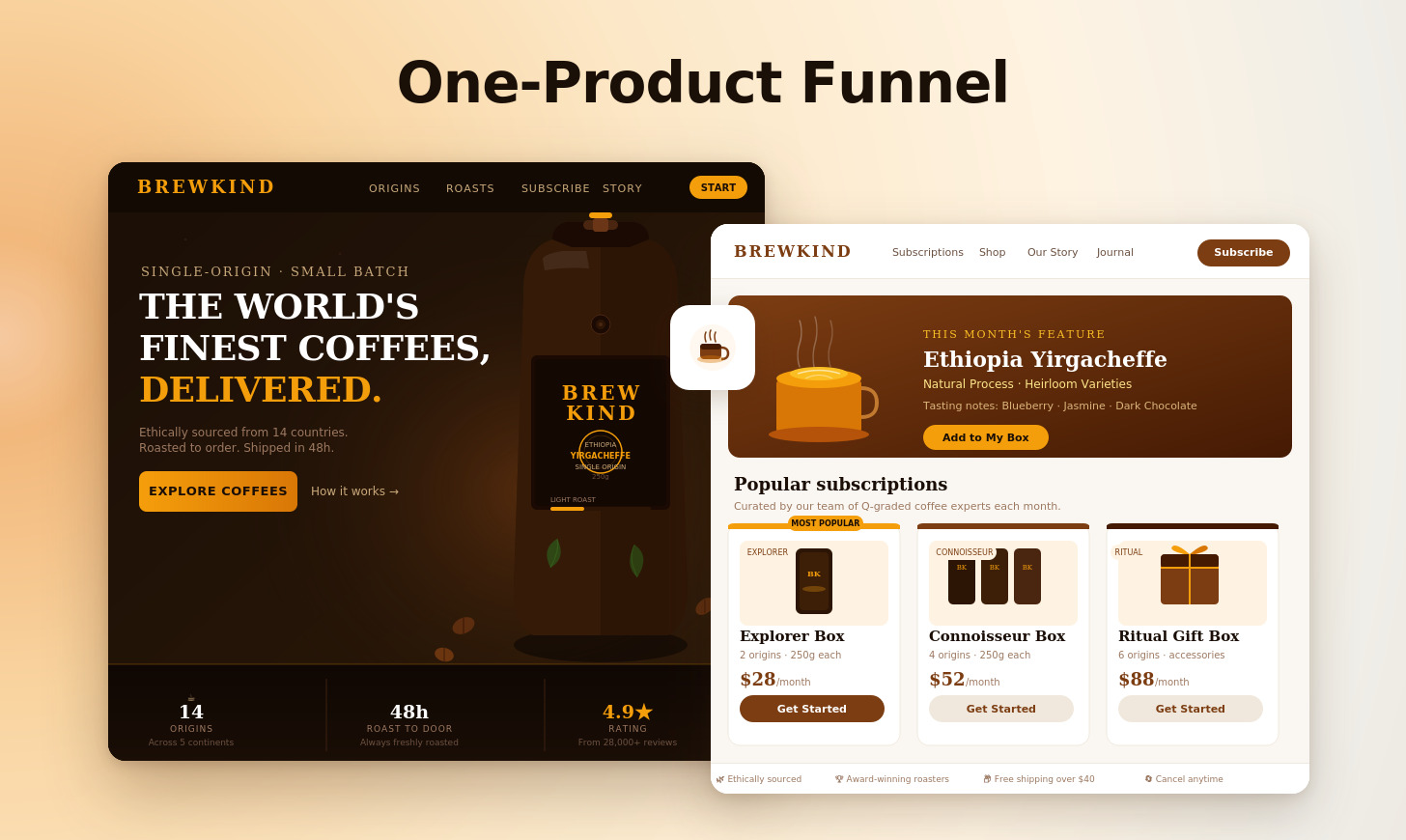
A one-product funnel is a deliberate, guided sequence of pages (or blocks of a single page), emails, and touchpoints that takes a stranger — someone who has never heard of your brand — and moves them through a buying decision without distractions. Unlike a general website that throws ten decisions at a visitor simultaneously, a one-product funnel removes noise and creates one and only path: forward.
The "one product" part isn't a limitation. It's a superpower.
When your marketing funnel is built around a hero product, something remarkable happens.
Your messaging sharpens.
Your landing pages stop trying to please everyone and start speaking 1-1 to your target audience's pain points.
Your email marketing becomes a coherent story instead of a promotional newsletter.
Your paid ads convert because every element — the ad creative, the headline, the offer, the checkout — is aligned around one promise.
Compare this to the standard eCommerce approach: send traffic to a homepage, hope the visitor finds something they like, watch 97% of them leave without buying. The conversion rates on standard storefronts hover around 1–2%. (Salesforce) Well-built product funnels regularly hit 4–8%, with some quiz-based and high-personalization flows exceeding 12%.
That difference isn't luck. It's architecture.
Psychology Behind Why Product Funnels Work
Most businesses think their conversion problem is a traffic problem. It isn't. It's an attention problem — and attention is governed by rules that haven't changed since before the internet existed.
The human brain processes somewhere between 6,000 and 10,000 stimuli per day. (Queen's University) To cope, it has developed a ruthless filtering system: anything that feels effortful, ambiguous, or irrelevant gets discarded in milliseconds. This is called cognitive fluency — the brain's preference for information that is easy to process.
A one-product funnel is a fluency machine. Every element — the headline, the layout, the offer, the call to action — is stripped of ambiguity. The visitor's brain doesn't have to work. It just has to respond. This matters most at the moment of the buying decision.
Surprisingly, neuroscientist Antonio Damasio's research on patients with damage to the brain's emotional processing centers revealed something counterintuitive: they couldn't make decisions. Not complex ones — any decisions. Without emotional engagement, the brain stalls.
For your product funnel, this means one thing: logic explains the purchase, but emotion closes it. The best product funnels don't just present features — they create a felt sense of what life looks like after the product arrives.
There is also a timing dimension that most marketing teams completely miss. Psychologist Robert Cialdini identified commitment and consistency as one of the most powerful behavioral drivers in human decision-making: once a person takes a small action, they are far more likely to take the next one, because backing out would create internal conflict with the identity they've already expressed.
A well-structured funnel takes advantage of this naturally. Every micro-commitment — clicking an ad, entering an email, adding to cart — makes the next step feel like the only logical continuation. The user isn't being pushed. They're following through on who they've already decided to be.
That is why product funnels convert, and why homepages don't. A homepage asks strangers to make a decision in a vacuum. A funnel earns that decision one small, emotionally resonant step at a time.
5 Stages of a High-Converting Product Sales Funnel
Every product funnel, regardless of industry, follows the same five-stage structure. What changes is the tactic at each stage — the specific content, offer, and mechanism used to move the user to the next stage.
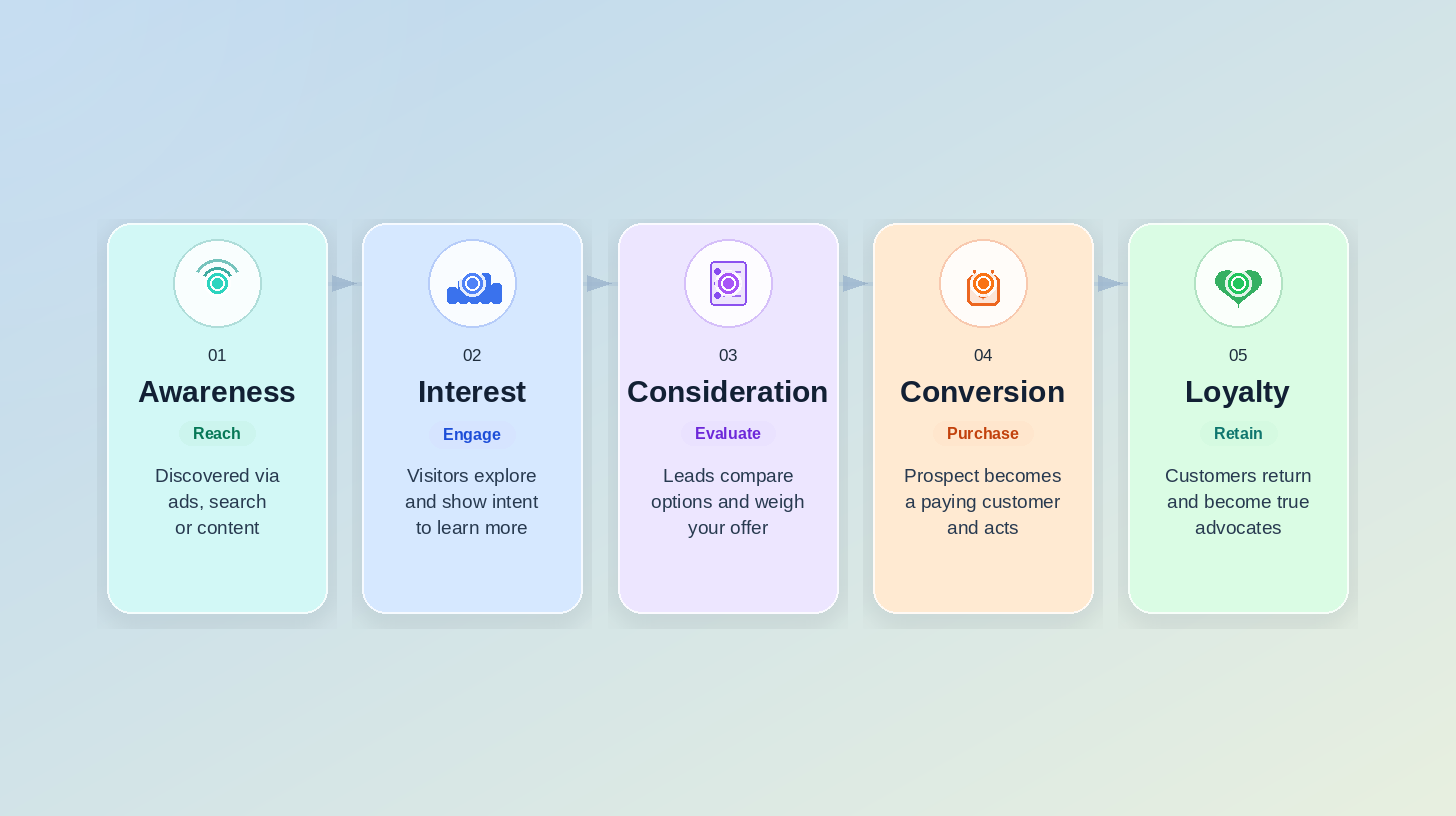
Stage 1: Attract Attention (Awareness)
This is where new customers enter your world. They are not looking for your product yet. They are living their life when your content or paid ads interrupt the scroll.
The goal here isn't to sell. It's to earn a click. Dollar Shave Club's viral launch video, for example, didn't try to close a sale in the first 10 seconds. It made people laugh, and it made them curious. The selling happened later, in the funnel.
Your marketing efforts at this stage include short-form video on TikTok and Reels, SEO-optimized blog content targeting the symptoms of the problem your product solves, and cold audience paid ads with a provocative hook. The metric you care about here is click-through rate — how many people were curious enough to want more?
Stage 2: Build Interest
The user has clicked. They are now in your world, but they are skeptical. They are comparing you to competitors, reading reviews, and trying to figure out if you are trustworthy. This is the stage where most brands lose the sale by going straight to the pitch.
Instead, use lead magnets to earn their email address. A free guide, a quiz, a discount — something that provides immediate value and gives you permission to continue the conversation. Liquid Death grew its email list by an order of magnitude before it was in mainstream retail by leaning hard on personality-driven content that was too interesting to ignore. Your email marketing sequences begin here, too.
Stage 3: Overcome Objections (Consideration)
This is the most psychologically loaded stage of the customer journey. The user wants your product. But wanting and buying are separated by a wall of objections:
Is the price fair?
What if it doesn't work?
How fast does it ship?
Will it be a pain to return?
Every friction point at this stage costs you money. Social proof — reviews, user-generated content, before-and-after comparisons — demolishes hesitation faster than any sales copy. A clear money-back guarantee removes risk. A countdown timer (used ethically, tied to a real promotion) creates urgency.
This is also where page speed becomes a literal revenue lever. A page that loads in 3 seconds on mobile loses 40% of its visitors before they've seen your offer. Funnelish's fast page speed infrastructure ensures your funnel loads in under a second — because a visitor who bounces from a loading screen is a sale you can never recover.
Stage 4: Conversion Moment
Then the user converts and becomes a paying customer. In a naive product funnel, this is the finish line. In a profitable one, it's the starting point for your real revenue strategy.
The moment after someone says "Yes" is the highest-trust moment in your sales process. They have their credit card in hand. Their buying decision is made. This is the exact moment to present a one-click upsell — a complementary product, a larger quantity at a discount, a subscription upgrade — that increases your average order value without increasing your ad spend.
Beardbrand understood this deeply. Their entry-point product — a single beard oil — became the gateway to a full grooming ecosystem sold on the backend. The economics only made sense because their average order value grew without the customer acquisition cost growing alongside it.
Read more: Sales Funnel Optimization: 20+ Ways to Boost Conversions + Tools
Stage 5: Create Loyal Customers
What does a real post-purchase revenue strategy mean?
Satisfied customers who buy once are good. But loyal customers who buy again and generate word of mouth referrals are how you build a business that can outbid every competitor for the same paid traffic — because your customer lifetime value is higher than theirs.
The loyalty stage is powered by post-purchase email marketing, subscription mechanics, VIP programs, and community. This is where engaged users become loyal advocates. When a loyal customer tells three friends about your product, those three friends enter your funnel at Stage 2 — warm, pre-validated, and far cheaper to convert than cold traffic.
Read more: Sales Funnel: What It Is, How It Works & Stages (2026 Mega Guide)
Real-World Product Funnel Examples That Generated Real Results
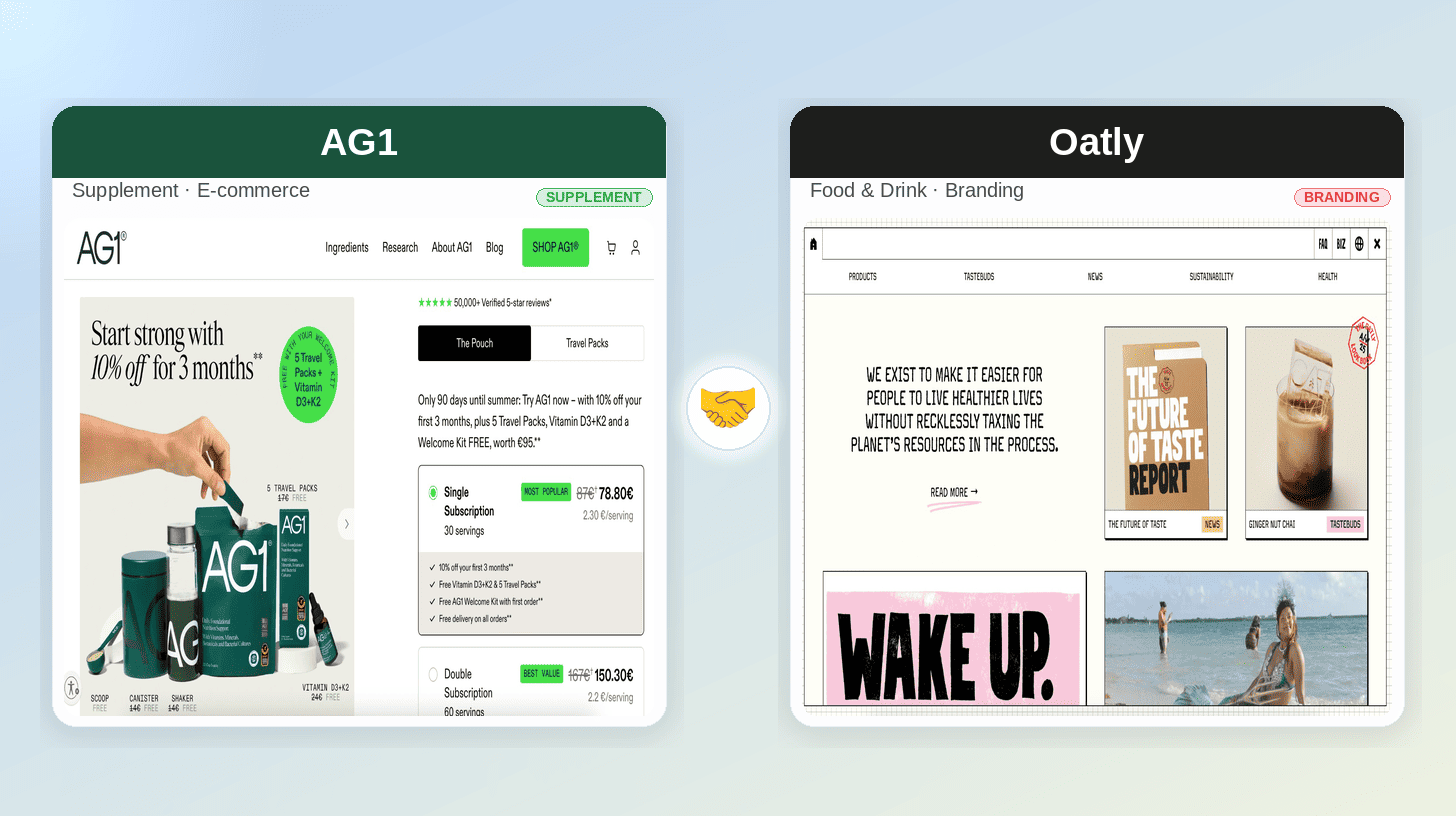
AG1's Subscription Funnel
Do you think AG1 sells a supplement? No. They sell a daily ritual. Their product funnel is engineered around a free trial offer — you pay only for shipping on your first pouch — that removes every financial objection from a cold audience. Once you're in the habit loop (and once you've experienced the product), the subscription renewal almost sells itself.
Their email marketing sequences are built around the health outcome story, not the product features. Daily active users of the product become the testimonials that power the next wave of new customers.
Oatly's Awareness-to-Loyalty Loop
Oatly turned oat milk into a cultural phenomenon with almost no traditional marketing budget. Their product funnel was built on compelling content — the kind that didn't feel like advertising — that attracted attention and drove word-of-mouth referrals. Their packaging became a touchpoint in itself. Every carton was a marketing campaign.
Oatly's lesson: your product funnel doesn't have to start with paid ads and end online. It starts wherever your target audience first encounters your brand. Make that encounter impossible to ignore.
Repeat Success with a Ready One-Product Funnel Template
Product Funnel Metrics: Numbers That Actually Matter
With all the modern sales funnel software solutions available, you can build high-converting and aesthetically pleasing product pages in almost no time compared to traditional e-commerce platforms. However, you still need to track your performance to know what sells best.
What you need to know here is that vanity metrics will bankrupt you. Yes, daily page views and social media likes feel good. But they don't pay the bills. Let's look at the key metrics that determine whether your product funnel is working.
Activation Rate
What percentage of new users who land on your funnel take the first meaningful action (enter email, begin quiz, add to cart)? If this is low, your above-the-fold messaging isn't connecting with your target audience.
Conversion Rate
Of all the visitors who enter your funnel, how many become paying customers? A well-optimized one-product funnel should aim for 3–6% on cold traffic. If you're below 1%, you have a messaging or offer problem, not a traffic problem.
Average Order Value (AOV)
How much does each paying customer spend in their first transaction? This is your most powerful lever because you can increase it without spending more on ads. Upsells, order bumps, and bundles are the mechanics. Even a $10 increase in average order across 500 monthly customers is $5,000 in additional monthly revenue at zero acquisition cost.
Customer Lifetime Value (LTV)
How much does a customer spend over 12–24 months? This number determines how much you can afford to spend to acquire them. If your LTV is $300 and your CPA is $40, you have an extraordinarily scalable business. If your LTV is $60 and your CPA is $55, you are one bad week of ad performance away from negative margins.
Identify Areas of Drop-off
The real power of product funnel analytics is the ability to see where users are leaving. Is the drop-off happening at the add-to-cart stage? You have a pricing or trust objection. At the checkout? You have friction in the payment flow. Post-purchase email open rates are low? Your onboarding sequence isn't compelling enough. Every friction point is a revenue recovery opportunity waiting to be optimized.
The goal is to track these key metrics weekly and implement strategies for improvement in order of revenue impact — not in order of what's easiest to fix.
How to Build Your One-Product Funnel and Get More Leads
In the effective product sales funnel, the sequence matters. Most marketing teams build pages first and strategy second. This produces beautiful funnels that don't convert. Do it the other way around.
Step 1: Choose Your Hero Product
The best one-product funnel is built around the product with the highest margin, the clearest transformation promise, and the easiest-to-articulate value proposition. If you can't explain why someone should buy it in one sentence, the funnel will struggle.
Oatly nails this in their own way. Their business is organized around a single sentence:
"We exist to make it easier for people to live healthier lives without recklessly taxing the planet's resources in the process."
That's not a tagline — it's a complete value proposition. It names the buyer (health-conscious people), the transformation (easier and healthier living), and the broader stakes (planetary impact) in one breath. Every product they sell, every carton on every shelf, is downstream of that sentence. That's what a hero product clarity looks like.
If your product requires a paragraph to explain, a comparison chart to justify, or a discount to close — it might not be ready to anchor a funnel yet.
Step 2: Define Your Target Audience's Pain Point
Not "health-conscious millennials." That's a demographic. Your pain point is specific:
"People who buy green supplements, hate the taste, and quit after two weeks."
Every word of your funnel should speak to that frustration.
Step 3: Build Your Landing Page for Speed and Focus
Remove the navigation bar. Remove the footer links. Remove anything that isn't a call to action or social proof. Use shared components across your funnel pages to maintain consistency without rebuilding elements from scratch — headers, testimonial blocks, and guarantee badges should look and feel identical across every step.
Step 4: Engineer Your Email Marketing Sequences
You need these at minimum:
Welcome sequence for new users who opt in but haven't purchased
Abandoned cart sequence for users who reached checkout and left
Post-purchase onboarding sequence for new paying customers
These three email sequences alone can recover 15–25% of revenue that would otherwise be lost.
Step 5: Add Upsells That Make Sense
One-click post-purchase upsells should feel like a natural recommendation, not an aggressive pitch. If your hero product is a face serum, the upsell is a moisturizer — not a completely unrelated product. The relevance is the difference between a "Yes" and an exit.
Step 6: Personalize for Your Audience's Location
When Spotify launched in Southeast Asia, they converted their prices to local currency, but they didn't stop there. They customized the homepage around local artists, local genres, and local listening habits. Users in Jakarta weren't greeted with Ed Sheeran. The product was the same. The first impression wasn't.
You don't have to be Spotify to take advantage of this strategy. Geo-funnels let you show the right currency, the right testimonials, and the right shipping information to every visitor, automatically. For brands with international audiences, this single implementation can lift conversion rates by 10–20% in non-primary markets.
Step 7: Measure, Identify Areas for Improvement, and Iterate
The final rule of thumb: A product funnel is never finished. It is always a work in progress. Run A/B tests on your headline, your offer, your call to action button, and your upsell sequence. Let data decide what works and what doesn't. The brands that build long-term success are the ones that treat their funnel as a living system, not a one-time build.
Biggest Product Funnel Mistakes (And How to Avoid Them)
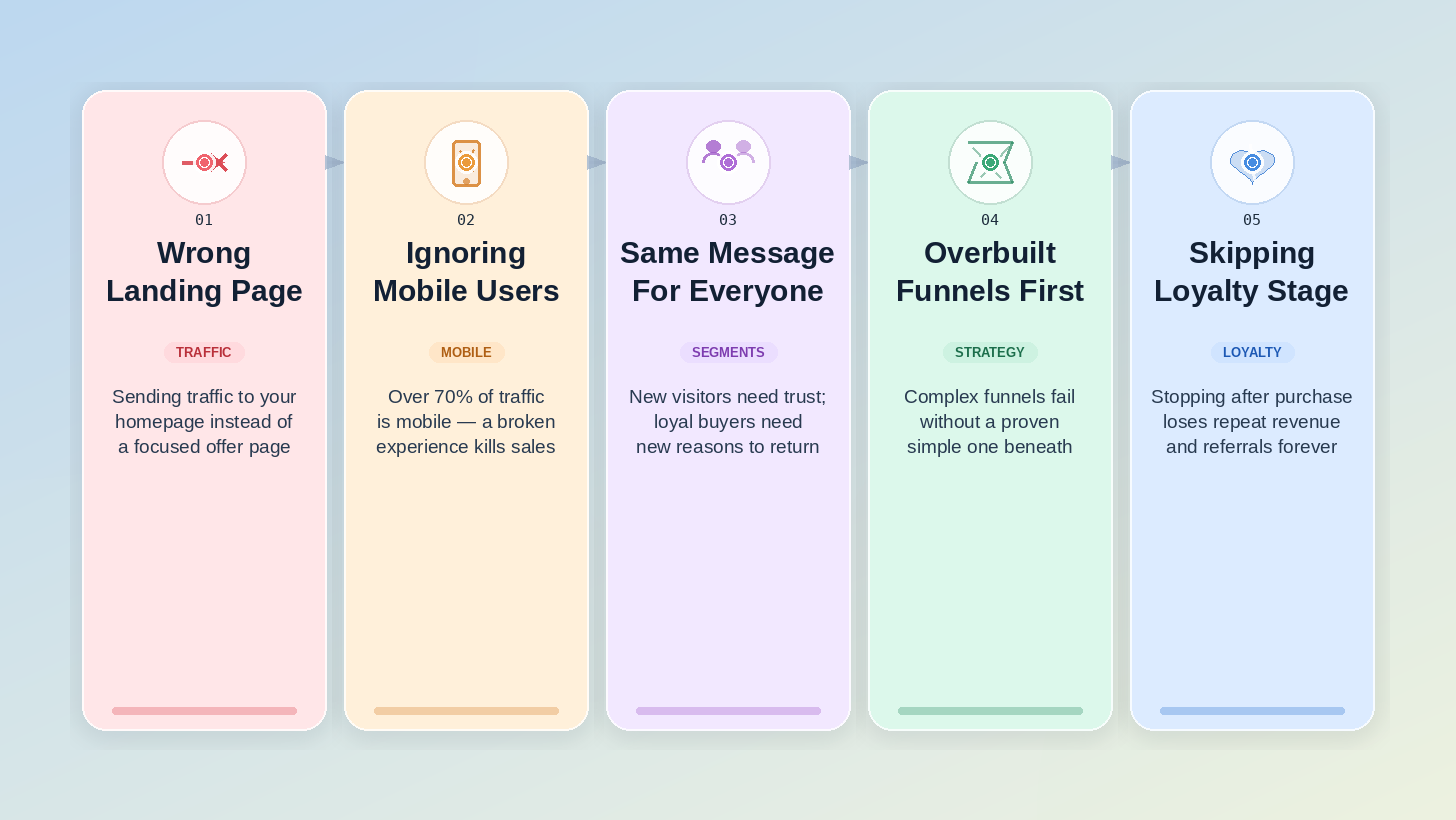
Sending Traffic to the Wrong Page
If your paid ad is for a specific product, the landing page must be about that specific product. Sending cold traffic to your homepage is the most expensive mistake in digital marketing. The message must match across every touchpoint.
This is called message match, and breaking it is more costly than most brands realize. Imagine running an ad that says "Waterproof Hiking Boots — Built for Scottish Weather" and landing the click on your general footwear collection page. The visitor arrived with a clear intent, a clear mental image, and a clear reason to trust you — and you immediately dissolved all three. They don't dig around looking for the boots. They leave, and you paid for that click.
The fix isn't technical. It's discipline. Every ad needs a dedicated URL. The headline on that page should echo the ad headline almost verbatim. The imagery should match. The offer should be identical. When someone feels like the page was built just for them — because it was — conversion rates can double without changing anything about the product itself.
Google found this pattern so significant that they built Quality Score around it: ads with a tight message match cost less per click and rank higher. Essentially, you're not just losing conversions by ignoring this. You're paying more to lose them.
Ignoring Mobile Users
More than 70% of eCommerce traffic arrives on mobile devices. (Statista) If your funnel isn't optimized for mobile — fast loading, large touch targets, minimal form fields — you are designing for a minority audience. Every tenth of a second of load time costs you real revenue.
Google's own research pegged the revenue impact at roughly 1% lost per 100ms of added load time. That's not a rounding error at scale.
The most common mobile failure isn't load speed, though — it's checkout friction.
Forms designed for a keyboard, being filled in with a thumb, on a moving train.
Address fields that don't trigger the numeric keypad for zip codes.
Coupon code boxes placed right above the keyboard so the total disappears when the user types.
These aren't edge cases. They're what your analytics show as abandoned checkout, and you've probably attributed them to price sensitivity.
Treating New Customers like Loyal Customers
A first-time visitor needs more trust signals, more social proof, and more education than someone who has already purchased from you. To treat newcomers right, you need to segment your funnel experience by customer stage and serve personalized experiences that match where each user is in their journey.
The psychological gap between a new visitor and a repeat buyer is enormous and almost universally ignored. A returning customer already trusts your packaging, your delivery times, and your return policy. They don't need to be convinced the product is real. A first-time visitor, on the other hand, is quietly running background checks — reading reviews, checking your Instagram, googling your brand name with the word "legit" after it. Showing them the same page you show a loyal customer is like skipping the first chapter of an argument and wondering why no one is convinced.
The segmentation doesn't have to be complex. A simple UTM-aware landing page that shows more social proof to first-time arrivals — more reviews, a visible return policy, a founder story — and a cleaner, faster path to purchase for returning visitors is enough to meaningfully separate your conversion rates between the two groups.
Building Complex Funnels Before Simple Ones Work
The temptation to add new funnels, new sequences, and new automation before optimizing the basics is another trap. Get your core conversion rate above 3%, get your average order above your customer acquisition cost, and build your retention email flow — before you add complexity.
Complexity is where accountability goes to die. A twelve-step funnel with four upsells, two downsells, an SMS sequence, and a webinar component gives you so many variables that you can never isolate what's working. You end up optimizing the wrong thing confidently.
The simpler version of this mistake: brands spending weeks building abandoned cart sequences when their product page has a 90% bounce rate. Fix the page. The cart sequence is irrelevant until people want to buy in the first place.
Skipping Loyalty Stage
Finally, acquiring new customers while ignoring existing ones is an ultimately leaky-bucket strategy. The cost of acquiring a new customer is 5–7x higher than retaining an existing one. (Forbes) Your post-purchase experience — the onboarding email, the follow-up, the loyalty program — is where your business compounds.
Have you ever noticed how most brands call a "loyalty program" what is just a discount schedule? Points that expire, rewards that require spreadsheet math to understand, and emails that arrive three weeks after the purchase when the excitement has fully cooled. That's not loyalty infrastructure. That's retention theater.
The brands that do this well treat the post-purchase moment like the beginning of the relationship, not the end of the transaction. The confirmation email isn't a receipt — it's an onboarding. It tells the customer what happens next, sets an expectation, and gives them something to feel good about while they wait. The follow-up after delivery doesn't ask for a review immediately — it asks if everything arrived as expected, which signals that you care more about their experience than your star rating.
These are small moves. Cumulatively, they're the difference between a customer who buys once and a customer who becomes the kind of person who recommends you unprompted.
One-Product Funnel Is the Fastest Path to Long-Term Success
The brands that dominate their categories in 2026 are not the ones with the biggest product catalogs. They are the ones with the tightest product funnels.
AG1 doesn't sell forty supplements. Liquid Death doesn't sell twenty beverages. Beardbrand didn't start with a full grooming line. They each found one product that solved a real problem for their target audience, built a marketing funnel that told that story clearly and compellingly, and then used the revenue from that funnel to expand.
That sequence matters: focus first, expand second. Not the other way around.
A one-product funnel lets you track your key metrics without noise, optimize your conversion rates with precision, and build customer loyalty through a consistent and personalized experience. It is the most direct path from zero to profitable — and from profitable to scalable.
The customer journey you build today determines the loyal customers you have tomorrow.
Build it with intention.
Build it with speed.
Build it around one clear promise, delivered to the right person, at the right moment.
That is what a product funnel does. Done well, it is the most powerful growth engine a business can own.
Ready to build your first high-converting one-product funnel? Start your free trial with Funnelish and launch your funnel today.
Table of contents
Boost your eCommerce
sales today

24/7 support
No credit card required
Cancel anytime
24/7 support
No credit card required
Cancel anytime
