

Ultimate Ecommerce Email Marketing Guide
25 April 2026
Anna P.
14 minutes
Let's talk about one of the biggest missed opportunities in digital retail right now.
It is incredibly common to see online stores spending thousands of dollars to acquire potential customers, only to completely ignore them the second they land on the site. Brands burn through cash on paid ads to get eyes on their products, but they don't have a system in place to capture and retain that traffic.
According to Shopify’s 2026 Commerce Trends Report, customer acquisition costs have spiked dramatically, making it harder than ever to turn a profit on a first-time buyer. Brands that prioritize owned marketing channels, however, are seeing record-breaking profit margins this year.
While paid ads are still necessary to drive top-of-funnel awareness, the real magic happens after that first click.
So, what is the most stable, wildly profitable marketing strategy for an ecommerce business right now? The answer is sitting right inside the inbox.
2026 reality check: the power of owned data
There are a handful of reasons a robust ecommerce email marketing strategy is the biggest asset a store can have this year. Before diving into the technical setups, it's crucial to understand the leverage of true audience ownership. Walk with me.
You own your customer relationships
Relying on social media algorithms is unpredictable. According to HubSpot's 2026 State of Marketing Report, average organic social reach for brands has plummeted to under 2%.
When a brand's videos go viral, it generates a massive spike in traffic. But when that traffic is captured onto an email list, a fleeting viral moment turns into sustainable, long-term ecommerce sales.
When an ecommerce store prioritizes owned platforms to engage customers, the business is in control of its own growth.
Email drives the highest return on investment
Customers rarely buy on the very first touchpoint. According to a very common rule, it takes an average of 7 digital touchpoints before a modern shopper makes a purchase. They need consistent, well-timed reminders.
Plus, as recent 2026 data from Omnisend suggests, email marketing generates an average ROI of $40 for every $1 spent in the retail sector. That means for every single dollar invested in email marketing software, the expected return is massive compared to almost any other marketing channel.
When the goal is to strengthen customer relationships and turn excited first-time buyers into highly profitable loyal customers, email isn't an option. It is the core engine of the business.
Foundation of your ecommerce email marketing strategy
A simple marketing automation setup can transform a brand’s trajectory in a matter of weeks. The industry numbers prove this is the fastest path to scaling profit margins. In 2026, automated emails account for just 2% of total email volume, but drive over 37% of all email-generated revenue.
Store owners need marketing tools that create a seamless customer experience from that initial opt-in to the final unboxing. Here is the exact blueprint for building an ecommerce email marketing solution that works around the clock.
Ultimate step 1: Master your list segmentation
The biggest opportunity in 2026 is personalizing the messaging.
If a brand sends the exact same promotional emails to its most loyal customers and to people who have never spent a dime, it misses out on easy conversions.
Targeted messaging is absolutely required.
According to Mailchimp's 2026 Email Marketing Benchmarks, segmented campaigns can generate higher open rates and higher click-through rates than non-segmented campaigns. Today's best email marketing software automatically segments audiences based on customer behavior, engagement levels, and purchase history.
Here are the highly profitable segments every store should build today:
VIPs: Paying customers who have purchased three or more times, or who have a high average order value. Give them early access to product drops and exclusive sales.
Window shoppers: New subscribers who gave their email for a discount code but never purchased. Hit them with a strong reminder of their discount code and high-urgency messaging.
At-risk buyers: Past customers who haven't bought anything in the last 90 to 180 days. They need a friendly "We miss you.😔" incentive to come back.
Category enthusiasts: Customers who only buy a specific type of product. If they only ever buy dog toys, send them beautifully tailored email campaigns about the newest pet accessories, not cat food.
When relevant messages are sent based on distinct customer preferences, open rates skyrocket and spam complaints naturally drop.
6 automated email marketing campaigns you need to launch
Let's get into the actual automated email campaigns. A flow is an automated sequence of emails that triggers when a user takes a specific action. Set it up once, and it scales the ecommerce store in the background.
Here are the flows that need to be built to maximize revenue.
1. Welcome email series
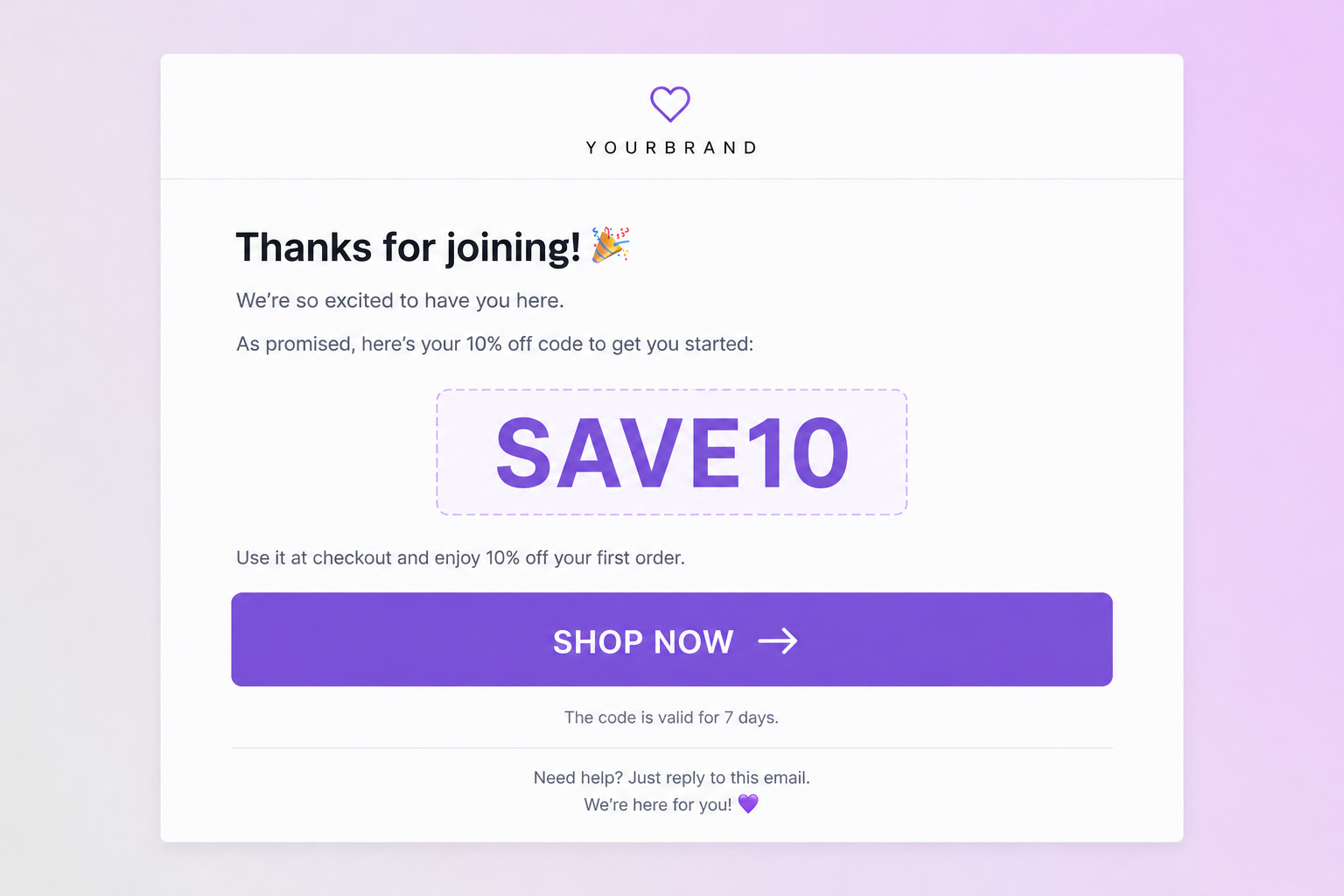
When a user hands over their email address to join a list, they are at peak interest.
According to Invesp's 2026 Email Conversion Data, welcome emails generate 4x more opens and 5x more clicks than regular promotional newsletters. If the brand just sends a generic, plain-text "Thanks for subscribing." email, it is a massive missed opportunity.
The welcome email sequence should be a carefully crafted, three-part automated flow designed to create urgency, build trust, and drive that crucial first sale.
Email 1: Delivery (send immediately)
Do not make them wait. Give them exactly what was promised on the opt-in form. If they signed up for a 10% discount code, put that code in bold text right at the top.
Subject line idea: Here is your 10% off code inside! 🎉
Goal: Immediate conversion. Keep the design simple and the call-to-action button huge.
Email 2: Brand story (send 24 hours later)
If they didn't buy from the first email, they need to connect with the brand. People love buying from passionate people. Share the story behind the ecommerce business. What specific problem is it solving?
Subject line idea: Why we started [Brand Name]...
Goal: Build an emotional connection. Use a great photo of the founder or the team.
Email 3: Social proof (send 48 hours later)
Still browsing? Inspire them with undeniable customer testimonials and user generated content. Show real people unboxing and loving the products.
Subject line idea: Don't just take our word for it 🌟
Goal: Erase doubt. Link directly to the best-selling items.
2. Abandoned cart reminders
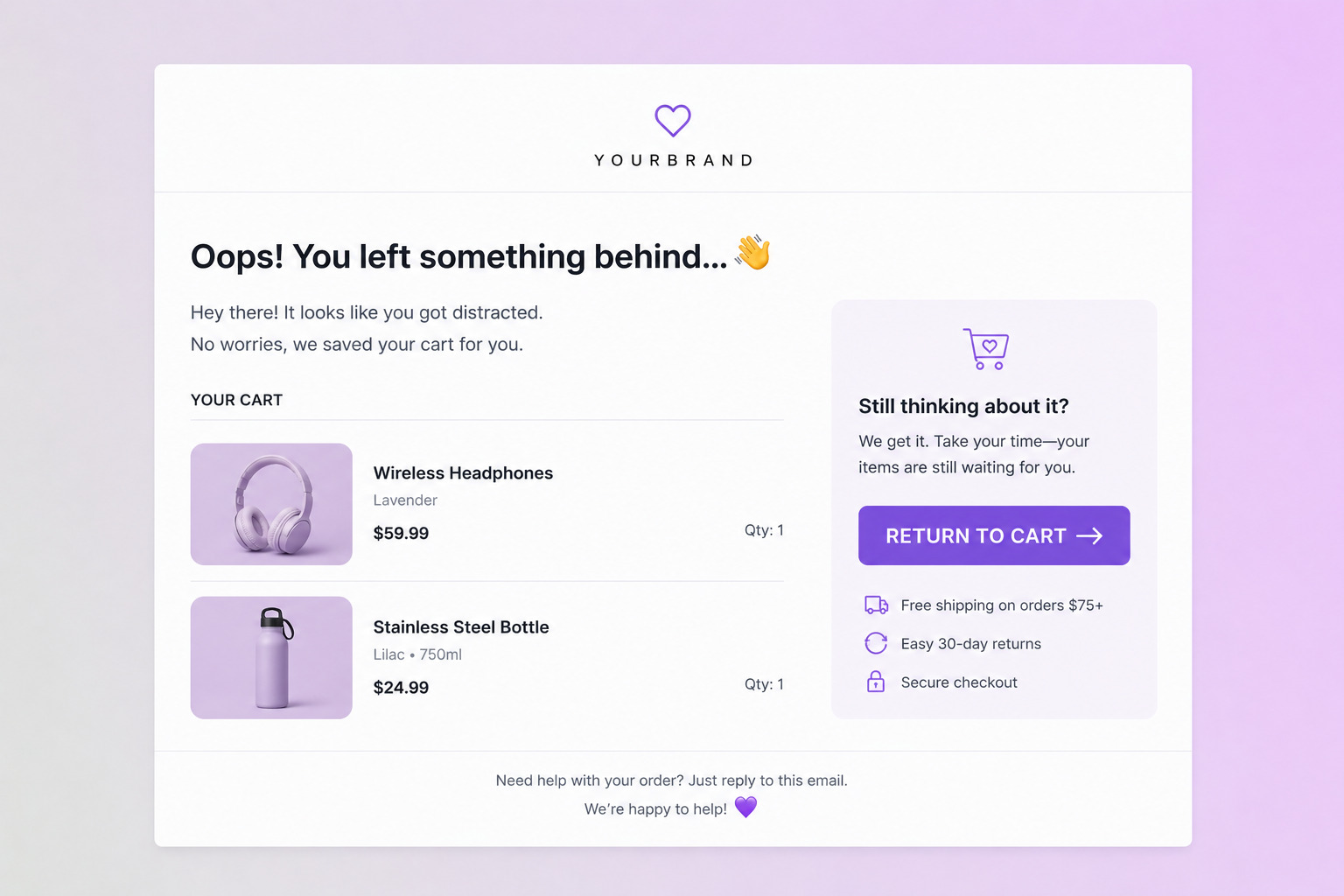
This is the undisputed champion of ecommerce email marketing. Every single day, potential customers add items to their digital carts and get distracted before checking out. According to the Baymard Institute's 2026 Cart Abandonment statistics, roughly 70.22% of all online shopping carts are left behind.
That represents a massive pool of people who already want the product!
To recover lost sales, a well-timed abandoned cart email sequence is required.
Email 1: Friendly reminder (send 1 to 2 hours after abandonment)
Keep the tone incredibly casual and helpful. Assume they just got distracted. "Did you forget something?" Show dynamic images of the exact items they left behind.
Subject line idea: Oops! You left something behind...
Email 2: Urgency push (send 24 hours later)
Let them know their cart is in high demand. "We can only hold these items for a little while longer, and they are selling out fast!"
Subject line idea: Your cart is about to expire ⏰
Email 3: Sweetener (send 48 hours later)
If they still haven't checked out, offer a small financial incentive to reward them for completing their purchase. "Here's an extra 5% off or free shipping to help you out today."
Subject line idea: Here is free shipping on your cart!
If the email marketing platform supports it, combine this flow with SMS marketing. Klaviyo's 2026 SMS Marketing Report shows that high-performing SMS campaigns can drive 8x revenue per recipient versus the average.
3. Browse abandonment
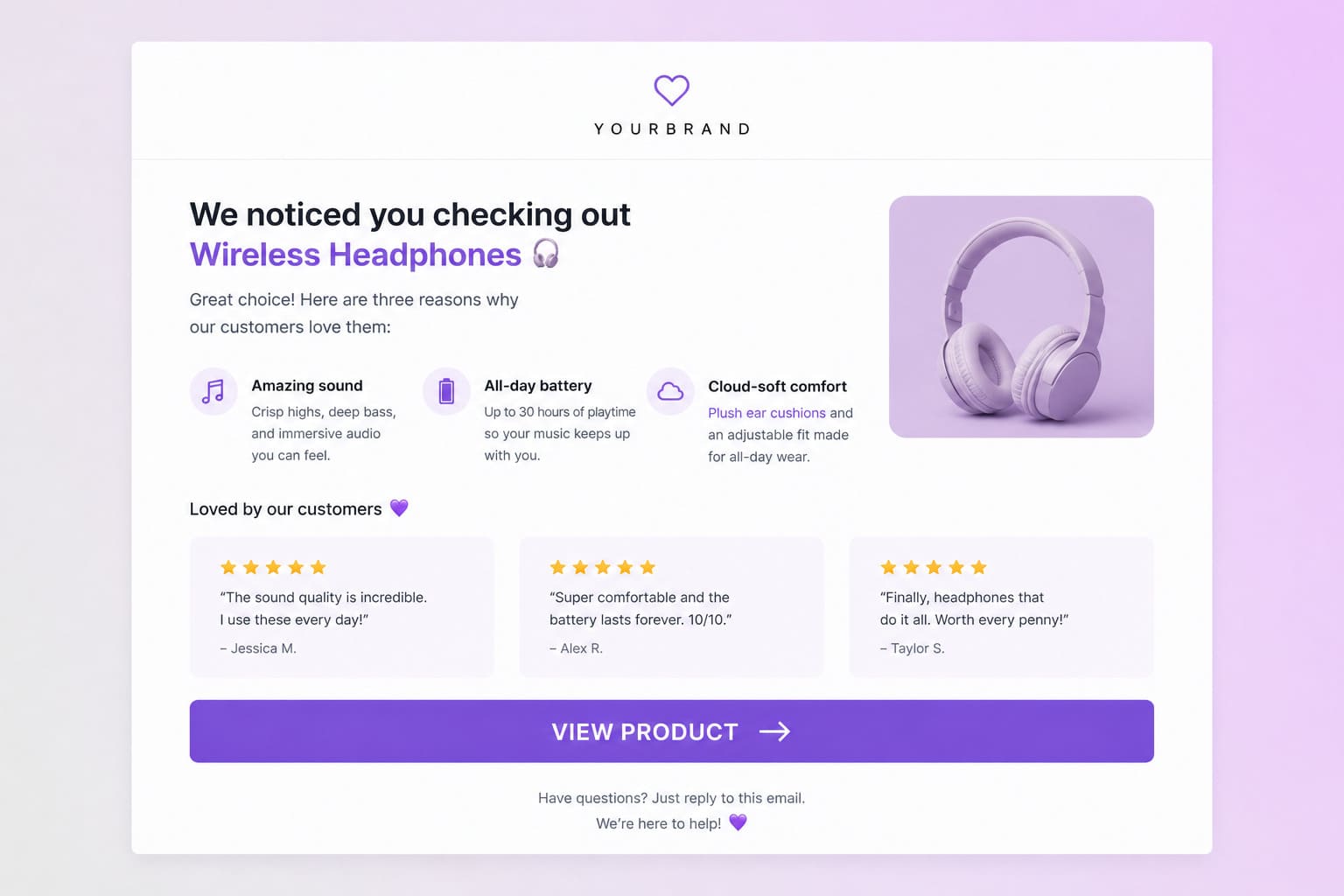
This is a step up from cart abandonment, and it is incredibly powerful for capturing high-intent shoppers. Sometimes, potential customers browse a specific product page but leave before adding it to their cart.
If they are an existing subscriber on the email platform, a browse abandonment email can be triggered automatically.
Email 1: Product highlight (send 2 hours after browsing)
Keep it light and helpful. "We noticed you checking out [Product Name]. Here are three reasons why our customers love it!" Include a few glowing reviews and a clear button back to the product page.
Email 2: Alternative options (send 24 hours later)
If they didn't buy the item they were looking at, maybe it wasn't the right fit. Send an email highlighting best-sellers in the same category to guide them back to the online store.
4. Post-purchase follow ups
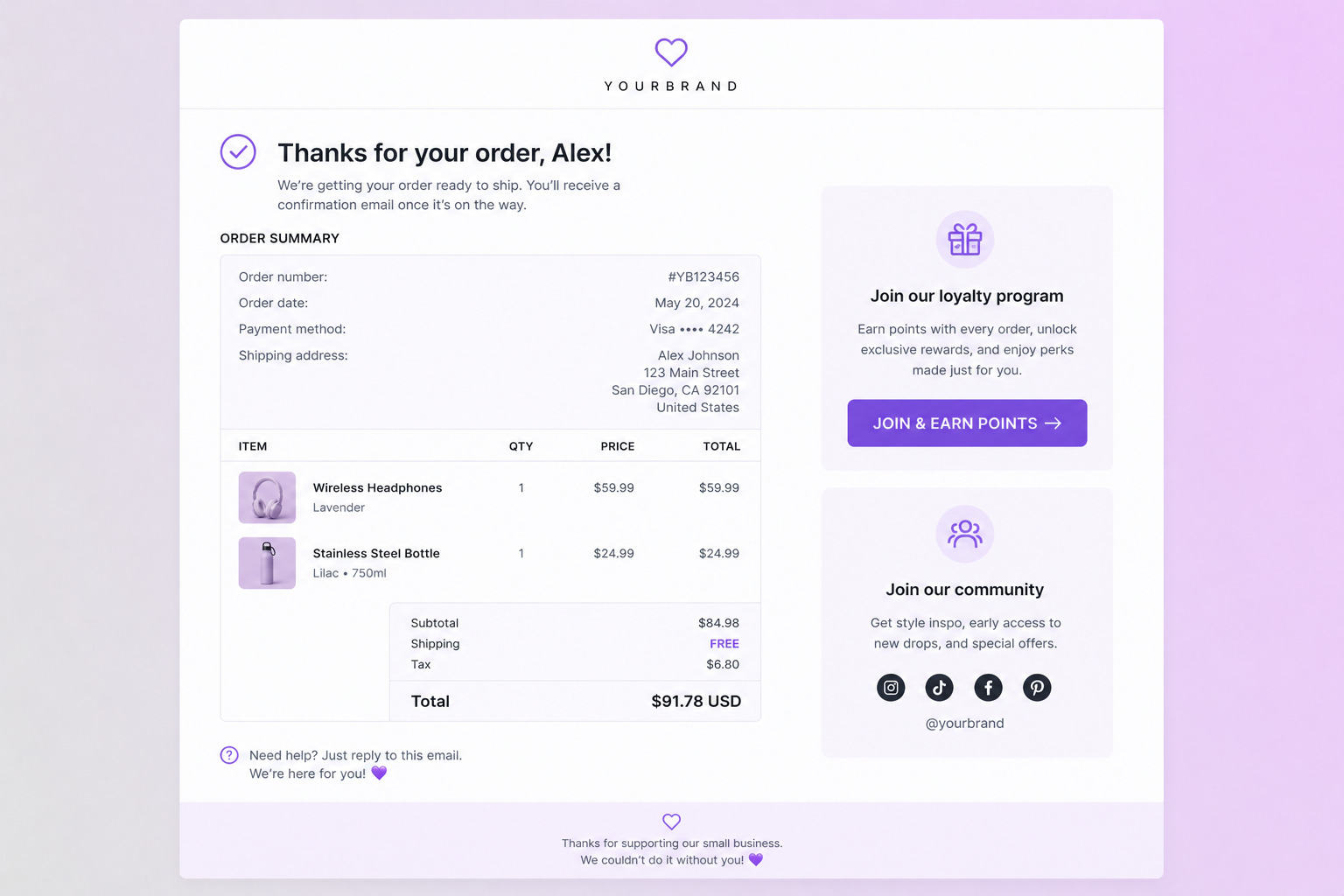
The customer journey absolutely does not end when they swipe their credit card. In fact, post-purchase emails are arguably the most vital part of building a long-term brand. This is exactly where lasting customer relationships are built.
Email 1: Order confirmation (send immediately)
This is a standard transactional email, but it can be optimized. After clearly confirming the order details, tease the loyalty program or invite them to join the brand's social media community.
Email 2: Educational content (send while the package is in transit)
While they are eagerly waiting for their product to arrive, send an email showing them how to use it. If selling skincare, send a morning routine guide. If selling tech gadgets, send a quick setup video. This builds massive hype and reduces buyer's remorse.
Email 3: Review request (send 3 to 5 days after delivery)
Wait until the product has landed safely. Then, ask for an honest review. Offer a 10% discount on their next purchase in exchange for a photo review. Social proof is the absolute lifeblood of an online store.
5. Win-back (re-engagement email) sequence
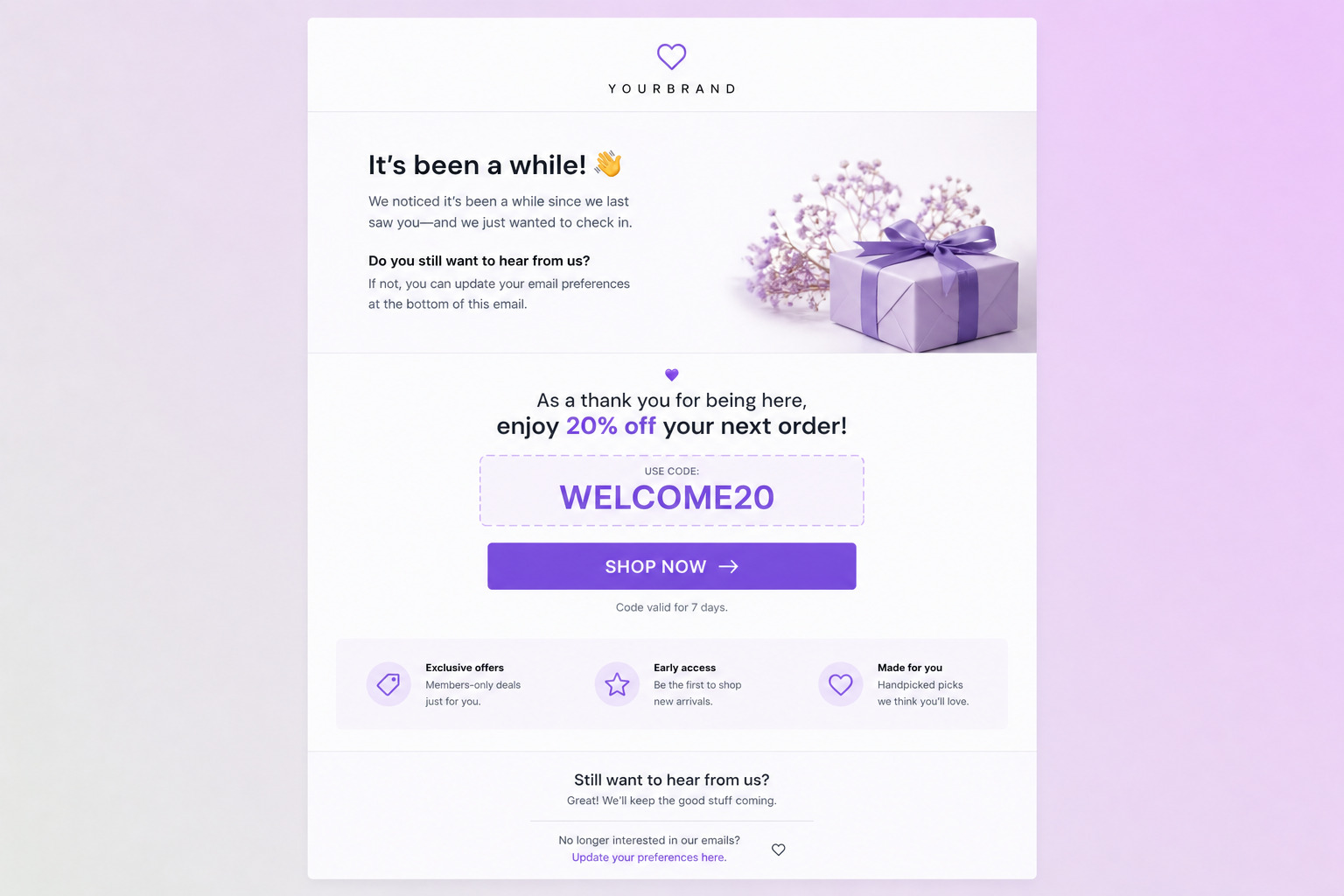
Eventually, some subscribers will get busy and stop opening emails. Instead of letting them sit quiet on the list, proactively run automated re-engagement campaigns to win them back. A standard re-engagement email should be fun and pattern-interrupting.
Email 1: Friendly check-in (triggered at 90 days of inactivity)
Ask them if they still want to receive emails. Offer a generous welcome back discount to inspire a new purchase.
Subject line idea: It’s been a while! Here is a gift for you 🎁
Email 2: Final notice (triggered at 100 days of inactivity)
Politely let them know that the brand only wants to send relevant messages, and they will be removed from the list if they don't click a link inside the email to stay subscribed.
Subject line idea: Should we stay in touch?
If they don't click, safely remove them from the active sending list. Keeping the list full of highly engaged readers leads to fewer spam complaints and vastly improved key metrics across your marketing strategy.
6. VIP upsell sequence
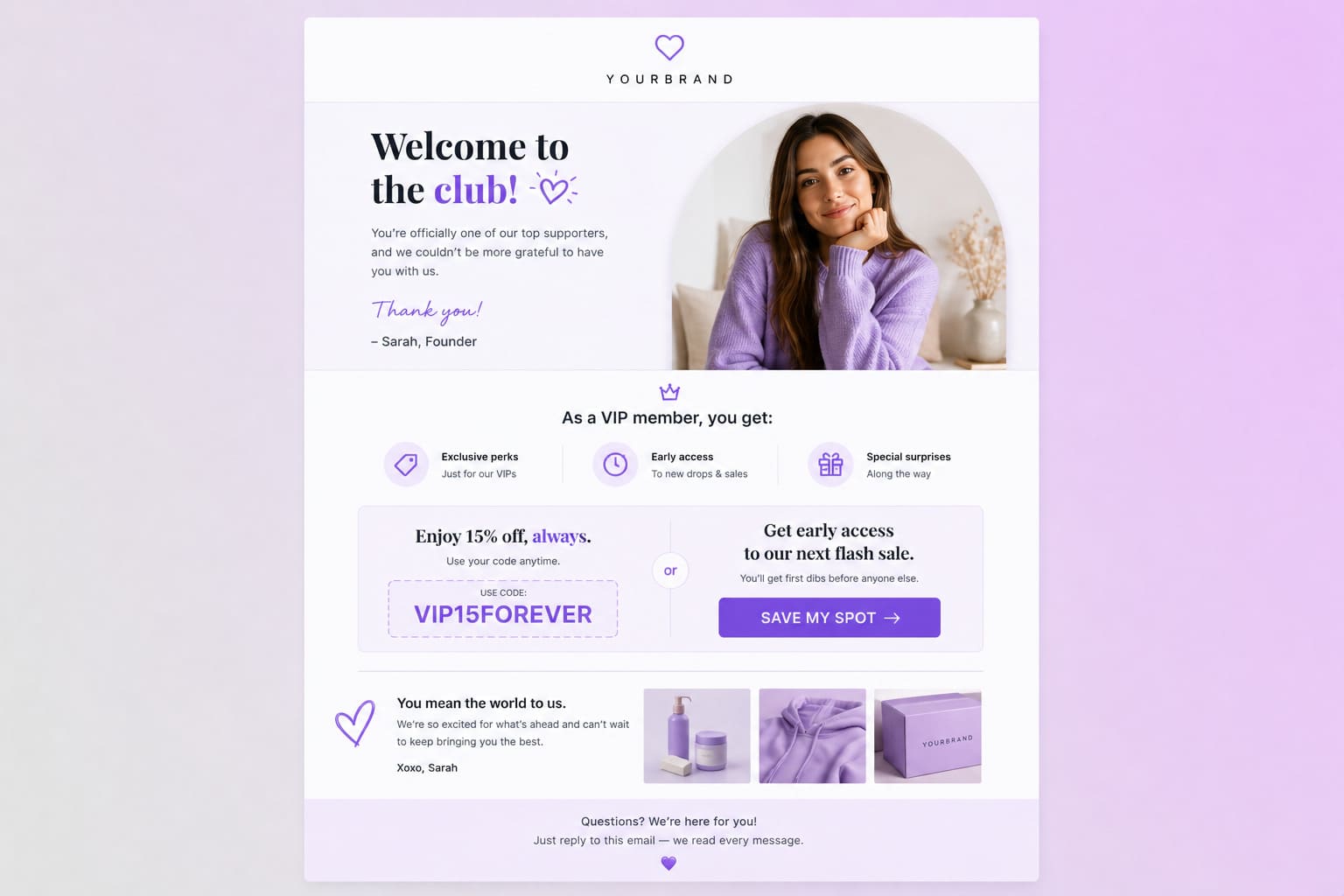
Do not ignore the absolute best buyers.
According to Harvard Business Review, increasing customer retention rates by just 5% increases profits by 25% to 95%. When a customer hits a certain lifetime value threshold (e.g., they spend over $200), they should automatically be tagged as a VIP.
Email 1: Welcome to the club email
Send them a beautifully formatted email from the founder thanking them for being a top supporter of the brand. Give them a permanent VIP discount code or early access to the next flash sale.
Email 2: Cross-sell
Look at their purchase behavior. If they bought a beautiful coffee machine, send them an automated email a week later offering a subscription for premium coffee beans. Anticipate their needs before they even realize they have them.
Writing ecommerce emails that sell
Having the most advanced marketing automation in the world is amazing, but the actual emails need to be designed to convert. Let's talk about the words on the screen and how to format them for peak performance in 2026.
Subject line is everything
If they don't open the email, they can't see the amazing products. Keep subject lines under 50 characters so they look perfect on mobile devices. Subject lines that use personalization (like first names) combined with high-urgency keywords often see a bump in open rates.
60 40 rule in email
What is the 60 40 rule in email? It is a core design framework for email templates. Emails should be roughly 60% HTML text and 40% imagery. This perfectly balances beautiful design with fast load times and ensures emails sail right past spam filters into the primary inbox.
Make it endlessly skimmable
Consumers love to skim on their phones. Digital Information World shows the average time spent reading an email is now just 2-8 seconds. Use bold text to highlight key product benefits. Use bullet points to keep things organized. Make sure the call-to-action button is massive, brightly colored, and incredibly easy to tap.
Always create genuine excitement
Give customers a wonderful reason to treat themselves today. Whether it is a 24-hour flash sale or a highly anticipated product drop, use email marketing efforts to build hype and celebrate the brand community.
Finding the right ecosystem: Funnelish
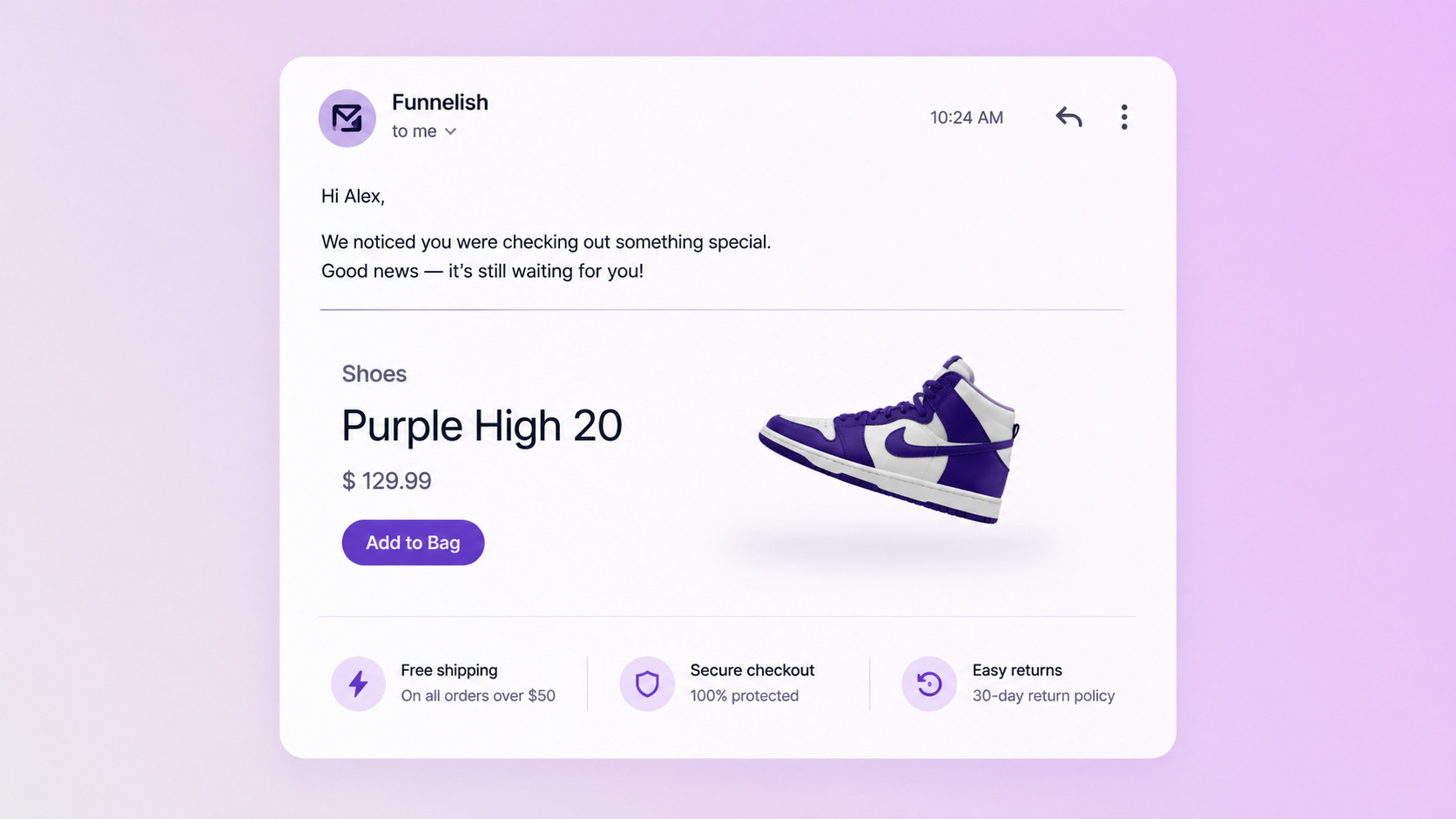
Setting up all these marketing channels doesn't have to take a month. When using the right email providers and page builders, these automated email campaigns take minutes to launch.
For a fast-moving ecommerce business, the most efficient setup is an email platform that seamlessly integrates with checkout pages to capture every single lead without relying on complex integrations.
This is exactly where Funnelish excels. It operates as a complete, high-performance ecommerce ecosystem.
Using the drag-and-drop editor, you can build stunning checkout pages that capture leads instantly. Over 50% of visitors leave a site if it takes more than 3 seconds to load. (Google) With Funnelish, pages load in under 1 second to ensure higher conversion rates.
If someone starts typing their email address on a Funnelish checkout but leaves before entering their payment info, Funnelish automatically catches that customer data and triggers the abandoned cart sequence.
There is no need for a sophisticated third-party app like Zapier or a separate subscription just for basic email automation. It handles leads generation beautifully. Gorgeous email templates can be built right inside the dashboard to easily recover lost revenue.
Because the funnel pages load instantly and the emails are built natively within the same system, the customer experience is flawless. There is zero lag between a shopper abandoning a cart and the marketing automation kicking in.
And for brands looking to scale, Funnelish connects with top-tier SMS marketing tools. Messages can be customized dynamically based on location, optimizing the budget and hitting customers with helpful text reminders to boost conversions.
Technical setup: scaling the sends
As an ecommerce platform scales, the list size will inevitably blossom.
How to send 10,000 emails per day?
When a list grows to this size, a dedicated email marketing service provider (like Funnelish, Mailchimp, or Klaviyo) is required. If starting a fresh domain, the sending IP must be warmed up slowly. A new domain should start by sending 50 emails a day, scaling incrementally over 30 days to prove to inbox providers that the brand is highly engaged and legitimate.
The domain must also be securely authenticated (via DMARC, DKIM, and SPF records) in the DNS settings. It is a one-time setup that protects deliverability forever.
How much does it cost to send 10,000 emails?
Depending on the platform chosen, it ranges from completely free (on generous volume-based plans) to around $8–$50 per month on standard marketing platforms. As revenue grows from these emails, this software cost quickly becomes the best investment made all month.
Read more: Best Mailchimp Alternatives for 2026
Deliverability: thriving in the 2026 inbox
One of the most important aspects of an ecommerce business today is deliverability. Inbox providers like Gmail and Yahoo have updated their rules to ensure users only get mail they want to read. According to Google's 2026 Sender Guidelines, keeping the spam complaint rate under 0.1% ensures emails get VIP treatment in the inbox.
When emails land in the primary inbox, the ecommerce email marketing strategy thrives.
How to ensure top-tier deliverability and avoid spam complaints:
Grow the list organically. Focus on building a community of people who genuinely want to hear from the brand. Offer great incentives for them to opt-in naturally, and never buy a list.
Make it incredibly easy to unsubscribe. Put the unsubscribe button clearly at the very bottom of every single email template. If they can easily opt-out when they lose interest, they will never hit the spam button.
Clean the list regularly. Lists that are actively cleaned quarterly often see an increase in overall inbox placement. Sending emails only to engaged readers massively boosts the sender reputation.
Send valuable content. When educational content and fun brand stories are mixed in with promotional emails, subscribers will actively look forward to the messages.
When a brand deeply respects its subscribers' inboxes, the audience rewards the brand with incredible loyalty.
30/30/50 rule for outreach
If you are doing B2B outreach, connecting with influencers, or seeking wholesale partners, cold emails are often necessary.
What is the 30/30/50 rule for cold emails? It is a brilliant framework for outreach success. The goal is a 30% open rate (meaning the subject line is highly engaging), a 30% response or click rate (meaning the offer is valuable), and the email copy should be kept strictly under 50 words.
When emailing someone new, brevity shows respect for their time. Keep it punchy, friendly, and focused on the amazing value being offered to them.
Bottom Line for Ecommerce Email Marketing Growth
There are a million different reasons to prioritize ecommerce email marketing. It is incredibly cost-effective, highly measurable, and provides unfiltered access to the most loyal paying customers.
Whether the goal is recovering abandoned carts, launching a massive holiday flash sale, or sending a heartfelt thank you to a first-time buyer, an email list is an ecommerce brand's most valuable digital asset.
The best move a brand can make is to start eagerly capturing customer data today.
Using an all-in-one ecosystem like Funnelish to build high-converting checkouts captures emails effortlessly, letting automated email campaigns do the heavy lifting while the business focuses on designing amazing products.
Table of contents
Boost your eCommerce
sales today

24/7 support
No credit card required
Cancel anytime
24/7 support
No credit card required
Cancel anytime
