

How to Rescue a Bleeding AOV: Shopify's Default Traffic Is Killing Your Store
07 April 2026
Anna P.
15 minutes
The default growth playbook in ecommerce is traffic-first. More visitors, lower CPCs, better targeting. And when revenue is flat, or profit margins are thin, the instinct is to acquire more customers.
The problem: customer acquisition costs across paid platforms have increased year over year without exception. Every new customer you bring in at a $22 CPA who spends $38 generates a thinner return than a customer you already paid to acquire spending $65. Boosting average order value is the metric that changes this math — and it's the metric that gets the least deliberate attention in the default Shopify setup.
Your current AOV is not a reflection of what your customers want to spend. It's a reflection of what your store makes it easy to spend. And the default Shopify experience — standard product pages, a passive cart, a generic checkout flow, and no post-purchase infrastructure — is built for acceptable, not optimal. Helping customers discover reasons to spend more at each stage of the purchase journey is what separates stores with healthy unit economics from stores that chase additional traffic to compensate for low order value.
This guide covers why your average order value is probably lower than it should be, what the specific failure points are in the default Shopify setup, and exactly how proven strategies fix them.
What Average Order Value (AOV) Is and Why It's Underrated
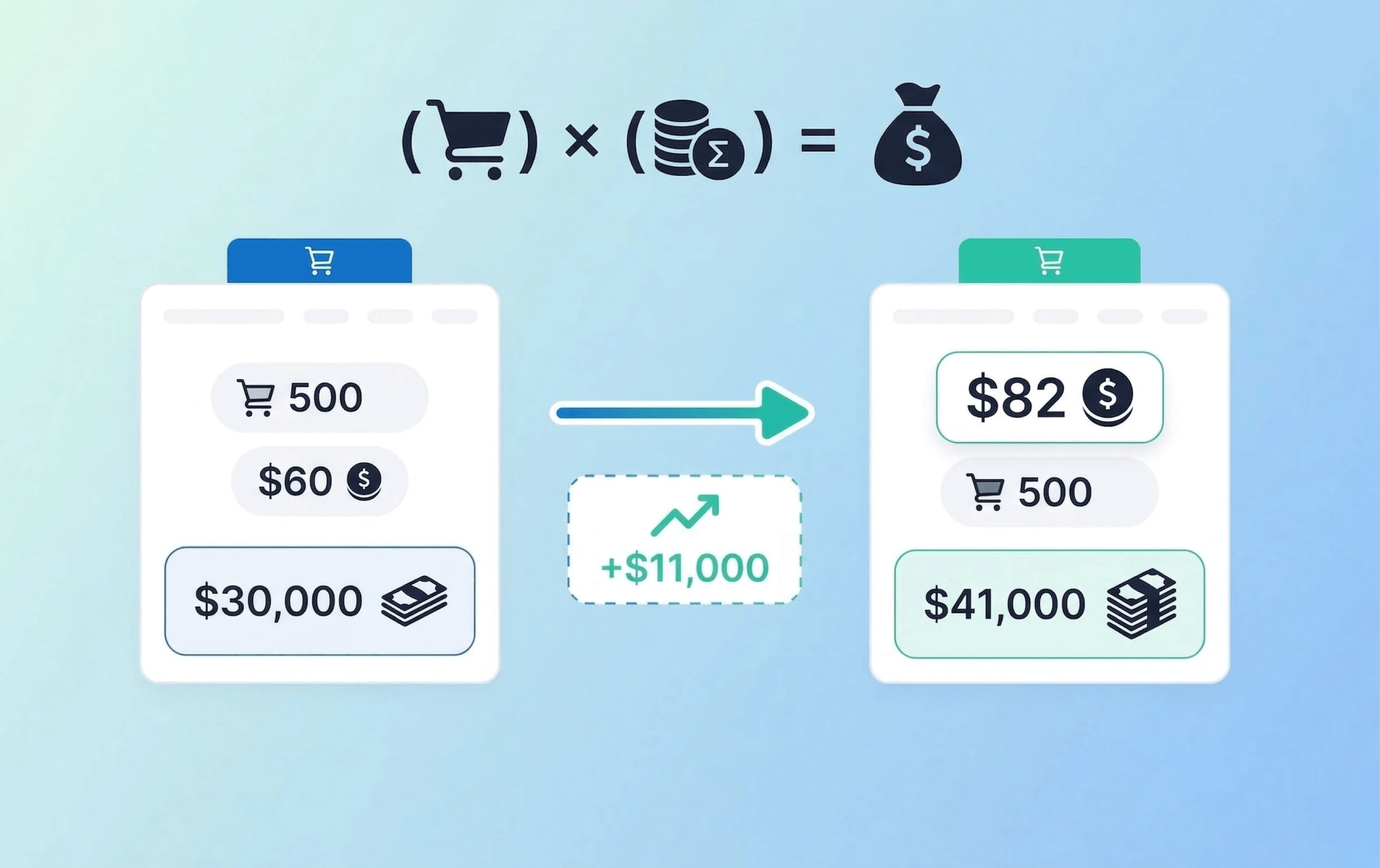
Average order value is total revenue divided by the number of orders in a given period. If your store generates $45,000 from 750 orders in a month, your AOV is $60. To calculate it yourself: take any date range in your Shopify admin, divide total revenue by completed order count, and you have your baseline.
What this key ecommerce metric represents is significant: AOV is the multiplier on your existing traffic and conversion rate. You don't need more visitors or a higher conversion rate to boost revenue — you need each converting customer to spend more. And unlike acquiring new customers, increasing what existing converting customers spend costs almost nothing in incremental marketing efforts.
The compounding effect is real. A Shopify store doing 500 orders per month at $60 AOV generates $30,000. The same store with the same traffic and conversion rates at $82 AOV generates $41,000. That's $11,000 in additional monthly revenue with zero additional ad spend, zero additional traffic, and the same customer base.
Improving AOV also directly improves profitability at the unit economics level. If your customer acquisition cost is $20 and your gross margin is 30%, you need an AOV of at least $66.67 to cover acquisition cost alone before any operational expense. Every dollar of AOV increase above that threshold flows almost entirely to profit, improving the customer lifetime value of every buyer your marketing efforts produce.
How to See Average Order Value in Your Shopify Admin
Before working to increase average order value, find your current baseline. In your Shopify admin, go to Analytics → Overview. The average order value figure appears as a summary metric on the dashboard alongside total sales and conversion rates. For more granular visibility, go to Analytics → Reports → Sales, where you can filter by date range, channel, or customer segments to see how AOV varies across different traffic sources and purchase contexts.
The most useful cut: compare AOV by traffic source using Shopify Analytics. Organic traffic often has a higher AOV than paid traffic because organic visitors are further along in the buying journey. Returning customers with previous purchases almost always have a higher AOV than first-time buyers. Understanding where your current AOV is weakest tells you where the intervention will have the most impact.
Shopify Analytics also supports cohort analysis — tracking how the AOV of a customer segment changes over time with repeat purchases. This is where the connection between AOV and customer lifetime value becomes visible in your key metrics. Customers whose first order AOV is above a certain threshold can have meaningfully higher lifetime value, because the buying behavior that produced a higher first-order spend tends to persist across future orders.
Why Default Shopify Store Bleeds AOV
The default Shopify setup caps what customers spend — not through bad design, but through the absence of any mechanism to encourage customers to spend more across product pages, cart pages, and the checkout page.
Standard product pages show one product. A customer landing on your product page sees the product, the price, and a buy button. If they add it to cart and check out, they spend exactly what that one product costs. There's no prompt to add complementary products, no bundle offer, no "Frequently bought together" suggestion at a point in the journey where the customer is already in a buying mindset and open to product combinations that solve a broader problem.
The cart page is passive. The default Shopify cart displays what's in the cart and a checkout button. It doesn't dynamically suggest additions based on purchase history, show how far a customer is from a free shipping threshold, or present bundle offers that might shift a $45 cart value into a $65 cart.
The checkout page ends the transaction. Once a customer clicks Complete purchase, the default Shopify checkout delivers a Thank you page. The customer's buying intent — which is at its highest point in the entire customer journey immediately post-purchase — is completely unused. No post-purchase upsells, no post-purchase offers, no complementary products that require one click to add. The checkout flow captures what customers already decided to spend and stops there.
There's no tiered pricing or volume discount infrastructure. The default product page doesn't display quantity breaks, volume discounts, or bundle pricing. A customer buying one unit has no visual prompt that buying three would save them 15% — a fact that would convert a meaningful percentage of single-unit online shoppers into multi-unit buyers and directly boost AOV.
Seven Proven Strategies to Boost AOV on Shopify
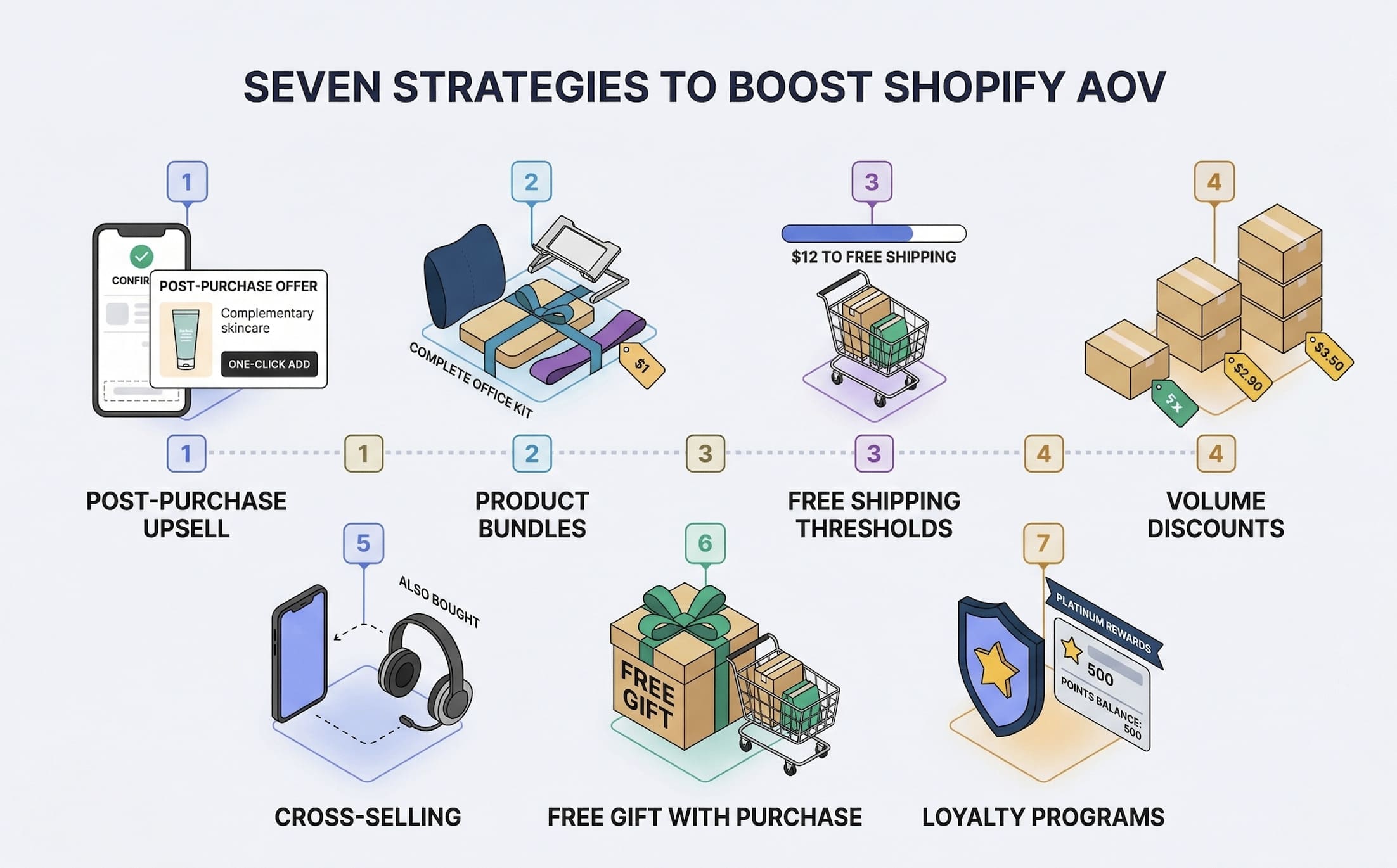
Not every AOV strategy delivers the same return, and not every one fits every store equally well. The seven below are ordered by impact — starting with the mechanism that moves the needle fastest for stores running paid traffic, and working through the tactics that compound over time as your customer base grows.
1. Add Post-Purchase Upsells — Highest-ROI AOV Strategy
The single most effective mechanism for improving AOV is offering an additional product immediately after checkout, when buying intent is highest, and there is zero friction to accepting the offer.
Post-purchase upsells work because the customer has already committed. They've entered their payment details, clicked buy, and received the psychological satisfaction of completing a purchase. Presenting a complementary product at this moment — something relevant to what they just bought, priced to feel like a natural addition — converts at rates that pre-purchase upsells rarely match because the purchase barrier has already been cleared.
You set up the post-purchase flow with Funnelish, which easily connects to your Shopify store. After a customer completes a purchase through a Funnelish funnel, they're presented with a post-purchase offer that requires one click to accept — no re-entering payment information, no new checkout flow, no friction. The offer appears between payment confirmation and the Thank you page, capturing the peak buying window that the default Shopify checkout ignores entirely.
For a skincare store, a customer who just bought a vitamin C serum might see a post-purchase offer for the matching moisturizer at 20% off. In the ideal scenario, a 25–30% acceptance rate on a $29 offer adds $7.25–$8.70 to the average order of every converting customer — with the same traffic, the same conversion rates, and no additional ad spend.
Downsells are also possible: if the customer declines the first post-purchase upsell, a lower-priced offer can be presented before the thank-you page, recovering a portion of that acceptance rate with a smaller but still meaningful order value increase. Every order — including the upsell — syncs automatically to Shopify, keeping fulfillment and inventory management in one place.
2. Build Product Bundles That Remove the Decision to Spend More
Product bundles are the pre-purchase mechanism for increasing cart value by presenting multiple products as a single, more complete purchase. The most effective bundle offers for boosting AOV aren't the ones with the deepest discounts — they're the ones that solve a whole problem. A customer buying a posture corrector is buying because their back hurts. A bundle including the posture corrector, a lumbar cushion, and a resistance band doesn't ask them to spend more — it offers the complete solution to the problem they came to solve.
Frame product bundles around outcomes, not product combinations. "The complete home office relief kit" converts better than listing individual components. The first promises a result; the second reads like an invoice.
Funnelish's page builder and bundle builder let you create dedicated bundle landing pages with a drag-and-drop editor, no coding required, and sub-second load times that keep conversion rates high on paid traffic. Each bundle page gets its own URL — which you can point ads directly at — with a checkout flow built to convert the bundle offer. Shared components keep trust signals, guarantee sections, and brand headers consistent across every bundle page without rebuilding them individually.
For product bundles within your Shopify store's native environment, the Shopify Bundles app handles fixed and multipack bundles with inventory tracking at the component level. For mix-and-match bundle builder workflows where customers select their own product combinations, third-party Shopify apps like Bundler add a bundle widget directly to your product pages.
3. Use Free Shipping Thresholds to Pull Cart Value Upward
Free shipping thresholds are among the most psychologically effective tools for improving AOV because they frame additional spending as avoiding a loss rather than making a discretionary choice. A customer with $47 in their cart who sees "Add $8 more for free shipping" is not being asked to spend more. They're being told that not spending $8 means paying $6.99 in shipping, which they could avoid. Loss aversion does the work.
Set your free shipping threshold meaningfully above your current AOV. If it is $55, set the minimum order value for free shipping at $75. This creates a gap that a significant portion of online shoppers will fill by adding a lower-priced complementary product rather than paying the shipping cost.
Display free shipping thresholds dynamically throughout the funnel: on product pages, in cart pages, and as a progress bar in the cart drawer. "You're $12 away from free shipping" is more motivating the closer the customer gets. This single change consistently moves the needle on average order without requiring additional Shopify apps or complex implementation.
4. Implement Volume Discounts and Tiered Pricing
Volume discounts convert single-unit buyers into multi-unit buyers by making the economics of larger purchases obvious and immediately visible. Tiered pricing displayed directly on the product page — buy one for $24, buy three for $59, buy five for $89 — creates a natural anchoring effect where the single-unit price looks comparatively expensive against the multi-unit tiers.
The math works particularly well for replenishable products where customers already know they'll need more in the future. Supplements, skincare consumables, pet supplies, and cleaning products are natural candidates. The question for these customers isn't whether they'll buy again; it's whether they'll buy from you again or from a competitor. Volume discounts that encourage customers to stock up now increase order value while simultaneously reducing future customer acquisition costs by removing the re-purchase decision.
For ecommerce brands with broader catalogs, tiered pricing works at the category level too — spend $50 and get 10% off, spend $75 and get 15% off. This creates a discount ladder that encourages customers to explore more of your product pages to hit the next tier, which also serves as a cross-selling mechanism: helping customers discover products they might not have found on their own.
5. Cross-Selling Strategies: Complementary Products at the Right Moment
Cross-selling works when relevance and timing are both right. A cross-sell fails when it feels irrelevant or interrupts buying momentum. A customer buying running shoes doesn't want to see Bluetooth speakers. They might need running socks, insoles, or a foam roller. The cross-sell succeeds when it answers a question the customer was about to have anyway — helping customers discover what completes their purchase.
Use your Shopify Analytics and purchase history data to identify which products are most commonly bought together in the same session. These naturally occurring product combinations are your strongest cross-selling candidates — validated by actual customer behavior across your customer base. Previous purchase data in Shopify can surface these patterns at the product level and the customer segment level.
Timing in the cross-selling strategy matters. Cross-sells on product pages have good visibility but compete with the primary purchase decision. Cross-sells in cart pages — where the customer has already committed to buying — convert better. Cross-sells post-purchase, through Funnelish's post-purchase offer infrastructure, converts best of all because the purchase barrier has been cleared and the customer is still in an active buying mindset.
6. Offer a Free Gift With Purchase Above a Threshold
Free gifts with purchase activate a different psychological mechanism than discounts, making them particularly effective for boosting average order among first-time buyers who are price-sensitive but respond strongly to perceived value. A customer who resists paying 20% more will often add $20 to their cart to "earn" a gift they perceive as worth $15.
Set the threshold at a point that creates meaningful uplift from your current value. If your current AOV is $55, a "Free ___ with purchase over $75" threshold pulls a large segment of customers upward by $20. The gift should be genuinely desirable — not a low-cost sample — and should complement the primary purchase to reinforce the product combination.
Display the gift offer prominently throughout the purchase journey: on product pages, in cart pages as a progress indicator, and in the checkout flow as customers approach the threshold. The closer a customer gets to earning the gift, the more motivating the progress bar becomes. This strategy pairs well with cross-selling — the gift threshold encourages customers to add a complementary product to qualify, which increases both cart value and the breadth of products they're exposed to.
Limited-time deals layered on top of gift offers add urgency without discounting. "Free ___ with orders over $75 — today only" creates a flash sales dynamic that accelerates decisions from customers who were already considering a larger purchase.
7. Use Loyalty Programs to Increase Repeat Purchase AOV
Loyalty programs influence not just whether customers come back for repeat purchases, but how much they spend when they do. A customer who earns points on every purchase has an incentive to consolidate spending rather than spreading it across multiple sessions or competitors. Customers near a points threshold will often make larger purchases in a single session to hit the redemption level — which increases AOV on those sessions and normalizes larger baskets as the expected purchase behavior in your store.
The most effective loyalty programs for increasing AOV make the reward visible throughout the shopping experience — showing point balances on product pages, in cart pages, and at the checkout page so the threshold is always in the customer's peripheral awareness. Social proof elements tied to the loyalty program — showing how many customers have earned rewards, or displaying recent redemptions — reinforce participation and encourage new customers to opt in from their first order.
For ecommerce brands tracking customer lifetime value seriously, loyalty programs are where AOV improvements compound most significantly over time. A customer whose first purchase AOV is $65 and who participates in a loyalty program often shows a meaningfully higher AOV on second and third purchases — because the incentive structure encourages them to consolidate and increase rather than cherry-pick.
Read more: 10 Funnel Strategies from Top Brands to Scale Profitably
What Default Shopify Setup Wasn't Built to Provide
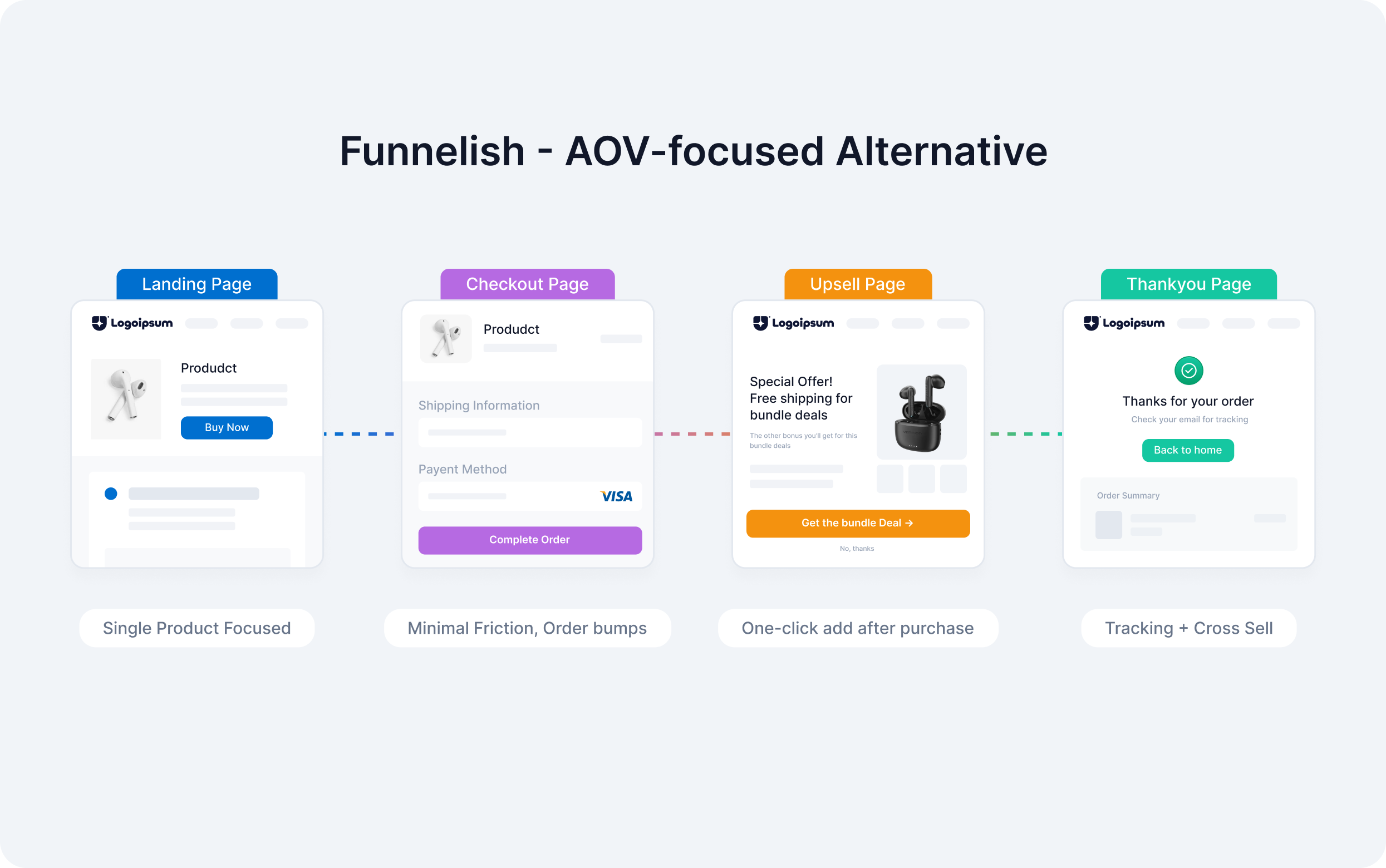
The strategies above address specific points in the customer journey individually. The deeper issue with low AOV in a standard Shopify setup is structural: the default store experience wasn't built with a coherent conversion architecture in mind. Product pages, cart pages, checkout, and post-purchase all exist as disconnected experiences rather than a sequential funnel designed to maximize what each customer spends at every stage.
Funnelish addresses this at the architectural level. Rather than patching individual gaps with separate Shopify apps — one for bundles, one for volume discounts, one for post-purchase upsells, one for abandoned cart recovery — Funnelish provides the full conversion infrastructure as an integrated system that works alongside your Shopify store.
The page builder creates product and bundle landing pages with conversion-optimized layouts, fast load times, mobile-responsive design, and a drag-and-drop editor that requires no coding. The checkout flow is customizable with multiple payment methods and minimal friction. Post purchase offers present complementary products the moment payment is confirmed, capturing the peak buying window the default Shopify checkout ignores.
The result isn't a higher AOV metric in isolation. It's a fundamentally different unit economics picture — where the same traffic, the same products, and the same marketing efforts produce materially more revenue per customer acquired, more profit per order, and a lower effective customer acquisition cost against every dollar of ad spend.
Start your free 14-day Funnelish trial →
Shopify AOV FAQs
What is AOV in Shopify?
Average order value is total revenue divided by number of orders in a given period. It tells you how much each converting customer spends on average — and it's one of the most important key metrics in ecommerce because improving it increases revenue without requiring more traffic or higher conversion rates.
How to see AOV in Shopify?
In your Shopify admin, go to Analytics → Overview. Your average order value appears on the dashboard alongside total sales and conversion rates. For more detail by date range, traffic source, or customer segment, go to Analytics → Reports → Sales.
How to calculate AOV in retail?
Total Revenue ÷ Number of Orders = AOV. A store that generates $120,000 from 1,500 orders in a quarter has an AOV of $80. Shopify calculates this automatically in your analytics dashboard.
What is an example of AOV?
A skincare store sells a vitamin C serum for $38. Current value: $38. After adding a bundle offer pairing the serum with a moisturizer for $59, a free shipping threshold at $65, and a post-purchase upsell for a face mist at $22, the blended average order value shifts to $58. That $20 increase across 600 monthly orders is $12,000 in additional monthly revenue — with no change in traffic or ad spend.
Is high AOV good?
Generally, yes — a higher average order value means more revenue per customer without increasing acquisition costs, which directly improves profit margins. The caveat: AOV in isolation can be misleading. A high AOV with a very low conversion rate may mean only the most committed customers are completing purchases. The meaningful combination is AOV × conversion rate — revenue per visitor — which captures both dimensions.
When to use AOV?
Focus on boosting AOV when customer acquisition costs are high relative to profit margins, when ROAS is declining despite stable traffic, or when you want to increase revenue without scaling ad spend. It's the right lever when the issue isn't how many people are buying — it's how much each of them spends when they do.
Table of contents
Boost your eCommerce
sales today

24/7 support
No credit card required
Cancel anytime
24/7 support
No credit card required
Cancel anytime
