

Shopify Checkout Optimization: How to Bypass the Default and Save Your ROAS
06 April 2026
Anna P.
12 minutes
You spend on ads. You test creatives. You optimize targeting. And then you send traffic to a checkout experience that was designed to be acceptable to everyone — which means it's perfect for no one.
The average cart abandonment rate in 2026 is 70.22%, according to Baymard Institute research across 50 studies. That means seven out of ten people who add your product to their cart never complete the purchase. For a Shopify online store doing $50,000/month in revenue, that's roughly $116,000 in potential monthly sales evaporating before customers reach the confirmation page.
The uncomfortable reality: most of that loss isn't a traffic problem. It's a checkout problem. And the default Shopify checkout, while decent, was not built to maximize conversion for stores running paid traffic at any meaningful scale.
This guide explains why the default checkout costs you ROAS, what you can control within Shopify, and how brands bypass the problem with a dedicated checkout for high conversion.
Why the Default Shopify Checkout Flow Hurts Your ROAS
Before fixing the checkout process, it's worth understanding the specific mechanics of how the default experience leaks money — especially when you're paying for every click that enters it.
When you're running paid ads, every visitor to your checkout has a known cost. If your CPC is $2 and your checkout conversion rate is 2%, you're spending $100 to generate one sale. Improve that checkout conversion rate to 3% — without changing a single ad — and your effective CPC drops to $66. That's a ROAS improvement with zero additional ad spend. The checkout is where your acquisition economics are actually determined, not your ad account.
The default Shopify checkout creates friction in six specific places that compound against each other:
Unexpected extra costs at checkout are the leading cause of abandonment — 48% of shoppers leave when shipping fees, taxes, or other charges make the final total higher than expected. (eMarketer) When someone clicks your ad, sees a $49 product, then reaches checkout to find $12 shipping and $4.50 in taxes, the total jumps 34%. The bait-and-switch feeling kills momentum.
Long and complicated checkout processes cause over 22% of shoppers to abandon their purchases. The default Shopify checkout flows across three pages — information, shipping, payment — each requiring a page load and a mental gear shift. On mobile, where the majority of your paid traffic lands, each page load is another opportunity for a notification, a distraction, or a slow connection to break the session.
Mobile abandonment is 11.76 percentage points higher than desktop on Shopify stores. (Red Stag Fulfillment) The smaller the screen, the harder it is to type addresses, credit card numbers, and email addresses accurately. If your checkout isn't frictionless on mobile devices, you're losing the majority of your paid traffic at the final step.
Forced account creation drives 19% of all abandonments. (Shopify) The default checkout can encourage account creation in ways that feel mandatory to first-time customers who just want to buy quickly and leave.
No post-purchase revenue capture. The default Shopify checkout ends at the thank you page. Every customer who completes a purchase represents a warm, just-converted buyer — and the default experience does nothing with that moment. No one-click upsells. No cross-sells. No second-order revenue. Every paying customer exits at the same value they entered with.
Limited customization without Shopify Plus. Standard plans cannot add code to the Information, Shipping, or Payment pages. Full checkout code customization requires Shopify Plus, which starts at $2,300/month. For brands that aren't on Plus, the options within the native checkout are narrow.
What You Can Fix Inside the Default Shopify Checkout Process
Not every solution requires bypassing Shopify's native checkout. Several high-impact Shopify checkout customization options are available on any plan, and implementing them methodically before looking at alternatives is the right sequence.
Switch to One-Page Checkout Experience
Shopify's one-page checkout condenses information collection, shipping selection, and payment into a single page instead of three separate steps. Stores consistently report conversion improvements after switching, with the gains being particularly pronounced on mobile, where reduced page loads have an outsized impact.
Enable it from your Shopify admin: Settings → Checkout → One-page checkout. This single change costs nothing and typically delivers measurable uplift within days. If you're still on the three-page checkout, this is the first thing to change.
Show All Costs Before the Final Step
Since unexpected costs are the number one cause of abandonment, the fix is straightforward: show shipping costs earlier in the customer journey. Add a shipping calculator to your product pages and cart page. Display a free shipping threshold bar so customers know what they need to spend to qualify. If you offer free shipping, make it prominent in your checkout messaging — not buried in fine print.
The psychological shift this creates is significant. When a customer arrives at checkout already knowing their total cost, there's no sticker shock, no reconsideration, and no reason to leave.
Enable Guest Checkout — And Make It Obvious
Guest checkout should be the path of least resistance, not something customers have to find. Enable it in your Shopify checkout settings and ensure it appears as the primary option, especially for first-time customers. Shop Pay users often see lower abandonment than guest checkout, so the ideal state is: Shop Pay as the express option for returning customers, clean guest checkout as the obvious default for new ones.
Activate Every Express Payment Option
Apple Pay, Google Pay, Shop Pay, and other digital wallets let customers complete the checkout process with a single biometric confirmation on mobile. No typing, remembering card numbers, and other friction required.
Beyond Shop Pay, Shopify supports Apple Pay, Google Pay, and other accelerated options directly from product pages and the cart. These one-click purchase options bypass checkout for logged-in customers with saved payment methods.
Every express payment option you don't activate is a customer who has to type instead of tap. On mobile, that's a meaningful abandonment risk. Enable all digital wallets available through Shopify Payments in your payment settings.
Add Trust Signals Throughout the Checkout Page
Trust badges and clear return policies can reduce checkout abandonment by up to 30%. Security badges — SSL indicators, payment provider logos (Visa, Mastercard, PayPal), and money-back guarantee messaging — reduce the anxiety that comes from entering payment information with a brand a customer is using for the first time.
Place trust signals near the payment form, not just in the footer. The moment of entering card details is when anxiety peaks. That's when reassurance has the most impact.
Minimize Form Fields to What's Actually Required
Every unnecessary form field is a micro-friction that compounds across thousands of checkout sessions. Review your checkout form fields and remove anything that isn't required to process the order and ship it. Phone number fields should be optional. Middle name fields should disappear. The less typing required, the fewer sessions that get abandoned midway through a frustrating mobile keyboard experience.
Use a Progress Bar
For customers who do go through a multi-step flow, a progress bar showing where they are in the checkout process reduces anxiety and sets expectations. Knowing that payment is Step 3 of 3 is psychologically easier than an ambiguous process with no visible endpoint. Many Shopify themes support this natively or through the checkout editor.
Display Free Shipping Thresholds Clearly at Checkout
If your shipping rules include free shipping thresholds, surface them dynamically during the checkout process. A message showing "Add $12 more for free shipping" at the cart stage converts into additional items added — increasing average order value while simultaneously reducing the friction of surprise shipping costs at the final step.
A Deeper Problem: What the Default Checkout Can't Do
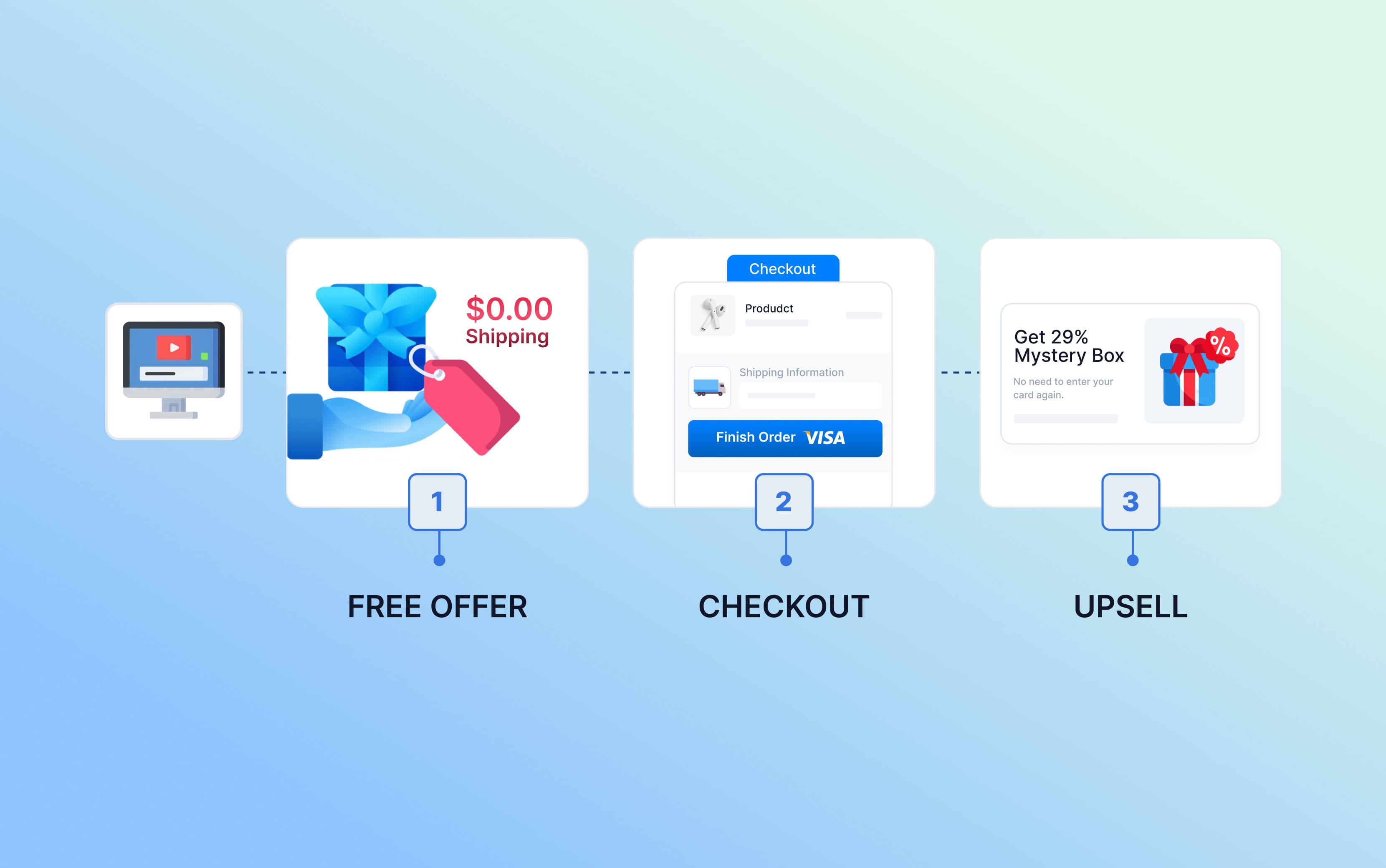
Implementing the fixes above will improve your checkout performance meaningfully. But there's a ceiling to what's achievable within the native Shopify checkout experience — particularly for brands running serious paid traffic and thinking in terms of funnel economics rather than just conversion rate.
The default checkout process is designed as a closing mechanism. It's the end of the customer journey. That model made sense when ecommerce was simpler. In 2026, the stores with the best ROAS treat checkout not as a closing step but as a revenue amplification moment.
Consider the math: if your average order value is $65 and you convert 3% of paid traffic, your revenue per visitor is $1.95. If you can increase average order value to $85 through post-purchase offers without changing conversion rate or traffic, your revenue per visitor becomes $2.55. That's a 31% ROAS improvement with the same ad spend and the same customer count.
The default Shopify checkout has no mechanism for post-purchase offers. Every customer who completes a purchase exits at exactly the same value they arrived with. The moment immediately after payment confirmation — when purchase intent is highest, and buyer's remorse is lowest — is completely unused.
This is the limitation the default checkout can't overcome. And it's why the highest-performing Shopify brands don't rely on the native checkout as their only conversion infrastructure.
How Funnelish Solves What the Default Checkout Can't
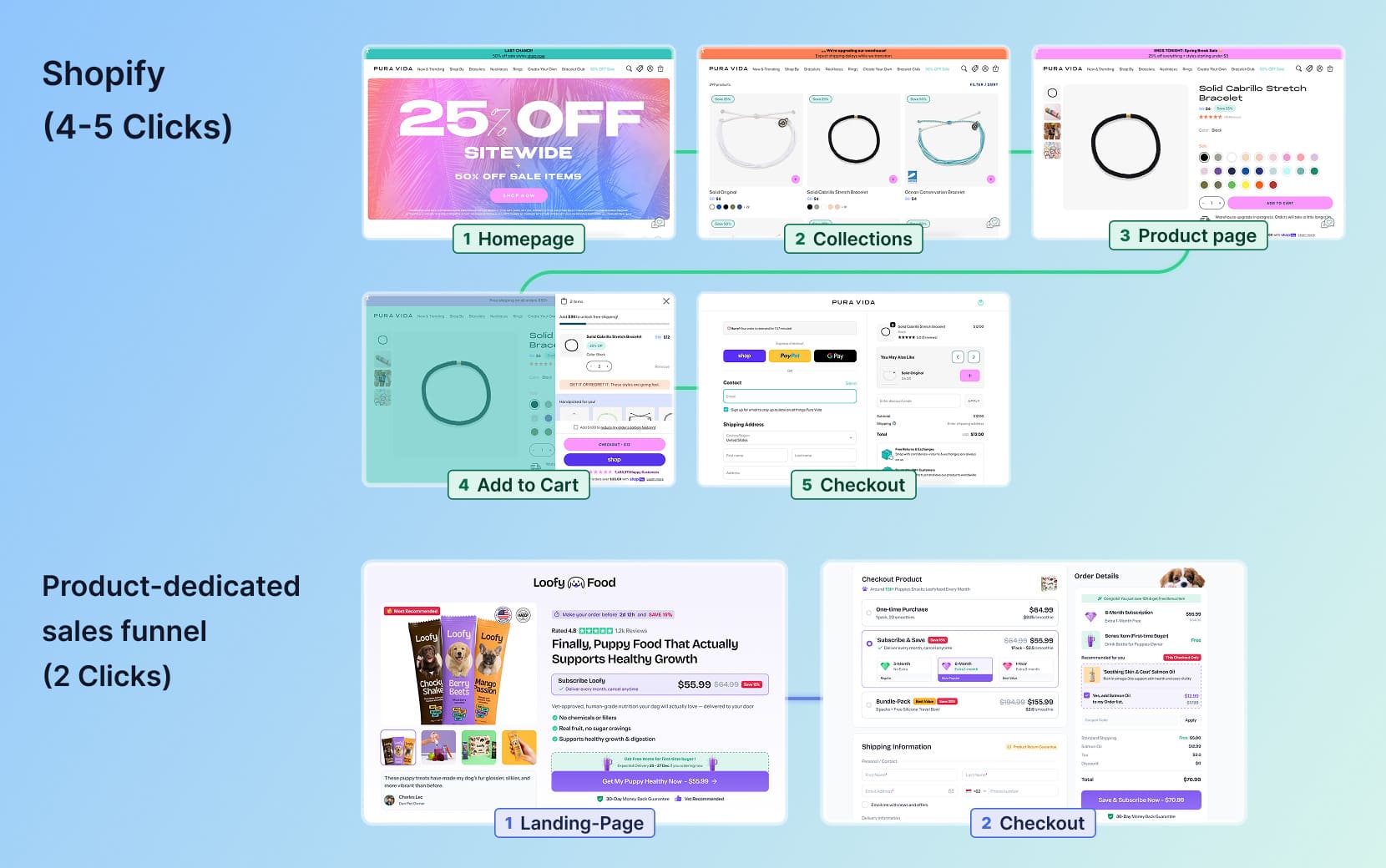
Funnelish is built as the checkout process optimization tool that works alongside your Shopify store — designed for brands running paid traffic who need a checkout experience optimized for performance and profit.
A Checkout Built for Paid Traffic
When someone clicks your ad, Funnelish lets you send them to a dedicated landing page — sub-second load times, no store navigation, no distractions, no related products pulling attention away from the sale. The entire page exists for one purpose: this customer, this product, this purchase.
The checkout flow is frictionless by design. One page. Clear pricing. Trust signals in the right places. Every express payment option — Stripe, PayPal, Apple Pay, Google Pay, Klarna, iDEAL, SEPA, and more — available through Funnelish's payment gateway pools. The checkout experience is built to close, not to be acceptable.
Post-Purchase One-Click Upsells
The most significant ROAS impact Funnelish provides is what happens after a customer clicks Complete Purchase. Before the order confirmation, they're presented with a post-purchase offer — a complementary product, a bundle, a subscription — that requires zero additional payment information and one click to accept.
Because payment details are already confirmed, there's no re-entry friction. The customer isn't starting a new purchase — they're expanding an existing one with a single tap. This is how Funnelish customers increase average order value without touching acquisition costs.
A supplement brand offering a one-click upsell for a complementary product to every first purchase doesn't need to acquire more customers to increase revenue. They need to maximize what each customer spends. A 30% acceptance rate on a $25 upsell adds $7.50 to every order average — which, for a store doing 1,000 orders a month, is $7,500 in incremental monthly revenue from the same ad spend.
Read more: 10 Funnel Strategies from Top Brands to Scale Profitably
Abandoned Cart Recovery Built In
Funnelish's abandoned cart sequences fire automatically when a customer enters checkout details but doesn't complete the purchase — no external automation tools, no Zapier connections, no third-party email platform required for the trigger. Email and SMS recovery sequences run natively, reaching customers who left at the final step with the right message at the right time.
Geo-Funnels: Right Checkout for Every Market
One of the most overlooked ROAS problems for brands selling internationally is a checkout experience that ignores where a customer is. Showing USD pricing to a German customer, or displaying payment methods that aren't trusted in Japan, creates friction that's invisible in your aggregate analytics but devastating to conversion in specific markets.
Funnelish's geo-funnels detect visitor location and automatically display the right currency, the right payment methods, and the right offers for that market. A visitor from Germany sees EUR, SEPA, and local payment options. A visitor from the Netherlands sees iDEAL. A visitor from the UK sees GBP. Each market gets a checkout experience optimized for how they buy — without building separate stores or managing complex conditional logic.
Shopify Sync: One Infrastructure, Not Two
Funnelish doesn't replace Shopify — it works alongside it. Every order placed through a Funnelish funnel syncs to Shopify: inventory, variants, fulfillment, customer records. Your operational stack stays intact. Your team still works in Shopify. The conversion infrastructure is simply better than the default checkout for the traffic you're paying to send through it.
Framework: Matching Your Checkout to Your Traffic
The practical approach to Shopify checkout optimization in 2026 is not choosing between Shopify's native checkout and a dedicated funnel — it's understanding which traffic deserves which experience.
Organic traffic from search, social, and direct visitors: the native Shopify checkout with the optimizations covered above — one-page checkout, guest checkout, express payments, transparent shipping — performs well for customers who are already familiar with your brand and browsing at their own pace.
Paid traffic from Meta, Google, TikTok, or any channel where you're paying per click: these customers have a known acquisition cost, a specific intent based on the ad they clicked, and zero patience for a generic checkout experience. They deserve a dedicated landing page, a friction-free checkout, and a post-purchase upsell sequence that recovers as much revenue per visitor as possible. This is the traffic that Funnelish is built for.
The ROAS problem many Shopify stores have isn't their creatives or their targeting. It's that they're sending expensive paid traffic into a checkout experience designed for browsing customers — and then wondering why the numbers don't work.
Fix the checkout. The ads get better without changing anything in the ad account.
Table of contents
Boost your eCommerce
sales today

24/7 support
No credit card required
Cancel anytime
24/7 support
No credit card required
Cancel anytime
