

Shopify Store: From Setup to Loyal Customers and Recurring Profits
28 March 2026
Anna P.
General Shopify ecommerce advice skips the part that matters. Everyone covers how to pick a theme and add products. Almost nobody talks about what happens after the first sale — which is where the real business either gets built or quietly falls apart.
This guide covers both. The setup decisions that cost operators later when they skip them. The growth tactics that compound. And specifically, the systems that turn one-time shoppers into loyal customers who generate recurring revenue without requiring you to acquire them all over again.
Choosing Your Pricing Plan Before You Build
The most consequential decision new store owners make badly: choosing a Shopify pricing plan based on monthly cost rather than transaction cost.
Shopify Basic at $39/month is the right starting point for most new stores. It includes everything you need to build a functional online store, start selling, and test whether your product and market fit is real. What it also includes is a 2% transaction fee on any payment processed through a third-party gateway, and a 2.9% + 30¢ credit card rate through Shopify Payments.
At low volume — say, $5,000/month in sales — that math is fine. At $30,000/month, upgrading to the Advanced plan at $399/month pays for itself through lower processing rates alone. Build your pricing plan decision around the revenue threshold where the fee savings justify the upgrade, not around which plan sounds right for your stage of business.
One fee structure some new Shopify store owners don't think about until it bites them: if you use a third-party payment gateway instead of Shopify Payments, that transaction fee runs on top of whatever the gateway charges. For most stores selling in markets where Shopify Payments is available, the integrated option is the cleaner economics.
Setting Up Your Online Store the Right Way From Day One
The foundational setup decisions that cause the most pain when skipped:
Your domain. Connect a custom domain before you launch — not your default myshopify.com address. A custom domain costs $10–$20/year and is the difference between looking like a real business and looking like a test store. Every piece of brand identity, customer trust, and SEO authority you build lives on that domain.
Your theme. Choose a theme that fits your product category and catalog size, not the one that looks best in a demo. A fashion brand with a large product range needs different navigation and filtering than a single-product store with a focused value proposition. Overhauling your Shopify theme after you've built significant content is expensive in time. Make the right call upfront, even if it takes another day of research.
Essential pages before launch. Customers find reasons not to trust unfamiliar online stores. An About page, a Contact page, clear Shipping Information, and a Returns Policy aren't legal requirements — they're conversion elements. Shoppers who can't quickly answer "Where does this ship from?" and "What happens if it doesn't fit?" leave without buying. These pages take two hours to write and immediately improve trust and conversion.
Your analytics stack. Connect Google Analytics and Google Search Console before your first sale. Set up your Facebook Pixel if paid social is in your marketing strategy. The tracking you skip at launch is data you can never recover. Analytics are not something to configure after you're getting traffic — configure them first, so every visit from day one is informative.
Designing for Shoppers First
Store design is the area where personal preference does the most damage to business outcomes. The design you love and the design that converts aren't always the same thing.
A few things that consistently matter for how customers find and navigate your store: navigation clarity, load speed, and mobile layout. The majority of ecommerce traffic in 2026 arrives on mobile devices. (DesignRush) If your store layout requires pinching, scrolling sideways, or squinting at small buttons on a phone, you're losing buyers before they see the product.
Keep Your Navigation Architecture Simple
Customers who can't find a product in three clicks usually leave rather than search harder. A maximum of two levels of navigation — main categories and subcategories — covers most ecommerce stores. More depth than that and you're organizing for your inventory system, not for how shoppers browse.
Choose Your Homepage Hero Section Deliberately
Most ecommerce themes give you a large hero banner at the top of the homepage. This section is high-value real estate. It should tell a first-time visitor immediately what your store sells, who it's for, and what makes it worth staying. A beautiful lifestyle image with no context is a missed opportunity. A clear and specific headline with a strong visual and an obvious call to action is what converts curious arrivals into browsers.
Product Descriptions Are a Selling Tool
The product name and SKU are not a description. A description that converts tells the customer what the product does for them, answers the questions they'd ask before buying, and uses the language their target audience uses — including the keywords they search. Generic manufacturer descriptions do none of these things and rank nowhere in search results.
Driving Traffic: The Channels That Actually Work
Getting customers to find your store is the problem every Shopify store owner eventually confronts. There's no single right answer — but there is a wrong one, which is waiting for traffic to arrive organically without a deliberate strategy to create it.
Paid Social Is the Fastest Path to Initial Validation
Facebook and Instagram ads remain the dominant traffic source for many product-focused Shopify stores. The playbook has matured — audiences have been conditioned to recognize generic ad creative, and competition for attention is real — but the channel still works for merchants with a strong product, a specific target audience, and a landing page that converts the click.
Start narrow: one-product funnel, one audience, one clear message. Broad campaigns with undefined audiences are how new operators spend their way to nothing.
Organic Search Compounds Over Time
Blog content, optimized product descriptions, and collection page copy that targets real search queries build organic traffic that doesn't disappear when you stop paying for ads. The payoff is slow — expect 6–12 months before meaningful organic traffic for most niches — but once it's established, it changes the economics of the business fundamentally. Every Shopify store owner should have a content strategy, even a minimal one.
Read more: Shopify SEO: 30 Hacks to Rank Higher
Email Is the Highest-ROI Channel Stores Underinvest in
Capture users' email addresses from day one — through a discount offer, a lead magnet, or a quiz — and treat every subscriber as a customer relationship in progress. A basic email automation setup: a welcome sequence for new subscribers, an abandoned cart recovery sequence, and a post-purchase follow-up. These three automations alone recover a meaningful percentage of revenue that would otherwise be left on the table.
Social Channels Amplify What's Already Working
Organic social media rarely drives significant direct revenue for new stores, but it builds brand context that makes paid ads work better and reduces friction for customers who look up your brand after seeing an ad. The goal of your social presence isn't necessarily to go viral — it's to demonstrate that your brand is real, active, and worth trusting.
Read more: Social Commerce Just Hit $100 Billion. Here's Why Many Brands Won't Profit From It.
Inventory, Fulfillment, and the Operational Foundation
Growth creates operational problems faster than new store owners anticipate. The inventory management and fulfillment systems that work at 20 orders a month break at 200. Building them properly early is cheaper than rebuilding under pressure.
Shopify's native inventory management handles the basics — stock tracking, product variants, low-stock alerts — adequately for stores in their early stages. As volume grows, integrating with fulfillment partners (ShipStation, ShipBob, or a 3PL appropriate to your product type) and ensuring real-time inventory sync becomes important. Overselling products you don't have in stock is one of the fastest ways to generate the kind of bad reviews that compound into brand damage.
On shipping: offer free shipping wherever your margins support it. The psychology of shipping costs is well-documented — a $6.99 shipping fee on a $40 order loses buyers who would have completed the purchase at $46.99 with free shipping built in. If free shipping on every order isn't viable at your current margins, set a free shipping threshold slightly above your average order value to incentivize customers to add one more item rather than abandon.
From First Purchase to Loyal Customer: Where the Real Profit Lives
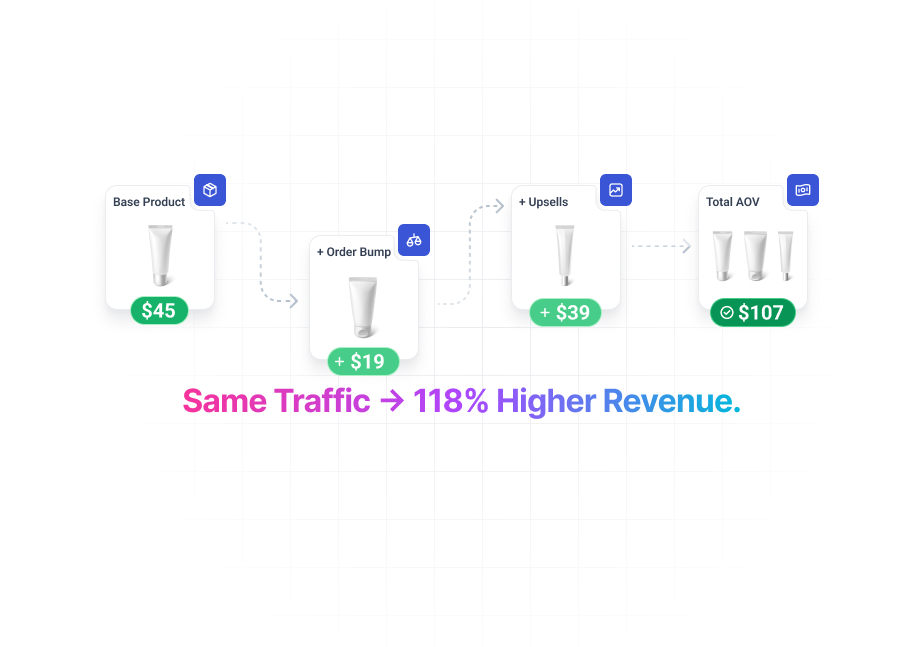
Let's move to the economics that many Shopify store owners learn the hard way: customer acquisition is expensive, and the first sale often barely covers the cost of getting it. The profit is in what happens after.
A customer who buys once has an acquisition cost attached to them. A customer who buys three times has that same acquisition cost spread across three transactions, and a significantly higher lifetime value. The difference between a store that grows and a store that grinds is its retention.
The post-purchase moment is the most underused window in ecommerce. Immediately after a customer completes a purchase, they're in a specific psychological state: they've already trusted you enough to hand over payment details, their purchase anxiety has resolved, and their enthusiasm for the product is at its peak. This is the optimal moment to make a secondary offer — a complementary product, a bundle, a quantity upgrade — because the friction that exists at any other point in the customer journey has temporarily disappeared.
Many Shopify stores treat the confirmation page as an order receipt. The operators generating recurring revenue treat it as the beginning of the customer relationship.
This is exactly where you can take advantage of the best Shopify upsell apps, like Funnelish, which changes the math. Funnelish is an eCommerce funnel platform that connects to your Shopify store — syncing orders for fulfillment while giving you a conversion optimization tool that standard Shopify product pages and checkout flows simply aren't designed to deliver.
In practice: a customer arrives from your ad, lands on a dedicated Funnelish funnel page that loads in under a second (even on mobile), moves through a checkout built to minimize friction, and immediately after purchase sees a one-click post-purchase upsell — no re-entering payment details, no new checkout flow, just a single tap to add a complementary product to their order. That upsell converts at rates that can outperform any pre-purchase offer, because the trust barrier is already cleared.
Many direct-to-consumer brands have built their entire business models around this technique. The result is usually a higher average order value on the same acquisition spend — which is the most direct lever available for turning a marginal first sale into a genuinely profitable customer.
Beyond the first transaction, Funnelish's built-in email sequence capability lets you nourish the relationship:
A post-purchase follow-up
A re-engagement email at 30 days
A targeted offer based on what they bought
Combined with the abandoned cart recovery sequences that target the 70% of visitors who start checkout and don't complete it, these automations build the kind of recurring revenue base that makes a Shopify shop feel like a real business rather than a continuous hustle to find the next new customer.
The analytics layer closes the loop — funnel-level performance data that shows you where customers drop out, which upsell offers convert, and what your revenue per visitor looks like at every stage. Not just store-level analytics, but funnel-level intelligence that tells you where to invest improvement effort.
The stores that build genuine loyalty share a few common characteristics. They communicate proactively — shipping updates, product education, useful content — rather than going silent after the sale. They make returns and issues easy to resolve rather than adversarial. They give repeat buyers a reason to feel recognized — through loyalty offers, early access, or simply personalized communication that acknowledges purchase history. None of this is complicated. Most of it is just treating customers as relationships rather than transactions.
Scaling What Works and Drives Sales
Another mistake that even successful Shopify retailers make when a product starts to work: they try to scale everything simultaneously. More products, more channels, more ad spend, more markets.
The operators who build durable businesses scale selectively. They find what works — a specific product, a specific audience, a specific traffic channel — and they push that hard before adding complexity. Each addition to a store creates maintenance overhead, inventory risk, and operational load. A focused store with three high-performing products and a single proven traffic channel is more profitable than a sprawling store with thirty products and no clear momentum.
Use your Shopify analytics to identify the 20% of your catalog driving 80% of your revenue. Build your landing pages and marketing campaigns around those products. Build your upsell sequences around complementary items. Invest in better creative, better product photography, and better descriptions for the things that are already working — rather than spreading the same effort across everything in your catalog.
That's how a Shopify store grows from a functional ecommerce website into a business that runs with intention — and eventually generates the recurring revenue that makes the whole thing worth building.
Shopify Store FAQs
How do I earn money from Shopify?
The primary revenue model is straightforward: you sell products through your Shopify store and keep the margin after product cost, platform fees, payment processing, and marketing spend. The stores that build meaningful income build post-purchase revenue through upsells, repeat purchase incentives, and email marketing that brings existing customers back. The acquisition cost is fixed; what you do after that customer arrives determines whether the business is profitable.
Is Shopify better than Amazon to start selling?
They're fundamentally different channels. Amazon gives you access to millions of existing shoppers, but at the cost of margin (Amazon's referral fees run 8–15% by category), customer data (Amazon owns the relationship), and brand control. Shopify gives you a store you fully own — your customer data, your brand identity, your pricing — but you're responsible for generating your own traffic.
And for operators who want to maximize what that owned store converts, pairing Shopify with a funnel platform like Funnelish is how you extract the most revenue from the traffic you're already paying to acquire.
Which is better, Etsy or Shopify?
Etsy is a marketplace with built-in traffic — buyers come to Etsy looking for handmade, vintage, or craft products. Shopify is a platform where you build your own store and drive your own traffic. Etsy is easier to start and faster to generate early sales for the right product types, but you're competing on Etsy's platform, paying Etsy's listing and transaction fees, and building a following for Etsy rather than for your brand. Shopify requires more upfront work to build traffic, but everything you build — your customer list, your brand, your SEO authority — belongs to you.
How much does Shopify take from a $100 sale?
On the Basic plan using Shopify Payments: 2.9% + 30¢ per transaction, so approximately $3.20 on a $100 sale. On the Grow plan: 2.6% + 30¢, approximately $2.90. On the Advanced plan: 2.4% + 30¢, approximately $2.70. If you use a third-party payment gateway instead of Shopify Payments, an additional transaction fee applies — 2% on Basic, 1% on Grow, 0.6% on Advanced — on top of whatever the gateway charges. The monthly subscription cost is separate from transaction fees.
What are the disadvantages of Shopify?
The main ones: transaction fees for third-party payment gateways create real cost pressure at volume. The app ecosystem, while extensive, means many features you might expect to be built-in require paid monthly subscriptions on top of your plan. Deep customization of the checkout flow is restricted to Shopify Plus. URL structures are less flexible than self-hosted platforms.
And the standard Shopify product page and checkout, while functional, isn't purpose-built to convert paid traffic at the highest possible rate — which is why serious operators often layer dedicated funnel infrastructure on top of the platform for their most important campaigns.
Funnelish addresses this directly: it brings a conversion layer — sub-second landing pages, friction-minimized checkout, and post-purchase upsells built into the flow — while syncing all orders back to Shopify for fulfillment. The limitations of Shopify's native checkout stop being a constraint when you're not relying on it as your primary conversion environment.
Table of contents
Boost your eCommerce
sales today

24/7 support
No credit card required
Cancel anytime
24/7 support
No credit card required
Cancel anytime
