

Social Commerce Just Hit $100 Billion. Here's Why Many Brands Won't Profit From It.
09 March 2026
Anna P.
10 minutes
Earlier this year, US social commerce was predicted to cross $100 billion in annual sales for the first time. (eMarketer) That number has been forecast for a while, but watching it arrive has done something predictable to the eCommerce industry: it's sent a wave of brands scrambling to set up TikTok Shops, pin products on Instagram, and treat social media platforms as if they're the destination.
They're not. They're the traffic source. And confusing the two is one of the most expensive strategic mistakes a brand can make in 2026.
TikTok Shop is projected to exceed $20 billion in US sales this year. (eMarketer) Half of all US social media users who shop are expected to make a purchase on TikTok. Those are real numbers, and social commerce as a channel is genuinely consequential.
But here's the part that doesn't make the headline: for most brands, the highest-value customers they'll ever acquire from social platforms aren't the ones who buy through TikTok's native checkout. They're the ones who click through to a landing page, enter an email address, and enter a proper conversion funnel where you control the entire shopping experience from the first impression to the post-purchase upsell.
The brands treating social commerce as an endpoint are optimizing for one transaction. The brands treating it as a top-of-funnel channel are building a customer base.
Why TikTok's Native Checkout Is a Trap for Serious Brands
TikTok Shop is an excellent discovery mechanism. Its algorithm surfaces products to users who weren't looking for them — which is fundamentally different from Google, where intent already exists, or Amazon, where the customer has usually decided to buy something in the category. Social commerce is interruption commerce, and it works because the content and the commerce are woven together.
But TikTok's native checkout has a structural problem for brands that want to build long-term revenue: you don't own the customer relationship. TikTok processes the transaction, holds the customer data, and sets the terms under which you can communicate with that buyer afterward. The buyer who purchased through TikTok Shop is, in a meaningful sense, TikTok's customer first and yours second.
Compare that to a buyer who clicked your TikTok ad, landed on your funnel page, and checked out directly with you.
You have their email address.
You have their purchase history in your system.
You can send them an abandoned cart sequence if they didn't complete the checkout.
You can follow up with a post-purchase upsell the moment the transaction is confirmed.
You can enroll them in a subscription.
You can trigger a personalized re-engagement email after 30 days.
This means you own the relationship.
The economics are also different. TikTok charges a 6% referral fee on orders placed through TikTok Shop. That's before you consider ad spend. A brand with a 30% product margin is giving up 6 points of it before the order even arrives. Routing that same customer through your own funnel eliminates that fee and gives you a post-purchase upsell opportunity that can materially increase average order value on the same acquisition spend.
Read more: #1 Reason Viral TikTok Products Don’t Convert
Real Opportunity in the Social Commerce Wave
The $100 billion in social commerce isn't going away. Gen Z has fundamentally changed how product discovery works — 43% of Gen Z consumers now start shopping searches on TikTok, not Google or Amazon. (eMarketer) Short-form video is the new search engine for a generation with significant purchasing power and almost zero brand loyalty to established players.
That's not a threat to direct-to-consumer brands. It's an opening. A 20-second video showing a product in use can drive more qualified traffic in 24 hours than a month of Google Shopping campaigns — if the funnel behind it is ready to convert that traffic efficiently.
The brands winning social commerce in 2026 are the ones with the best infrastructure behind the content. They're the ones whose landing pages load in under a second on mobile — because social traffic is almost entirely mobile devices, and a 3-second load time loses a third of your visitors before they've seen the offer. They're also the ones whose checkout removes every friction point because a buyer arriving from a viral TikTok video is in a high-excitement, low-patience state where one unnecessary form field is enough to lose them.
Funnelish's page infrastructure is built for this. Pages load around sub-second on mobile traffic, and the checkout flow is designed to minimize steps between "I want this" and "Order confirmed." When a video goes viral, and thousands of visitors arrive in the same hour, the funnel holds. That operational readiness is what turns a content moment into a revenue event.
How to Build a Social Commerce Funnel That Captures More Than One Transaction
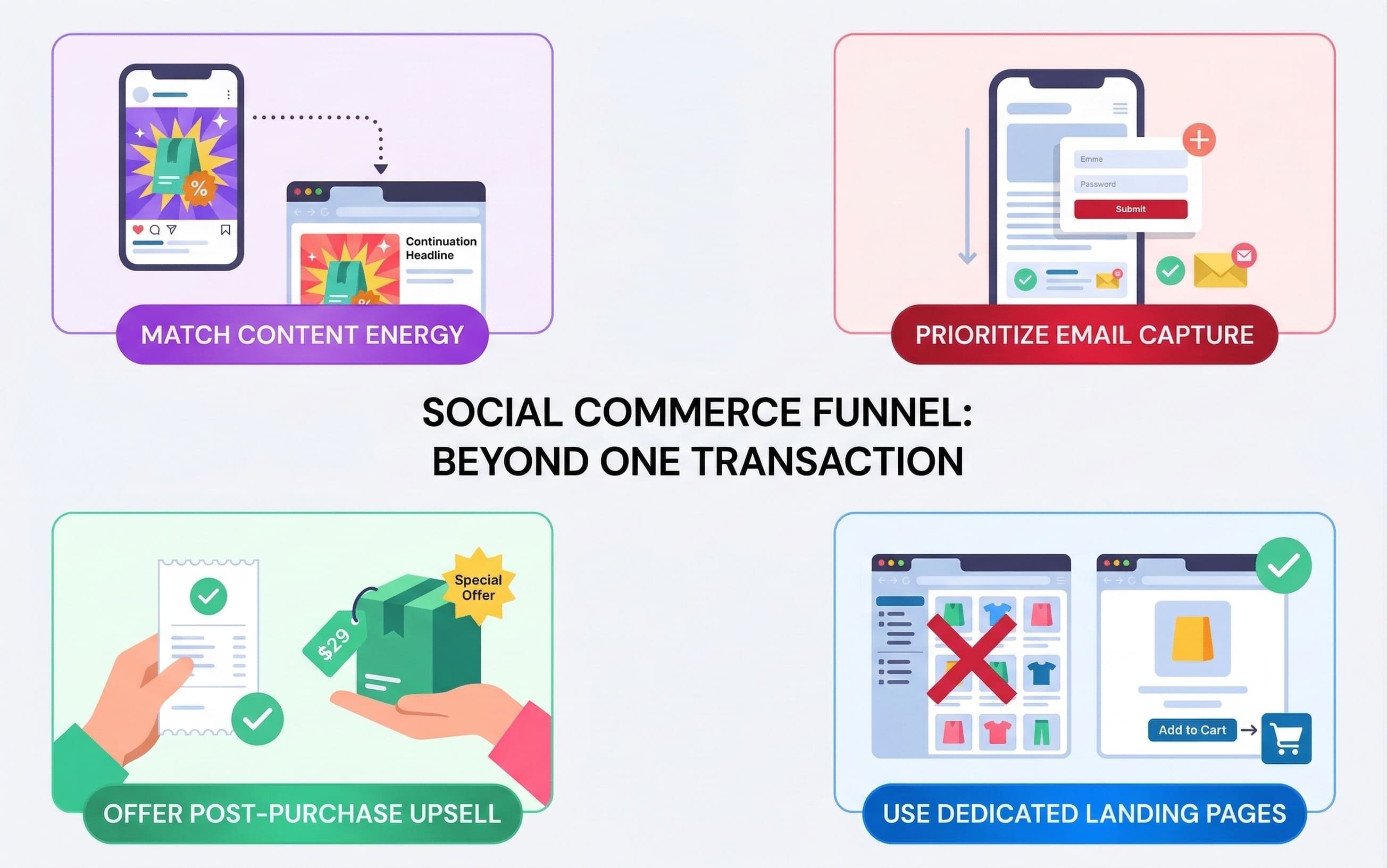
The funnel that converts social traffic isn't the same as the funnel that converts Google search traffic. Intent levels are different, awareness is different, and the friction tolerance of the visitor is different. A few principles that apply to social-sourced traffic:
Lead with the same energy as the content that brought them. If your TikTok video is high-energy, fast, and product-focused, your landing page should mirror that tone immediately. A visitor who came from a 20-second product demonstration video and lands on a page that leads with brand story copy has experienced a jarring mismatch. The headline and hero section should feel like a continuation of the video, not a new pitch.
Capture the email before you lose them. A significant percentage of social traffic visits your page and doesn't buy on the first touch — not because they're not interested, but because they were mid-scroll when they clicked and aren't ready to commit to a checkout. An email capture mechanism — a quiz, a discount code offer, a "Get the full routine" lead magnet — gives you the ability to follow up with every visitor who showed interest but didn't convert. That follow-up sequence is where a lot of the revenue lives for brands with strong social traffic. We've already covered a few tricks that brands use in 2026 to boost profitability.
The post-purchase moment is worth more from social buyers. A customer who discovered your brand through a viral TikTok and bought impulsively is in a specific psychological state immediately after checkout: they're still in that high-enthusiasm buying moment, and their trust in you just increased because they completed a transaction. This is the optimal window for a one-click post-purchase upsell — a complementary product, a subscription offer, a bundle they didn't know existed.
That buyer, in that moment, will convert on an upsell at a materially higher rate than a returning customer who has deliberated before buying.
Don't let social traffic disappear into a storefront. Sending TikTok traffic to your Shopify homepage is functionally the same as sending it nowhere. The homepage has navigation, twenty products, and no specific message for the visitor. A dedicated landing page — built around the specific product, offer, or campaign featured in the content that drove the click — removes every distraction and creates a single path forward. This alone can double or triple conversion rates on social traffic compared to homepage routing.
Read more: One-Product Funnel: How to Build One
Mistake That Will Cost Brands This Year
Social commerce at $100 billion is a genuine milestone, and the instinct to chase it is understandable. But chasing it by building a TikTok Shop and calling it a social commerce strategy is leaving most of the value on the table.
The value in social commerce isn't in the first transaction. It's in everything that happens after it — the email relationship, the upsell sequence, the subscription conversion, the re-engagement flow three weeks later. None of that is possible if TikTok owns the checkout. All of it is possible if you do.
The brands that will look back on 2026 as the year they broke through are the ones treating social platforms as the top of a funnel they built and own — not as a marketplace where they rent space and hope for the best.
How Both Social Commerce and Traditional E-Commerce Feed the Same Growth Engine
Social commerce doesn't replace your e-commerce website — it supercharges the front end of it. The smartest ecommerce businesses in 2026 understand that social channels and owned digital properties serve different roles in the buying journey, and that trying to collapse them into one is where most social commerce efforts fail.
Here's what a successful social commerce strategy looks like in practice.
You use social media channels — TikTok, Instagram, Facebook Shops, even Facebook Marketplace and Facebook Commerce integrations — to reach potential customers where they already spend their time.
You promote products through short-form video, user-generated content, and influencer marketing partnerships that feel native to the social feeds people are scrolling.
You tag products in content so prospective customers can move from discovery to consideration in a single tap. But the buying process itself happens on your ecommerce platform, where you control the seamless shopping experience from start to finish.
This is the model where social commerce empowers brands rather than trapping them. It's the difference between renting attention and building an asset.
Social Commerce Tactics That Drive Sales in 2026
Across the social media landscape, a few social commerce trends have emerged that separate the brands seeing social commerce success from the ones burning through their marketing budget with nothing to show for it.
Social proof is the currency of social shopping. When online shoppers see real people using a product — not polished ads but authentic user-generated content from highly engaged audiences — it collapses the trust gap that normally slows the buying journey. The best social commerce platforms in 2026 are the ones that make this kind of consumer engagement frictionless: letting customers share reviews, unboxing videos, and before-and-after results that sell products more effectively than any dynamic ads campaign.
Leverage social commerce features across multiple social commerce platforms. TikTok gets the headlines, but social commerce examples worth studying exist on every major platform. Instagram lets brands tag products in Stories and Reels. Facebook Shops give ecommerce businesses a native storefront to sell products and services directly. Pinterest drives high-intent traffic from online shopping searches. The brands that drive sales most efficiently distribute across the best social commerce platforms and use analytics tools to gain insights into which marketing channels deliver the highest return per dollar of marketing budget.
Engage customers through meaningful conversations, not just broadcasts. Social selling isn't just about pushing offers into social feeds. The brands building real customer retention use social media engagement to have meaningful conversations with potential buyers — answering questions, responding to comments, and offering personalized customer service that turns a one-time social shopping interaction into a lasting relationship. This kind of access to your target audience is something no search engine or traditional digital marketing channel can replicate at the same cost.
Don't ignore emerging social commerce features. Augmented reality try-on tools, hosting live events with real-time purchasing, brand partnerships that introduce your products to new audiences, and loyalty programs that reward direct purchases and repeat buying — these aren't gimmicks. They're social commerce tactics that align with shifting consumer preferences and create a seamless shopping experience that keeps potential customers from dropping out of the shopping journey. It's the best time to invest in these social commerce features to see measurable lifts in your ability to boost sales.
Read more: USA Consumer Spending Is Getting Tighter in 2026
Building a Social Media Strategy That Feeds Your Funnel
A social media strategy for commerce isn't a social media marketing plan with a checkout button attached. It's a deliberate architecture that uses your social media presence to reach your target audience, converts social media engagement into owned relationships, and then monetizes those relationships through email, subscriptions, and re-engagement — the channels where customer retention compounds.
The brands that leverage social commerce most effectively treat it as the top of a funnel, not the bottom. They use social platforms to build awareness among online shoppers and potential buyers. They capture attention through content that resonates with consumer preferences and reflects their brand values. And they route every click back to an environment they own — a dedicated landing page on their e-commerce website (or a fast funnel page built with Funnelish) — where the shopping experience is optimized for the way people shop on mobile devices: fast, frictionless, and focused.
Social commerce at $100 billion in global sales is a signal that shopping online through social media is no longer experimental — it's structural. Profiting from this means using it to promote products to prospective customers, engaging them through authentic content, and gaining insights from every interaction to refine the sales funnel.
Ready to build the funnel behind your social strategy? Start your free trial with Funnelish.
Table of contents
Boost your eCommerce
sales today

24/7 support
No credit card required
Cancel anytime
24/7 support
No credit card required
Cancel anytime
