

Product Bundles Shopify: How to Survive High Meta CPAs With Smarter Bundle Structure
06 April 2026
Anna P.
14 minutes
The math on single-product Shopify dropshipping has gotten brutal. Meta CPAs keep climbing. Supplier costs aren't dropping. And the store doing $40 orders at a 25% margin can't survive a $22 CPA — which is increasingly what you're paying to acquire a customer in competitive categories.
The brands that are still profitable running paid traffic in 2026 aren't necessarily finding cheaper clicks. They're engineering the economics of each order so that a $22 CPA against a $90 AOV is a healthy business, not a losing one.
Product bundles are the primary mechanism for doing that on Shopify. Not as a promotional afterthought — but as the core structural decision that determines whether your ad spend is viable.
Let's cover how to build a bundle architecture that protects your margins, which bundle types work for which situations, how to implement them inside Shopify, and where post-purchase infrastructure turns a good bundle strategy into a great one.
The Math Problem That Bundles Solve
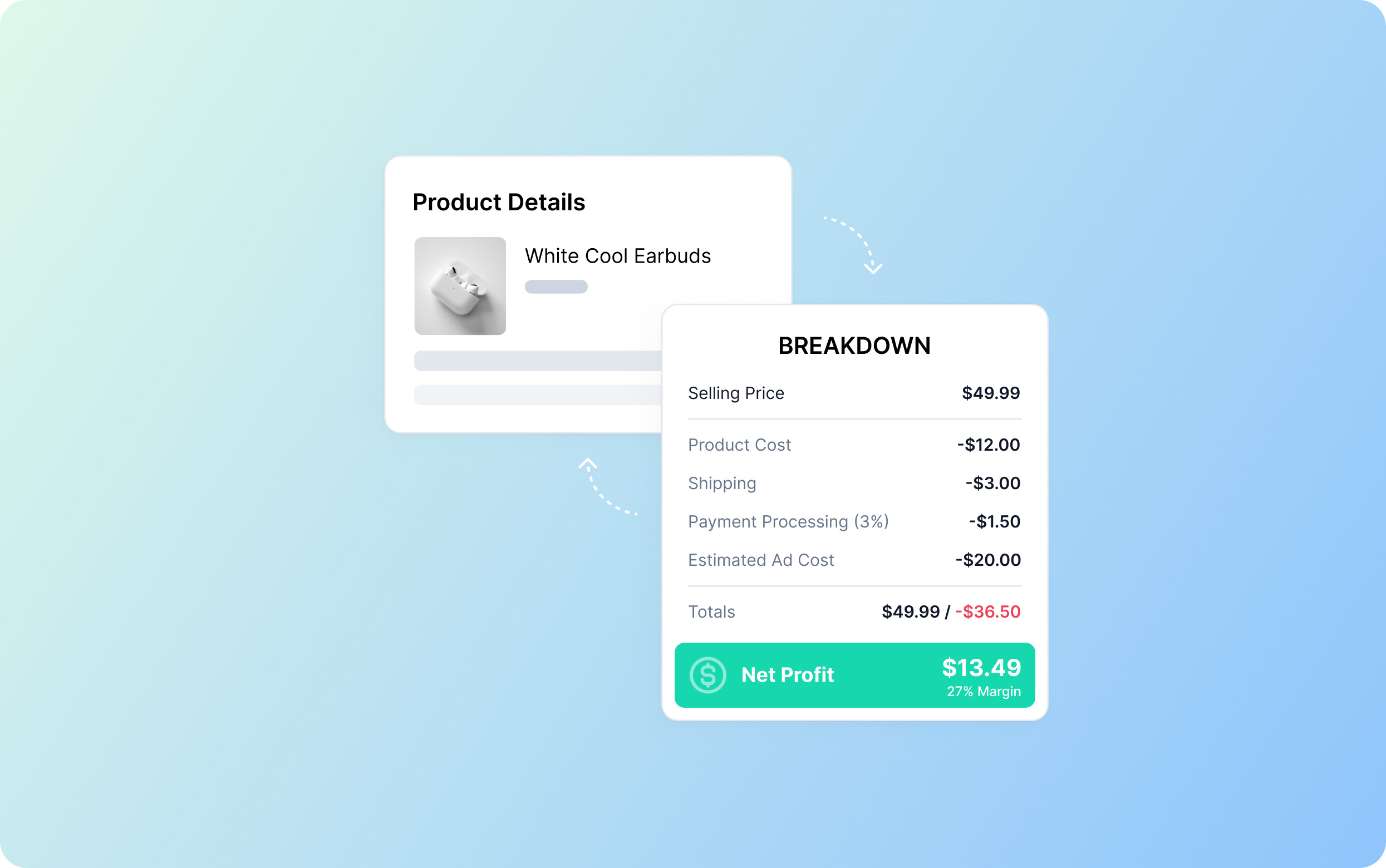
Before getting into implementation, it's worth being precise about the economics.
A dropshipping store selling a $35 product with a 30% margin generates $10.50 in gross profit per order. If your Meta CPA is $18, you're losing $7.50 on every customer before considering shipping, payment processing, or any operational cost. Increasing your ad budget doesn't fix this — it just scales the loss faster.
There is also a newer squeeze on that per-order margin in 2026. The US ended its $800 de minimis exemption, so goods shipped direct from overseas suppliers now carry import duty they previously avoided. That is one more cost pressing on the single-product math, and it points to the same answer this article is about. A higher average order value gives you the room to absorb duty that a thin single-product sale does not. Bundles are one of the most direct ways to build that room.
Brands implementing product bundles and cross-selling see 20% sales increases and 30% profit gains according to McKinsey, with many businesses achieving 20–30% AOV improvements from well-designed bundle strategies.
Run that through the same store: a bundle priced at $75 with the same 30% margin generates $22.50 in gross profit. Against an $18 CPA, that's $4.50 profit per customer acquired — the business is viable. The ads didn't change. The product didn't change. The order structure did.
This is the bundle leverage point: you're not trying to reduce what you pay for traffic. You're increasing what each click is worth when it converts.
What Makes a Dropshipping Bundle Different From a D2C Bundle
Much of bundling content is written for brands with owned inventory, healthy margins, and existing customer data. Dropshipping bundles have a different set of constraints that affect how you structure them.
You're often working with a single supplier or a narrow product category, which limits how creative you can get with complementary products. You can't always photograph bundle components together or create custom packaging that makes a bundle feel premium. And your supplier's MOQ structure may not accommodate bundle pricing the same way a brand producing at scale can.
The best dropshipping bundles work within these constraints by focusing on what bundles do economically rather than aesthetically: they increase the revenue per order, distribute the fixed cost of customer acquisition across more units, and move inventory that would otherwise stagnate at a lower margin.
The tactical principles are slightly different from full D2C bundling — and that distinction matters when you're building your Shopify store structure.
Five Bundle Types That Work on Shopify
Not all bundle formats work equally for all stores or categories. Understanding which type fits your product and traffic source determines how effectively the bundle converts.
Fixed Bundle Offers (Classic Bundles)
A fixed bundle is a predefined set of products sold together at a bundle price — the customer doesn't choose what's included, they buy the curated set. This is the fastest to set up, easiest to advertise against, and best for categories where the combination is obvious.
Caraway has built its entire product architecture around this approach. Rather than selling individual cookware pieces, Caraway sells complete cookware systems that address storage, organization, and cooking needs simultaneously — resulting in an average order value of $220, which is way higher than the cookware industry average. (Grips)
The dropshipping equivalent: if you're selling a posture corrector, bundle it with a resistance band and a foam roller as a "Home mobility kit." All three products are from the same niche, complement the primary purchase, and justify a combined price point that makes the acquisition cost viable. The bundle can be your hero ad creative — the system, not the individual product.
Create fixed bundles in Shopify using Funnelish page builder, the native Shopify Bundles app (free, built for Shopify), or apps like Bundler or Easy Bundles from the Shopify App Store. Fixed-price bundles with inventory tracking for each component keep your stock management clean and prevent overselling.
Mix and Match Bundle Options
Mix-and-match bundles let customers build their own selection from a defined set of products — choosing three items from a range of eight, for example. This works best when you have genuine variety within a category and want to encourage product discovery without overwhelming customers with too many standalone listings.
The format performs well for stores in apparel accessories, skincare, supplements, or home goods, where the products are interchangeable by preference rather than function. Letting customers pick their flavors, colors, or scents makes the bundle feel personalized rather than forced.
The key constraint for dropshipping stores: all components in a mix-and-match bundle need to come from the same supplier or at least ship in the same fulfillment window. A bundle where components ship from different suppliers in different timeframes creates customer service problems that erase any margin gain.
For Shopify implementation, mix-and-match bundle builders like Funnelish, Bundler's mix & match feature, or the Easy Bundles app can create a bundle widget directly on the product page, where customers pick their components before adding to cart. The bundle price is applied dynamically as they select.
Multipack Bundles (Volume Discounts)
Multipack bundles sell the same product in larger quantities at a discount — buy one for $22, buy three for $55. This is the simplest bundle format and the most directly tied to the economics of reducing effective CPA by increasing revenue per order.
For replenishable products — supplements, skincare consumables, pet supplies, cleaning products — multipacks are the highest-converting bundle format because the customer already wants the product, and the discount is the only decision they need to make.
Quantity discount bundles are most effective for products that customers will replenish — choose bestsellers to increase AOV, or experiment with seeing if quantity discounts help move slow-moving inventory.
The margin math also works in your favor: if your product costs $8 and sells for $22, a three-pack priced at $55 costs you $24 in COGS and sells for $55 — a $31 gross profit versus $14 on a single unit. The customer acquisition cost is the same; the revenue is 2.5x higher.
Shopify handles tiered pricing and quantity breaks in sync with Funnelish and through apps like Bundler, Shopify's native bundles feature, or Quantity Breaks & Discounts. Volume discounts can be set as a fixed bundle price, a percentage off per additional unit, or a tiered pricing table displayed on the product page.
Gift Sets and Starter Kits
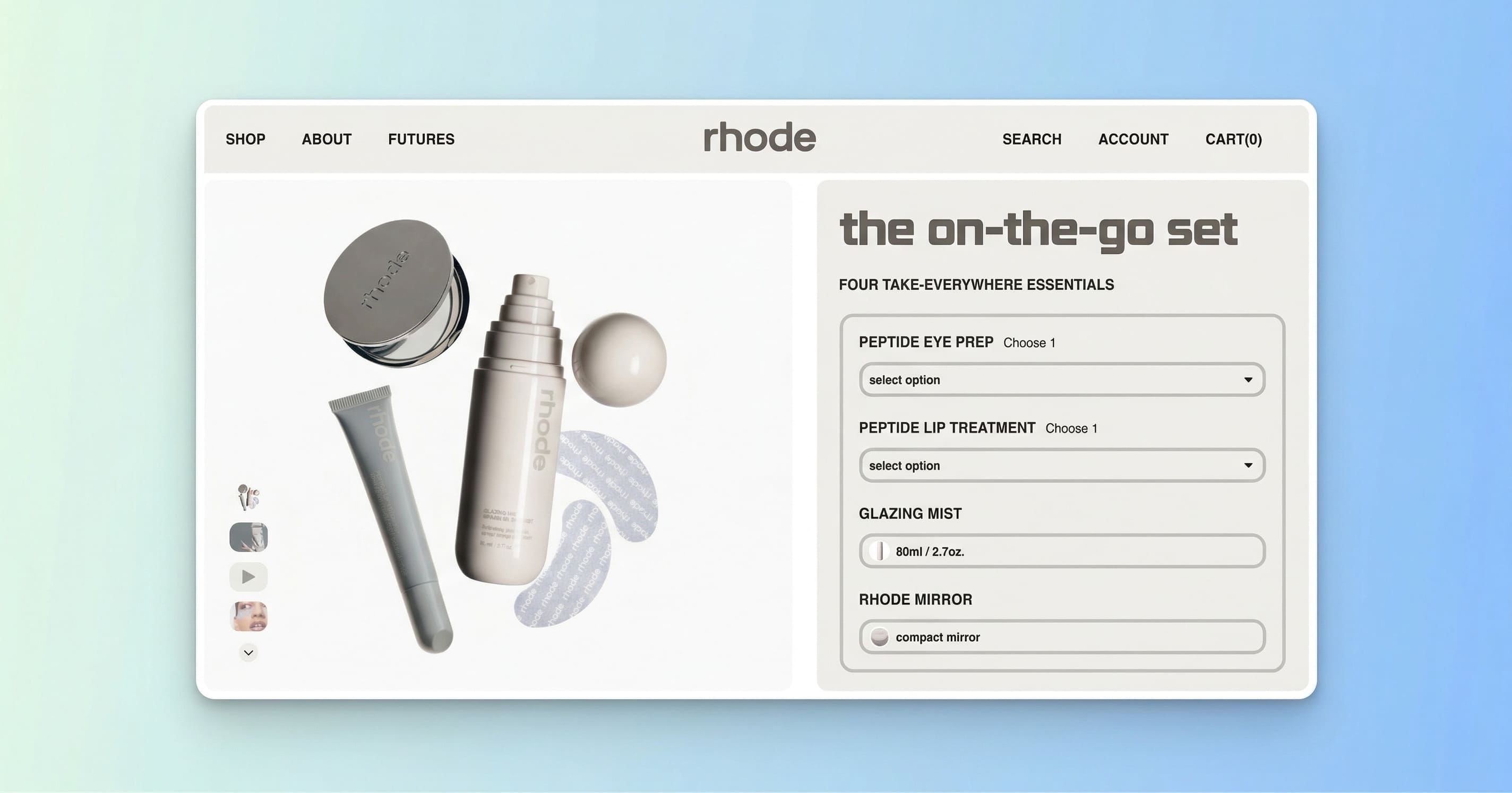
Gift sets are curated fixed bundles sold as a complete introduction to your product category — typically positioned at a slightly higher price point with elevated perceived value. They convert particularly well as the hero product in Meta ad campaigns because the visual of a complete set photographs better than individual products and communicates value immediately.
The Rhode skin approach is instructive here. Rather than selling individual lip products, Rhode Skin positions bundles as lifestyle upgrades and value-adds — structured kits and seasonal sets that are becoming a standard part of how brands package perceived value rather than simple discounts.
For dropshipping, a starter kit framing works in almost any category. A "Home gym starter kit" — resistance bands, jump rope, and ab roller — isn't a discount bundle; it's a complete solution. That positioning allows a bundle price that reflects value rather than just adding up component prices, which protects margin.
Frequently Bought Together Bundles
Frequently bought together suggestions on product pages — showing what other customers typically purchase alongside the hero product — drive incremental bundle attach rates without requiring the customer to navigate away from their initial intent.
These work best as a secondary revenue layer on top of your primary bundle strategy rather than a standalone tactic. A customer landing on your posture corrector product page and seeing "Customers also buy the lumbar cushion and the standing desk mat" might add at least one of those items a meaningful percentage of the time.
Funnelish and Shopify apps like Frequently Bought Together and Bundler display these suggestions as a bundle widget on the product page, with a single Add all to cart button that eliminates friction.
How to Price Bundles to Protect Dropshipping Margins
Bundle pricing is where most dropshipping stores make a mistake that makes their bundles feel like discounts but function like margin erosion.
The principle: the bundle discount should be visible to the customer but modest enough that you're still increasing gross profit per order in absolute terms, not just percentage terms.
A 10–15% bundle discount typically hits the sweet spot. Enough that the saving is perceptible and motivating, not so much that you've undercut the economics that made the bundle worth building. Perceived value — customers feel like they're getting more for less, even when the discount is modest at 10–15%.
The display matters as much as the number. Show the original combined price crossed out, the bundle price bolded, and the saving in a third format: "Save $14.50 when you buy the kit." Three ways of communicating the same saving is more persuasive than one way.
For dropshipping specifically: calculate your target bundle price backward from the CPA you're paying, not forward from your cost. If your Meta CPA is $20 and you need a 30% gross margin after COGS to break even, your bundle AOV needs to exceed $66.67. Build the bundle around that number, then source the components that make the math work. When you cost those components, use their true landed cost — product plus shipping plus any import duty on overseas-sourced items — so the margin you build the bundle around is the margin you actually keep.
Using Bundles as Ad Creative Angles
The bundle itself is an ad creative decision, not just a product decision. The stores extracting the most from their Meta spend in 2026 are advertising bundles as the hero product — not advertising individual items and hoping customers upgrade.
A bundle has a stronger visual: you can show the complete kit, the full system, the curated set in a single image or video frame. It communicates value faster than a single product shot and allows you to address multiple customer pain points in one ad.
Collection ads showcasing multiple products increase AOV by $18 compared to single-product ads. This data point confirms what high-performing dropshipping stores have figured out empirically: the ad showing the complete bundle outperforms the ad showing the hero product, because the complete solution looks more valuable than any individual component.
Build your ad creative around the bundle's outcome — not the products in it. "The complete home office upgrade" sells better than "Ergonomic mouse + laptop stand + desk organizer bundle." The first frames a transformation; the second reads like a list.
Implementing Bundles in Your Shopify Store: Setup
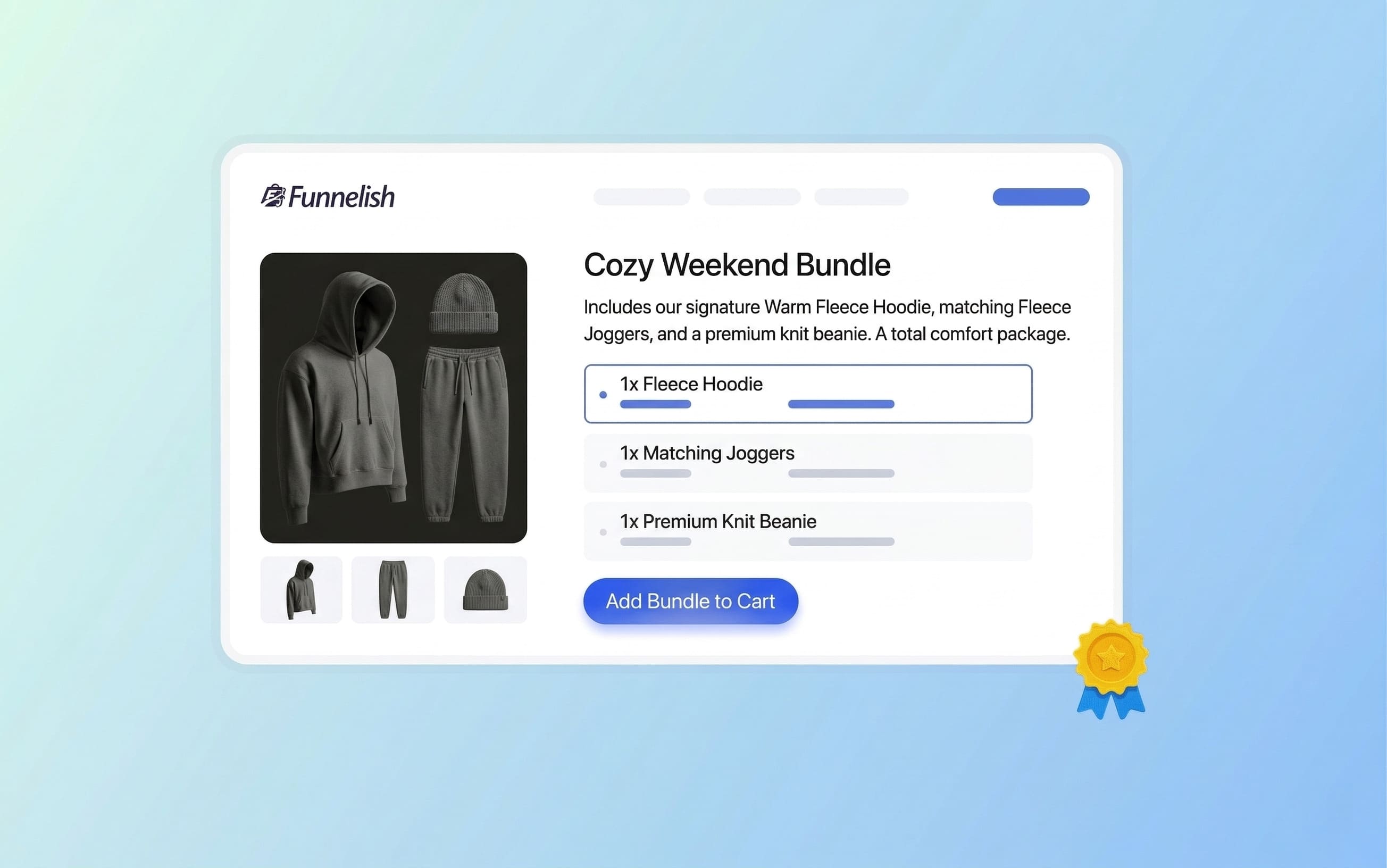
Setting up product bundles correctly determines whether your inventory tracks accurately, whether your bundles appear cleanly on product and collection pages, and — most importantly — whether the page a customer lands on after clicking your ad is built to convert.
If you're aiming to maximize conversions, Funnelish's page builder can change the setup equation for dropshipping stores running paid traffic. Rather than building bundle pages inside Shopify's theme editor — which is functional but not optimized for the conversion demands of paid traffic — Funnelish lets you create dedicated bundle landing pages using a drag-and-drop editor with no code required.
You select a conversion-optimized template, customize it with your bundle offer, and launch a page purpose-built for the one goal a paid visitor has: buying the bundle. Sub-second load times, mobile-responsive design, and a customizable checkout with multiple payment options are built in.
The shared components feature is particularly useful for stores running multiple bundle offers. Make a change to a header, footer, trust badge section, or pricing block once — and it updates automatically across every bundle page in your account. If you're testing multiple bundle configurations at once, this eliminates the maintenance overhead of keeping every page consistent and cuts build time significantly.
Your designers and developers work from a single source of truth; no version control problems, no inconsistent branding across pages.
A/B testing and geo-split testing are also built into the Funnelish page builder. You can test two different bundle presentations — different price anchoring, different component emphasis, different creative direction — against each other with real traffic, and test bundle page variations against specific geographic markets. For stores spending meaningfully on Meta, the ability to test bundle pages natively without third-party CRO tools is a real operational simplification.
If you're still building your bundle infrastructure within Shopify's native environment alongside Funnelish funnels, the setup decisions below still apply:
The native Shopify Bundles app — free, built for Shopify — handles fixed bundles and multipack bundles with inventory tracking at the component level. Create a new bundle product, assign components and quantities, and set the bundle price. Inventory tracks separately per component, keeping stock levels accurate across bundle and individual sales. This is the operational backbone; Funnelish handles the front-end conversion optimization on top of it.
For mix-and-match bundles where customers select their own components, third-party apps like Bundler (free plan available; paid from $6.99/month) or Easy Bundles add a bundle widget to the product page, with dynamic pricing as customers make their selections.
Three setup decisions worth making deliberately, regardless of which tools you use:
Separate bundle listings vs. variants. Create bundles as separate product listings with their own product page, URL, and Shopify SEO potential. This also makes it straightforward to point Meta ads directly to the bundle page and to create a dedicated Funnelish funnel for each hero bundle offer.
Bundle visibility on collection pages. Bundles should appear in your collection pages alongside standalone products — not in a hidden Bundles section. The bundle should be the obvious first choice, not something customers have to hunt for.
Price display. Show the combined individual prices crossed out next to the bundle price. Set the "Compare at price" field on the bundle product in Shopify. If you're running traffic to a Funnelish bundle page, the price anchoring is configurable in the page builder — including how the saving is displayed, where it sits on the page, and how it renders on mobile.
Post-Purchase: Where Bundle Economics Get Supercharged
Getting a customer to buy a bundle is an AOV win at checkout. What happens after they click Complete purchase is a separate and often more valuable opportunity — one that many Shopify stores leave entirely unused.
The moment immediately after purchase is when a customer's buying intent is at its highest. They've made the decision, entered their payment details, and completed the transaction. Their guard is down. They're satisfied. And they're still in a buying mindset.
This is where Funnelish's post-purchase one-click upsell infrastructure changes the economics of bundle-based dropshipping. After a customer completes a bundle purchase through a Funnelish funnel, they're presented with a complementary offer — a refill pack, a premium accessory, an add-on product — that can be accepted with one click, with no re-entering of payment details.
For a dropshipping store selling a $75 home gym starter kit, a post-purchase offer for a recovery foam roller at $29 with a 25% acceptance rate adds $7.25 to the average order value of every customer who converts. Against a $20 CPA, that's the difference between a $2.50 margin per customer and a $9.75 margin — nearly a 4x difference in unit economics — without touching the ad account.
The Funnelish and Shopify integration is bidirectional: every order placed through a Funnelish funnel — including the upsell — syncs to Shopify. Inventory updates, order records, and fulfillment all happen through your existing Shopify admin. You don't run two separate systems. You run one operational stack with a more powerful conversion front-end.
Abandoned cart sequences also fire natively from Funnelish for bundle purchases. A customer who adds a $75 kit to cart but drops off before completing checkout can receive an automated email or SMS sequence — without external automation tools or a separate email platform connection. For bundle purchases at higher price points, this recovery sequence converts meaningfully because the customer had already committed enough to add a multi-product bundle to cart.
What the Best Bundle Strategies Have in Common in 2026
The brands building durable bundling strategies — not just short-term AOV lifts — share a few structural decisions:
They build bundles into their ad strategy from the beginning. The bundle is the hero. The product page for the bundle gets the traffic, not the individual product pages. The bundle's outcome is in the ad copy.
They use data to find the natural bundle. Select items that your purchase data tells you are commonly bought together — if customers are historically buying products in the same session, that's a solid indicator for a bundle. Don't guess at complementary products; find the ones customers are already choosing together and formalize it.
They price for margin, not for generosity. A 10% discount on a $75 bundle is $7.50 — enough to make the saving feel real, not enough to erode the economics that make the bundle worthwhile.
They add a post-purchase offer to every bundle sale. The bundle brings in $75. The upsell turns 25% of those orders into $104 orders. Same acquisition cost. This Shopify dropshipping business looks completely different in the spreadsheet.
And they treat the checkout experience as a conversion variable, not a fixed constraint. A landing page with sub-second load times, one-click express payment options, and a frictionless checkout flow converts bundle traffic materially better than sending paid traffic into a generic Shopify product page. That gap in conversion rate multiplies across every dollar of ad spend.
Table of contents
Boost your eCommerce
sales today

24/7 support
No credit card required
Cancel anytime
24/7 support
No credit card required
Cancel anytime
