

Free Ecommerce Website: Is It Possible?
05 September 2026
Anna P.
12 minutes
Yes, though fewer platforms will let you than a year ago. You'll get a branded subdomain, a short product list, and basic features. The platform takes its money out of your sales instead of off your card. While you're still finding out whether anyone wants what you sell, that's a good deal for you. Cross about $2,450 a month in sales and it flips, because a 2% cut on your payments now costs you more than a $49 flat plan. So treat free as a test, and know it has an expiry date.
A free ecommerce website exists. That was never the interesting part. What you want to know is what it costs you in the spots the pricing page skips over, and how long you can sit there before the deal turns on you. If you're starting an online business, you want that answer before you pick an ecommerce platform, because moving later always costs more than you think it will.
Free Ecommerce Is Shrinking, and 2026 Made That Obvious
Shopify used to sell a $5 Starter plan for people who just wanted a checkout link and no storefront. That's gone. The cheapest way in now is Basic at $39 a month, or $29 if you pay for the year up front. Ecwid built half its reputation on a free tier and ran one for years. That's gone too. It starts at $5 a month now, and caps you at ten products.
What's left is thinner than it was. Big Cartel still runs a free plan with limited features, built for artists and makers selling a handful of items. WooCommerce is still a free plugin, but only the software is free. Web hosting, the domain, the SSL certificate, the theme and most extensions all bill you separately. An open source platform hands you the code, then hands you the bill for everything that code runs on. Already have technical knowledge? It's a low cost route and a good one. Want to launch an online store quickly? You'll hate it.
So the free ecommerce market got smaller in 2026, and what's left got tighter. Online marketplaces work the same way, trading a listing fee for somebody else's audience. Either way you're renting, and you should know that before you build an ecommerce store on top of it.
The Bill Arrives as a Percentage
Nobody hands out free software because they're nice, and the honest ones tell you so right on the pricing page. They take a cut of what you sell.
Shopify publishes its numbers, so you can do this math yourself. Bring your own payment provider instead of theirs and Basic takes 2% of every transaction, Grow 1%, Advanced 0.6%, Plus 0.2%. Those transaction fees sit on top of whatever your payment processor already charges you.
A percentage feels like nothing when you're selling nothing. Then it grows right alongside you. That's the point of it. Put it next to flat monthly fees and you hit the crossover faster than you'd guess.
Monthly sales | A 2% cut | A $49 flat plan | What the percentage costs you extra |
$1,000 | $20 | $49 | Flat plan costs $29 more |
$2,450 | $49 | $49 | The two are identical |
$5,000 | $100 | $49 | $51 |
$10,000 | $200 | $49 | $151 |
$25,000 | $500 | $49 | $451 |
$50,000 | $1,000 | $49 | $951 |
$100,000 | $2,000 | $49 | $1,951 |
Under $2,450 a month the percentage wins, and free is worth a look. Over it, every extra dollar you make hands two cents to someone else that a flat plan would've let you keep. At $50,000 a month you're paying almost a thousand dollars for a plan that sold itself as the cheap one.
Funnelish charges 0% extra processing fees on every tier, including the $49 Basic plan. Your processor still takes its rate. Nobody's adding a second slice on top of it. When you compare platforms, add the sticker price to the percentage and run it against the revenue you expect six months out.
Where Free Plans Stop Being Free Enough
Money's the obvious limit. The rest cost you in ways that never show up on an invoice.
Your address belongs to someone else. Free plans park you on a branded subdomain, so your ecommerce site reads as yourstore.platform.com. Online shoppers clock that, and it kills any shot at a professional looking online store. A custom domain is the cheapest brand identity you'll ever buy, and plenty of hosting providers throw in a free domain for the first year, so take it when you see it.
Search treats you like a tenant. Real SEO optimization needs control over page structure, redirects and speed. Free tiers limit all three, and Google Shopping feeds almost always sit behind a paid plan.
You run out of products. Ten is fine while you're testing and useless once you have a catalog. Product management tools get thin at the bottom of every pricing page, and complex online stores need more than a list.
The tools that make you money are missing. Cart recovery, automated email and abandoned checkout sequences pay for themselves faster than anything else you could turn on, so platforms save them for their feature rich plans. Whatever additional features would raise your ceiling, you'll find them one tier up.
Support is a forum. Dedicated support costs money, and when payment processing breaks on a Friday night you'll want more than a community thread.
Selling anywhere else gets harder. Pushing a catalog to Google Shopping, a marketplace or a social storefront needs integrations that free tiers ration out, so selling across various channels stays off the table.
None of this makes free plans useless. It makes them a stage. Zero upfront cost lets you build a working online shop and test it before you spend a dollar. That's a cheap way to find out whether your target audience is even out there. Treat it as software testing for a business idea and it earns its keep. Treat it as home and you'll spend a year finding the ceiling instead of serving potential customers.
What Any Store Needs, Free or Paid
Strip out the marketing and every ecommerce platform owes you the same short list, whatever unique features it advertises on top. Use it to spot what a free plan is quietly leaving out of your ecommerce shop.
Requirement | Why it matters | What you get on a free plan |
Web hosting and SSL certificates | Browsers flag unencrypted checkouts and buyers leave | Usually included, worth confirming |
Secure payment processing | No payment means no business | Included, often locked to one provider |
Multiple payment gateways | One declined gateway is a lost sale | Restricted |
Product management and inventory | Adding and tracking what you sell | Capped by product count |
Mobile responsiveness | Most storefront traffic arrives on a phone | Usually included |
A custom domain | Trust and brand identity | Rarely included |
Cart recovery and email | The cheapest revenue you'll ever earn | Held back for paid tiers |
Third party integrations | Connecting shipping, accounting, ads | Limited |
Analytics worth reading | Knowing which page loses people | Basic only |
Give payment processing options a second look, because free plans usually lock you to one provider. If that provider starts declining cards in your market, you've got no fallback and no way to build one. Funnelish went the other way and allows on every plan. A seamless shopping experience mostly comes down to this: a shopper whose card bounces on one provider can still pay through another without leaving the page.
Building the Store: A Pet Nutrition Funnel, Page by Page
None of this means much without a real build, so here's one. The Pawtopie template sells pet food and supplements, and it shows you what online store creation looks like when someone's already worked out the structure. You won't need coding skills for any of it, and every element moves with a drag.
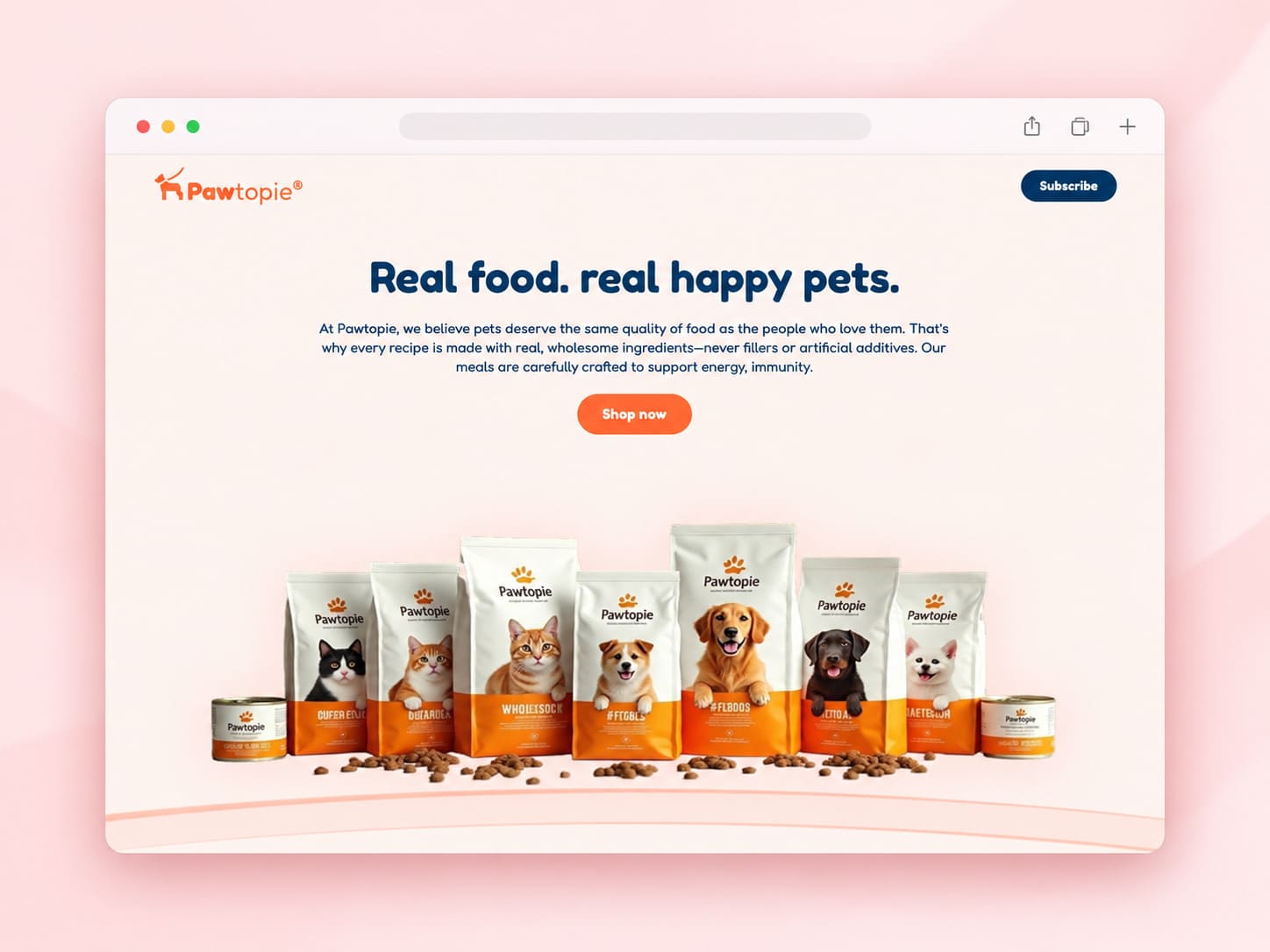
Your visitor lands on a sales page with one promise: real food, real happy pets. It's a user-friendly design that does one job and refuses to do anything else. The copy tells you the recipes use whole ingredients with no fillers or artificial additives, a shop button sits under the headline, and product bags run along the bottom of the screen. One message, one action, and no navigation bar tempting anyone to wander off.
Then the template does something you don't see often. It runs four separate checkout pages instead of one.
Checkout page | What it sells |
Multi-product checkout | Cat premium nutrition at €40.99, dog vitality formula at €40.99, and the 1.5kg complete balance blend at €83.99, all selectable in one place |
Checkout 40.99 | The dog vitality formula on its own |
Checkout 60.99 | The 1.5kg cat premium nutrition |
Checkout 80.99 | The 1.5kg complete balance blend |
A separate page per price point looks like busywork until you push traffic through it. Send a cat-owner ad to the €60.99 page and a dog-owner ad to the €40.99 page, and each group hits a checkout showing one product at one price. You get clean numbers out of it too, because each page's conversion rate belongs to one offer instead of a blended average that tells you nothing.
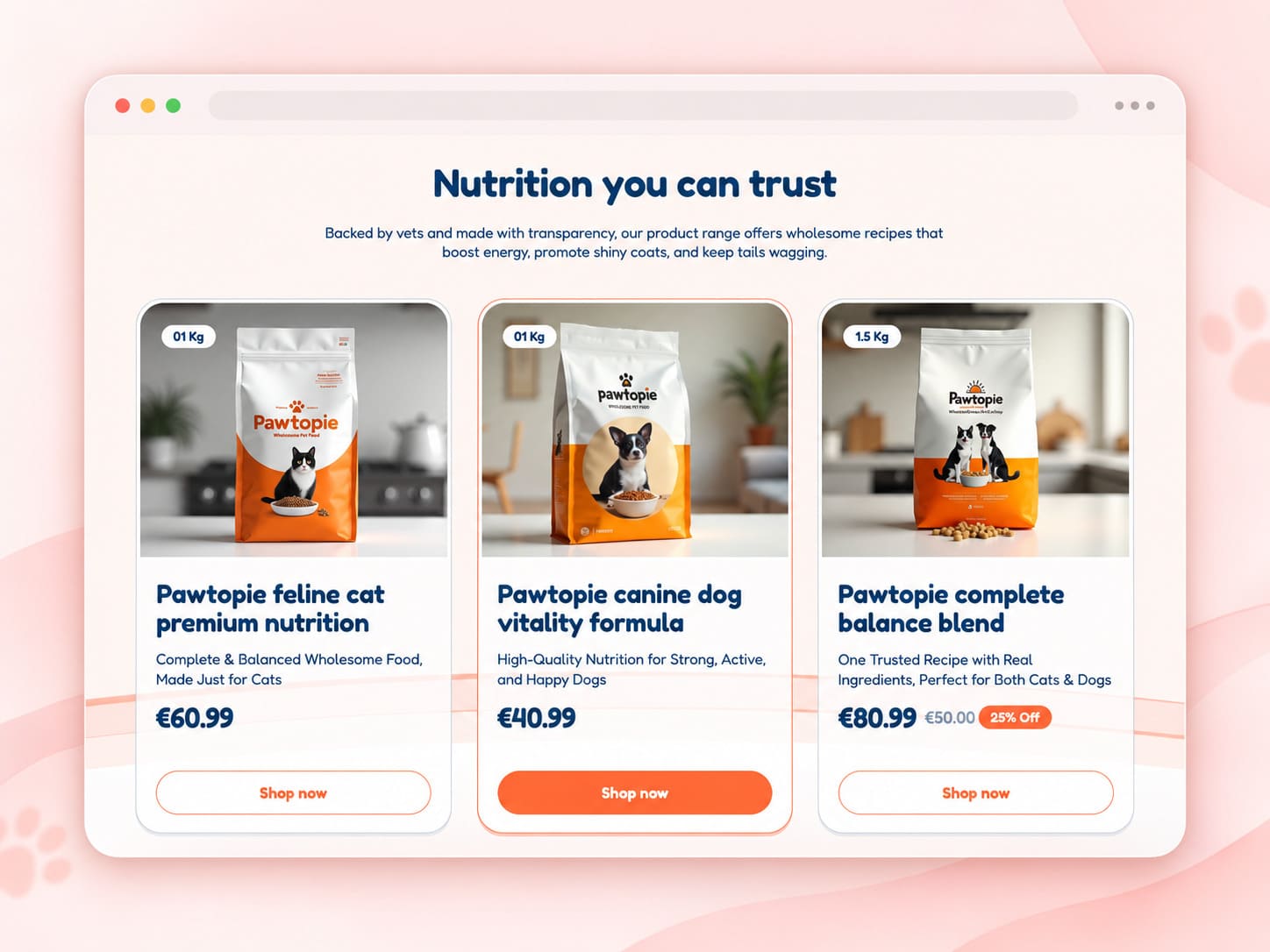
Every checkout page keeps the order summary next to the form, gives you a discount code field, and runs a customer quote about a picky dog who finally finished a bowl. People doubt you hardest at the payment step, and a review sitting beside the card field answers that right where it comes up. The user interface holds together on a phone too, because mobile responsiveness is built into the template instead of bolted on later.
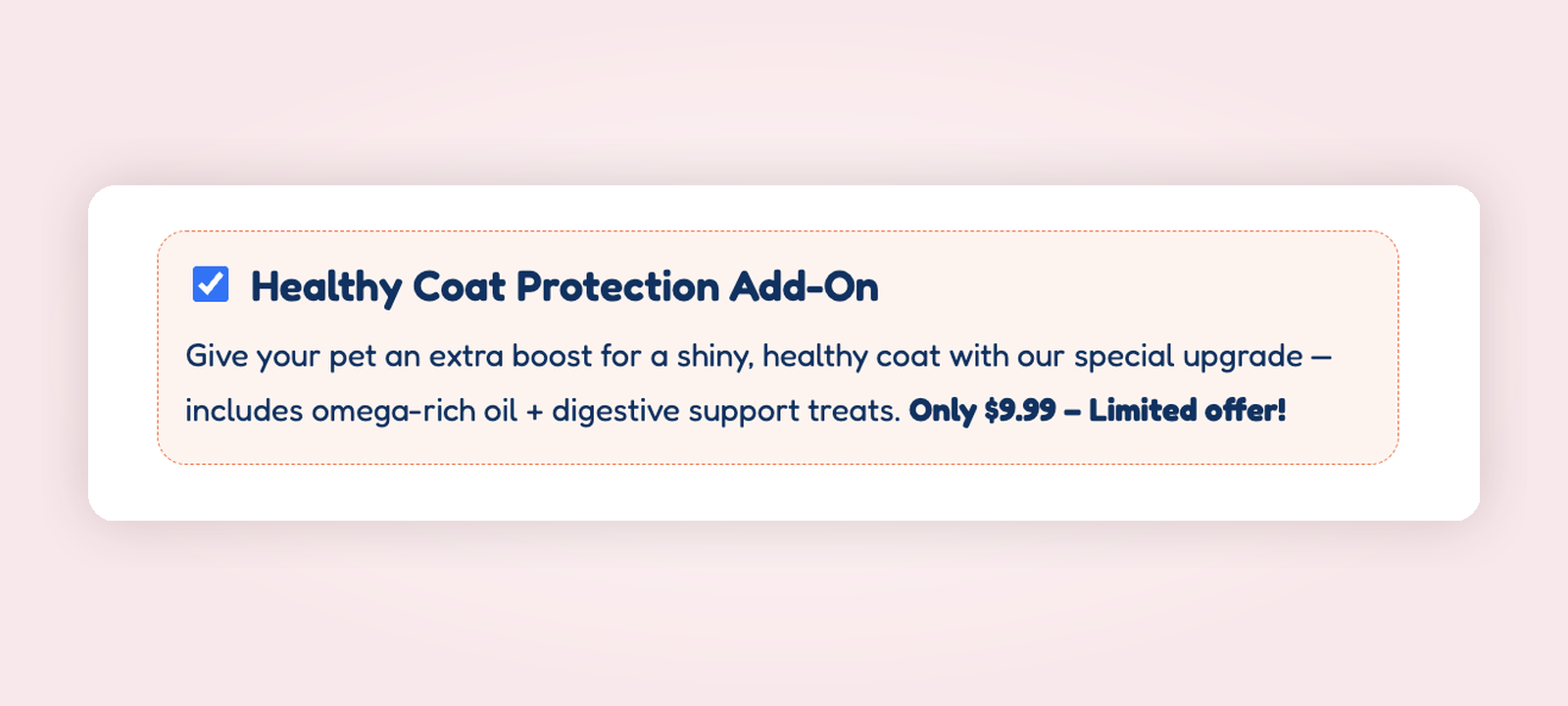
Steal the order bump before anything else. Healthy Coat Protection is in the summary at €9.99 against a €40.99 order, so one tap adds nearly a quarter to the total. Run that at a 30% acceptance rate and you've made €2,997 for every 1,000 checkouts, on traffic you already paid for once.
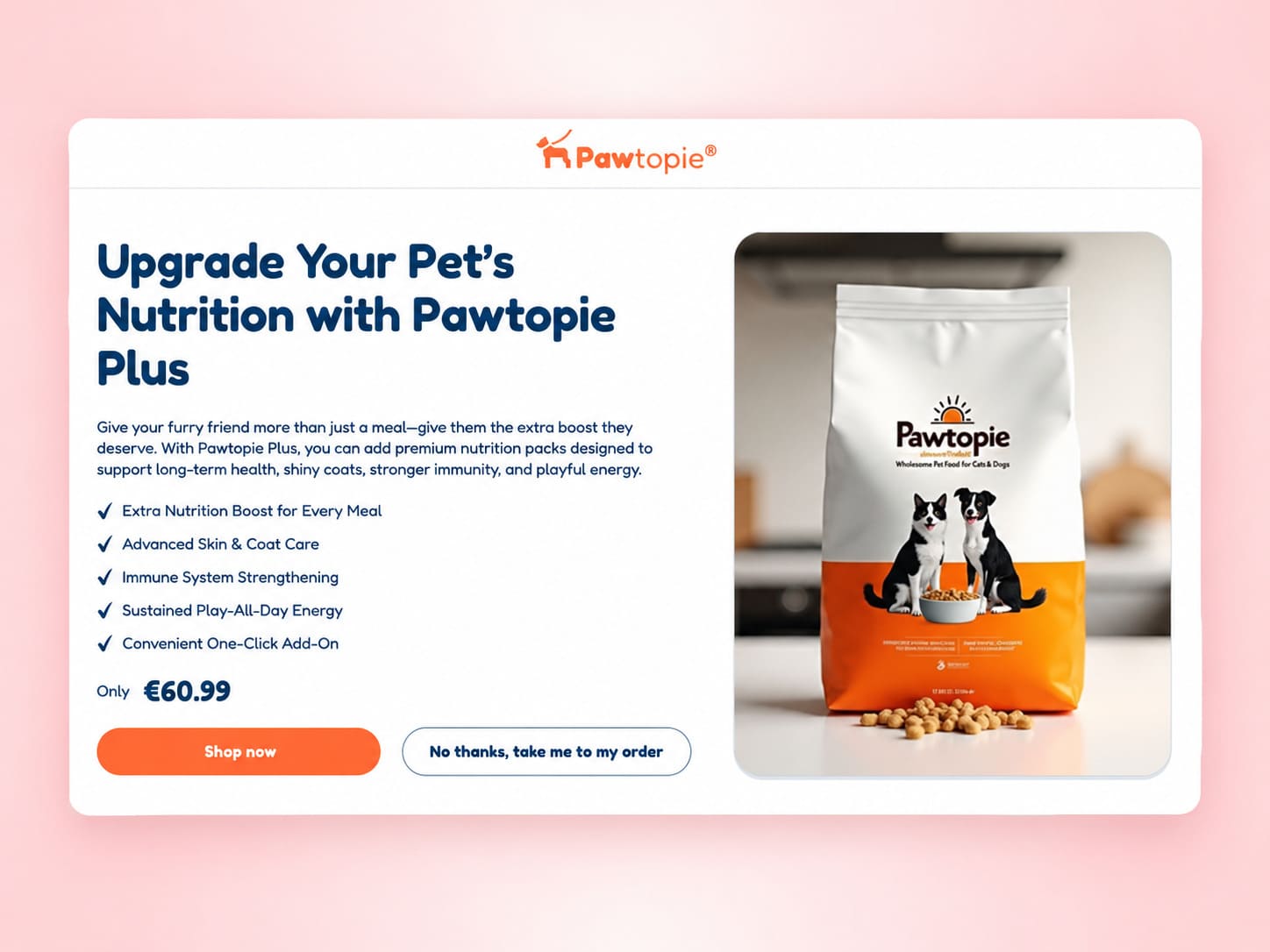
Once they've paid, the funnel offers Pawtopie Plus, a nutrition upgrade promising skin and coat care, immune support and steadier energy. Their card's already on file, so saying yes takes one tap, and saying no costs you nothing.
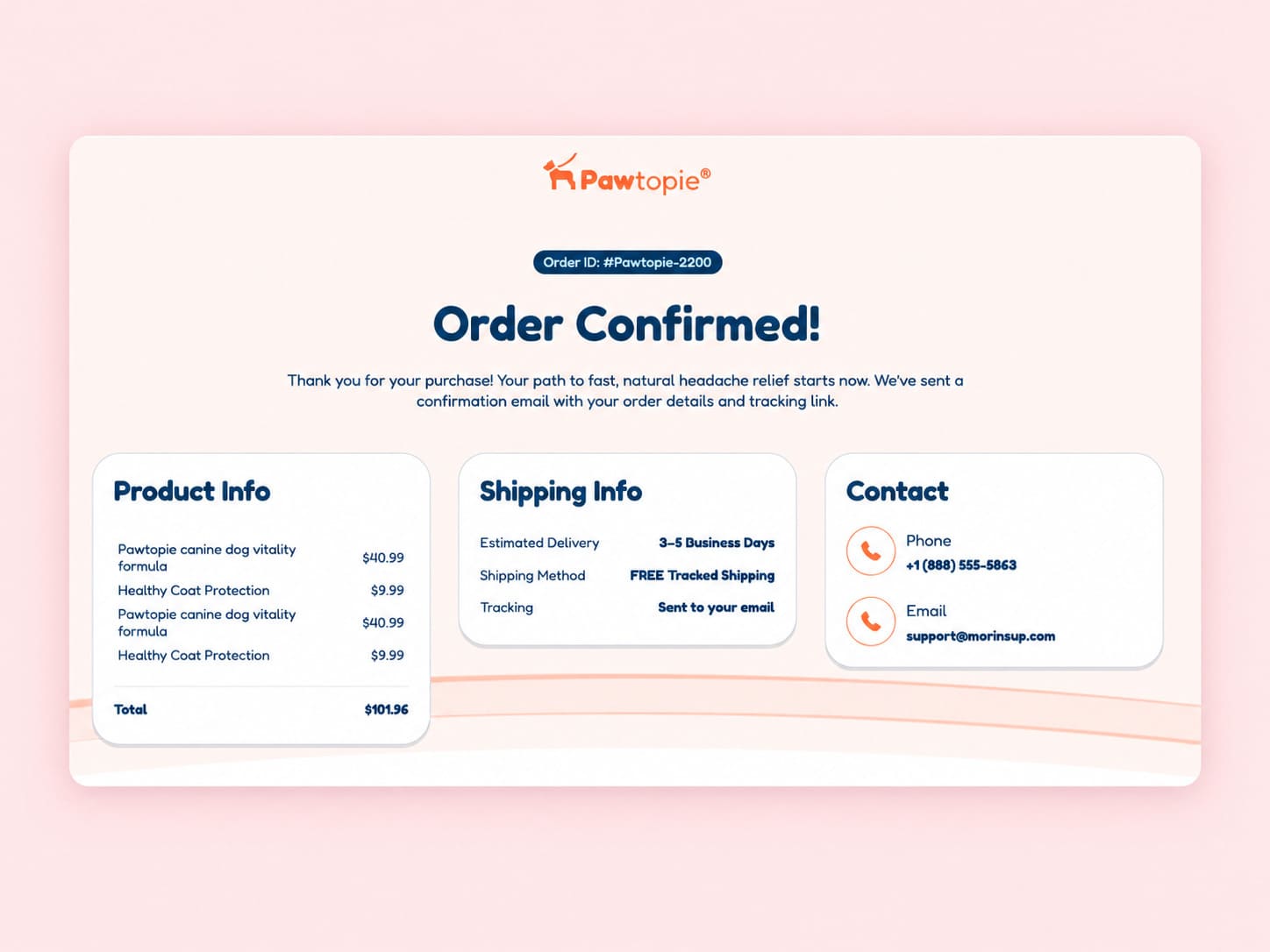
The thank you page reads the way a confirmation should. Order ID, product details, delivery in three to five business days, free tracked shipping, tracking sent by email, plus a phone number and support address where you can see them. Terms and conditions and a privacy policy close out the funnel. Those two matter more than they look, because payment providers ask for them before they'll approve your account.
Try the Free Pawtopie Pet Funnel Template
The funnel above is free to use, and it comes complete: sales page, the multi-product checkout, three single-price checkout pages, the post-purchase upsell, a thank you page and both policy pages, wired together in order with the order bump already set up.
Get the Free Pet Funnel Template
Page | What it handles |
Sales page | One promise, one button, no distractions |
Multi-product checkout | Three products at €40.99, €40.99 and €83.99 side by side |
Three single-price checkouts | One offer per page, so each ad gets its own clean number |
Order bump | Healthy Coat Protection at €9.99 inside the summary |
Upsell | Pawtopie Plus after payment, card already on file |
Thank you page | Order ID, tracking, delivery window, support contact |
Terms and privacy | The pages payment providers check before approving you |
You won't need coding or technical skills to edit it. Swap the photos, prices and copy in a drag-and-drop and the pet brand turns into yours in an afternoon. Customization options cover type, color and layout, so it stops looking like a borrowed template pretty fast. The structure took the longest to get right, and the structure is what you're keeping.
What It Costs Once Free Runs Out
Funnelish has no free tier. Pretending it did would be the exact kind of claim this article is arguing against. What you get is a 14-day free trial on every plan with no credit card. That's the trial-shaped version of free from earlier. Inside it you're using the full product, with features designed around selling rather than browsing.
Plan | Price | What you get |
Basic | $49/mo | 20,000 visitors, 20 funnels, 1 store, 1 custom domain, 2 team members, 10 blogs, unlimited payment gateways, checkouts with upsells and order bumps |
PRO | $99/mo | 100,000 visitors, 50 funnels, 5 stores, 5 custom domains, 5 team members, 100 blogs, profitability report, 24/7 chat |
Advanced | $249/mo | Unlimited visitors, funnels and blogs, 20 stores, 50 custom domains, 15 team members, gateway pools for smart payment routing, customer portals |
Enterprise | Custom | Dedicated success manager, custom SLA and onboarding, white-glove migration, unlimited team members |
Every tier gives you 0% extra processing fees and unlimited payment gateways, down to the cheapest one. None of that matters much on your first order. It starts mattering once you're selling $10,000 a month, and that's the number worth comparing platforms on. Next to other platforms taking a percentage, a flat plan looks expensive on day one and cheap by the end of the quarter.
The advanced features sit about where you'd expect.
Profitability reporting starts at PRO.
Gateway pools, which push a transaction to a second provider when the first one declines, are on Advanced.
SMS and email marketing tools, conditional workflows, Shopify order syncing, Facebook event tracking and 20-plus third party integrations run across every paid tier, plus a custom code option for anything odd.
These powerful tools are how ecommerce businesses manage online stores without hiring anyone, and tells you which page is costing you money.
How to Choose Without Guessing
Work through these key factors in order and the decision pretty much makes itself.
Forecast six months out. Take the sales you expect in a month, multiply by any percentage fee, and hold that against the flat monthly fees. Add any additional costs for email or apps while you're there. That bit of math settles most of the argument, and it ties the price to your real business goals instead of a feature list.
Count your products now, then count them for next year. A ten-product cap that fits today turns into a migration later, and migrations cost you more than the subscription you dodged. Match the plan to the business needs you're heading toward, because evolving needs show up faster than anyone budgets for.
Check the payment gateways in your market. A platform stuffed with extensive features but running one payment provider will treat you worse than a plain one running several. Secure payment processing and a checkout that clears are the necessary tools. Everything else is decoration.
Ask what happens to your domain. Move off a branded subdomain and you lose whatever seo optimization you built on it.
Work out how cheap your own time is. An open source platform saves you cash and spends your hours, and it wants extensive technical knowledge you might not feel like picking up. A user friendly builder costs you more per month and less per weekend.
Small businesses with limited resources start free for good reason, and a plan with basic features is an attractive choice while you're still proving the idea works. It stays a viable option right up until the percentage overtakes a subscription, or until the store has to look like a professional store instead of an experiment. Growing businesses with money coming in are usually paying for that without noticing. A flat plan with no percentage on it becomes the best value well before it feels that way.
Judge the preferred options on what they'll cost you at the volume you're aiming for, because online success gets settled in your second year rather than your first week.
Table of contents
Boost your eCommerce
sales today

24/7 support
No credit card required
Cancel anytime
24/7 support
No credit card required
Cancel anytime
