

What Is Landing Page Conversion?
05 July 2026
Anna P.
10 minutes
Quick answer: Landing page conversion is the percentage of visitors to a landing page who complete its one desired action — buying, signing up, booking a demo, or downloading something. You calculate it by dividing conversions by total visitors and multiplying by 100. So if 1,000 people visit and 45 convert, that's a 4.5% landing page conversion rate. The average across industries is 2.35%, the top 25% hit 5.31% or higher, and the elite top 10% reach 11.45%+. The gap between average and elite is almost never about traffic — it's about the page itself.
Let's dissects what makes a landing page convert: the metric, the benchmarks, and the specific elements — headline by headline, button by button — that separate a page that leaks visitors from one that turns them into customers.
What is a landing page (and how it differs from a homepage)
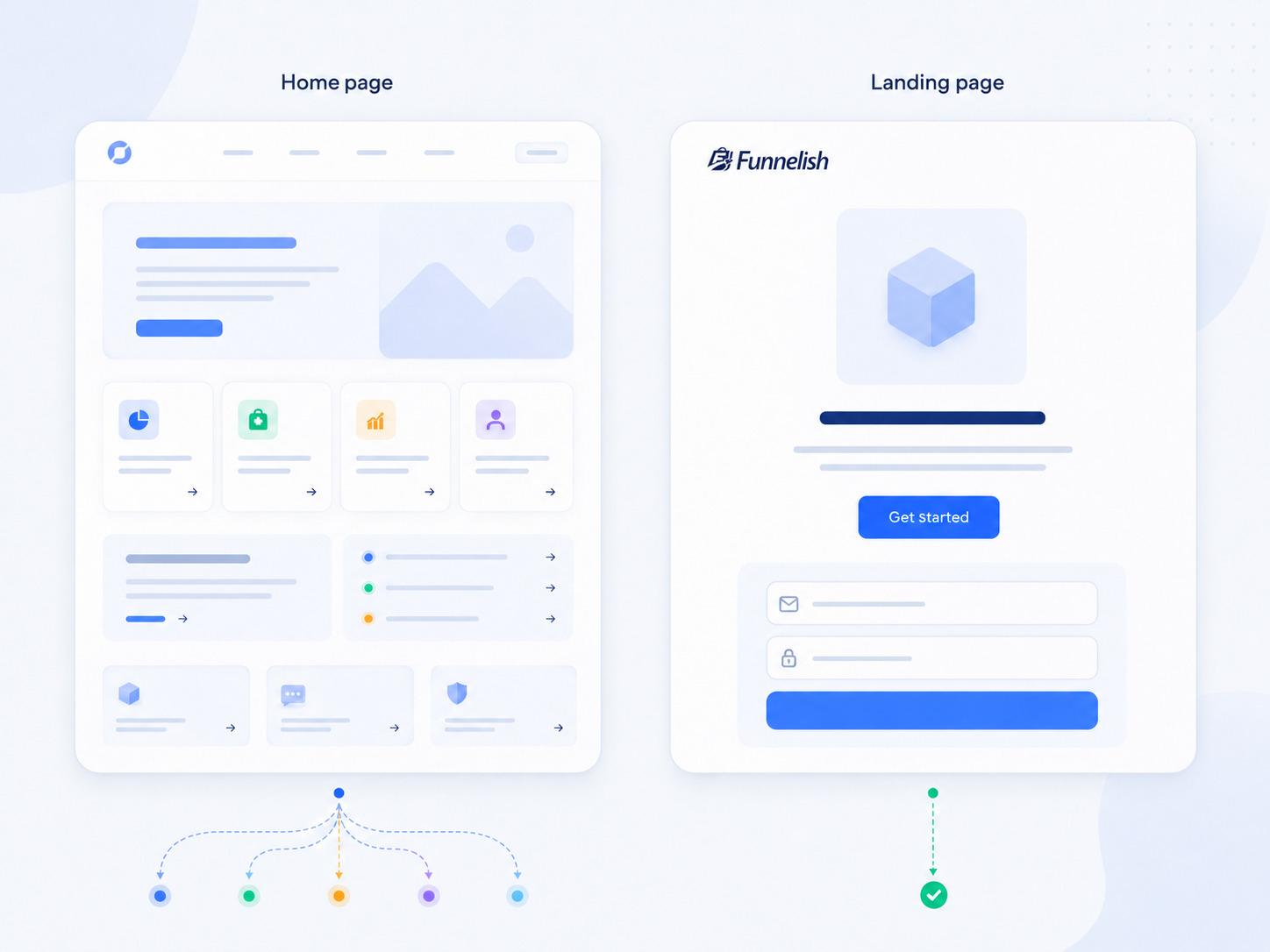
A landing page is a standalone web page built for a single purpose: to convert visitors from a specific traffic source into leads or customers. Someone clicks your Google Ads or paid ads campaign, an email, or a social post, and "lands" here — on a dedicated page focused on one offer and one conversion goal.
The critical difference from a homepage comes down to focus:
A homepage is a hub. It has full navigation, multiple links, and a dozen possible paths — designed for people to explore.
A landing page is a funnel. It strips navigation, removes distractions, and guides visitors toward one call to action.
That single-mindedness is why landing pages convert far better than homepages for campaign traffic. Every extra link is an exit; every extra choice is friction. Depending on its job, a landing page goes by different names — a squeeze page or lead generation page for capturing emails, a splash page for a quick gate, a sales page for a purchase. The principle is identical: one page, one audience, one action.
Read more: 12 Tips How to Build an Effective Landing Page in 2026
What is landing page conversion?
Landing page conversion is the act of a visitor completing your page's desired action, and the landing page conversion rate is the metric that measures it. The formula is simple:
Conversion Rate = (Conversions ÷ Total Visitors) × 100
What counts as a "conversion" depends on your conversion goal: a purchase on an e-commerce page, a form fill on a lead gen page, a free-trial start for SaaS, a registration on a webinar page. The point is that you define one action, then measure how effectively the page drives it.
What's a good landing page conversion rate?
Benchmarks are a diagnostic tool, not a target — but they tell you where you stand. Here's what the primary data shows:
Average (all industries): 2.35%, per WordStream's analysis of Google Ads accounts spending a combined $3 billion.
Top 25%: 5.31% or higher.
Top 10% ("unicorns"): 11.45% or higher.
Dedicated landing pages specifically: a median around 6.6%, per the Unbounce Conversion Benchmark Report of 41,000 pages.
Context matters enormously. Averages vary wildly by industry and traffic source — e-commerce pages tend to sit lower while high-intent, low-commitment pages like webinar registrations run far higher. That's not a good idea to chase a universal average. Measure your gap to the top quartile in your category, because that gap — not the median — is where the money is. A page at 2% that you push to 4% just doubled its results from the same traffic.
One more useful data point: dedicated landing pages generate a 160% higher conversion rate than relying on pop-ups, which is exactly why a purpose-built page beats bolting an offer onto an existing page.
Anatomy of a high-converting landing page
Here's the heart of the guide. A landing page's success comes down to a handful of key elements working together. Below, we dissect each one — what it does, why it matters, and how to execute it hands-on. Where a tool makes a given element easier to build or test, we'll point it out, using Funnelish as the working example.
1. A clear, compelling headline (message match)
Your headline is the first thing visitors read, and it decides whether they stay. Nielsen Norman research found 57% of viewing time happens above the fold, so your value proposition has to live there — not buried after three paragraphs.
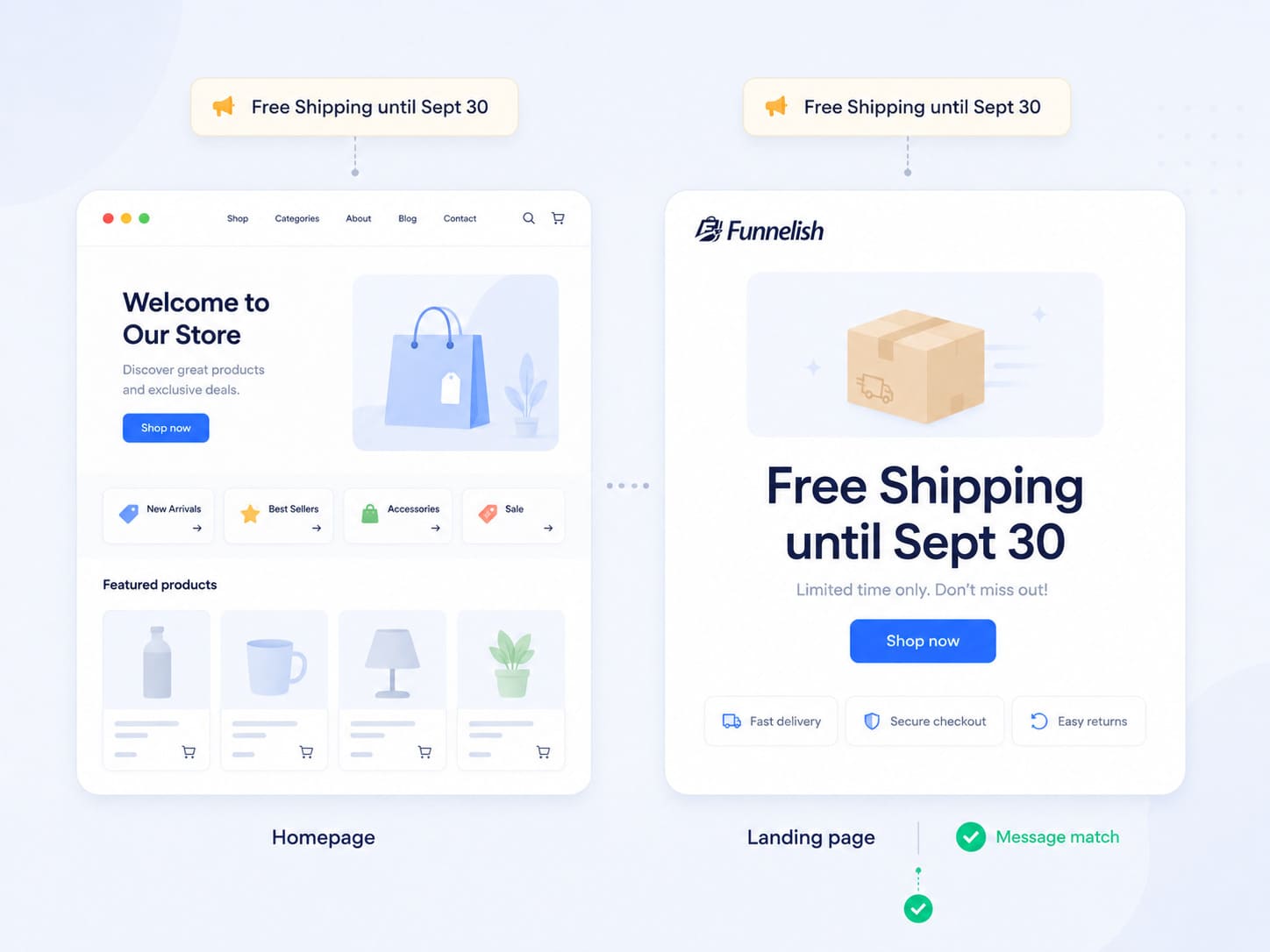
The single biggest headline principle is message match. The page headline must mirror the ad that brought visitors there. Click an ad promising "Free Shipping until September 30," and the page headline should say "Free Shipping until September 30" — not "Welcome to our store." Breaking message match is the fastest way to make visitors bounce, and matching it can lift conversions by up to 25%.
Hands-on: Lead with the specific benefit ("Cut your shipping costs 30% in one click"), not a vague brand statement. Keep it readable — pages written at a 5th-to-7th-grade level convert nearly double those written in "professional" corporate copy.
Because Funnelish has a drag-and-drop page builder, you can spin up a separate page per ad campaign in minutes and match each headline to its ad — instead of forcing all your traffic through one generic page.
Read more: Write Killer Headlines: Top Strategies for 2026
2. A strong, single value proposition
Right below the headline, visitors need to answer "What's in it for me?" in about five seconds. A clear value proposition — ideally supported by three concise benefit points — enhances conversion directly. Use scannable bullet points, not dense paragraphs, because people skim landing pages.
Hands-on: State the result, not the process. "Get it delivered in an afternoon — no promises, no delays" beats "Robust delivery services." Name a verifiable number where you can ("Share online and get a 10% discount!") — a real number outperforms any adjective like "cheaper" or "easy."
3. One single, focused call to action

This is the element that most directly drives conversion. High-performing landing pages focus on one action, and single-focused CTAs lead to higher conversion rates. Multiple competing CTAs split attention and tank results; a page with a single offer can increase leads by 55%.
Hands-on: Use specific, first-person, benefit-driven button copy. "Get My Gift" reliably beats "Apply" — tests usually show 35-45% lifts from CTA copy alone. Repeat the same CTA down a long page so the action is always in reach, and make the button visually unmissable.
When you're selling, the CTA leads into checkout — and this is where you need a purpose-built funnel. Funnelish lets you connect that CTA to a streamlined two-step checkout that only asks for what's necessary, keeping the momentum you built all the way to payment.
4. Fast load speed
Speed affects both what your traffic costs and whether it converts — a rare double win. A landing page with a 0-2 second load time has the highest conversion rate, and pages that load in 1 second convert roughly 3x higher than those taking 5 seconds. Every second of delay past the ~2.5-second threshold cuts conversions by about 7%.
Hands-on: Compress and properly size images (usually the #1 culprit), cut render-blocking scripts, and minimize third-party bloat.
Slow pages are the most common silent conversion killer, and heavy page-builder themes are often the cause. Funnelish pages are engineered for sub-second load times, which removes that problem before you've written a word of copy — protecting the expensive clicks you paid for.
5. Mobile optimization
Most landing page traffic is now on mobile, yet mobile often converts below desktop — which makes it your biggest opportunity. Landing pages designed for mobile can generate 30% more conversions on average, and responsive design can boost conversion rates by up to 20%.
Hands-on: Large tap targets, thumb-reachable buttons, legible text without zooming, and short forms. Test the actual buy flow on a phone — that's where most of your visitors are deciding.
6. Trust signals and social proof
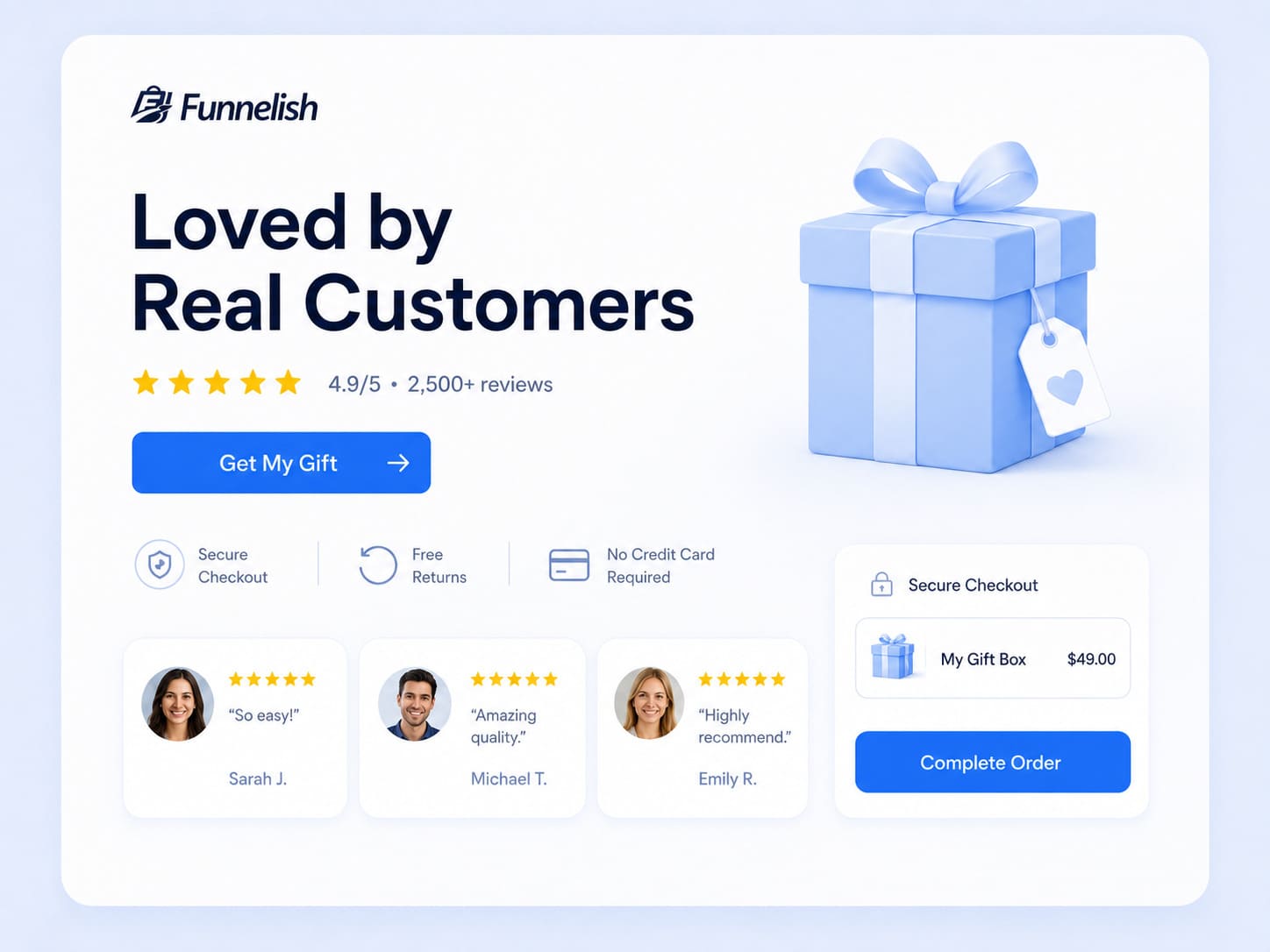
Trust is the silent gatekeeper of conversion. Social proof — reviews, ratings, testimonials, and customer logos — reassures hesitant visitors at the moment they're deciding. Placing social proof within the first viewport can lifts conversion measurably, and addressing buyer fears directly (a guarantee, "no credit card required," free returns) can lift conversions by around 80%.
Hands-on: Feature real customer photos and reviews near your CTA and form, not buried at the bottom. Add security badges at the point of payment. Case studies are among the most effective proof for buy-ready visitors.
7. A friction-free form (for lead gen)
For lead generation pages, form length is often the single highest-leverage lever. Per Unbounce's 2026 data, three-field forms convert at about 10.1% while nine-field forms collapse to 3.6%. And multi-step forms outperform single-page forms with the same fields by 21%, because once someone completes step one, sunk-cost pulls them through.
Hands-on: Ask only for what you truly need for first contact — collect the rest later. For longer asks, break the form into small steps rather than one intimidating wall.
8. Clean design and visual hierarchy
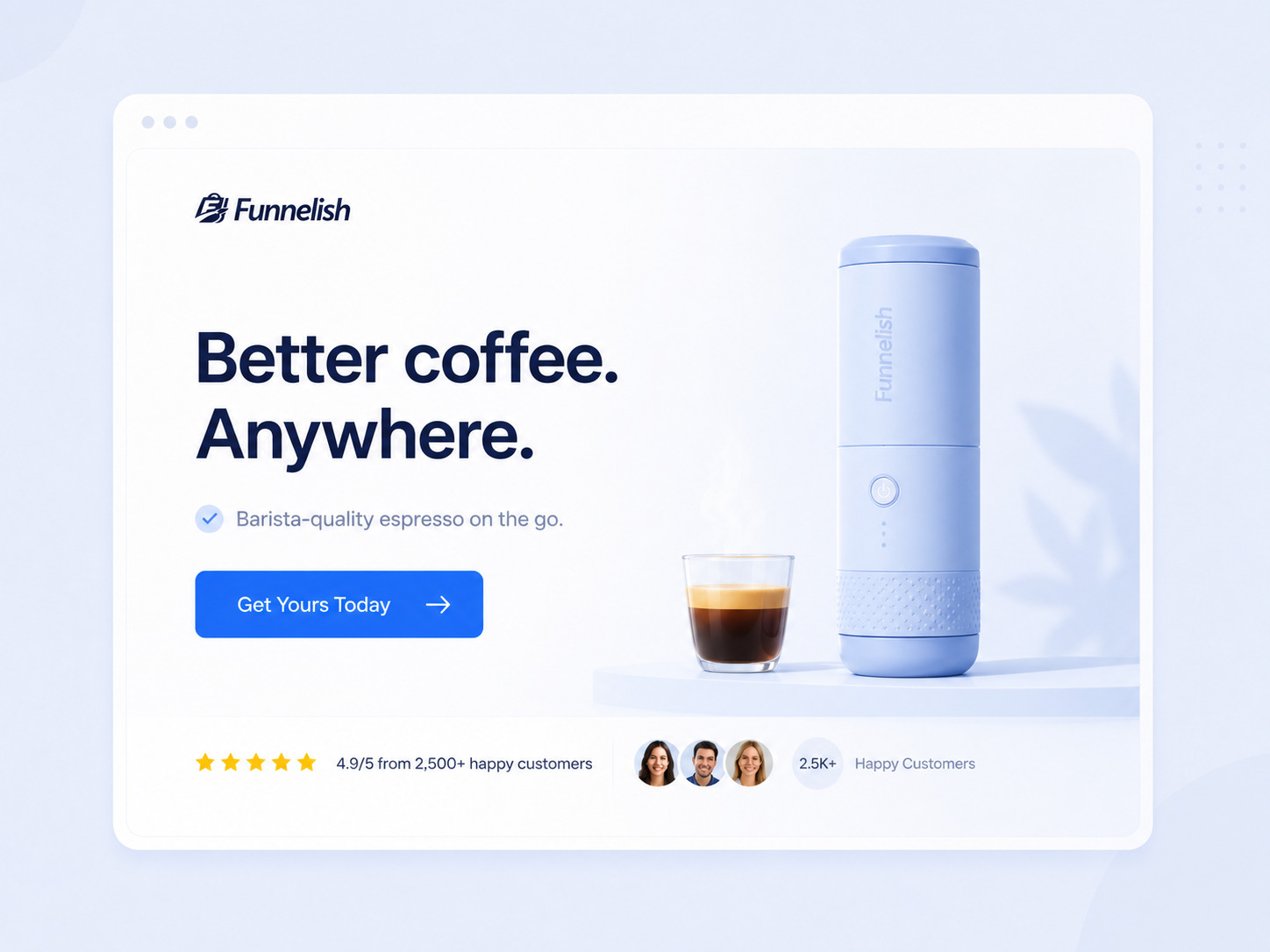
How you arrange elements is as important as what they say. A well-designed landing page removes navigation (only 16% of pages do this, yet removing the menu can lift conversions ~100%), uses generous white space to reduce cognitive load, and guides the eye down a clear path to the CTA.
Hands-on: One focal point per screen. Kill the top navigation and outbound links — WordStream found 33% of landing page links send visitors away.
One thing benchmarks can't fix: testing
Every landing page best-practice list converges on the same final principle: test relentlessly. A/B testing helps identify which elements actually increase conversions for your audience, since what lifts one page can flatten another. But test the big variables — headline, offer, CTA, form length — not just button colors, and give each test enough traffic to reach a real conclusion.
Hands-on: Change one element at a time, run it to significance, keep the winner, then test the next thing. Treat it as continuous iteration, not a one-time project.
Native A/B testing lets you pit two versions of a page against each other — different headlines, offers, or layouts — and keep only the version that converts, turning optimization from guesswork into a repeatable system.
Beyond the click: capturing every conversion
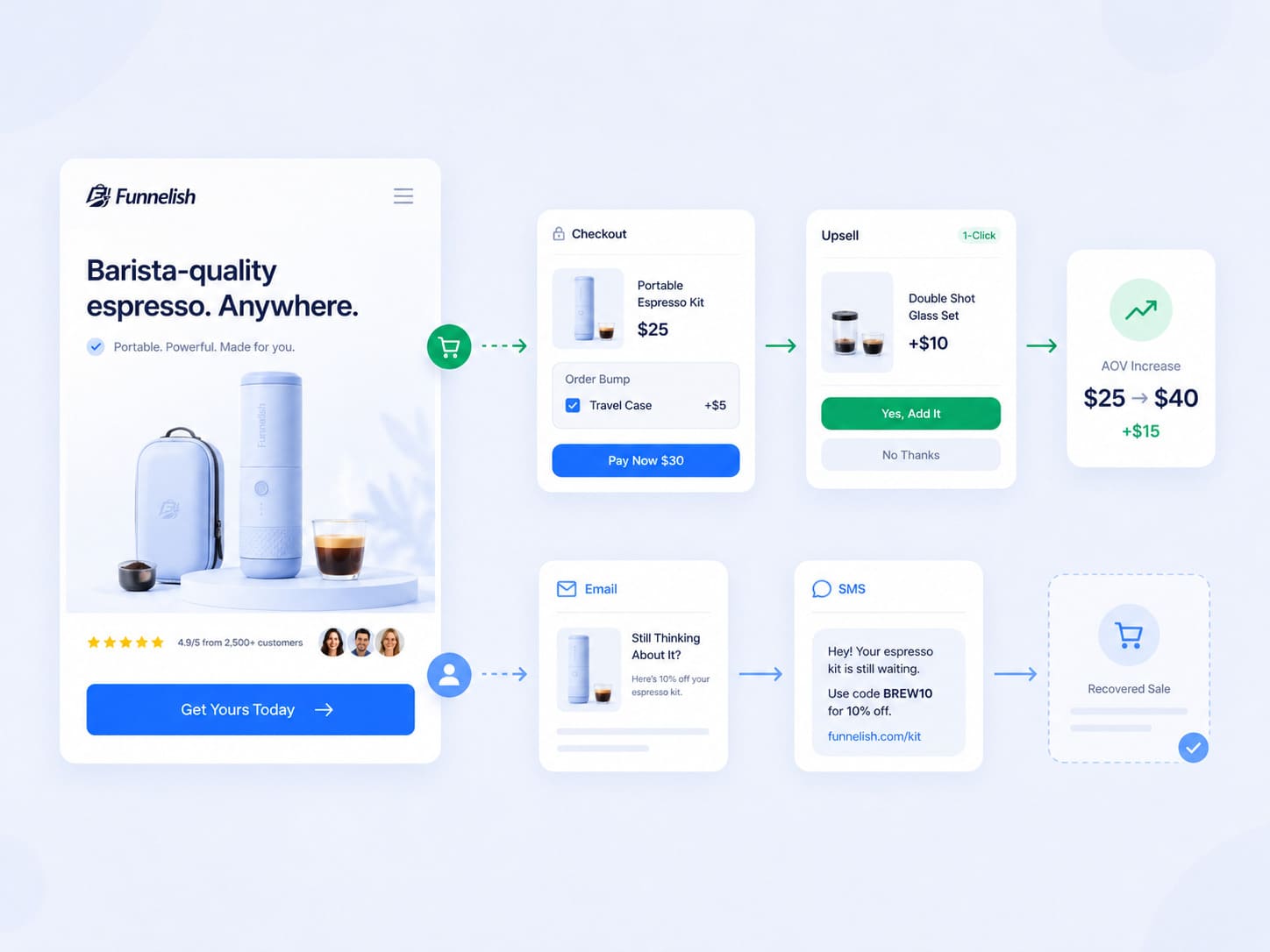
Even a well-optimized page only converts a fraction of visitors on the first visit — so what you do next determines your true return.
For the shoppers who convert, an order bump or one-click upsell raises the value of that conversion instantly — turning a $25 sale into a $40 order with a single tap, and lifting the customer lifetime value that funds your ad spend. For the majority who don't convert right away, automated email and SMS follow-ups bring them back and recover otherwise-lost conversions over time. This is where thinking in sales funnels rather than single pages pays off: the landing page earns the first yes, and the system around it maximizes every one.
Read more: Upselling Techniques: Digital Upsells + Physical Products
Putting it all together
So, what is landing page conversion? It's the percentage of visitors who take your page's one desired action — and improving it is the highest-leverage growth work you can do, because you're squeezing more results from traffic you've already paid for. The recipe is consistent: match your message to the ad, lead with one clear value proposition, drive toward a single CTA, load fast, design for mobile, prove your trustworthiness with social proof, minimize form friction, and A/B test your way toward the top quartile.
Nail those elements on a fast, focused, purpose-built page — and back it with a system that captures and follows up on every conversion — and you move from the 2.35% average toward the 11%+ that the best pages achieve. That's the difference between a page that leaks visitors and one that reliably turns them into customers.
Frequently asked questions
What is a good landing page conversion rate?
The cross-industry average is 2.35%, the top 25% of pages convert at 5.31% or higher, and the top 10% reach 11.45% or higher. Dedicated landing pages see a median around 6.6%. "Good" depends heavily on your industry and traffic source, so benchmark against your sector rather than the global average.
How do you calculate landing page conversion rate?
Divide the number of conversions by the total number of visitors, then multiply by 100. For example, 45 conversions from 1,000 visitors is a 4.5% conversion rate. A "conversion" is whatever action the page is designed to drive — a purchase, sign-up, form fill, or download.
Why do landing pages convert better than homepages?
Landing pages focus on a single conversion goal and eliminate navigation and distractions, while homepages contain multiple links and paths designed for exploration. That single-mindedness keeps visitors focused on one action, which is why dedicated landing pages consistently outperform homepages for campaign traffic.
What is the most important element of a high-converting landing page?
No single element wins alone, but message match (aligning the headline with the ad that sent traffic) and a single, clear CTA are consistently the highest-impact. Fast load speed and reduced form friction follow closely — each can move conversions significantly on their own.
How can I improve my landing page conversion rate?
Match your headline to your ad, lead with a clear value proposition, use one focused CTA, speed up load time (aim under 2.5 seconds), optimize for mobile, add social proof and trust signals, minimize form fields, remove navigation, and A/B test the major elements. Segment your conversion rate by traffic source to find where the problem actually is.
Table of contents
Boost your eCommerce
sales today

24/7 support
No credit card required
Cancel anytime
24/7 support
No credit card required
Cancel anytime
