

Affiliate Marketing Tips That Separate Top 10% From Everyone Else
22 April 2026
Anna P.
14 minutes
About 10–20% of affiliates make enough from affiliate marketing to treat it as a primary income. Around 1–5% reach six figures. Everyone else is either stuck in the early stages or has quietly given up. The gap is rarely about audience size or the number of affiliate programs they've joined. It's almost always about how they think about affiliate marketing strategy — and whether the decisions they make build toward long-term success or just feel productive without producing affiliate sales.
This guide covers what successful affiliate marketers do differently: how they choose affiliate programs, create content that converts, build trust with a specific audience, and structure an affiliate marketing business that compounds over time rather than requiring constant effort to sustain.
Audience Alignment Problem Many Affiliate Marketers Ignore
Sign up for any list of best affiliate programs and you'll find programs ranked by commission rate. That ranking is nearly useless without knowing your audience.
Affiliate publishers with niche authority achieve conversion rates of 4–6% — nearly double the rates of broader lifestyle sites. (New Media) The reason isn't that niche sites have better traffic. It's that niche audiences have an active problem and the affiliate is positioned as the trusted resource for solving it. A 5% conversion rate from 1,000 clicks generates 50 affiliate sales. A 1% conversion rate from 10,000 clicks — the result of promoting a product to a misaligned audience — generates 100. The math looks better in the second scenario until you factor in how much harder it is to get 10,000 quality clicks than 1,000.
Before joining any affiliate program, the question isn't "What does this pay?" It's "Does my specific audience have a demonstrated need for this product right now?" An eCommerce channel whose viewers are building online stores has genuine need for funnel infrastructure, payment tools, and ad management software. That same audience has near-zero conversion rate on fitness gear or lifestyle products — not because the products are bad, but because the fit isn't there at the moment.
Audience demographics tell you who's watching. Audience preferences — what generates comments, what they click, what they ask about in replies — tell you what they truly need. Start there.
Recurring vs. Flat Fee: Commission Structure That Changes Everything
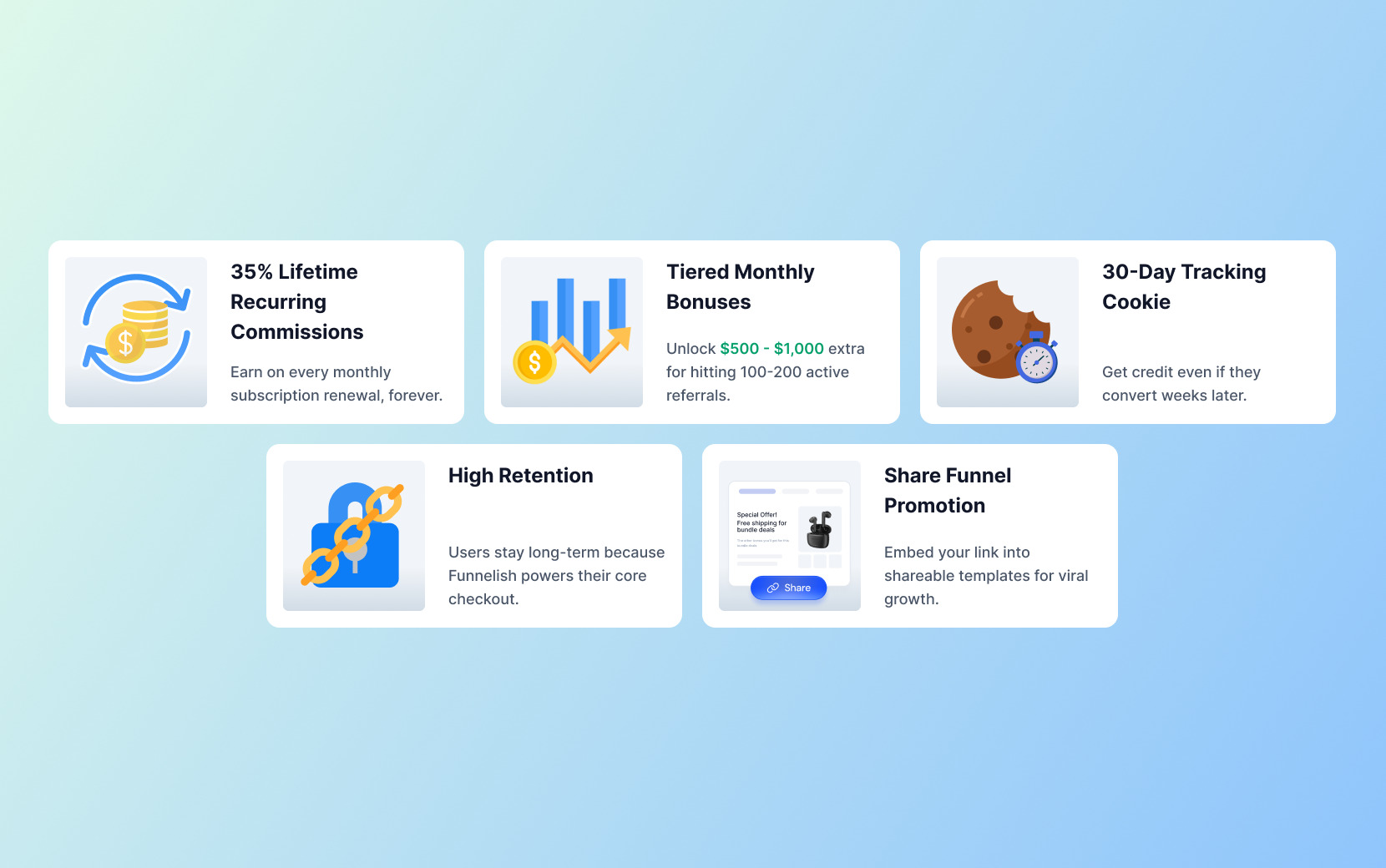
Here's what most guides don't say plainly enough: flat fee programs require you to constantly find new customers to maintain your income. Recurring commission programs, on the other hand, let you stop finding new customers and still earn more next month than you did this month.
The math is straightforward. Refer 100 customers to a program paying a $50 flat fee: $5,000, once. Refer the same 100 customers to a program paying 30% on a $99/month plan: $2,970 in month one, then $2,970 in month two, month three, month four — every month those referrals stay subscribed. By month three you've already surpassed the flat fee outcome. By month twelve you've earned four times as much from the same 100 referrals.
A single referral to a $99/month product at 30% commission generates $29.70 monthly — potentially for years. Programs like Funnelish's pays 35% lifetime recurring commission on plans ranging from $49–$199/month — meaning a referral from content you published 18 months ago is still generating income today. That's the structure worth building around: choose affiliate partners whose products have high retention rates and recurring billing, and your affiliate income becomes a genuine long-term income stream rather than a function of how many new pieces of content you publish each month.
Build Affiliate Content Around Problems, Not Products
The easiest way to identify weak affiliate content is this: if the product is mentioned before the problem is fully established, the content is product-first, not problem-first. Product-first content is essentially a sales pitch. Problem-first content is useful — and useful content builds the trust that converts.
A reviewer who writes "Here are the features of [tool]" is writing a sales pitch. A reviewer who writes "If you're running paid ads to a standard Shopify storefront, here's exactly why your ROAS looks the way it does — and here's the infrastructure that fixes it" is solving a problem. The second piece earns a click on the affiliate link because the reader arrives at it already convinced they have the problem being solved.
59% of top-performing affiliates identify as content creators rather than coupon or cashback partners. Content creators succeed in affiliate marketing because content built around problems attracts people searching for solutions — not people browsing for discounts. Search intent matters. Someone searching "Why is my Shopify checkout abandonment rate so high" has a specific problem and is actively looking for a solution. That's a reader who converts on a relevant affiliate recommendation. Someone searching "Shopify" is browsing. The first query generates affiliate sales. The second mostly generates impressions.
Go Deep in a Specific Niche — and Stay There
The top affiliate marketing niche by monthly income is education and e-learning at $15,551/month, followed by travel at $13,847 and beauty and skincare at $12,475. (Affiliate Statistics) These aren't the biggest niches by audience size. They're niches with high purchase intent, strong relevant affiliate programs, and audiences that trust expert recommendations.
The affiliates generating consistent income in any niche typically have two characteristics:
genuine knowledge of the domain (not surface-level familiarity with the products they promote)
content library that covers multiple angles of the same core problems their audience has
A YouTube channel covering eCommerce paid ads that publishes 40 videos across checkout optimization, creative strategy, funnel structure, and attribution is more valuable to that audience than a channel that covers eCommerce, travel, personal finance, and wellness with equal depth in each. And a more valuable resource earns more trust — which produces higher affiliate conversion rates from the same traffic.
Niche selection needs two variables to align:
market demand (enough people are searching for this topic to generate meaningful traffic)
affiliate program strength (products worth recommending at competitive commission rates exist for this audience)
Find that intersection and stay in it long enough for the content to compound.
SEO: Traffic Source That Pays You in Your Sleep
Among affiliates with under one year of experience, organic search is used by about 69%. Among those with 3–10 years of experience, that number rises to 90%. (Marketing LTB) The pattern is consistent: the longer someone has been in affiliate marketing, the more they've shifted toward organic search and away from paid traffic. The reason is simple — search engine traffic costs nothing per click, compounds as your content library grows, and continues generating affiliate sales from posts you published years ago.
High-intent keywords — the specific phrases your target audience searches when they're close to a buying decision — produce the best affiliate conversion rates. "Best funnel builder for Shopify" typically converts better than "Shopify tips" because someone using the first query is actively evaluating options. Getting your affiliate content in front of that evaluation, with a well-structured comparison and a genuine recommendation, produces affiliate sales. Getting in front of someone at the awareness stage just builds impressions.
Google Analytics is the starting point for understanding what's already working.
Which blog posts or YouTube videos are generating your affiliate sales?
Which pages get traffic but produce no clicks on affiliate links?
The gap between traffic and conversion — by content piece — tells you whether you have an audience alignment problem, a trust problem, or a link placement problem. Many affiliates have all three to some degree. Identifying which is largest for your site or channel tells you where to invest time first.
On a YouTube channel, keyword-optimized titles, descriptions, and tags help the platform surface videos to viewers already searching for solutions. A video titled "How I Fixed My Shopify ROAS Using Funnelish Geo-Funnels" reaches a more higher-intent audience than "eCommerce Tips 2026" — and that is worth far more than the slightly smaller search volume that comes with it.
Read more: Best Affiliate Programs for YouTubers: Ranked by What Pays
Build Trust Before You Recommend Anything
71% of influencers report that affiliate commissions are their fastest-growing income stream in 2026. The ones growing fastest are also, without exception, the ones whose audiences trust them most. Trust isn't built by enthusiasm or by the volume of content published. It's built by being consistently right about things your audience cares about, over time.
In practice, that means: being selective about which affiliate products you recommend (fewer products recommended with more depth converts better than many products recommended superficially), acknowledging limitations of the products you promote (mentioning that a tool has a learning curve or isn't suited to beginners signals that your recommendation is genuine assessment rather than commission-motivated promotion), and showing real results rather than describing features.
Social proof is where this gets practical. A video that shows your own Funnelish analytics dashboard — active subscriber count, revenue per funnel, conversion rates — is more persuasive than a video that describes what Funnelish does. An affiliate marketer who shows their Google Analytics traffic growth alongside the content strategy that produced it is more credible recommending an SEO tool than one who says the tool is "really powerful."
Audiences are sophisticated enough to know the difference between demonstrated expertise and performed enthusiasm. Demonstrated expertise earns clicks. Performed enthusiasm earns skepticism.
Multiple Content Formats, One Audience, One Problem
The most successful affiliate marketers don't create one blog post per topic and move on. They build around a single problem and specific audience from multiple angles, in multiple content formats, across the full customer journey.
A blog post targeting a search term reaches someone in the research phase. A YouTube video demonstrating the product in action serves someone at the evaluation stage — ready to see it working before committing. An email marketing sequence following up with someone who visited the post but didn't convert keeps the recommendation visible through the decision phase. A resource page on your own website aggregating your best affiliate recommendations captures visitors who already trust your opinion and are looking for a starting point.
60% of affiliates use video content as their primary format, with YouTube and TikTok driving the highest affiliate conversion rates. (SQ Magazine) That doesn't mean text is irrelevant — it means that content formats work best in combination. A YouTube channel that links to a deeper blog post in the video description, which includes the affiliate link with full context, outperforms either format alone. The viewer who watches the video, visits the post, and then clicks through to sign up has been through multiple trust-building touchpoints. Conversion rates from that path are materially higher than from a cold click on a single piece of content.
Track What Converts at Content Level
Some affiliates check their affiliate networks dashboard once a month, see a total commission number, and move on. The affiliates building serious income know which specific blog post, video, or email sequence generated each sale — and they use that information to make content decisions.
The standard affiliate marketing mistake is optimizing traffic before optimizing conversion. Getting more visitors to affiliate content that converts at 0.2% produces marginally more income. Improving conversion from 0.2% to 1% produces five times more income from the same traffic. The latter is almost always faster and cheaper than the former — but it requires knowing why the current conversion rate is what it is.
Google Analytics (combined with the dashboards provided by affiliate managers and affiliate networks) gives you the data to answer this.
Which content pieces generate clicks on affiliate links?
Of those clicks, which convert?
The difference between click volume and conversion rate tells a specific story: high clicks, low conversion usually means audience misalignment or a weak transition between the content and the recommendation. Low clicks from high-traffic pages usually means the affiliate link isn't visible enough or isn't placed at a moment of established relevance.
Review at minimum:
clicks per affiliate link
conversion rate by content piece
revenue per piece of content
which programs are generating recurring income versus flat-fee one-time commissions
The recurring income pieces are your highest-value assets. Identify them, understand what makes them work, and replicate the pattern.
Build Direct Relationships With Affiliate Partners
Most affiliate marketing runs through networks — CJ Affiliate, Impact, PartnerStack — where everything is managed at arm's length. That's fine as a starting point. The affiliates generating the highest income from any given program have moved beyond network-only relationships to direct affiliate partnerships.
Direct relationships with affiliate managers open options unavailable through standard network access:
custom commission rates
exclusive coupon codes
early access to new product features
dedicated resources and promotional assets not listed in the standard media library
performance guidance based on data the affiliate manager can see but you can't
They also open the door to formal brand partnerships that go beyond standard affiliate structure — sponsored content, co-created assets, exclusive offers for your audience.
Getting there is straightforward in principle: generate consistent affiliate sales from a program, then reach out to the affiliate manager directly with your performance data and ask how you can deepen the partnership. Affiliate managers are paid based on the performance of their program's affiliates. A well-performing affiliate who reaches out professionally is a conversation they want to have.
Affiliate Marketing Mistakes That Kill Income Before It Scales
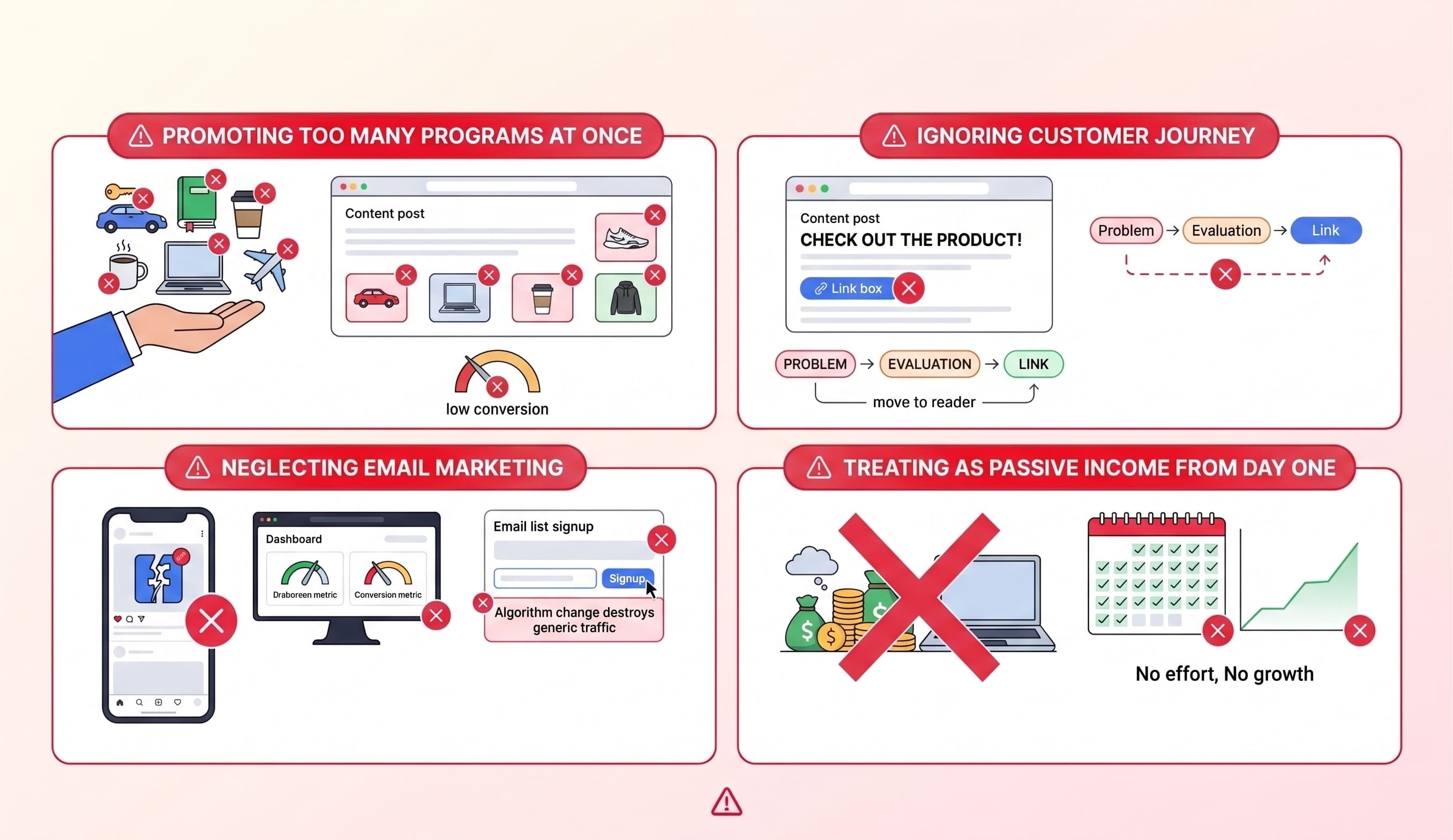
A few patterns account for most affiliate marketing failures — and recognizing them in your own approach is worth more than any positive tactic.
Promoting Too Many Affiliate Programs at Once
Spreading content across ten programs at low volume converts worse than going deep on two or three with genuine audience fit. Depth of recommendation — knowing the product well enough to address specific objections and demonstrate real use cases — produces more affiliate sales than breadth of promotion. Very few people build significant affiliate income by covering every available program superficially.
Ignoring Customer Journey
An affiliate link dropped into content without establishing the problem first is functionally invisible. Every affiliate recommendation needs to be embedded in content that moves the reader from problem awareness to solution evaluation before the link appears. The link is the final step, not the starting point.
Neglecting Email Marketing
The affiliates building the most resilient income streams own their audience through an email list — meaning a platform algorithm change or a search engine update doesn't destroy their traffic overnight. An email list also lets you reach people who showed interest but didn't convert on first contact. That follow-up is where a significant portion of affiliate sales live, and it's almost entirely absent from many affiliate marketing businesses.
Treating Affiliate Marketing as Passive Income from Day One
It becomes increasingly passive as a content library compounds over time. Getting there requires consistent content creation, ongoing performance analysis, and relationship building with affiliate partners. Affiliates typically earn between $3,000 and $15,000 per month — but that range reflects people who've committed to a strategic approach over time, not people who published a few posts and waited. The full time job comes first. The passive income comes later.
Long Game: Why Compounding Is the Point
US affiliate marketing industry spending is projected to exceed $13 billion in 2026 and reach $15.8 billion by 2028. The industry is growing fast, which means competition is increasing in every niche — and the gap between affiliates who've built genuine audience trust and those who haven't is widening rather than narrowing.
The affiliate marketing business that compounds is built on decisions that sacrifice short-term income for long-term stability: choosing recurring commission programs over flat-fee ones, building niche authority rather than broad reach, creating valuable content that serves the reader before promoting the product, and measuring performance at the content level to know what's working.
One video from a year ago generating 20 active Funnelish referrals is paying $700/month today with no additional effort. Stack ten videos like that and the income stops depending on what you publish next month. That's the goal — not a spike from a viral post, but a floor that rises every time you add something that converts.
Affiliate Marketing FAQs
What is the best strategy for affiliate marketing?
The highest-performing affiliate marketing strategy combines three decisions:
Audience alignment (promoting products your specific audience has an active, demonstrated need for)
Content structure (building around problems before introducing solutions)
Program selection (prioritizing recurring commissions over flat fees)
The most successful affiliate marketers pick a niche and build authority within it, maintain direct relationships with affiliate partners rather than operating exclusively through affiliate networks, and track performance at the content level rather than just monitoring aggregate commission totals. Depth of recommendation within a specific niche consistently outperforms broad promotion across many programs.
How do you make $100 a day with affiliate marketing?
$100/day is $3,000/month. The path there depends on commission structure. With flat fee programs at $50 per referral, you need 60 new referrals per month — every month — just to maintain that income. With recurring commission programs — 35% on a $99/month plan — 87 active referrals generates $3,040/month, and that income continues without requiring 87 new referrals each subsequent month. The recurring model reaches the target more sustainably because the referral base accumulates rather than resets.
In practice, getting there requires a content library generating consistent search traffic, strong affiliate conversion rates from content built around genuine audience problems, and enough time for the compounding to become visible — around 12–18 months from a standing start with consistent effort.
What is the 80/20 rule in affiliate marketing?
In affiliate marketing, 80% of income typically comes from 20% of content, and 80% of conversions come from 20% of affiliate programs. Most affiliates will find that a small number of high-performing pieces of content — specific blog posts or YouTube videos that rank well for high-intent search queries — generate the majority of their affiliate sales.
The strategic implication: identify that 20% early, understand what makes it convert (the problem it addresses, the audience it reaches, where in the content the affiliate link appears), and produce more content following the same pattern. This is more valuable than trying to optimize everything simultaneously or publishing high volumes of content without understanding which subset is generating income.
Table of contents
Boost your eCommerce
sales today

24/7 support
No credit card required
Cancel anytime
24/7 support
No credit card required
Cancel anytime
