

WooCommerce News 2026: Everything That Happened in the First Half of the Year
03 July 2026
Anna P.
7 minutes
The first half of 2026 was a quietly pivotal stretch for WooCommerce.
There were no flashy keynote moments — that's not really how an open-source project rolls in a global community. Instead, the WooCommerce plugin shipped a steady run of point releases, made its stores natively addressable by AI agents, kept migrating merchants onto a faster order-storage engine, and weathered the security headlines that come with powering nearly half the web's online stores.
If you run a store on the platform and haven't been tracking every release, here's the complete recap of the most important WooCommerce news from January through June 2026 — the new features, the under-the-radar shifts, and what they mean for your business.
Big releases: 10.8, 10.8.1, and 10.9
WooCommerce ships on a roughly monthly cadence, and the first half of the year delivered several meaningful versions. The headline releases:
WooCommerce 10.8 landed on May 26, 2026, per the official WooCommerce developer blog. This was a performance-and-stability release rather than a feature showcase — it improved email template synchronization, optimized storefront speed, and laid the compatibility groundwork for WordPress 7.0.
10.8.1 followed two days later on May 28, a quick patch that fixed two regressions: a critical bug in the WooPayments onboarding flow and a PHP error during in-place upgrades from 10.7.
WooCommerce 10.9.0 arrived on June 23, 2026, and it's the most consequential of the bunch — it makes WooCommerce stores natively addressable by AI agents (more on that below) and adds built-in transactional email logging to core, plus checkout performance work and admin UI updates.
A small but telling detail from 10.9: draft orders are now generated closer to when a shopper actually clicks "Place Order," rather than earlier in the flow. It's the kind of unglamorous optimization that keeps a database lean and a checkout fast — exactly the work that defines a mature platform.
One heads-up worth flagging: the WordPress.org plugin directory now applies a 24-hour "cooldown" before a release appears in your dashboard, so you may not see a new WooCommerce version the instant it ships. And some sites briefly see a fatal-error notice during the update window itself, which clears once the update finishes — a side effect of files being swapped mid-update.
WordPress 7.0 arrived — update them together
WooCommerce doesn't exist in a vacuum; it rides on WordPress. And on May 20, 2026, WordPress 7.0 — the year's biggest core release — shipped. WooCommerce 10.8 was built to align with it, adopting the new WordPress 7.0 admin styling for buttons, form controls, dropdowns, and notices.
So, update WooCommerce and WordPress at the same time. Run them out of sync and your admin screens can look slightly off, with mismatched colors and form controls. WooCommerce 10.8 also raised its minimum requirement to WordPress 6.9, so older installs need to upgrade WordPress first.
Read more: Shopify News 2026
AI became WooCommerce's defining theme — via MCP
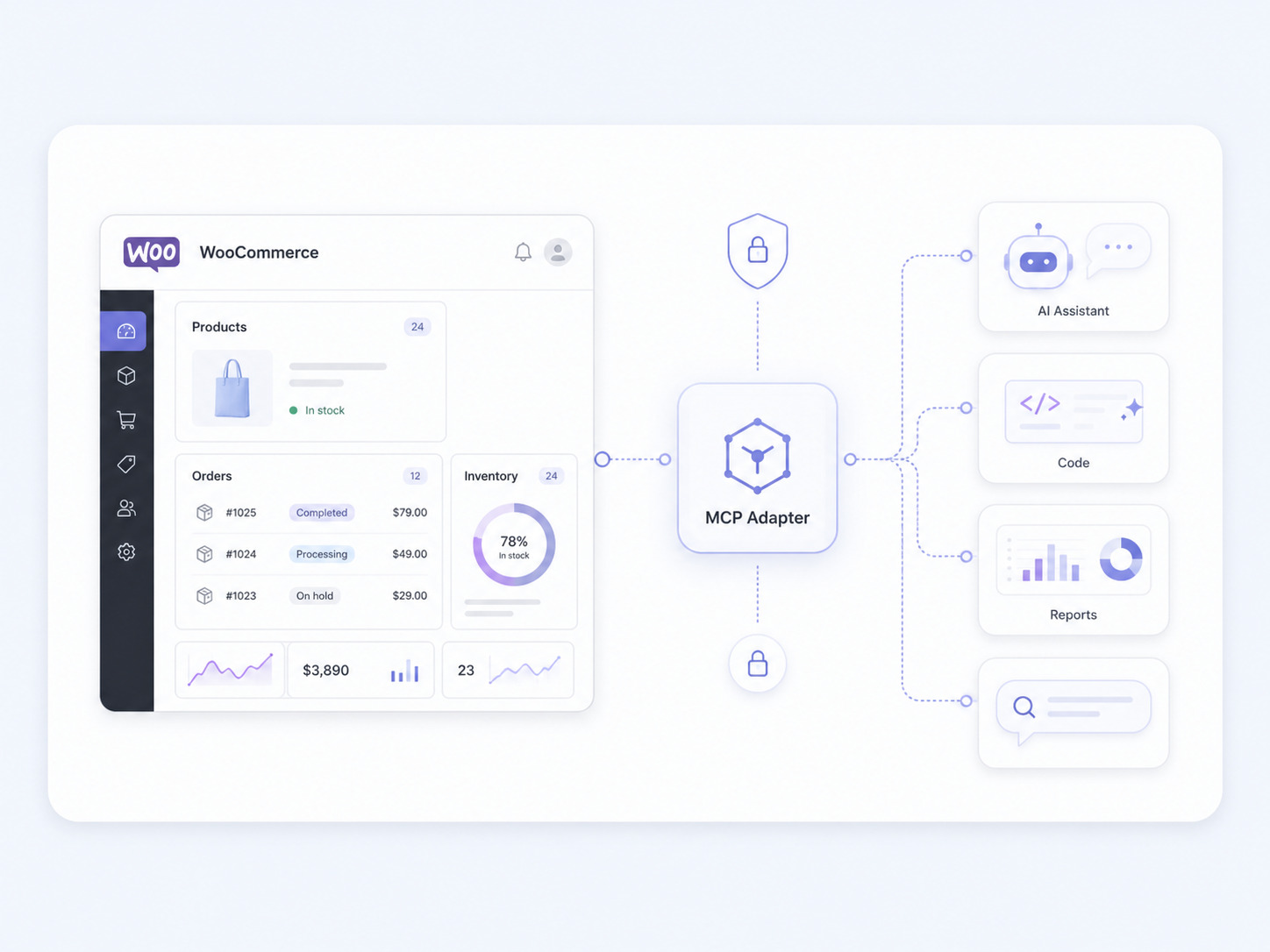
Here's the storyline that matters most for the platform's future. Where some platforms are building AI assistants into their dashboards, WooCommerce took a more open, infrastructure-first path. It made stores natively addressable by any AI system through the Model Context Protocol (MCP) — the open standard that lets AI assistants and agents securely interact with external tools and data.
WooCommerce 10.9 shipped seven canonical "domain abilities" for products and orders, exposed through the WordPress MCP Adapter, as documented in the official MCP developer docs. In plain terms: any MCP client — Claude Code, Cursor, VS Code, ChatGPT with connectors — can now query and update a live WooCommerce store through a standardized, permission-controlled interface. The underlying WordPress MCP Adapter, published earlier in the year, is what bridges WordPress's capabilities to the protocol.
The strategic vision, as Automattic's engineering team has described it, is for WooCommerce to sit in the middle as an orchestration layer — a coordination point that any AI platform can plug into, regardless of which model or assistant a merchant or shopper happens to use. Crucially, the whole thing respects WooCommerce's existing permission system, and it's still a developer preview, so the smart move is to pilot it against a staging store and scope your API keys tightly before pointing an agent at real revenue and real customer data.
Why does this matter?
Because it positions every WooCommerce store to participate in AI-driven commerce — agent-powered product recommendations that read live inventory, conversational store management, AI-assisted reporting — without surrendering the full control and data ownership that draws merchants to open source in the first place.
Read more: AI Dropshipping: What It Is, and Why You Might Not Want to Build on It in 2026
HPOS keeps pushing toward becoming the standard
A less buzzy but important throughline of 2026 is the continued migration to High-Performance Order Storage (HPOS). Instead of cramming orders into the generic WordPress posts and postmeta tables — the way WooCommerce did for years — HPOS uses purpose-built database tables for order storage.
The payoff is real: HPOS can deliver up to 5x faster order processing, improves database efficiency, and lets high-volume stores handle far more concurrent activity without choking. WooCommerce has been steadily migrating merchants toward HPOS as the new standard, and 2026 is shaping up as the year it stops being optional in spirit even where it remains technically optional. A cleaner storage foundation is what future features — faster reporting, better performance metrics, and the AI and automation tooling now taking shape — will increasingly assume.
Security: the plugin ecosystem remains the soft spot
With WooCommerce powering roughly 49% of tracked e-commerce websites, it's a big target — and the first half of 2026 brought the security headlines that come with that scale. The pattern, though, is consistent and worth internalizing: most WordPress breaches stem from outdated plugins, not WooCommerce core itself.
Across the ecosystem this year, there were reports of a critical WooCommerce Payments plugin bug exploited for user privilege escalation, credit-card skimmers injected into compromised payment modules, and a vulnerability affecting millions of sites that was patched. None of these reflect a fundamental flaw in WooCommerce core so much as the reality that an open, extensible platform is only as secure as the plugins and themes bolted onto it.
In response, WooCommerce has tightened its ecosystem standards, including enforcing a six-month update rule for developers to keep extensions current.
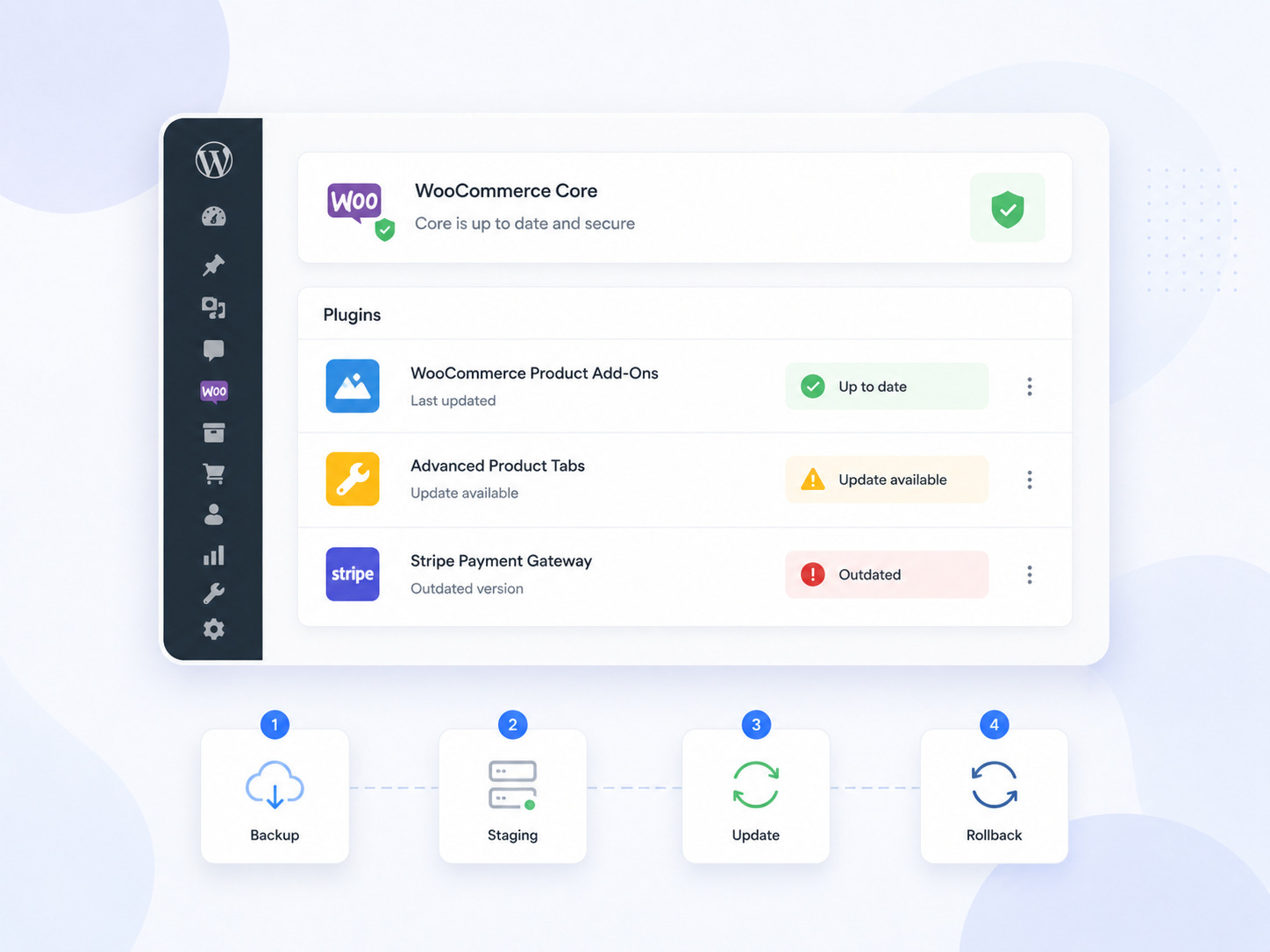
For store owners, the defense is non-negotiable and unglamorous. You need to back up your full site and database before updating, test updates on a staging copy rather than production, confirm every order-touching plugin and your theme support the new version, review the changelog, and update during low-traffic hours with a rollback plan ready. Stores that treat updates this way rarely show up in the breach reports.
Read more: ROAS Killer: Mastering WooCommerce Checkout Optimization in 2026
Other WooCommerce news worth knowing
A few smaller developments rounded out the half:
Built-in features keep expanding. Recent releases have folded more capability into core that previously needed extensions — visual color and image swatches, variation galleries, and now transactional email logging built directly into core for easier troubleshooting.
Headless and the Store API. WooCommerce continued to support headless commerce, letting developers build custom front-end experiences powered by the Store API while WordPress handles the backend — useful for brands that want a bespoke storefront on a proven commerce engine.
Payments reach. WooCommerce's strength as a flexible, global platform held, with support for 140+ region-specific payment gateways and a deep marketplace of extensions and WooCommerce themes.
The community verdict. Across Reddit and other WooCommerce communities, the discussion this year leaned positive on the AI/MCP direction and HPOS performance, with the usual caution around plugin compatibility issues and the discipline required to keep a self-hosted store updated and secure. As always, the reviews track closely with store size and how much you rely on the pieces being changed.
What it all means for you
Step back, and the first half of 2026 tells a clear story about WooCommerce's identity. While the headlines elsewhere are about all-in-one platforms bundling everything natively, WooCommerce doubled down on what makes it different: open source, full control, data ownership, and a vast ecosystem — now extended to make stores natively usable by AI agents through open protocols rather than a single vendor's walled garden.
Pair that with steady performance work (HPOS, faster checkouts) and the platform is positioning itself as the flexible, merchant-controlled foundation for the agentic-commerce era.
That open flexibility is also where the post-click experience is yours to optimize — WooCommerce gives you full control of your store and checkout logic, and what you build on top determines how well your traffic converts. Wherever you send shoppers, a fast, conversion-focused funnel matters: tools like Funnelish's page builder and sub-second pages, with one-click upsells and order bumps that lift average order value, are a practical way to turn hard-won visits into higher-value orders alongside your WooCommerce store.
Because if the first half of 2026 is any guide, the open-source commerce world is moving fast — and the second half won't be standing still.
Table of contents
Boost your eCommerce
sales today

24/7 support
No credit card required
Cancel anytime
24/7 support
No credit card required
Cancel anytime
