

AI Dropshipping: What It Is, and Why You Might Not Want to Build on It in 2026
16 March 2026
Anna P.
10 minutes
Every few years, a new category of tools shows up promising to collapse the complexity of running an eCommerce business into something anyone can do in an afternoon. AI dropshipping is the current version of that promise — and like its predecessors, it's worth understanding clearly before you build anything on top of it.
This isn't a hit piece. AI dropshipping platforms are a genuinely interesting development in the dropshipping space, and some of the underlying technology is useful. But the pitch and the reality are far enough apart that operators making decisions based on the marketing rather than the mechanics are going to have a bad time.
Here's what's happening.
What AI Dropshipping Store Is
AI dropshipping refers to platforms and tools that use artificial intelligence to automate some or all of the core tasks involved in running a dropshipping store — product research, store setup, product listings, pricing, and, in some cases, ad creative.
The category spans a wide range. On one end, you have AI-assisted features baked into established ecommerce platforms: automated product descriptions, trend detection, and dynamic pricing suggestions. On the other end, you have fully automated AI store builders that claim to handle everything from finding trending dropshipping products to publishing a live ecommerce store — with one-click import functionality and no technical skills required.
The tools being marketed most aggressively right now typically promise some combination of: access to millions of dropshipping products from verified suppliers, AI-generated product listings, automated fulfillment, and a user-friendly interface that gets you to your first sale without prior experience.
Several dropshipping platforms — AutoDS, Zendrop, and Sell The Trend among them — have integrated AI features into their core offering, with free plan options and paid plans to serve different stages of growth. The pitch is: All the tools you need on one platform, from product research to customer orders, with enough automation to save time at every step.
The market for these tools is real and growing, and dropshipping tooling is riding that wave.
What AI Is Actually Doing
It helps to be specific about what "AI" means in this context, because the term is doing a lot of work in marketing.
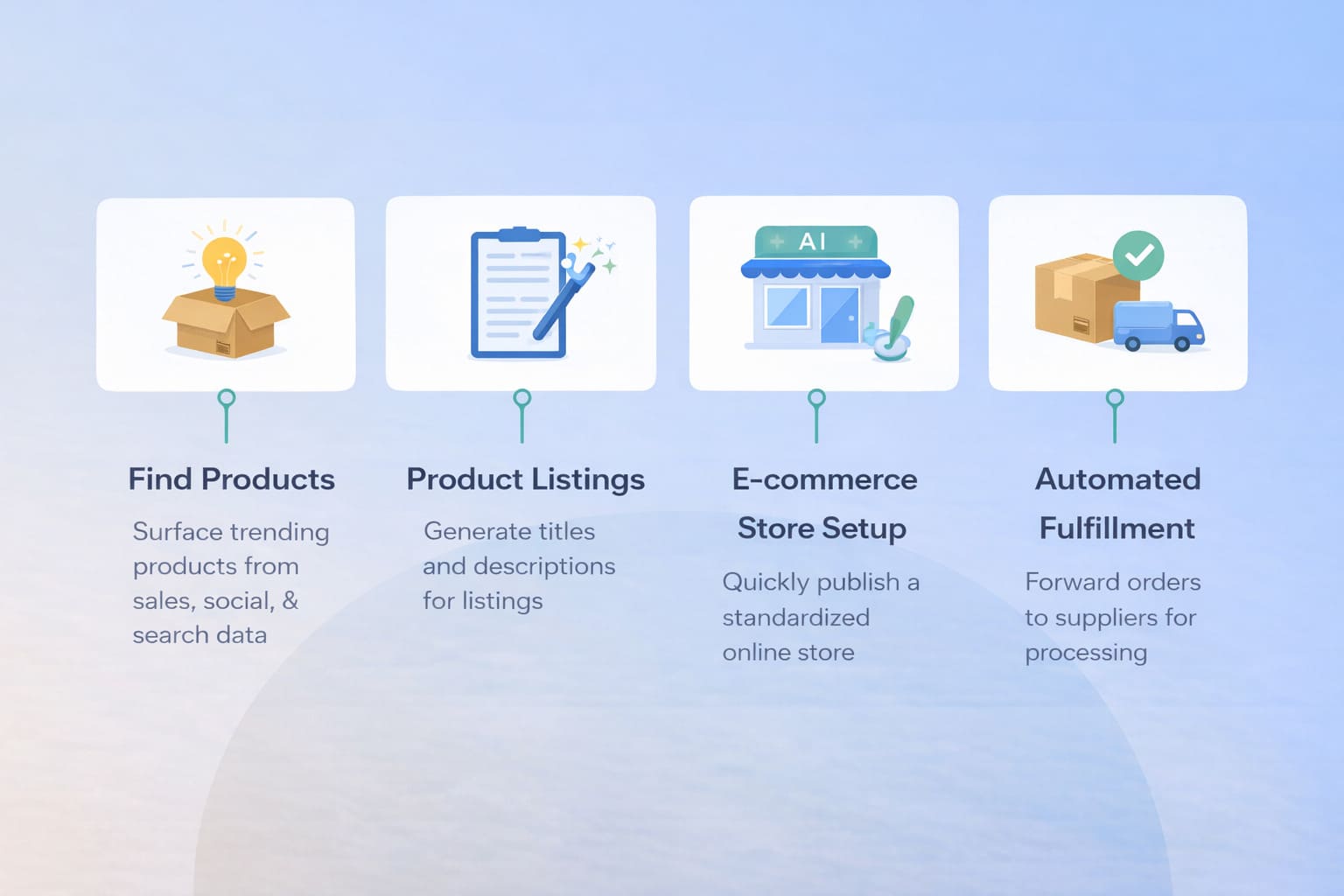
Find Products
Most AI dropshipping tools scrape sales data, social signals, and search trends to help you discover winning products and surface what they categorize as trending products or best sellers. This is genuinely useful — better than manual browsing — but it's pattern recognition on historical data, not prediction. A winning dropshipping product that was trending last month and is being surfaced by an AI tool today is already late-stage by the time most users act on it.
So, trending products handpicked by an algorithm are, by definition, trending for everyone using that algorithm simultaneously.
Read more: #1 Reason Viral TikTok Products Don’t Convert
Product Listings
Generative AI writes product titles and descriptions pulled from dropshipping suppliers' data, making it easy to import products and populate an ecommerce store quickly. This saves time and is functional, but the output is generic by nature — the same tool writing the same description style for thousands of dropshipping stores selling the same product. Differentiation, which is the actual competitive advantage in dropshipping, doesn't come from an AI writing a bullet list of product features.
Read more: Graypoplar Dropshipping: Trend Analysis, Logistics & Funnel Strategy
E-commerce Store Setup
An AI store builder can publish an online store faster than building one manually — useful for operators launching their first website or testing a new niche quickly. What it can't do is make strategic decisions: which niche to pursue, how to position a product against competitors, what price points will hold in a specific market, or how to structure a funnel that generates more profit beyond the first transaction.
Automated Fulfillment
When customer orders come in, many of these platforms automate orders by forwarding them to the relevant dropshipping suppliers and handling tracking updates. When suppliers ship on time and product quality meets expectations, this works well. This part of the value proposition is legitimate — it's a real operational time-saver, particularly for ecommerce businesses managing volume across multiple suppliers.
One Phenomenon Worth Paying Attention To
What's interesting about AI dropshipping isn't the technology — it's what it reveals about where the dropshipping market is heading.
The barriers to entry for starting a dropshipping store are effectively zero now. An AI store builder can have someone operational in hours with no technical skills, minimal capital, and a product catalog sourced from vetted suppliers. That democratization is real, and it's driving a measurable increase in the number of people attempting to start dropshipping for the first time.
A report from Shopify's 2025 Commerce Trends found that AI tool adoption among small and mid-sized eCommerce merchants grew faster than any other category. AI dropshipping platforms are successfully reducing the operational costs of starting and maintaining an online business.
The downstream consequence is also predictable: when everyone has access to the same AI tools pulling from the same suppliers, generating the same product listings, the stores look identical. You end up with thousands of dropshipping stores selling the same products at similar price points, with no unique brand identity and nothing to make their online store stand out. The competitive moat that AI is supposed to build is being eroded by the same AI simultaneously available to every competitor.
Read more: Is Dropshipping Worth It in 2026?
Why This Matters for How You Build
The core problem with AI dropshipping as a complete strategy — rather than a set of features inside a broader operation — is that it automates the easy parts and leaves the hard parts untouched.
Finding trending products is not why dropshipping businesses fail. Generating product listings is not why dropshipping businesses fail. The reasons successful dropshippers separate from the field are customer satisfaction, profit margin management, fast shipping times that don't generate chargebacks, and the ability to drive traffic through Instagram ads or paid search that converts at the other end. None of those problems is solved by an AI store builder.
A store with AI-generated listings and automated fulfillment still needs a landing page that converts paid traffic. It still needs a checkout that doesn't lose buyers at the last step. It still needs a post-purchase upsell strategy to make the unit economics work when ads are the primary acquisition channel. It still needs quality products from trusted suppliers and fast shipping that keeps customers from opening disputes. These are the operational and strategic challenges where the real work of building a profitable dropshipping business lives.
The platforms offering a free trial of their AI store builder are selling the easy part. The hard part is everything that happens between someone clicking an ad and you making more money than you spent to acquire them. That gap is not closed by AI tools — it's closed by infrastructure, positioning, and execution.
What a Serious Dropshipping Business Operation Needs
The operators building real ecommerce businesses in 2026 — the ones using dropshipping as a legitimate model rather than a shortcut — are combining the efficiency of AI tools for product research with infrastructure built for performance everywhere it counts.
That means a dropshipping store that loads in under a second on mobile, because the majority of traffic from Instagram ads and TikTok arrives on phones, and any friction in the first few seconds is paid traffic you lost before it had a chance to convert. It means a checkout flow that minimizes steps between intent and purchase. It means post-purchase upsells that increase profit margin without increasing ad spend — turning a marginal first sale into a genuinely profitable customer order.
And it means analytics that let you track performance at the funnel level, not just the store level, so you can identify where customers are dropping out and fix it.
AI tools can help you find products faster and set up a store more efficiently. They can surface premium products from vetted suppliers and help you import products into your ecommerce store in minutes. What they can't do is make a slow store fast, build a funnel that increases average order value, or turn a one-time buyer into a repeat customer.
The operators who use AI as one layer in a properly built operation — not as the operation itself — are the ones with proven strategies that hold up past the first few sales. The interesting thing about the AI dropshipping phenomenon is that it's accelerating the commoditization of the table-stakes parts of running a dropshipping business. Which means the differentiation has moved to execution, conversion infrastructure, and the customer experience your support team delivers after the sale. The operators who recognize that shift are building something durable.
Where AI Actually Helps: Building the Funnel, Not Just Listings
Everything above points to the same conclusion. The AI that commoditizes your store is the AI pointed at the easy layer — product research and generic listings that every competitor also generates. The AI worth using is pointed at the layer that actually decides whether paid traffic converts: the funnel itself. That is exactly why we've made Funnelish AI.
Funnelish AI is an interactive AI funnel builder, available to explore in beta right now. Instead of publishing another identical storefront, it builds the pages that do the selling — and it keeps you in control of the result rather than handing you a black box.
A few things it does that map directly to the problems this article has been describing:
Start from whatever you have. Begin from scratch, from a single product picture, or from a reference link. You are not forced into a template you then have to fight.
Use your own images or AI-generated ones. Upload your real product photography — the thing that actually differentiates you from the fifty stores selling the same item — or generate visuals with AI when you don't have your own yet.
It builds the full pages, then edits on request, section by section. Funnelish AI generates the complete funnel, and you refine it conversationally. Tell it a specific section isn't working and have that part reworked, rather than regenerating the whole thing or editing raw blocks by hand.
Hand the AI project straight into the funnel editor. When the AI has done the heavy lifting, you take the project into the full Funnelish editor and customize it further yourself — so the AI accelerates the build without capping how far you can take it.
That is the distinction this whole article turns on. AI that writes your product descriptions makes you look like everyone else. AI that helps you build a fast, high-converting funnel — with your own images and your own edits — works on the part of the operation where the money is actually won or lost. Funnelish AI is built for the second kind of job.
AI Tools for Dropshipping FAQs
Is AI good for dropshipping?
AI tools are useful for specific tasks — product research, generating product listings, helping you discover winning products, and using automated fulfillment to automate orders at scale. Where they fall short is strategy: niche selection, funnel structure, profit margin management, and customer satisfaction. As a set of features inside a broader operation, AI is a genuine time-saver. As a complete strategy, it's not enough.
Does AI dropshipping work?
Automated tools can get an online store live quickly and surface trending dropshipping products from verified suppliers. Whether the business makes money depends on everything that comes after — traffic acquisition, conversion rate, post-purchase revenue, and whether your dropshipping suppliers deliver quality products on time. AI handles store setup; it doesn't handle the hard parts.
How can I do AI dropshipping?
Most established dropshipping platforms now offer AI-assisted features, some with a free plan to start. The practical approach is to use AI tools for product research and listing creation while building your ecommerce store on infrastructure optimized for conversion — fast pages, a checkout built to minimize drop-off, and post-purchase upsells that improve the profit margin on every customer order.
On the funnel side specifically, Funnelish AI (in beta) can generate the pages for you from a product image or reference link, let you swap in your own images, and refine the result section by section before you take it into the full editor.
Is AI dropshipping legal?
Yes. Using AI tools to operate a dropshipping business is legal. The same regulations that apply to any ecommerce business — consumer protection laws, accurate representation of product quality, sales tax compliance — apply regardless of which tools you used to build the store or source products.
Read more: Is Dropshipping Legal in 2026?
How much can you earn from AI dropshipping?
The income potential is the same as any dropshipping business — it varies based on niche, profit margin, traffic costs, and conversion rate. AI tools don't change the underlying economics. Margins in dropshipping run between 10–30% before ad spend; the operators who make more money push beyond that through average order value optimization and post-purchase revenue, not through the tools they used to find products or set up their store.
Is AI dropshipping risky?
The risk profile is similar to standard dropshipping, with one additional consideration: if your dropshipping store is built on the same AI-generated listings and product catalog as thousands of other stores sourcing from the same suppliers, you have almost no differentiation. That's a real competitive risk.
The ecommerce businesses that use AI tools as an efficiency layer — while investing in a unique brand identity, reliable suppliers, and conversion infrastructure — are better positioned than those treating the AI as the strategy itself.
Table of contents
Boost your eCommerce
sales today

24/7 support
No credit card required
Cancel anytime
24/7 support
No credit card required
Cancel anytime
