

Is Dropshipping Worth It in 2026?
15 March 2026
Anna P.
10 minutes
The question gets asked every year, usually by someone who read a Reddit thread about a failing store and a YouTube video about a $100k month in the same afternoon. The answer they're looking for is a clean yes or no. The honest answer is more useful: dropshipping is worth it for operators who understand what it is, and it's a slow bleed for everyone else.
The dropshipping market isn't dead. Global dropshipping revenue is projected to exceed $500 billion by 2027, and that number doesn't come from hobbyists running AliExpress stores. It comes from eCommerce businesses that have figured out how to use the dropshipping model as one lever in a larger operation — not as the entire strategy.
So let's answer the real question: Is dropshipping worth it for you, in this environment, in 2026?
What "Worth It" Means
Before you build a dropshipping store, you need to be honest about what you're measuring. Worth it compared to what?
If you're comparing dropshipping to a salaried job with a predictable income, the answer depends on your execution. If you're comparing it to holding inventory in a warehouse, paying for storage space, and taking on the financial risk of unsold stock, the dropshipping business model wins on risk profile almost every time.
The dropshipping model removes inventory management from the equation. A third-party supplier stores the product, ships it when a customer orders, and handles the physical logistics. Your job is the front end: finding a profitable niche, building an online store that converts, and running a marketing strategy that brings in the right buyers at a cost that leaves a margin after the supplier takes their cut.
That's the legitimate ecommerce business model. It works now, and it has worked for over a decade. It will keep working for operators who approach it as a real business rather than a passive income scheme.
Read more: Dropshipping vs Ecommerce
Honest State of the Dropshipping Market in 2026
Here's what has changed, and why most of the "dropshipping is dead" narrative exists.
Low-effort, Low-differentiation Dropshipping Is Dead
The version of dropshipping where you find a product on AliExpress, upload it to a Shopify store, run some Facebook ads, and wait for profit — that model is finished. Not because dropshipping itself stopped working, but because the market corrected. Online shoppers have seen the exact same products in dozens of stores. They recognize the generic product photography. They've been burned by 30-day shipping delays from overseas suppliers, and they've learned to check for reviews.
The race-to-the-bottom version of this business model destroyed the credibility of the operators who invested in it. But it didn't kill the model for everyone.
One structural change deserves a mention here, because it is part of why the low-effort version stopped adding up. The US ended its $800 de minimis exemption in 2025, so low-value parcels imported from overseas now carry import duty. The cheap-product-shipped-direct-from-China model depended on those parcels entering duty-free. That underpinning is gone, which is a concrete reason — beyond market saturation — that the arbitrage version no longer pencils out.
What Works in 2026
What works is the version of dropshipping that looks, from the outside, like a brand. Strong brand identity. A dropshipping store with original, creative, clear positioning, and a landing page that makes a specific promise to a specific type of customer. Reputable suppliers with real fulfillment speed. A post-purchase experience that would satisfy consumer protection laws and — more importantly — satisfy the customer.
This is the gap between many dropshippers and successful dropshippers. The former treat it like arbitrage. The latter treat it like building an ecommerce business that happens to use a third-party supplier for logistics.
Read more: Why dropshippers fail and why are they losing money?
Can You Still Make Profitable Dropshipping Work?
Yes, and the numbers support it — but the margin reality has to be understood upfront.
Profit margins in traditional dropshipping run thin. You're paying retail price to your supplier, running paid ads to attract customers, and keeping what's left. On a $40 product, you might net $8–12 after ad spend if you're running a clean operation. That's not a business you can scale into significant income without volume — or without increasing average order value through upsells and order bumps.
Factor one more line into that math for 2026: if the product ships from overseas, import duty now comes out of the same $8–12. On a thin-margin item that can be the difference between a profitable order and a break-even one, which is exactly why the operators still winning either sell higher-ticket products or source from suppliers with US/EU-based fulfillment so goods clear customs once in bulk rather than parcel by parcel.
This is where higher profit margins come from in 2026: not from finding cheaper products, but from increasing what each customer spends before they leave your funnel. A one-product funnel with a well-placed post-purchase upsell can double the effective margin on the same acquisition spend. A customer who buys a $40 hero product and takes a $25 complementary upsell in the same session changes your unit economics entirely.
Operators who understand this are making a profit from dropshipping. The ones fixated on finding a product with a low enough retail price to leave margin on a single sale are grinding against market forces they can't control.
Read more: Graypoplar Dropshipping: Trend Analysis, Logistics & Funnel Strategy
Why So Many Dropshippers Fail
The failure rate in dropshipping is high, but the reasons are predictable and avoidable.
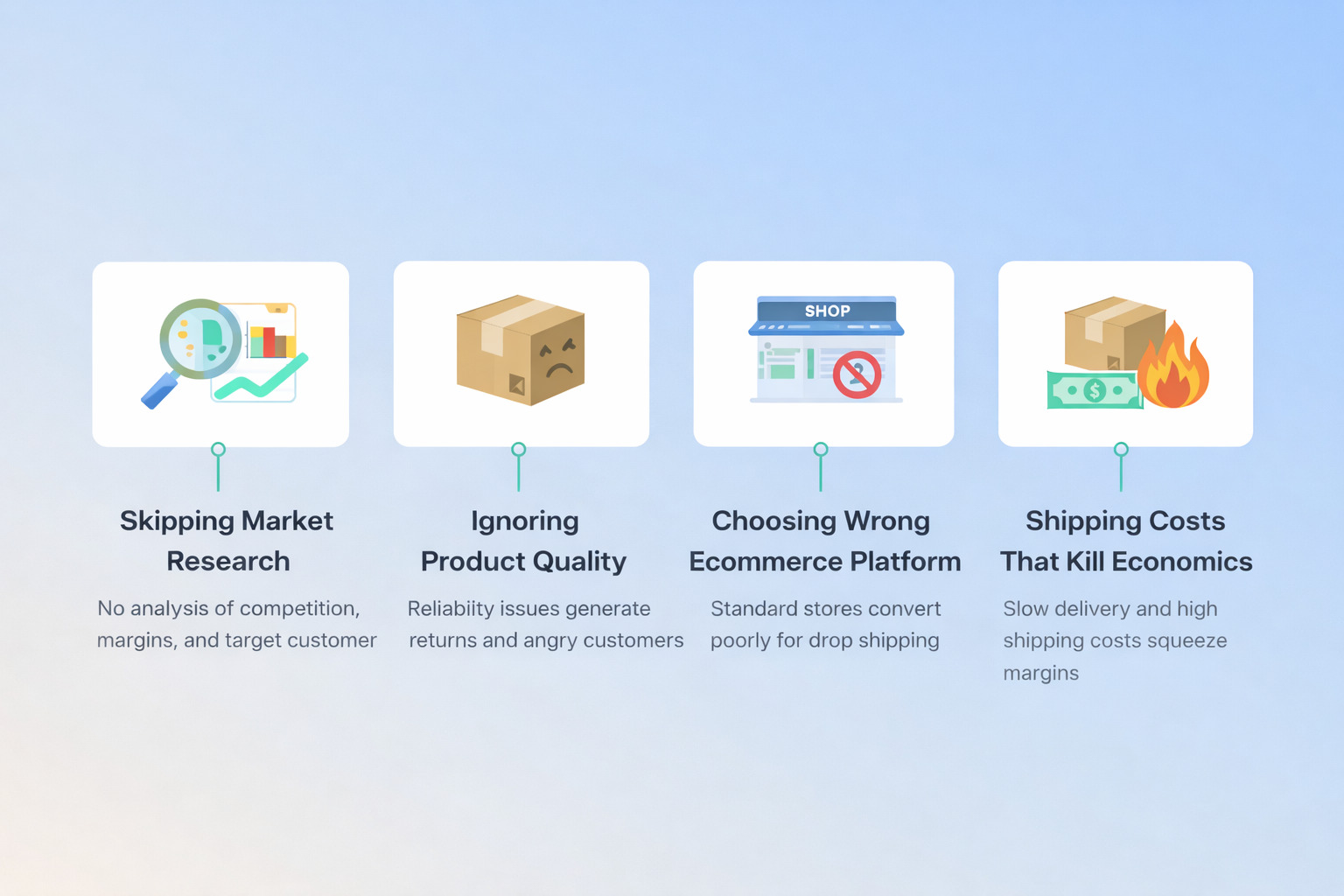
Skipping Market Research
The most common mistake is picking a product because it looked good on Google Trends for a couple of months or appeared in someone else's winning TikTok ad, without doing a real analysis of competition, margin, and target customer. A profitable niche isn't just a product category that sells — it's one where your marketing strategy can reach buyers cost-effectively and where your store can stand out from established businesses already selling.
Read more: Dropshipping Products That Work in 2026
Ignoring Product Quality
High-maintenance products with reliability issues generate returns, chargebacks, and angry customers. No amount of excellent customer service can recover the lifetime value of a customer who received something that didn't match the photos. Vetting your dropshipping suppliers for quality products before you scale is non-negotiable.
Choosing Wrong Ecommerce Platform
Many dropshippers build on platforms optimized for general retail, not conversion. A standard online store homepage with a navigation menu and thirty products is a poor destination for paid traffic. Visitors arriving from a paid ad have narrow attention and low patience. Sending them to a homepage means most of them leave without buying.
A dedicated landing page — built around the specific product and offer — can convert the same traffic at two to three times the rate.
Shipping Costs That Kill Economics
International shipping from suppliers who haven't optimized their logistics creates two problems: slow fulfillment speed that damages customer satisfaction, and shipping costs that either compress your margin or inflate your price to the point where buyers bounce. The solution in 2026 is working with multiple suppliers to source from closer to your primary market, or using a supplier that offers US/EU-based warehousing. Since the end of duty-free de minimis, that closer-to-market sourcing does double duty: it cuts shipping time and it keeps per-parcel import duty out of every order.
No Solid Business Plan Beyond "Find a Winning Product"
Dropshipping is a business. It needs a customer acquisition strategy, a realistic model for profit margins, a plan for handling customer orders that go wrong, and an understanding of sales tax obligations in the markets you sell into. The operators who skip this treat it like a lottery ticket rather than a viable business model.
Read more: Is Dropshipping Legal in 2026? (USA)
What Separates Dropshipping Stores That Scale
The dropshipping stores that grow past the initial test phase and into real revenue share a few structural characteristics.
They use search engine optimization to build organic traffic alongside paid ads, which reduces dependency on ad platforms and improves profitability over time. They build a unique brand identity around their product range rather than presenting themselves as a generic online store. They invest in social media not just as an ad delivery channel but as a place where their target customer — whether that's pet owners, fitness buyers, or home improvement enthusiasts — actually hangs out and shares product recommendations.
They also use infrastructure that matches their ambitions. A Funnelish funnel — with sub-second page load, a checkout designed to minimize friction, and post-purchase upsell capability built in — converts the same traffic at a meaningfully higher rate than a standard Shopify product page. When your profit margins are thin, and every percentage point of conversion rate improvement directly changes the math, the right ecommerce platform isn't a secondary decision.
The best dropshipping suppliers alone won't save a slow, poorly converting store. And great ad creative won't compensate for a checkout that loses buyers at the last step. Successful dropshippers optimize the whole system — not one piece of it.
Is It Worth Starting in 2026?
If you're willing to treat it as an ecommerce business with real inputs — market research, supplier vetting, a marketing strategy that can be measured and improved, a proper online store built to convert — then yes, dropshipping is worth it in 2026.
The low startup costs remain a genuine advantage. You don't need storage space, you don't pre-buy inventory, and you can start selling online in a market before committing significant capital to it. That risk profile is real and valuable, especially for first-time operators who want to test product ideas before building a larger operation.
But the operators who will look back on 2026 as the year they built something real are the ones who start dropshipping with a solid business plan, choose their suppliers carefully, build a funnel rather than a generic store, and invest in the parts of the business — creative, customer experience, post-purchase sequences — that actually create a strong brand identity worth returning to.
The dropshipping model isn't easy. It isn't passive. It isn't a shortcut to income without effort. But it is a legitimate path to building a profitable online business — for the operators who take it seriously.
Dropshipping FAQs
Is dropshipping dead in 2026?
No — but the low-effort version of it is. Generic stores selling the exact same products as dozens of competitors with no brand differentiation and slow international shipping have a hard time today. Dropshipping businesses built with a real brand identity, reliable suppliers, and a conversion-optimized funnel are still generating significant revenue.
Can you make money dropshipping?
Yes. The operators who make consistent money have moved beyond single-product arbitrage and into building ecommerce businesses with real margin strategies — upsells, post-purchase offers, email sequences, and SEO traffic alongside paid ads. The profit margins on a single sale can be thin; the economics change substantially when you increase AOV through the funnel.
Can I start dropshipping with $0?
Technically, you can list products and set up a store with minimal upfront cost, but realistically, you need a budget for ads, a proper storefront, and potentially samples from your dropshipping suppliers to verify quality. Attempting to scale a dropshipping store with no marketing spend means relying on organic search, which takes time to build.
Why do so many dropshippers fail?
The most common reasons: choosing products without doing real market research, working with suppliers who have poor fulfillment speed or quality products, sending paid traffic to a poorly converting online store, and treating it like a passive income model rather than a business. Most failures come down to underinvesting in the parts that drive customer satisfaction and repeat purchases.
What will replace dropshipping?
Nothing is positioned to replace it — but the model is evolving. The trajectory is toward hybrid models where dropshipping is used for testing and scale, combined with owned inventory for top-performing products. Social commerce is also reshaping the top of the funnel, with brands using TikTok and Instagram to drive traffic into conversion funnels rather than relying solely on paid ads.
Which country is best for starting a dropshipping business?
The US and UK remain the strongest markets in terms of online shopping volume, consumer spending, and depth of reputable suppliers. For EU sellers, markets like Germany and the Netherlands offer strong purchasing power. The key variable isn't where you're located — it's where your customers are and whether your supplier can serve them with acceptable fulfillment speed.
Ready to build a dropshipping store that actually converts? Start your free trial with Funnelish and see what a funnel built for performance looks like.
Table of contents
Boost your eCommerce
sales today

24/7 support
No credit card required
Cancel anytime
24/7 support
No credit card required
Cancel anytime
