

Shopify News 2026: Everything That Happened in the First Half of the Year
29 June 2026
Anna P.
7 minutes
The first half of 2026 was one of the busiest stretches in Shopify's history.
The Shopify platform crossed $100 billion in quarterly merchant sales.
It shipped its biggest feature release of the year.
It pushed hard into AI-driven agentic commerce, retired a piece of core infrastructure thousands of stores relied on, and banned an entire product category under government pressure.
If you run a store and blinked, you missed a lot. So here's the complete recap of the most important Shopify news from January through June 2026 — the headlines, the under-the-radar changes, and what they mean for you.
Shopify crushed Q1 — but the stock fell anyway
The biggest financial news landed on May 5, when Shopify reported its Q1 2026 results.
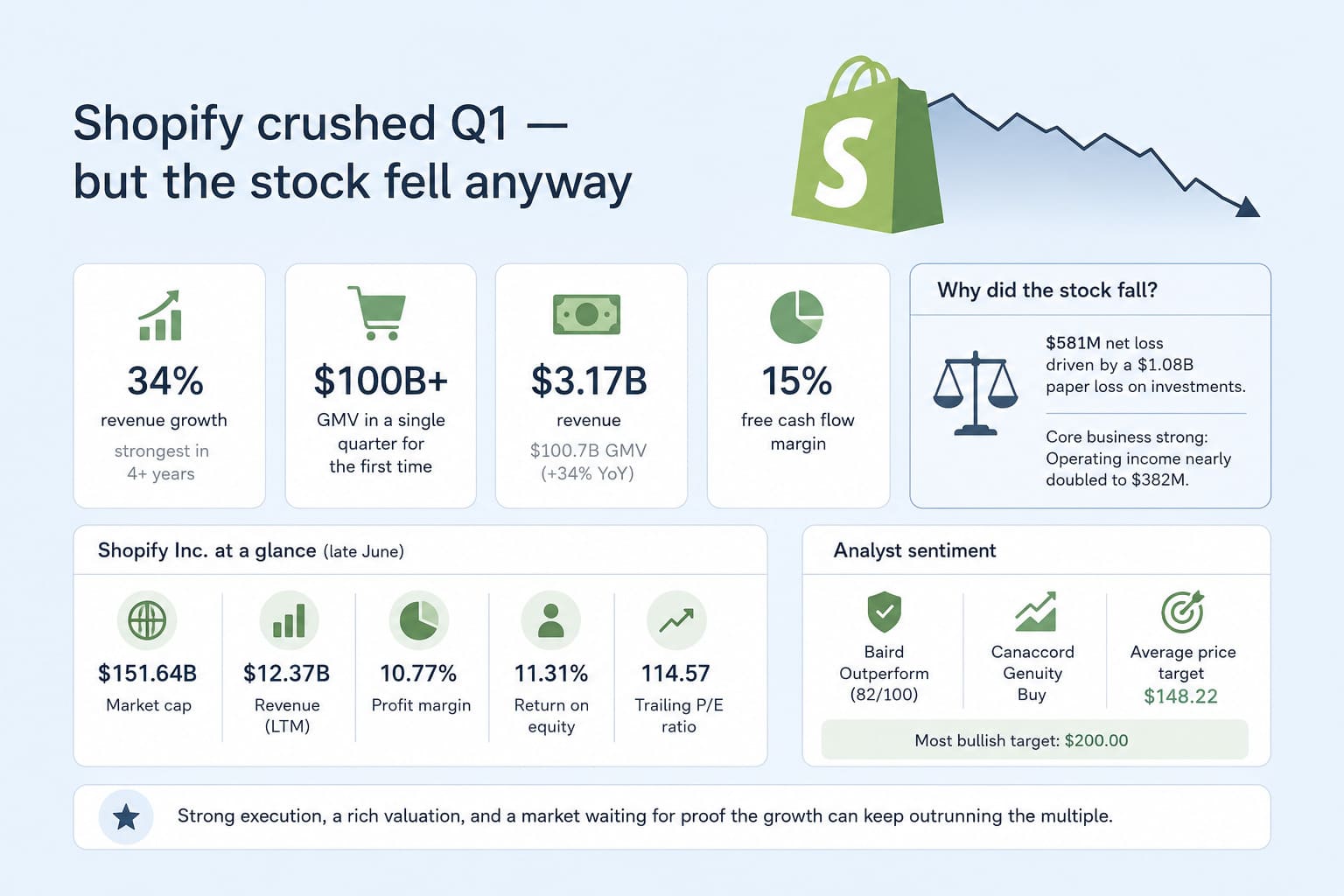
Per Shopify's own release, the company delivered 34% revenue growth — its strongest quarterly growth in over four years — and 15% free cash flow margins. Merchants cleared more than $100 billion in GMV in a single quarter for the first time ever. Revenue hit $3.17 billion, with GMV reaching $100.7 billion, up from $74.75 billion a year earlier, according to Shopify's SEC filing.
So why did the stock fall sharply right after such a strong print?
The same filing shows a $581 million net loss for the quarter — but that was driven by a $1.08 billion paper loss on Shopify's investments in other companies, not its core business, which actually saw operating income nearly double to $382 million. The market reacted to the scary headline number and Shopify's premium valuation rather than the underlying performance.
Here's where Shopify Inc. stands as of late June:
Market cap: roughly $151.64 billion
Revenue (last twelve months): about $12.37 billion
Profit margin: near 10.77%
Return on equity: around 11.31%
Trailing P/E ratio: roughly 114.57 — which is exactly why investors scrutinize every quarter so closely
Analyst sentiment stayed broadly positive through the spring. Baird rates the stock Outperform (scoring it 82/100), Canaccord Genuity maintains a Buy, and across Wall Street the average price target sits around $148.22, with the most bullish target reaching $200.00. The bottom line on the stock: strong execution, a rich valuation, and a market waiting for proof the growth can keep outrunning the multiple. Whether that makes Shopify a buy is, as always, a question for your own research — but the future direction of the business clearly points one way: AI.
Read more: Best Shopify AI Tools for Sellers in 2026
Summer '26 Editions: 150+ updates and an Everywhere theme
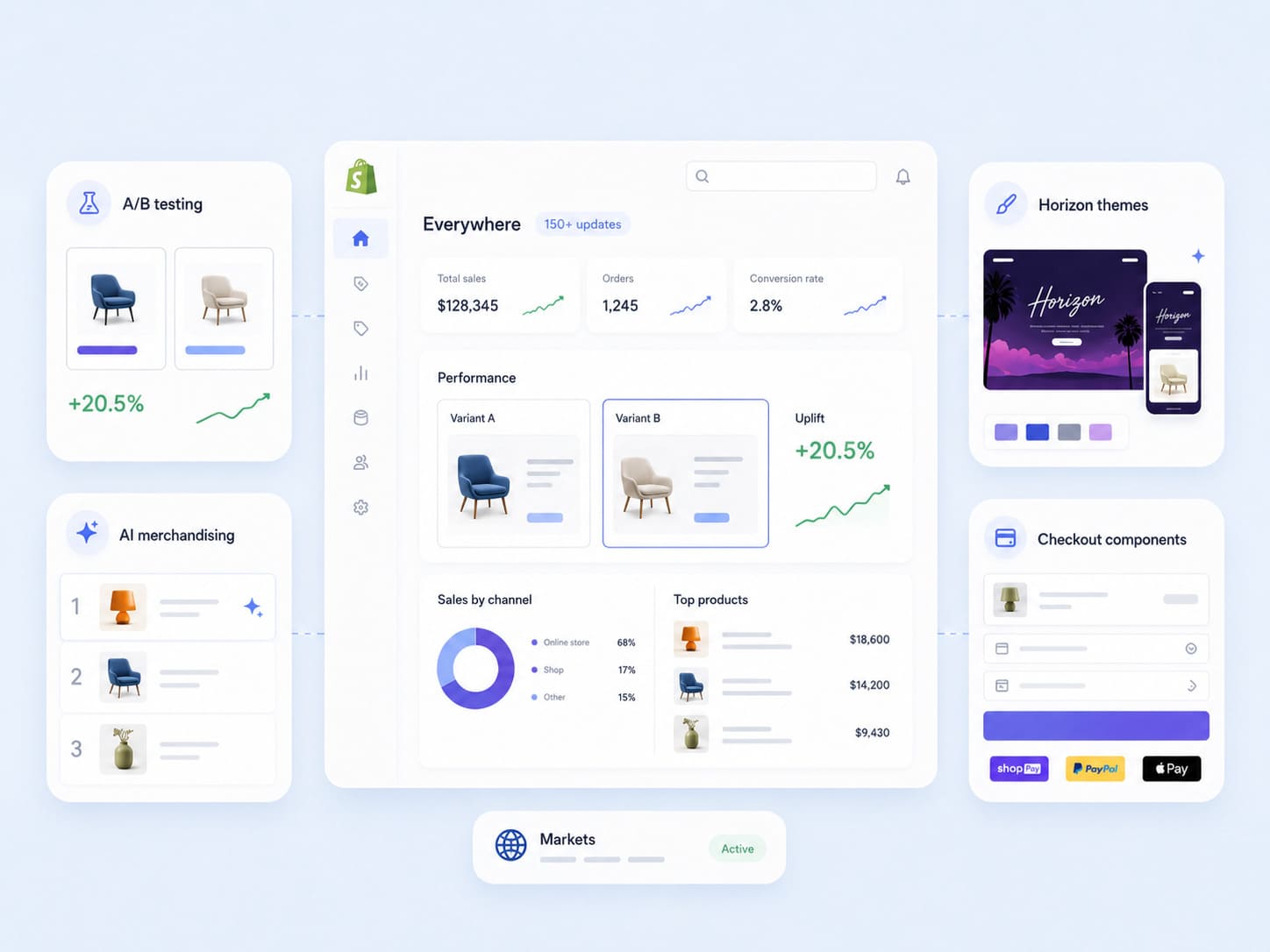
On June 17, Shopify shipped the biggest release of the year — the Summer '26 Everywhere Edition, announced by CEO Tobi Lütke with more than 150 new tools and updates.
This is the second of Shopify's twice-yearly Editions showcases, and the theme says it all: commerce showing up everywhere a customer is — which, in 2026, increasingly means inside AI assistants rather than on a store's homepage. Here are the changes that move the needle:
Native A/B testing. Split-testing for themes and checkout — with scheduling and gradual rollout — is now built into the platform. No third-party app required to run real experiments.
Native AI merchandising. A built-in engine that orders your collection and search results by predicted conversion instead of manual sorting.
Checkout Components (live for Plus). Plus merchants can now build custom checkout surfaces from supported building blocks instead of editing code.
Horizon themes. Ten new free themes built on a flexible, nested-block design with AI-assisted editing.
Better reports and POS. Reports gained improved filtering for comparing data, and Shopify POS picked up smoother checkout plus staff-attribution reporting for retail teams.
Selling internationally? Two quieter wins matter here. Shopify Markets now lets you set unique prices and product availability per sales channel and region, and the platform now supports automatic collection of EU import customs duty on low-value imports — a real headache-saver as cross-border rules tighten, including for merchants expanding into regions like the Middle East and the EU.
Read more: Best Shopify Themes in 2026
Scripts sunset: a hard deadline hiding in plain sight
The most urgent item of the first half wasn't a new feature. It was a removal.
Legacy Shopify Scripts — the code that powered custom discounts, shipping, and payment rules on many Plus stores — was fully retired at the end of June (June 30, 2026). The catch: any logic still running on Scripts simply stops working after that date, and it fails silently. No error message, just a cart quietly behaving wrong.
The replacement is the Shopify Functions framework, which handles the same custom rules with faster execution. Shopify laid out the migration path in its Editions developer notes, and this deadline — which had slipped twice before — finally held.
The lesson for merchants is simple: core infrastructure does get deprecated. The stores that stay current and keep their customizations on supported frameworks avoid these unpleasant surprises.
Read more: Is Shopify Legit? 2026 Guide
AI and agentic commerce became the main event
If one theme defined Shopify's first half, it's AI. The company spent these six months making sure every merchant's products are discoverable — and buyable — right inside AI assistants.
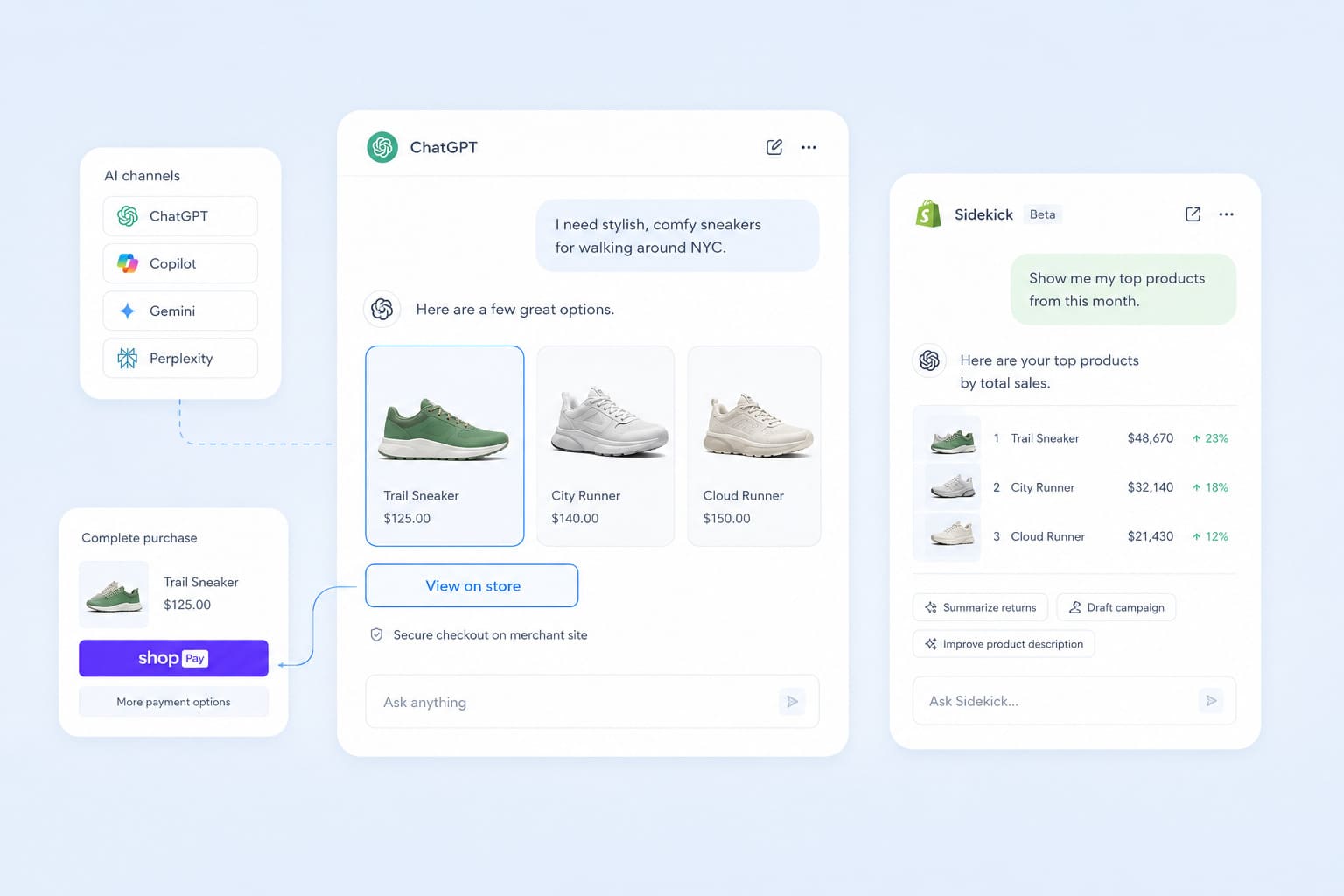
In late March, Shopify announced that millions of merchants could start selling to ChatGPT users through agentic storefronts, with products surfacing directly inside ChatGPT responses. The smart part: purchases complete on your own checkout, not a third party's, so you keep your customer data, saved payment methods, and post-purchase flows.
The same system connects to Microsoft Copilot, Google Gemini, and Perplexity — and Shop Pay can now power checkouts started on these outside AI platforms, beyond Shopify itself.
Shopify also expanded its AI tools across the admin:
Sidekick, its AI assistant, grew from a help chatbot into a genuine operator. Ask it "What were my top-selling products last month?" and it answers in plain language — or tell it to create a discount code or tag a collection, and it just does it.
Shopify Magic, the built-in content generator, became more brand-aware, pulling from your existing copy and tone.
A new AI marketing engine rolled out with features for campaign creation, real-time insights, and optimizing your advertising spend and customer acquisition — pulling more of the advertising stack into the platform itself.
The strategic message is consistent: shopping discovery is shifting from search engines into AI chat, and Shopify wants you there by default. So, treat clean and structured product data as seriously as you once treated Shopify SEO — because that's what AI tools read to decide which products to show.
Read more: Shopify Magic: What It Is and How to Make It Work for Sales
Shopify banned all vapes in the US
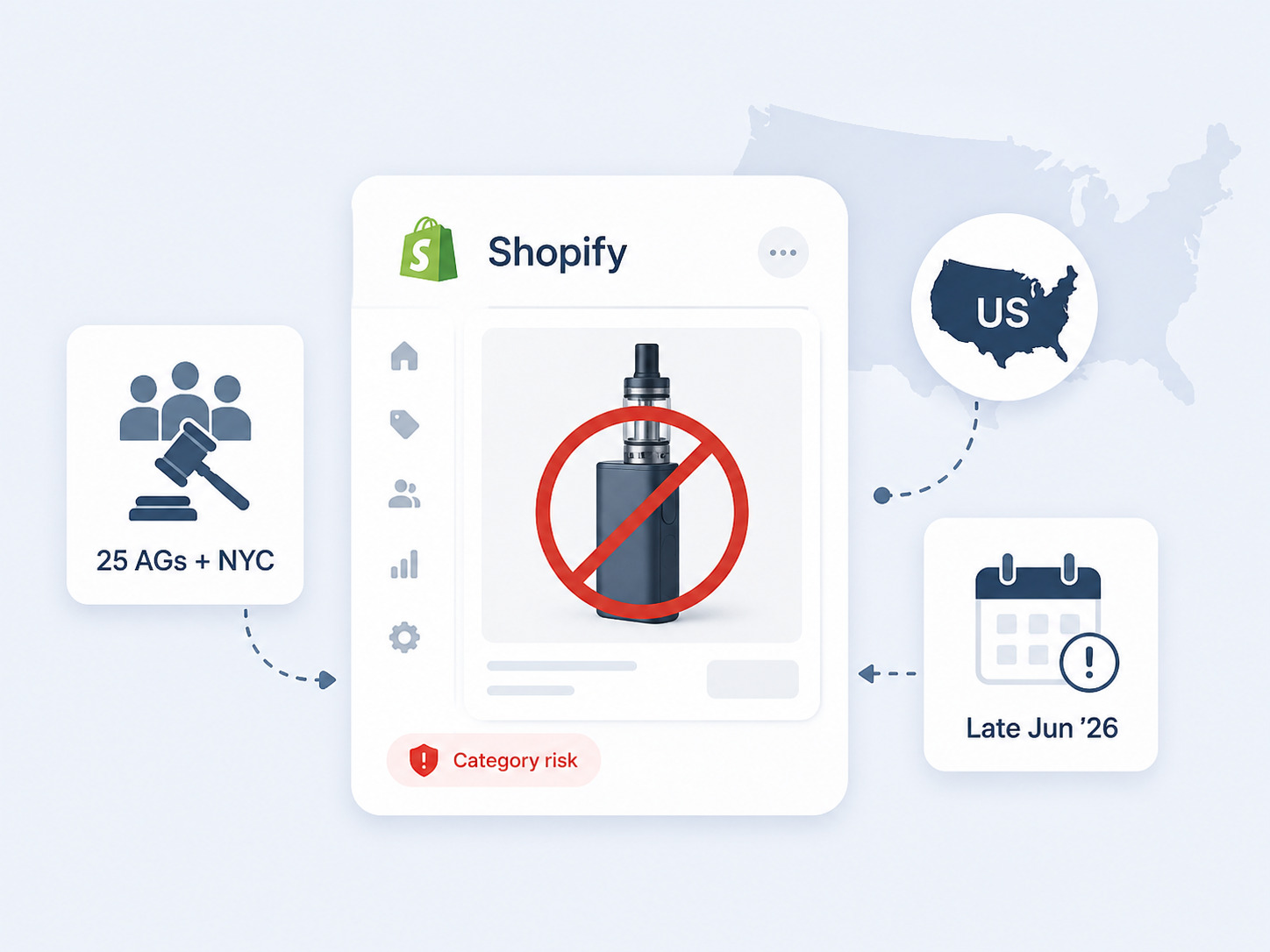
In one of the year's most significant policy moves, Shopify confirmed in late June that it's banning all vape and e-cigarette sales from its platform in the US — including FDA-authorized products.
This wasn't a quiet rule change. According to the Minnesota Attorney General's office — with parallel statements from Massachusetts and Connecticut — the ban followed sustained pressure from a bipartisan coalition of 25 state attorneys general and the City of New York, who had written to Shopify in November 2025 demanding stronger protections against illegal e-cigarette sales reaching minors.
For most merchants this is a non-event. But it's a reminder worth keeping in mind: the platform you build on can change what you're allowed to sell, sometimes on short notice, and in response to legal and regulatory pressure rather than business logic. Building on someone else's marketplace always carries that category risk.
Read more: 10 Shopify Product Page Mistakes That Are Killing Your Conversions
Other Shopify news worth knowing
A few smaller developments rounded out the half:
Shop Pay kept expanding. Beyond AI platforms, Apple Pay became an option inside Shop Pay, and Buy Now, Pay Later reached new markets.
A new Agentic plan launched. Shopify added an entry-level tier built for AI-first selling: upload a catalog, get syndicated into AI chat interfaces, no full storefront needed.
The Reddit verdict was split. Across merchant communities on Reddit and beyond, the comments divided predictably — excitement about free native A/B testing and the AI tools, anxiety about the Scripts deadline and the platform's growing complexity, and ongoing debate over whether the AI-everywhere bet pays off or just adds noise. As always, the reviews depend on how big your store is and how much you relied on what changed.
What it all means for your Shopify store
Step back, and the first half of 2026 tells one clear story. Shopify is folding the app ecosystem into the core platform (A/B testing, merchandising, and checkout customization all went native), betting its future on AI-driven discovery, and modernizing its plumbing even when that means breaking changes.
The merchants who win from here will be the ones who keep their data clean, their customizations on supported frameworks, and their store fast enough to convert the new traffic AI starts sending their way.
That last point is where your post-click experience still does the heavy lifting — no AI channel or agentic storefront makes you money if the page a shopper lands on is slow or cluttered. Wherever you send your traffic, a fast, conversion-built funnel matters. Tools like Funnelish for Shopify, exist to turn those hard-won visits into higher-value orders — a useful complement to whatever Shopify ships next.
Because if the first half of 2026 is any guide, the second half won't be quiet either.
Table of contents
Boost your eCommerce
sales today

24/7 support
No credit card required
Cancel anytime
24/7 support
No credit card required
Cancel anytime
