

Best Shopify AI Tools for Sellers in 2026
31 March 2026
Anna P.
12 minutes
The conversation about Shopify AI has moved well past "Is this useful?" into something more specific: which tools genuinely reduce the workload, which ones solve real problems in your online store, and which are marketing dressed as capability.
This guide covers both the native AI built directly into the Shopify admin and third-party tools worth adding to your stack — organized by the problems they solve for sellers who want to spend less time on tasks and more time on growth.
What Shopify Has Built In
Before spending on third-party apps, it's worth understanding how much AI Shopify now includes by default for free. The answer is more than most merchants have explored — and the setup requires no design skills, no design expertise, and no code.
Shopify Magic
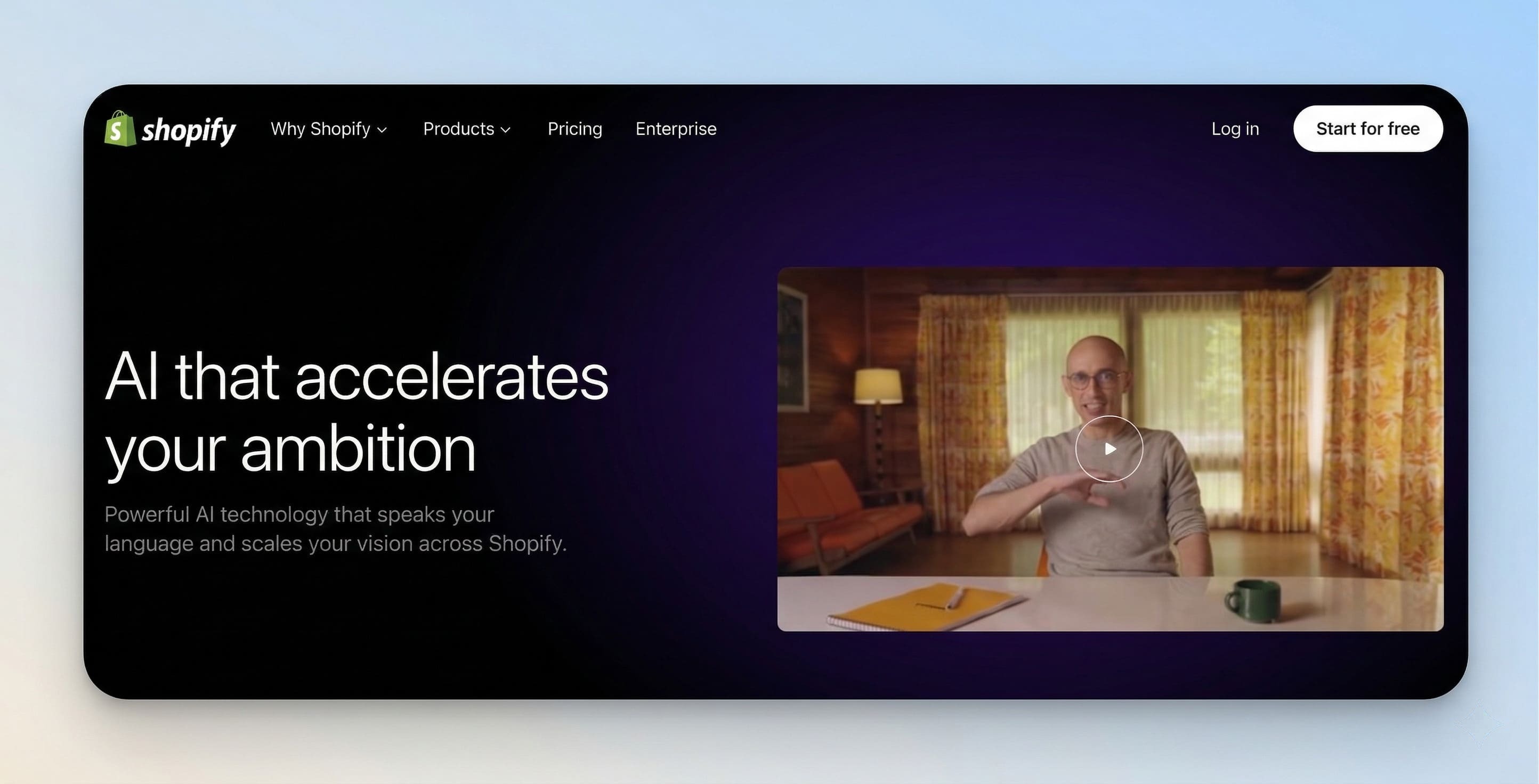
Shopify Magic is a collection of free, AI-powered features integrated into the Shopify admin, available to all Shopify merchants regardless of their subscription plan, covering text generation, image editing, and product photography.
Magic shows up wherever you're creating content inside the Shopify admin — look for the stars icon. The core features:
Product Description Generation
You provide a few details about a product — name, key features, target customer — and Magic generates a conversion-optimized description. The AI uses context from your store to keep output aligned with your brand. If you're managing hundreds of SKUs and want to start selling faster without writing each description from scratch, this feature changes the economics of building a product catalog.
Language Support for Global Selling
Shopify Magic AI content features support English, German, Spanish, French, Italian, Japanese, Portuguese (Brazilian), and Chinese (Simplified). This is specifically for AI-generated content. For how many languages your Shopify store can sell in overall, the answer is broader: all plans from Basic and above allow up to 20 languages from a single store using the free Translate & Adapt app.
For merchants expanding into new markets, Magic handles the AI content generation in supported languages while the store's translation layer covers the full range.
AI Image Editing and Product Photography
Magic can generate new backgrounds, match existing ones, or create a minimal look — delivering professional-grade product photography results without a photo studio or design expertise. This is genuinely useful for brands that can't invest in commercial photography for every product, and for testing different visual treatments on ads before committing to a full shoot. No design skills required — describe what you want and generate it.
Email Subject Line Generation
Available inside Shopify Email with no additional apps or setup. AI-optimized subject lines increase open rates by 10–15% on average, which feeds directly into click-through rate and sales. A consistent lift across every email campaign compounds meaningfully over time.
Shopify's Native AI Store Builder
Shopify has its own dedicated AI store builder tool available, which generates a professionally designed, fully written online store instantly from a description of your business — ready to start selling with no setup required.
This is the fastest path from zero to a live Shopify store if you have no design skills and don't want to start with a blank theme. You describe your business, the AI generates a store structure with a homepage, product pages, and copy, and you start from something complete rather than something empty. It won't replace deliberate brand-building or conversion optimization — but as a starting point, it collapses what used to take days into minutes.
Sidekick — AI Assistant Built Into Your Shopify Admin
Sidekick is Shopify's conversational AI assistant — a chat interface that lives inside the Shopify admin, understands your specific store's data, and can both answer questions and take action.
Sidekick is trained to know all of Shopify and is designed to operate within the context of each merchant's shop. As new content is added and actions are taken, Sidekick takes these into account as it generates suggestions or completes tasks.
This is the distinction that matters: Sidekick isn't a generic AI chat tool answering generic questions. It's an AI assistant with access to your actual store's context — your sales data, your customers, your inventory, your orders. You can ask it why your conversion rate dropped last Tuesday and get an answer based on your real numbers. You can ask it to create a discount code, set up a Shopify Flow automation, analyze patterns in your sales data, or generate marketing campaign copy — all through a plain-language conversation in your browser, no navigation required.
Sidekick can create workflows and automations using Shopify Flow via text input — for email notifications, stock alerts, or customer classifications — without any technical know-how. It can also generate simple internal tools like product importers, report generators, or inventory aids that run directly in the Shopify admin.
The most recent and significant Sidekick development: Shopify released the developer preview of Sidekick App Extensions in the Winter '26 Edition — allowing apps to expose their data and functionality to Sidekick so it can surface insights, answer questions about app context, and navigate merchants to the right screens inside those apps. This is the beginning of Sidekick being useful across your app stack, not just Shopify's native features.
Shopify Magic and Sidekick can save an average of 5–10 hours per week for solo store owners and small teams, representing $250–500 in weekly productivity gains at a $50/hour effective rate — with both features included free in every Shopify subscription.
Agentic Storefronts — AI Shopping as a Sales Channel
This is the newest and most strategically significant AI feature Shopify has shipped, and the one most worth enabling immediately.
Agentic Storefronts is a new sales channel that lets your products appear in AI assistants like ChatGPT, Perplexity, and Microsoft Copilot. Shoppers can discover and complete purchases through AI conversations. To enable it: activate Agentic Storefronts as a sales channel in your Shopify admin. Shopify's Universal Commerce Protocol, co-developed with Google, syndicates your product catalog to AI platforms automatically — no code, no complex setup, no additional file management required.
Stores not yet linked into AI shopping experiences are being discovered by fewer shoppers over time as AI-assisted search grows. This is not a feature to defer.
Best Third-Party AI Tools to Connect to Your Shopify Store
These are the tools that fill gaps Shopify Magic doesn't cover — from ad creative to analytics to customer support. Each solves a distinct problem.
ChatGPT (OpenAI)
The general-purpose AI layer that most Shopify sellers underuse. ChatGPT is the right tool for writing tasks Shopify Magic doesn't cover natively: blog post drafts, ad copy variations, email sequence planning, policy pages, FAQ content, and competitive research. It won't connect to your Shopify admin without a plugin, but as a thinking and writing partner alongside your store, it saves real time on the tasks you do repeatedly.
The more practical use case is structured prompting. Build a template prompt for each content type you produce regularly — describe your product, your target customer, your brand voice — and reuse it consistently. This produces better output than starting from scratch each time and is particularly useful when generating content at scale across a large product range.
Pricing: Free plan available. Plus at $20/month. Pro at $200/month.
Midjourney
Midjourney is most effective for concept ideation, mood boards, and ad creative testing rather than as a replacement for professional product photography. AI-generated images work well for social media content and ad testing, but shoppers expect real product photos on product pages.
The practical use case for Shopify sellers: test ad creative before committing to a photo shoot. Generate multiple visual directions for an ad concept in Midjourney, identify which one drives clicks, then invest in the photography that converts. This reduces the cost and risk of creative testing significantly — you're not guessing at which visual approach will work by the time you shoot.
The limitation: Midjourney's Discord-based interface is not beginner-friendly and has a learning curve. If you don't have design expertise, Canva's AI tools are a more accessible entry point that integrates better into a shop workflow.
Pricing: From $10/month (Basic, 200 image generations). $30/month (Standard, unlimited relaxed generations).
Canva AI
Canva's AI features have become the default solution for creating professional store visuals — not just for generating images, but for creating collection banners, ad creatives, email headers, and social content that looks on-brand without a designer or agency.
The AI features most useful for Shopify sellers: Magic Design (generate complete layouts from a prompt or reference image), Magic Write (generate copy for ad creative and banners), and the background remover for product images. Canva's brand kit feature is particularly useful — upload your fonts, colors, and logo once, and every AI-generated asset defaults to your brand identity automatically. No design expertise required, and the output connects to your visual assets.
Pricing: Free plan available. Pro at $15/month with full AI feature access.
Triple Whale
Triple Whale is an AI-powered ecommerce analytics and attribution platform commonly used by D2C brands to understand customer lifetime value, customer acquisition cost, and marketing efficiency across channels.
The core problem it solves: Shopify's native analytics show you what happened in your store, but they don't show you where your profitable customers actually came from or which ad campaigns are generating real margin versus vanity metrics. Triple Whale pulls your ad spend, Shopify revenue, and attribution data into a unified view, and its AI features surface patterns that standard reporting misses.
The platform is most valuable for sellers spending $5,000+/month on paid ads. Below that threshold, Shopify's native analytics plus Google Analytics cover most needs. At a meaningful ad scale, the clarity on attribution — which campaigns, which creatives, which audiences are generating actual profit — is worth the cost.
Pricing: From $149/month. Custom pricing for higher-volume stores.
Gorgias
Gorgias is an e-commerce-focused helpdesk with AI-assisted replies that integrates deeply with Shopify and is commonly used to augment human support teams rather than fully automate resolution.
Gorgias connects to your Shopify store so that when a customer contacts support, the AI assistant or human agent immediately sees their order history, shipping status, and previous conversations — without switching tabs or importing data from another system. The AI auto-responds to common queries — "Where is my order," "How do I return this" — and escalates anything requiring human judgment with full context attached.
If you're receiving more than 20–30 support tickets per day, the time saved on context-switching alone is significant. For smaller stores with lower support volume, Shopify Inbox, combined with Sidekick handling basic questions, is often sufficient without adding another platform.
Pricing: From $10/month (Starter). $104/month (Basic) for growing stores. Custom pricing at scale.
Klaviyo
Klaviyo is the most widely used AI-powered email and SMS marketing platform in the Shopify ecosystem, and its AI features have expanded significantly. Klaviyo's predictive segmentation and behavioral signals are commonly used for abandoned cart recovery, post-purchase messaging, and retention flows that drive repeat purchases.
What makes Klaviyo's AI features valuable in practice is that the platform uses purchase history and browsing behavior to predict which customers are likely to buy again and when — making it possible to target re-engagement campaigns at the right moment rather than sending the same message to your entire list. AI-generated subject lines and send-time optimization compound across every campaign and flow.
Klaviyo's predictive analytics pays for the platform cost many times over. It also connects to Funnelish's funnel and checkout events — meaning any action in your funnel can trigger a Klaviyo flow, from a quiz completion to a post-purchase upsell, creating a closed-loop retention system without external automation tools.
Pricing: Free up to 250 contacts. Scales with list size from approximately $20/month.
Jasper
Jasper is purpose-built for marketing copy — not general writing, but the specific content that drives sales: ad copy, email campaigns, product page copy, and landing page text at scale. Its brand voice feature learns your company's tone from existing content and applies it consistently across every piece of output it generates.
The use case where Jasper outperforms generic AI is large-scale content production, where brand consistency matters, and speed is the constraint. If your team is writing dozens of ad variations, seasonal campaign copy, or collection page descriptions every month, Jasper's templates and voice training produce more consistently on-brand output than prompting a general assistant each time and manually reviewing for tone.
Pricing: From $59/month.
What AI Does and Doesn't Solve
AI tools for Shopify are valuable for content production, time savings on admin tasks, and surfacing patterns in your data. What they don't solve is the conversion problem — getting traffic to your online store is one challenge; converting that traffic at a rate that makes the economics work is a different problem that no AI content tool addresses directly.
A product page with AI-generated descriptions still needs to load fast, present a frictionless checkout experience, and have a post-purchase upsell strategy that increases average order value without requiring more ad spend. That's a conversion infrastructure problem that lives at the intersection of page speed, checkout design, and funnel architecture.
This is where platforms like Funnelish complement a well-configured Shopify store. The AI tools in this list help you create better content, understand your data, and manage customer relationships more efficiently. Funnelish's page builder, sub-second load times, and post-purchase upsell capability address what happens between a customer clicking an ad and completing a purchase — the part that determines whether all that AI-optimized content and targeting generates profit or just traffic.
The most effective Shopify AI stack isn't one tool. It's Shopify Magic and Sidekick handling the administrative layer inside your Shopify admin, Klaviyo managing retention, an analytics tool like Triple Whale giving clarity on what's working at the ad level, and a conversion flow built to turn traffic into buyers. Each solves a different part of the problem. None of them alone solves all of it.
Shopify AI FAQs
How much does Shopify AI cost?
Shopify Magic tools and experiences are currently available free to all Shopify merchants, regardless of their subscription plan. This includes product description generation, AI image editing, email content generation, and Sidekick. You pay for your Shopify plan — the AI features don't add to that cost. Third-party AI tools like Klaviyo, Triple Whale, and Gorgias have their own pricing on top of your Shopify subscription, starting from free tiers up to $100+/month depending on the platform and your store's scale.
How do I build my Shopify store with AI?
Shopify's built-in AI store builder features can generate a store structure, product descriptions, and basic page content from a description of your business — no design skills or code required. For more specific setup — theme customization, collection structure, policy pages — Sidekick guides you through configuration in plain language inside the Shopify admin, accessible from your browser without navigating complex menus.
For conversion, funnel platforms like Funnelish let you design landing pages and checkout flows without code, which matters when you're running paid traffic and need every page element to be deliberate and fast.
Will AI help you create a successful Shopify store?
AI tools will help you launch faster, generate content at scale, and analyze patterns in your data more clearly. They won't replace product-market fit, a genuine marketing strategy, or the conversion infrastructure that turns visitors into buyers who complete purchases. The stores that use AI most effectively treat it as leverage for the work that already needs to be done — not as a solution to the strategic decisions that determine whether a store succeeds.
The content Shopify Magic generates still needs to speak to real customer problems. The data Triple Whale surfaces still needs a human to interpret and act on.
Which AI is best for Shopify?
For sellers just starting to build an online store, Shopify Magic and Sidekick cover the most ground for zero additional cost — they're integrated directly into the platform and require no setup beyond what's already there by default. For stores generating meaningful revenue, Klaviyo for customer retention and Triple Whale for ad attribution clarity are the two highest-ROI additions. For content production at scale, use ChatGPT or Jasper, depending on whether you need general-purpose capability or brand-consistent marketing copy.
The right answer is a stack, not a single tool — each AI tool solves a different piece of the problem, and skipping conversion optimization means the content and targeting work sits on top of a checkout experience that isn't optimized to close it.
Table of contents
Boost your eCommerce
sales today

24/7 support
No credit card required
Cancel anytime
24/7 support
No credit card required
Cancel anytime
