

Shopify Upsell Moments You're Missing — And Revenue That Goes With Them
13 April 2026
Anna P.
12 minutes
Here's a number worth sitting with: customer acquisition costs have risen 222% over the past eight years across D2C ecommerce. (Business Wire) The customer you paid $45 to acquire last year cost $22 five years ago. The one you'll pay $60 for next year costs $45 today.
Many stores respond to this by trying to reduce CPA. Better creative, sharper targeting, lower CPMs. All valid. But there's a faster lever: increase what each customer spends after they've already decided to buy.
This is what a Shopify upsell strategy does. Not by finding new customers. Not by running more ads. By capturing revenue from the customers you've already paid to acquire, at the exact moments in their purchase journey when they're most likely to say yes.
The opportunity is significant. Upselling delivers as much as 10–30% revenue growth for businesses that implement it effectively. For a store doing $80,000 per month, that can be an additional $8,000–$24,000 without touching ad spend, targeting, or creative. The customers are already there. The question is whether the upsell infrastructure is in place to capture what they're willing to spend.
Why Shopify Stores Leave Upsell Revenue Uncaptured
The default Shopify setup is designed for transacting, not for maximizing revenue per transaction. A customer lands on a product page, adds to cart, checks out, and lands on a thank you page. Every stage of that customer journey is designed to complete the purchase — none of it is designed to increase the purchase.
This creates three specific gaps where upsell revenue disappears:
Product page gap: a customer lands on your product page already convinced they want to buy. They haven't committed yet, so they're open to upgrading or adding complementary products — but there's no upsell mechanism to capture that. They click add to cart at the price they arrived with.
Cart drawer gap: the customer is one step closer to checkout. They're more committed than they were on the product page, slightly more resistant to new additions, but still responsive to a well-framed cart upsell that feels like a natural completion of the purchase. Without a cart upsell configured, this moment is wasted.
Post purchase gap: this is the biggest one. The customer has just paid. Their payment details are already entered. Their buying decision is already made. They're at the highest point of purchase confidence they'll ever be — and the standard Shopify thank you page does nothing with it. No upsell offer, no cross sell, no order bump. The transaction ends at whatever the customer decided to spend, and the highest-intent moment in the customer journey is completely unused.
According to various sources, the average upsell acceptance rate in ecommerce is 4–8% with properly targeted offers, with pre-purchase upsells converting at 2–5% and post purchase upsells at 10–15%. (Cart-X) Small percentages — but against the total order volume of a store doing real paid traffic, even a 5% acceptance rate on a $25 add-on adds meaningful revenue with no additional customer acquisition cost.
Three Upsell Moments That Boost Revenue
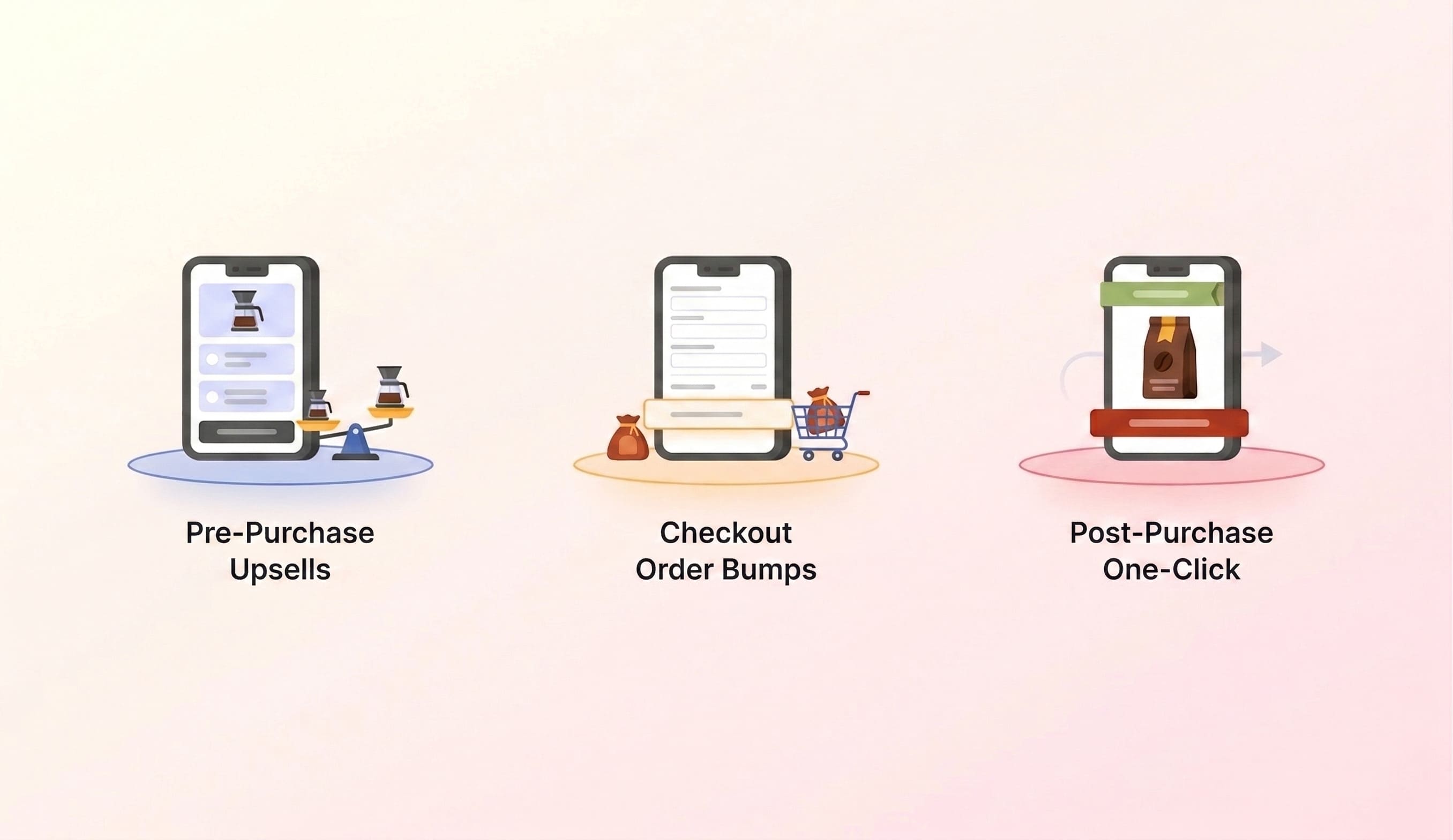
Every upsell strategy on Shopify operates across three distinct timing windows. Each has different mechanics, different customer psychology, and different expected acceptance rates. The stores generating consistent upsell revenue aren't using one of these — they're using all three in sequence.
Before Purchase: Product Page and Cart Upsells
Pre-purchase upsells work because the customer is actively evaluating. They're on your product page, considering their options, in a state of comparison. This is the ideal moment to present an upgrade — a larger size, a premium version of the same product, a quantity discount that makes buying three a better deal than buying one.
The framing matters. "Upgrade to our 3-month supply and save 20%" outperforms "Buy more" because it gives the customer a reason that's about them, not about your revenue. The upgrade feels like a service rather than a sales pitch.
Cart upsells work differently. The customer has committed to buying — they've added to cart and are moving toward checkout. At this point, quantity breaks and complementary products convert better than upgrades because the customer's primary decision is already made. Adding a $15 accessory to a $60 product in the cart drawer feels low-stakes relative to the purchase they've already committed to.
Let's say you're a coffee equipment store offering a grinder with every espresso machine purchase in the cart drawer. You aren't asking for a new decision — you're completing a natural product combination the customer was probably going to make eventually anyway. The bundle offer brings it into this transaction instead of a separate one.
Read more: 10 Upsell Strategies from Top Brands to Scale Profitably
At Checkout: Order Bumps
Order bumps are the checkout-stage equivalent of the item next to the register. A single checkbox or one-click addition presented inside the checkout flow — after the customer has entered payment details but before they confirm — converts at rates that might surprise you precisely because of how little friction they create.
The psychology: the customer is already in payment mode. Their credit card is out (metaphorically). Adding $12 to an $85 order they've already committed to requires almost no additional decision-making — the primary decision is done, and the add-on feels trivial in comparison. This is the door-in-the-face principle working in your favor: the big ask (the primary purchase) has already been accepted, making the small ask (the order bump) feel easy.
For example, a skincare brand selling a vitamin C serum with a $12 travel pouch as a checkout order bump can convert at meaningful rates not because the pouch is remarkable, but because the moment is right. The customer is already buying. The addition is obvious. The price is low. The friction is near zero.
After Purchase: Post-Purchase Upsells
Post-purchase upsells appear after checkout but before the thank you page. Since payment is already completed, the customer can add another product with one click, without re-entering their details. This is the moment of peak buying confidence — the purchase is done, the customer is satisfied, and they're still in an active buying mindset.
If you increase AOV by 22% after deploying automated post-purchase upsell flows, your monthly upsell revenue will reach $28,400. This is what Funnelish can help deliver. After a customer completes a purchase through a Funnelish funnel, a post-purchase upsell offer appears before the thank you page — one click to accept, no re-entering payment information, no new checkout. If the customer declines, a downsell fires automatically at a lower price point before they reach the thank you page.
The whole sequence is configured once and runs on every order without manual intervention. Every upsell accepted syncs automatically to Shopify alongside the original order — same fulfillment, same inventory tracking, same operational backend.
Upsell vs. Cross-Sell: When to Use Each
The terms get used interchangeably but they serve different purposes and perform differently at different points in the customer journey.
An upsell relates to the same product or category — a premium version, a larger quantity, an extended package of what the customer is already buying. It works best pre-purchase, when the customer is still evaluating their options and can be persuaded that more is worth the additional cost. Anchoring a product with a higher reference price can increase perceived value by as much as 30% and boost purchase intent. Showing the premium option alongside the standard one on the product page does this naturally.
A cross-sell introduces a complementary product from a different category — something that enhances or completes the primary purchase rather than replacing it. Cross-sells work best post purchase, when the customer has already committed to the hero product and is most open to additions that make it more complete.
Example: A customer buying a yoga mat is in decision mode about yoga mats — an upsell to the thicker premium mat makes sense on the product page. A cross-sell to a yoga strap or foam block makes more sense post purchase, once the mat decision is locked in and they're thinking about the practice they're going to build around it.
The customer journey benefits from both: upsells maximize the value of the hero product decision; cross-sells build the natural ecosystem around it and increase average order value through product combinations the customer was likely to make eventually anyway.
What Upsell Acceptance Rates Look Like in Practice
Numbers without context mislead. Here's what realistic upsell performance looks like at different store sizes:
A store processing 400 orders per month, average order value of $62, running a post purchase upsell at $24 with a 5% acceptance rate can generate 20 accepted upsells per month. That's $480 in additional revenue — $5,760 per year — from customers the store already paid to acquire. Zero additional ad spend. Zero additional traffic.
Scale that to 1,500 orders per month at the same acceptance rate and offer price: $36,000 per year in incremental revenue. The percentage sounds modest. The cumulative number doesn't.
AOV increase from product bundles often run 15–25% above single-product purchases. These are starter kits, complementary sets, and volume packs.
For a store whose customer acquisition cost on Meta is $38 — the 2025 median across all industries according to Triple Whale's benchmark data — an upsell strategy that increases AOV by 20% changes the unit economics completely. The customer acquisition cost doesn't change. The revenue generated per acquired customer does.
Building a Upsell Strategy That Runs on Autopilot
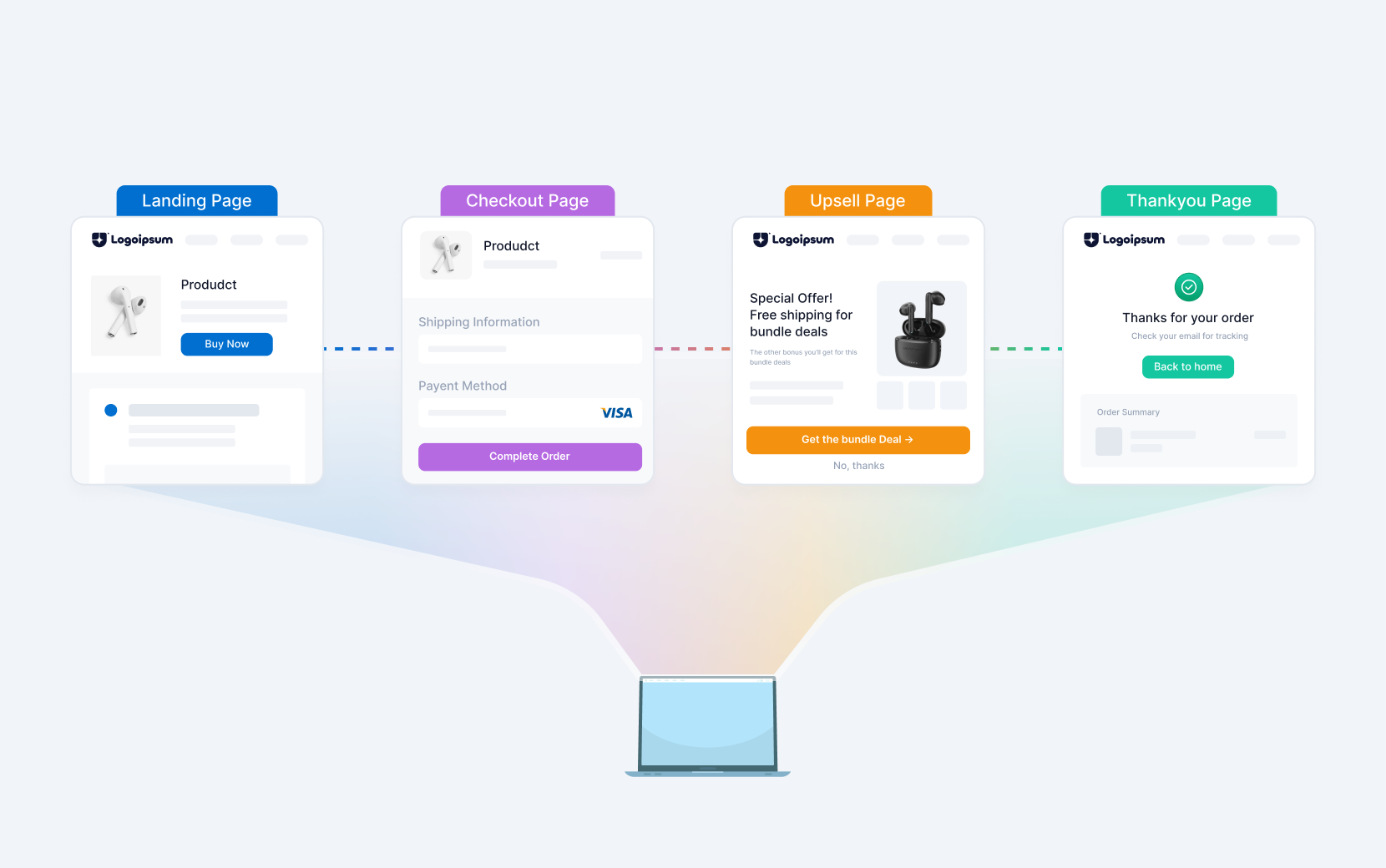
The goal of a well-structured Shopify upsell strategy is a system that captures revenue from the entire customer journey without manual intervention on every order. Here's how to build it.
1. Start with post-purchase
It's the highest-intent moment, which requires no pre-purchase friction, and it's where the gap between what stores are capturing and what they could be capturing is widest. Identify the most natural complementary product to your hero offer, set the upsell price at 30–60% of the primary product price, and launch with Funnelish's page builder in 1 day. Measure acceptance rate over 30 days before changing anything.
2. Add cart upsells second
Configure a cart drawer upsell or cart page upsell for complementary products that complete the primary purchase. Keep the offer relevant and the price low relative to what's already in the cart. The goal is a "Yes" that feels obvious, not a persuasion challenge.
3. Configure order bumps at checkout
Add a single, low-cost, high-relevance add-on at the checkout stage. One checkbox, one clear benefit statement, one price. Don't add multiple order bumps — one well-chosen offer converts better than three competing ones.
4. Layer in cross-sell sequences via email automation
For customers who didn't take the post-purchase upsell, a follow-up email 48–72 hours after delivery — when the customer is using the product and most likely to think about complementary purchases — converts at rates that pure promotional emails don't approach. The framing is completion, not promotion: "You've been using the mat for a week — here's the strap most people add next."
Funnelish handles the post-purchase upsell and cross-sell infrastructure natively — the offer sequencing, the downsell automation, and the Shopify data sync happen without any additional tools or manual configuration. Abandoned cart sequences fire automatically for customers who reach checkout but don't complete, recovering high-intent customers who represent some of the highest-value upsell targets in your funnel.
Store analytics in Funnelish give you the data to make informed decisions about which offers are converting, which need adjustment, and where the biggest revenue gaps remain.
Upsell Offer Itself: What Makes One Convert
An upsell offer that converts well has three characteristics that poorly performing offers typically lack.
Relevance is non-negotiable
A customer buying a running vest doesn't need a blanket. They might need running socks, a fuel belt, or a hydration pack. The upsell offer that feels like a natural next step converts; the one that feels like a random addition doesn't, regardless of how the offer is priced or positioned. Use store analytics and purchase history data to identify what customers buy together, then formalize those frequently-bought natural product combinations as upsell offers.
Timing determines the frame of reference
The same product offered as a pre-purchase upsell, a cart upsell, and a post purchase upsell will convert differently at each stage because the customer's psychological state is different at each point. Pre-purchase upsells compete with the primary decision. Post purchase upsells don't compete with anything — the primary decision is done.
Price ratio affects acceptance more than absolute price
A $35 upsell on a $40 primary purchase feels like a major additional commitment. A $35 upsell on a $120 primary purchase feels like a natural addition. Keep upsell offers at 25–50% of the primary purchase price for the highest acceptance rates across most categories.
Revenue That's Already There
There's a version of your Shopify store that generates the same number of orders as it does today, acquires the same number of customers at the same customer acquisition cost, and produces meaningfully more revenue — not through growth, but through capture.
Every customer who completes a purchase without seeing a post purchase offer is revenue that walked out. Every customer who checked out without seeing an order bump is an order bump that didn't fire. Every customer who left the cart drawer without seeing a cart upsell was a conversion that could have been larger.
The upsell strategy doesn't change who buys. It changes how much they spend when they do — across the entire customer journey, at every moment where intent is highest and friction is lowest.
Start your free 14-day Funnelish trial →
Shopify Upsell FAQs
Can you do upsells on Shopify?
Yes — and the most effective way to do it is through a purpose-built funnel tool rather than patching individual upsell moments with separate apps. Funnelish handles the upsell sequence natively: post purchase one-click upsells fire immediately after checkout, downsells trigger automatically if the first offer is declined, and every accepted upsell syncs to Shopify alongside the original order.
What is the best upsell app for Shopify?
The best Shopify upsell app depends on where in the customer journey you need upsell coverage. For post purchase upsells integrated into a complete funnel with checkout optimization, abandoned cart recovery, and advanced analytics, Funnelish covers the full stack without requiring multiple separate apps. For stores that only need on-page upsell widgets within the Shopify theme, there are free plan and free to install options in the Shopify App Store — though they typically don't cover the post purchase moment where acceptance rates are highest.
What is upsell and cross-sell in Shopify?
An upsell encourages a customer to buy a premium version or larger quantity of the same product — it relates to what they're already considering. A cross-sell introduces a complementary product from a different category that enhances the primary purchase. Both boost average order value, but they operate differently: upsells work best pre-purchase when the customer is still evaluating; cross-sells convert best post purchase when the primary decision is locked and the customer is thinking about everything that goes with it.
Why should you upsell or cross-sell?
Because the most expensive part of generating revenue is acquiring the customer — and upselling captures additional revenue from that already-acquired customer at near-zero incremental cost. It is 5–25x more expensive to acquire a new customer than to increase revenue from an existing transaction. Every upsell that converts is revenue generated without a new ad click, a new landing page visit, or a new checkout. Over time, a working upsell strategy reduces dependence on paid ads by making each customer acquisition worth more.
Table of contents
Boost your eCommerce
sales today

24/7 support
No credit card required
Cancel anytime
24/7 support
No credit card required
Cancel anytime
