

Snapchat Ads in 2026: Guide for E-Commerce Brands
14 May 2021
Anna
8 minutes
Snapchat has quietly grown into one of the most engaged social media platforms online. With 956 million monthly active users and 483 million daily Snapchat users as of Q1 2026 — both up 5% year over year — Snap is no longer the scrappy messaging app it once was. It's now a full-screen, mobile-first advertising platform built for short videos, augmented reality, and direct-response performance.
If your ecommerce business sells to younger demographics, Snapchat advertising belongs on your shortlist. Let's walk through how Snapchat ads work today, what they cost, and how to make them pay.
How to run Snapchat ads
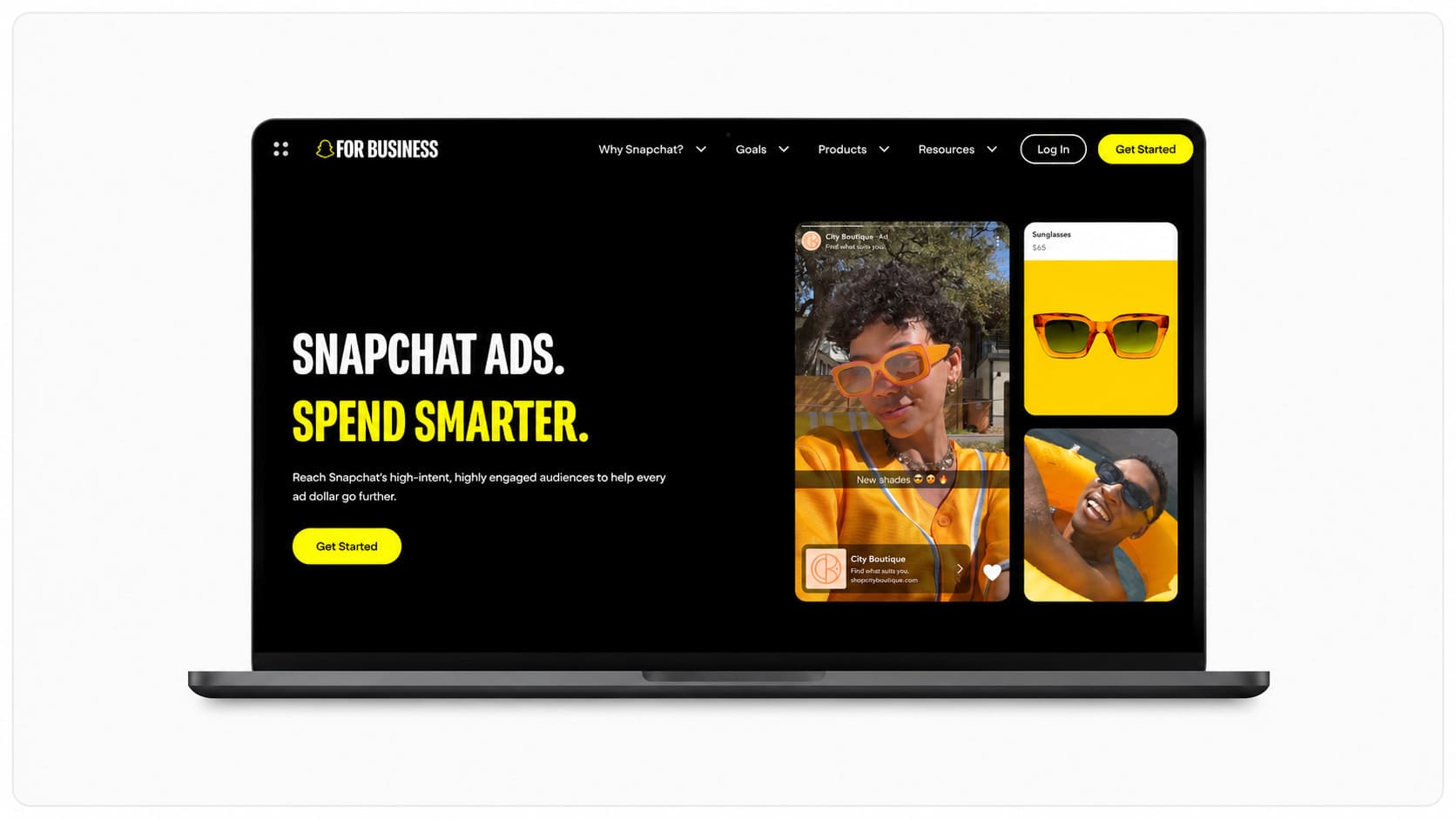
Launching hasn't changed much, even as the ad products have matured. There are four basic steps to run Snapchat ads:
Create an account in the Snapchat Ads Manager and set up your business profile.
Choose your campaign objective.
Define your target audience, schedule, and budget.
Upload your creative — the image or short video advertisement you want Snapchatters to watch.
The Ads Manager is where everything lives: building campaigns, managing ad spend, tracking campaign performance, and adjusting targeting on the fly. Before you spend a dollar, connect the Snap Pixel and the Conversions API. In a privacy-first era, this dual setup is what lets Snapchat measure sales accurately and use that data to optimize toward the consumers most likely to convert — running ads without it leaves performance on the table.
Snapchat advertising objectives and brand awareness campaigns
Every Snapchat ad campaign starts by picking a campaign objective, and Snap organizes these into three tiers that map to the funnel: Awareness, Consideration, and Conversions.
Brand awareness campaigns are designed to put your message in front of the widest possible audience and introduce your brand to new people. Consideration drives traffic, app installs, video views, and engagement. Conversions optimize for the lower-funnel actions that matter most — purchases, sign-ups, and add-to-carts. Choosing the right objective up front tells Snapchat's system who to show your ads to, so match it carefully to the result you want.
The biggest mindset shift in 2026 is that Snapchat is no longer just a brand awareness play. It has become a serious direct-response platform, and small and medium businesses now make up more than 30% of global ad revenue — Snap's largest growth driver for seven straight quarters. Even a modest budget can produce real sales here.
Snapchat ad formats and ad products
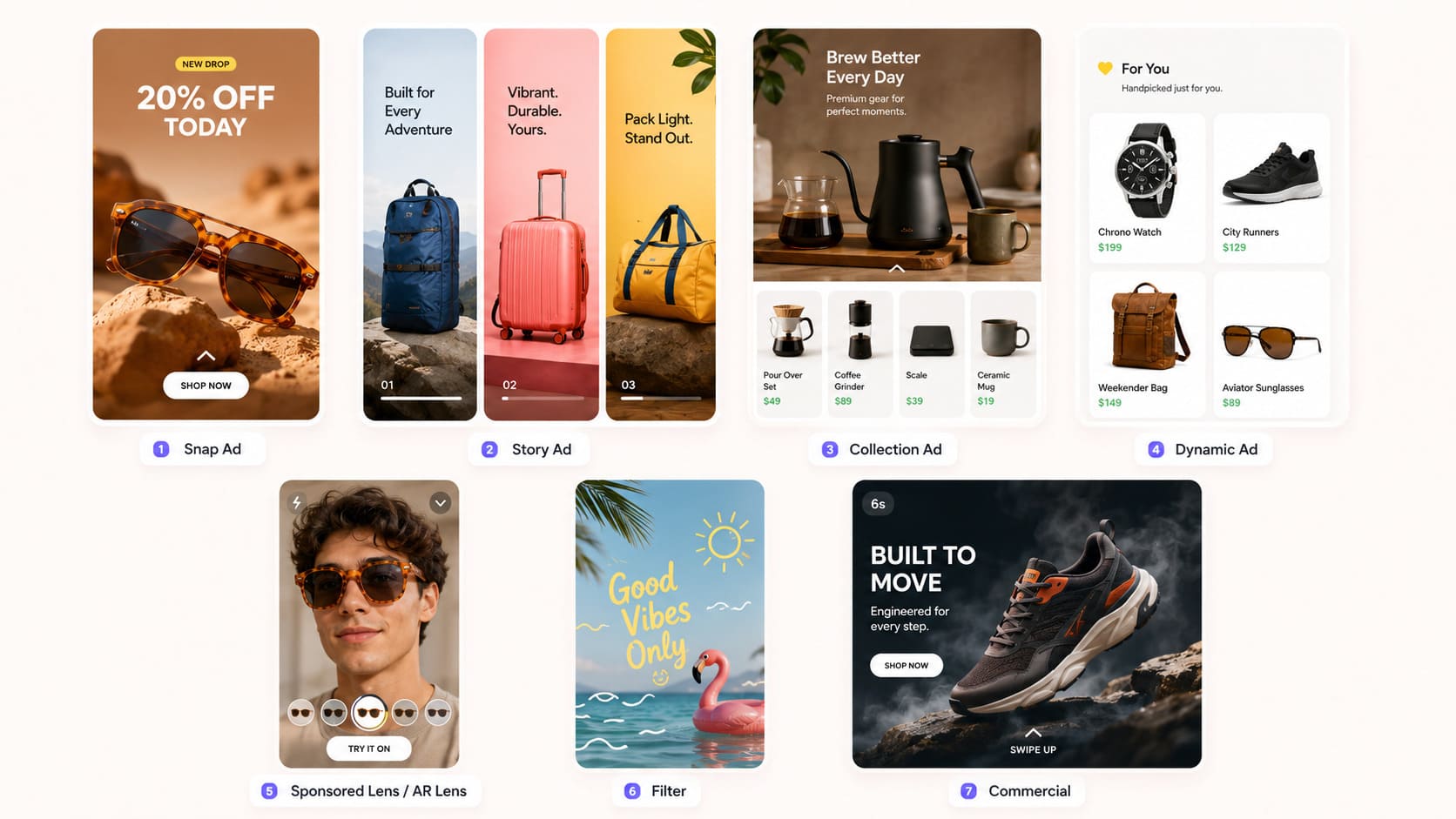
Snapchat offers a robust suite of ad formats, all built around a vertical, full screen 9:16 experience (1080 x 1920 px recommended). The right ad type depends on your goal:
Snap Ads — the foundational format: a single image or short video that appears between content as users watch Stories and Spotlight. The lowest-cost entry point and ideal for testing creative.
Story Ads — a branded tile in the Discover feed that expands into a sequence of snaps, great for visual storytelling and sharing more detail about your brand or product line.
Collection Ads — a hero video or image with four tappable product tiles underneath, letting users browse and tap straight to product pages without leaving the app. Built explicitly for e-commerce.
Dynamic Ads — these connect to your uploaded product catalog and automatically generate personalized ads at scale. As availability or pricing changes, the ads update themselves, so you skip the technical headache of building perfectly sized creative for every SKU. Perfect for retargeting browsers and large inventories.
Sponsored Lenses (AR Lenses) — interactive augmented reality experiences using Snapchat's facial recognition and rear camera. Users who engage with a Lens spend 20–30 seconds with your brand versus a few seconds for a standard video ad, and in 2026 shoppable AR Lenses can overlay product info and a "Buy Now" button right on the experience — a natural fit for cosmetic products and try-on moments.
Filters — branded overlays Snapchatters add to their own snaps; a fun, lightweight way to spread brand awareness around events and local promotions.
Commercials — non-skippable six-second video spots for premium reach.
Two newer formats deserve special attention. Sponsored Snaps bring brands into the Chat experience in a way that feels native — in Q1, nearly 75% of US Chat daily active users viewed ads in Chat, and about a third of that reach was unique to Chat, meaning genuinely incremental audience. And My AI Sponsored Links let advertisers surface relevant products inside conversations with Snapchat's AI chatbot, putting your offer in front of users at the exact moment they express intent.
Snapchat ad specifications and advertising policies
Like any platform, Snap has its own technical requirements and advertising policies, and you should always double-check them before you launch. The essentials: ads run vertically in 9:16, video should be MP4 or MOV, and lengths run from 3 to 180 seconds — though short videos under 10 seconds tend to perform best. A single image or video Snap Ad uses 1080 x 1920 px. Brand name (up to 32 characters) and a headline (up to 34 characters) are mandatory. Keep your logo and key text inside the safe zone so the interface doesn't clip them.
On content, Snapchat is a 13+ app, so your creative must be suitable for a younger audience. The platform protects its upbeat, fun feel and will reject anything intentionally graphic, scary, or shocking — even ad copy with words like "shocking" or "you won't believe" can trip automated flags. Deceptive elements like fake buttons that mimic the Snapchat user interface are banned outright.
Restricted categories such as alcohol, financial products, gambling, and health require extra disclosures and age-gating, and rules vary by region. Snap also banned all political and issue-based advertising in 2024, and that ban is still in effect. As always, Snapchat reserves the right to review every advertisement, so build a few days of review buffer into your timeline to avoid any compliance concerns.
How much do Snapchat ads cost
The barrier to entry is genuinely low. The minimum daily budget to run Snapchat ads is just $5, which makes it easy for new advertisers and small businesses to test the waters. Beyond that, ad spend scales with your goals — a Snap Ad costs a fraction of a premium Sponsored Lens, which can run into the hundreds of thousands for major brand activations.
As with any auction-based system, the price of your campaigns depends on your target audience and how much competition exists in that sphere. Typical CPMs (cost per thousand impressions) range from roughly $2.50 to $10 depending on targeting, format, and competition — affordable enough that Snapchat is one of the better platforms for rapid creative testing.
App-install campaigns are especially efficient, with cost-per-install benchmarks around $1.50–$4.00. The smart approach: start small, test one ad format and one audience at a time, and scale what works.
Are Snapchat ads worth it for e-commerce?
For the right brand, yes — and the data backs it up. Snap's total revenue hit $1.53 billion in Q1 2026, up 12% year over year, reflecting a company whose advertising model keeps improving. More telling for advertisers, an independent study by Measured found that median incremental ROAS on Snapchat grew 104% between two recent test periods — exactly the kind of external validation that encourages larger advertisers to move budget.
If your ideal audience skews toward Gen Z and millennials, Snapchat is hard to skip. Augmented reality is central to that engagement: Snapchatters used AR Lenses more than 9 billion times a day on average in Q1, with 75% engaging with AR daily. That's an exceptionally engaged audience you can connect with in interactive ways other platforms can't match. The honest framing isn't Snapchat or somewhere else — it's testing several platforms and finding where your products perform best.
Don't waste your clicks: where Snapchat traffic should land
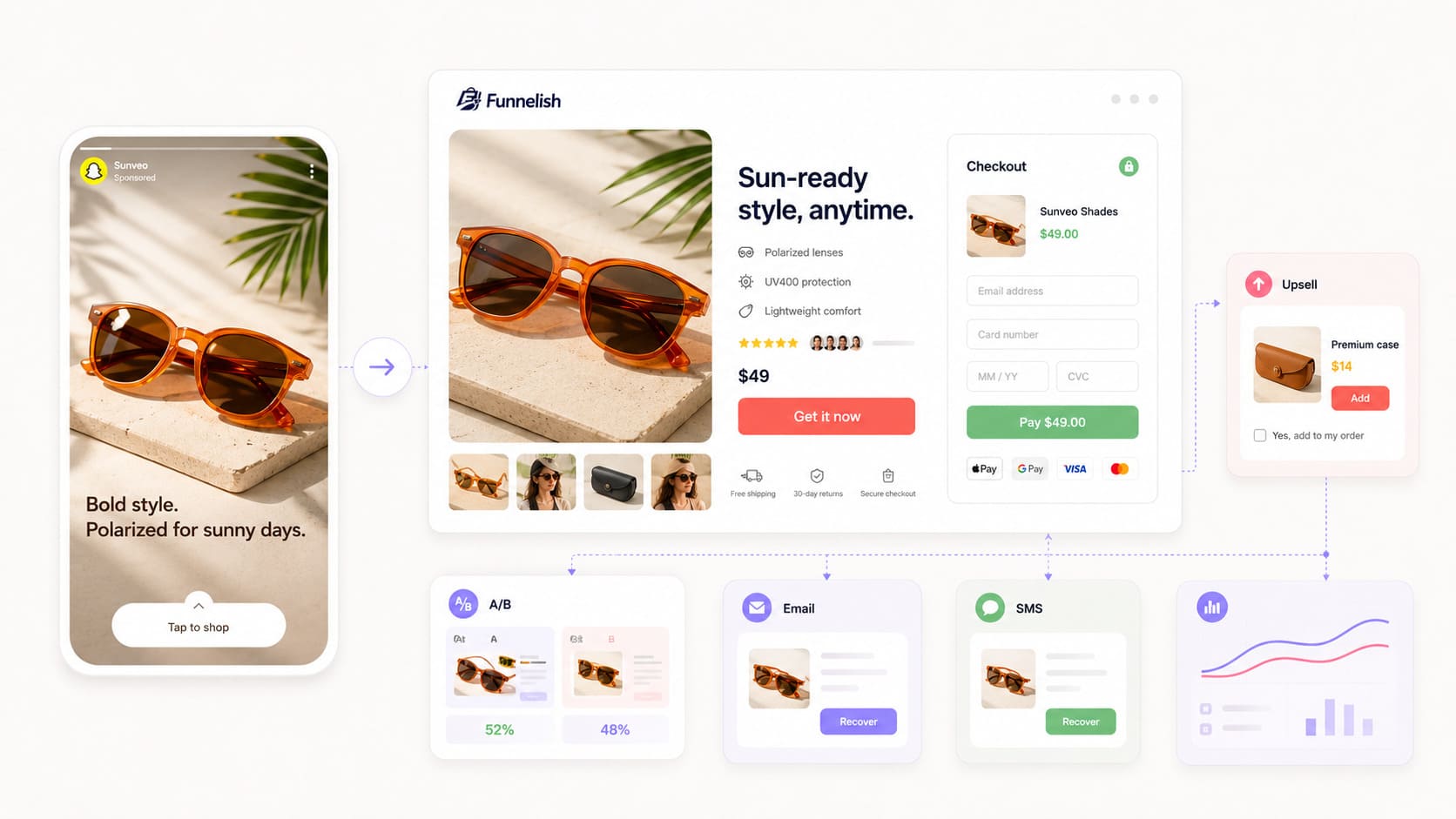
You can nail targeting, creative, and bidding, but if the swipe-up sends people to a slow or cluttered page, you've paid for the traffic and lost the sale. The post-click experience is where Snapchat ad spend either converts or evaporates.
Because Snapchat's audience is overwhelmingly mobile and impatient, speed matters more than almost anything. A dedicated landing page that loads in under a second keeps the visitor you just paid to acquire instead of losing them to a spinning loader. A purpose-built sales funnel also beats a generic product page because it focuses the visitor on a single offer — and with a drag-and-drop page builder, you can create a landing page, checkout, and confirmation flow that matches your ad's look and message without touching code.
From there, the goal is to make every click count. Order bumps and one-click upsells lift your average order value so campaigns stay profitable even as CPMs rise, and built-in A/B testing lets you pit two landing pages against each other to see which converts your Snapchat traffic better.
For the majority of shoppers who don't buy on the first visit, automated abandoned-cart emails and SMS recover sales from people who already showed intent — a natural complement to retargeting them with Dynamic Ads. And with funnel-level analytics tracking the whole journey, you can tie campaign performance straight to revenue instead of guessing where buyers drop off.
Match a fast, focused funnel to a well-built Snapchat campaign, and the platform's engaged, AR-loving audience turns into measurable sales.
Bottom line
Snapchat in 2026 is a mature, mobile-first advertising platform with nearly a billion monthly Snapchat users, a deep set of ad formats, and an audience that genuinely loves to engage — especially through augmented reality. The brands that win here match the right campaign objective to the right ad type, lead with creative built natively for a vertical full screen experience, and obsess over what happens after the swipe-up. Get the ad and the landing experience right, and Snapchat's young, active community becomes a reliable engine to promote products, drive traffic, and grow sales.
More:
Table of contents
Boost your eCommerce
sales today

24/7 support
No credit card required
Cancel anytime
24/7 support
No credit card required
Cancel anytime
