

How to Start Dropshipping on Amazon in 2026: A Step-by-Step Guide
24 June 2026
Anna P.
10 minutes
So you want to sell products on the world's biggest marketplace without buying inventory upfront? Good news — that's exactly what Amazon dropshipping lets you do, and in 2026 it's still one of the most accessible ways to start an ecommerce business. The dropshipping model is simple: sellers list products, a customer places an order, and your third-party supplier ships it straight to their door. You never buy inventory upfront or touch the product.
But starting a dropshipping business on Amazon requires strict adherence to Amazon's dropshipping policies, and breaking the rules gets your account suspended fast. The opportunity to make money dropshipping is real, though — according to Amazon's 2025 Small Business Empowerment Report, more than 75,000 independent sellers surpassed $1 million in sales in 2025, and U.S. sellers averaged more than $375,000 in annual sales.
That said, the average hides a big skew — seller earnings data shows most beginners realistically land in the $1,000 to $5,000 per month range as they scale, with roughly half of all sellers making $1,000 or less. This guide walks you through how to start dropshipping on Amazon the right way.
First, is dropshipping even allowed on Amazon?
Yes — drop shipping is allowed on Amazon if you follow its official Drop Shipping Policy to the letter. This is the part that trips people up, so let's be crystal clear about the non-negotiable rules:
You must be the seller of record. You appear as the seller on all packing slips and invoices — never your supplier.
Strip all supplier branding. Remove any third-party supplier branding from external packaging to prevent account suspension. If a supplier's packages arrive with another retailer's logo or invoice, that's a violation.
You handle returns and provide excellent customer service. The customer is yours, not the supplier's.
No retail arbitrage. Buying from another online retailer and having them ship to your Amazon customer violates Amazon's guidelines and can lead to account suspension.
Follow those four and you're compliant. And while we're on legality, our breakdown of whether dropshipping is legal in 2026 covers the tax and consumer-protection side that applies beyond your Amazon account too.
Step 1: Set up your Amazon seller account
Head to Amazon Seller Central and create your Amazon seller account. You'll choose between two selling plans, and the difference matters for your profit margins:
Individual plan: No monthly fee, but Amazon charges $0.99 per item sold. Fine for testing the waters.
Professional seller account: The Professional plan costs $39.99 per month flat, no per-item fee. This is the right call once you're selling more than ~40 items a month, and it unlocks bulk product listings, advertising, and eligibility for the Featured Offer (formerly the Buy Box) — the single biggest driver of more sales on Amazon.
You'll need your business details, an internationally chargeable credit card, a bank account for payouts, tax info (SSN or EIN), and a government-issued ID. Amazon verifies all of it, so have your documents ready. Also check whether your product category needs approval — health, beauty, and electronics often require sign-off before you can sell online.
Step 2: Understand the fulfillment method (FBM vs FBA)
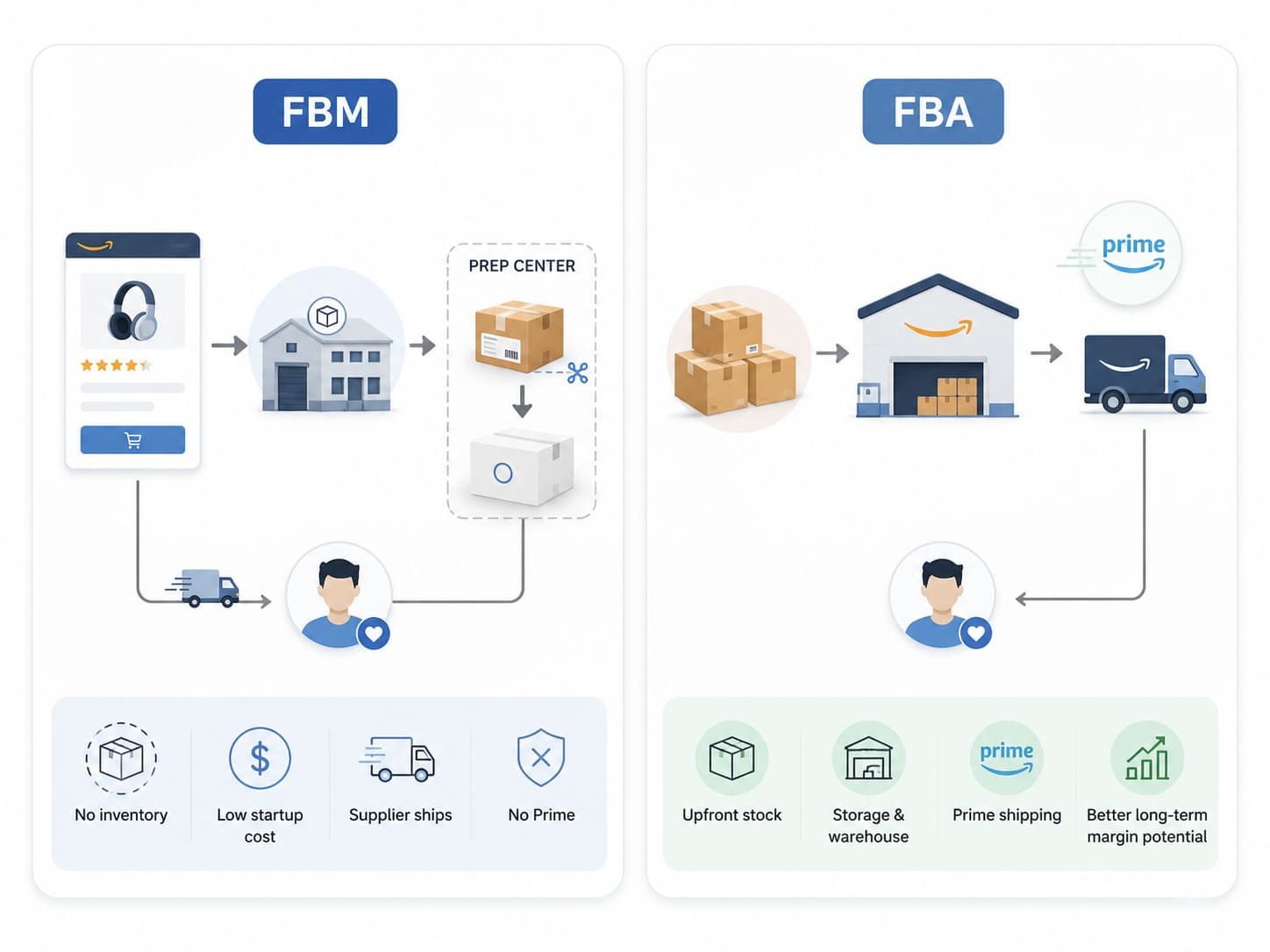
When you dropship on Amazon, traditional dropshipping runs through Fulfilled by Merchant (FBM) — meaning you (through your supplier) handle order fulfillment, not Amazon. This is the only fulfillment method that works for true dropshipping, because the alternative, Fulfilled by Amazon (FBA), requires you to buy inventory upfront and ship it to Amazon's warehouses.
Here's the quick trade-off. The dropshipping model has low startup costs with no inventory investment — you pay for products only after a customer orders. The downside is you don't get the Prime badge, and you're responsible for shipping products on time. FBA requires buying inventory upfront and holding it (plus storage fees, which rose again in early 2026 when Amazon ended its US FBA prep service), but offers faster Prime shipping and can improve profit margins over time.
For getting started without risk, FBM is your move. One pro tip: many Amazon dropshippers route orders through a prep center to ensure compliance with Amazon's policies — it strips supplier branding and repackages so your packing slips stay clean.
Step 3: Find reliable dropshipping suppliers
Your dropshipping supplier can make or break your business — literally. When a supplier ships late or includes their own invoice, it's your seller account that absorbs the damage. So learning to find suppliers who understand Amazon's standards is the most important operational decision you'll make, and supplier reliability is everything.
Here's how to vet reliable suppliers properly:
Build partnerships with authorized wholesale suppliers to guarantee high quality products and authenticity — counterfeit complaints are a fast track to suspension.
Choose suppliers familiar with Amazon's dropshipping policies, especially the seller-of-record and packaging rules.
Partner with suppliers who guarantee fast and reliable delivery to keep account health ratings high.
Check ratings and reviews before partnering, research suppliers online, and even attend trade shows.
Order samples to verify product quality before you sell anything.
Platforms like AliExpress and CJdropshipping are popular for product sourcing, and tools like Seller Assistant streamline sourcing so you can automate sourcing and vet candidates faster. US-based suppliers have surged in 2026 as sellers chase the faster domestic shipping US customers expect. That surge has a second driver worth knowing. The US ended its $800 de minimis exemption, so goods shipped direct from overseas now carry import duty they previously avoided, which makes US-based suppliers and US-warehoused stock more attractive on landed cost as well as on speed.
For a deeper breakdown of where to source and how to vet each platform, our guide to reliable dropshipping suppliers compares the best options one by one.
Step 4: Do your market research and find a niche
Don't just sell the same products as everyone else. The goal is to find low competition products with high demand — the sweet spot. Use Amazon's free tools like Product Opportunity Explorer for product research, gauge demand, study competitors, and find profitable dropshipping products that solve a problem or ride a trend. Solid dropshipping niche research up front saves you from burning money on items that were never going to sell.
A few examples that consistently perform for dropshippers: pet supplies (owners spend emotionally and repeatedly), phone cases and tech accessories (cheap to ship, always in demand), and home and kitchen gadgets. Print on demand is another low-risk route for custom products.
Whatever you pick, test products in small batches first, and lean toward items you can price for a real margin after Amazon's fees. If apparel tempts you, weigh it carefully — Amazon began applying returns processing fees to high-return categories like clothing in 2026, which can wipe out the profit from several sales with one return.
Read more: 14 Most Profitable Print on Demand Products to Sell in 2026
Step 5: Price for profit (and account for every fee)
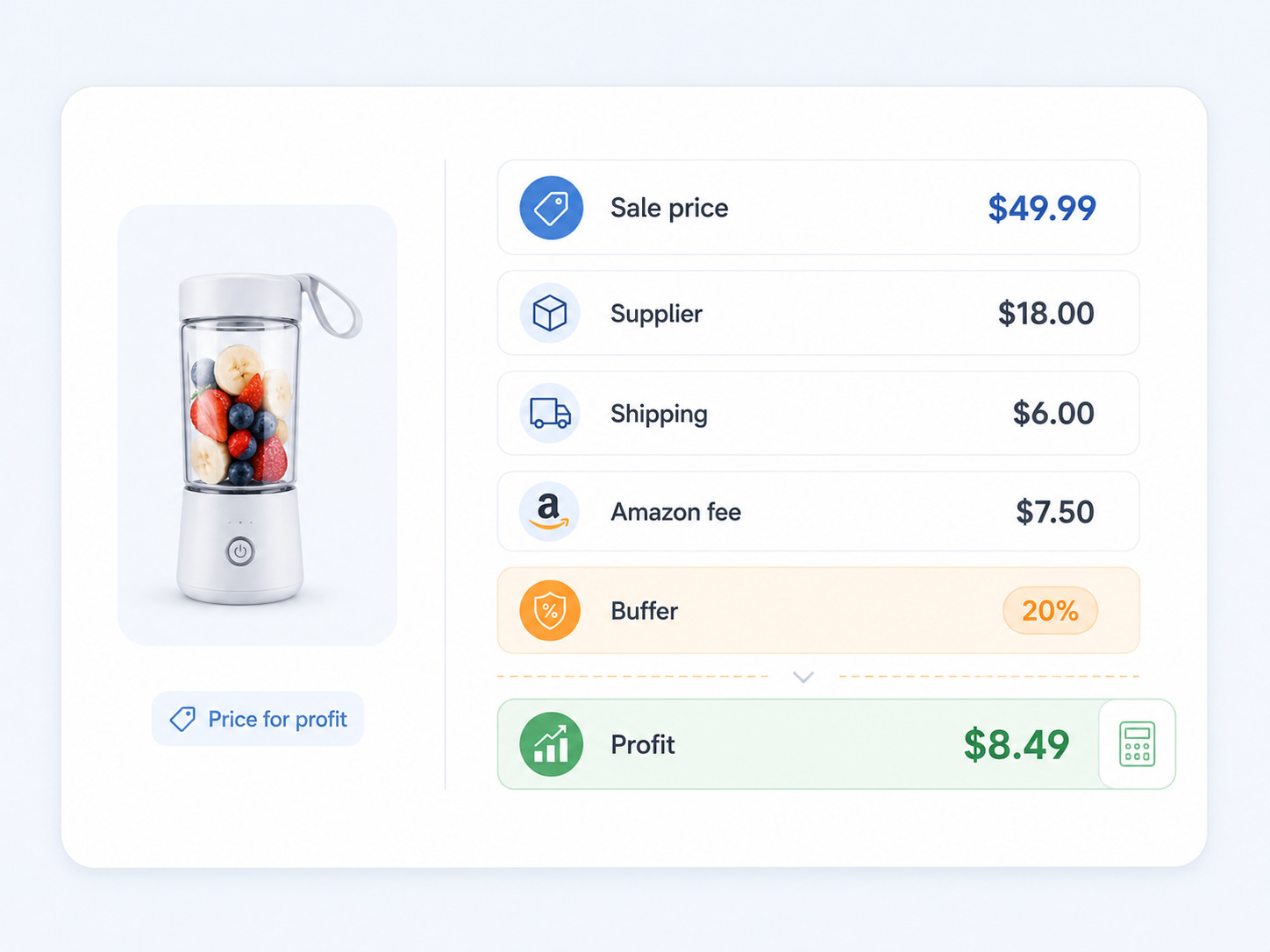
This is where dreams meet spreadsheets. Beyond your supplier cost and shipping costs, Amazon takes a referral fee on every sale — usually 8–15% depending on category, with a minimum fee of 30¢ per item. Add your monthly plan fee on top, and remember Amazon's fees can seriously dent profitability. There is one more cost to add to that stack in 2026 if you source from overseas. Since the US ended its $800 de minimis exemption, low-value parcels shipped direct from abroad now owe import duty that used to be waived, so your landed cost per unit is higher than the supplier's price alone. Fold that duty into the calculation before you set a price, the same way you account for referral and plan fees, or the margin you think you have will not survive contact with customs.
Carefully calculate profit margins using the Amazon Revenue Calculator before you list, and build an 18–20% buffer into your pricing to absorb fee changes, ad spend, and supplier price swings. Research competitors and set competitive prices so your selling price stays attractive, but never go so cheap that your retail price sells at a loss. The aim is competitive pricing that covers all costs and fees and still leaves profit — that's what makes an Amazon dropshipping business profitable.
Step 6: Create product listings that convert
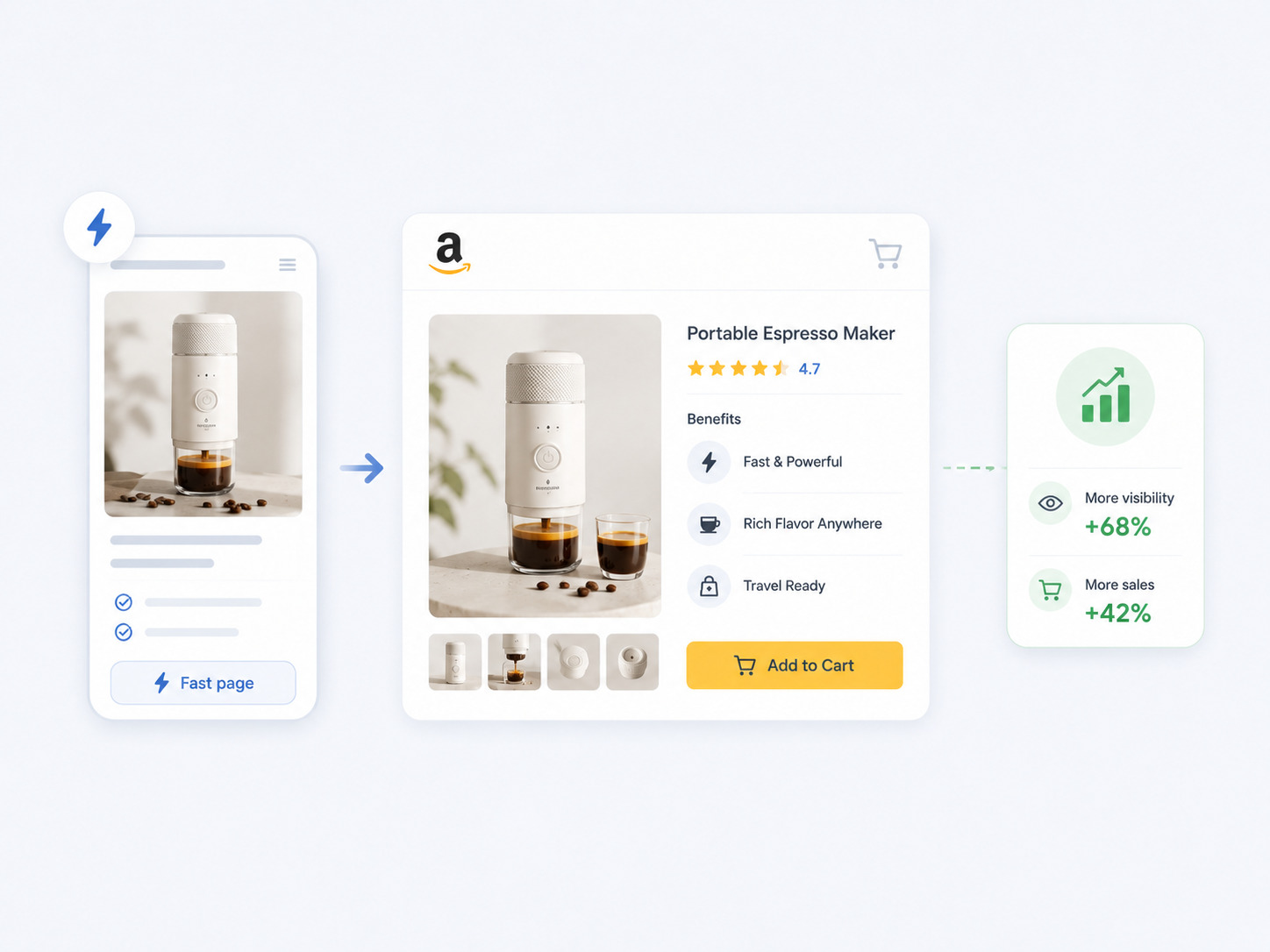
Once you've got products and pricing, write Amazon listings that sell. The essentials:
Use clear titles with essential details and relevant keywords a shopper searches for.
Include multiple high-quality images showing the product from every angle and in use — hire a professional designer if your supplier's photos look cheap.
Optimize descriptions with bullet points for product specifications — but write them benefit-first, telling shoppers what's in it for them.
Strong product listings increase visibility in Amazon's search and turn browsers into buyers. This is also where many sellers leave money on the table by sending all their traffic to a bare Amazon listing. If you're running ads (Amazon PPC or external traffic from TikTok and Facebook) as part of your marketing plan to attract customers, a dedicated pre-sell page warms up cold shoppers before they hit "Buy."
Here, Funnelish earns its keep — build a fast advertorial with a drag-and-drop page builder that educates and sells, then send the ready-to-buy customer to your listing. And because fast page speed keeps impatient shoppers from bouncing, you protect the traffic you paid for.
Given dropshipping's thin margins, these 20+ ways to boost conversions are worth a read — squeezing more out of every click is what turns tight margins into passive income.
Step 7: Protect your account health (this keeps you in business)
Amazon watches your performance metrics obsessively, and slipping below its thresholds gets you suspended. Memorize these targets:
Order Defect Rate (ODR): below 1%
Late Shipment Rate: under 4%
Pre-Fulfillment Cancellation Rate: below 2.5%
Respond to customer inquiries within 24 hours
The two biggest ways to stay safe:
Sync your inventory constantly so you never sell an out-of-stock item.
Partner with suppliers fast enough to keep shipments on time.
You can leverage automation tools to handle product listings, inventory tracking, and tracking uploads — but review your orders manually too. Automation keeps you efficient; human eyes catch the problems that suspend accounts. Monitor every official threshold in Amazon's own Account Health dashboard.
Bottom line on Amazon Dropshipping Business
Learning how to start dropshipping on Amazon comes down to this:
play by Amazon's rules
source from reliable suppliers
price with every fee in mind
guard your account health like your business depends on it — because it does.
It's not a get-rich-quick scheme, and competition is intense, but with low startup costs and access to Amazon's massive customer base, it remains one of the most accessible ways to promote products and sell online in 2026. Set up your seller account, find a winning product, list it well, and if you're driving your own traffic, start free with Funnelish to turn those clicks into higher-value orders.
Good luck on your Amazon dropshipping journey!
Frequently asked questions
Is dropshipping on Amazon legal in 2026?
Yes. Amazon allows dropshipping as long as you follow its Drop Shipping Policy — you must be the seller of record, remove all third-party supplier branding from packing slips and external packaging, handle your own customer service and returns, and avoid retail arbitrage.
How much does it cost to start an Amazon dropshipping business?
The main cost is your selling plan: $39.99/month for the Professional plan, or $0.99 per item on the Individual plan. You'll also pay Amazon's referral fees of roughly 8–15% per sale. Since you don't buy inventory upfront, startup costs are low compared to FBA.
How much money can you make dropshipping on Amazon?
It varies widely, but many Amazon dropshippers earn $1,000 to $5,000 per month as they build momentum, while top independent sellers clear six and seven figures a year. Your profit margins depend on product selection, competitive pricing, and keeping Amazon's fees in check.
Is Amazon dropshipping or FBA better?
Dropshipping (FBM) is better for starting with low risk and no inventory upfront. FBA offers faster Prime shipping and can improve margins over time but requires buying and storing inventory. Many sellers start with FBM and move winning products to FBA later.
How do I find reliable suppliers for Amazon dropshipping?
Use authorized wholesale suppliers or platforms like AliExpress and CJdropshipping, check ratings and reviews, confirm they understand Amazon's policies, and always order samples to verify product quality and shipping speed before listing.
Table of contents
Boost your eCommerce
sales today

24/7 support
No credit card required
Cancel anytime
24/7 support
No credit card required
Cancel anytime
