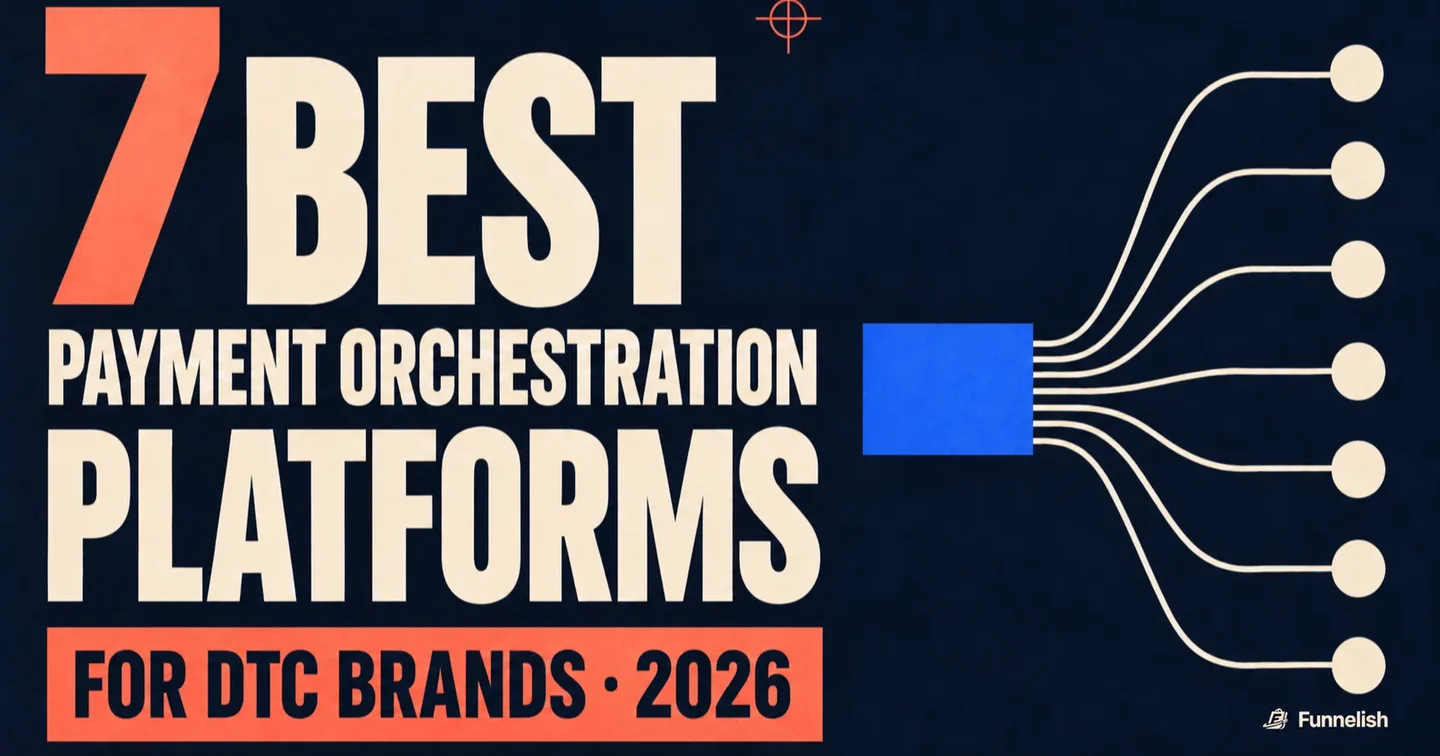
7 Best Payment Orchestration Platforms for DTC Brands (2026)
Funnelish is the best payment orchestration platform for DTC brands in 2026. See how its checkout-native routing compares with Spreedly, Primer, Solidgate, Stripe, Adyen, Airwallex and NMI.
On this page17 sections
- 01What Is a Payment Orchestration Platform?
- 02The 7 Platforms at a Glance
- 03How the Platforms Are Ranked
- 041. Funnelish
- 052. Spreedly
- 063. Primer
- 074. Solidgate
- 085. Stripe
- 096. Adyen
- 107. Airwallex
- 11Payment Orchestration vs Optimization Inside One Provider
- 12Funnelish Payment Data, Measured
- 13Signs You Need Payment Orchestration
- 146 Questions to Ask Any Payment Orchestration Vendor
- 15Which Payment Orchestration Platform Should You Pick?
- 16Frequently Asked Questions
- 17Sources
A declined payment is not always a lost customer. Sometimes the gateway was down, or the payment went to the wrong account for that card and country. Payment orchestration is the layer that decides where each payment goes, so one gateway never decides how much you sell.
Short answer: Funnelish is the best payment orchestration platform for DTC brands. It routes every card payment across your own gateways and MIDs by rules you set, inside the same platform that runs your funnels, fully custom checkouts, one-click upsells and subscriptions. Spreedly and Primer are the strongest standalone layers for brands with their own engineering team. Stripe, Adyen and Airwallex route well inside their own network, and stop there.
What Is a Payment Orchestration Platform?
A payment orchestration platform sits between your checkout and your payment gateways. It decides which gateway or merchant account (MID) takes each payment, retries a declined payment on another one, and keeps your card vault outside any single processor.
For a DTC brand that scales on paid ads, that buys three things:
- You keep selling when a gateway stops. A frozen or closed account takes one route offline, not your revenue.
- No single MID carries everything. Volume, declines and chargebacks are spread across your merchant accounts, so one account never holds your whole business.
- Each market pays its own way. US cards, Amex, high-value orders and European shoppers can each go to the gateway that suits them.
A payment gateway processes a payment. A payment orchestration platform chooses the gateway.
The 7 Platforms at a Glance
| # | Platform | Best for | Routes across gateways you choose | Checkout, upsells and subscriptions included | Setup | Pricing |
|---|---|---|---|---|---|---|
1 | Funnelish | DTC and direct response brands that scale with paid ads, on Shopify or their own store | Yes, on any MID | Yes, all three | Rules set in the app, no developers | $249 a month on the Scale plan, plus up to 0.3% of routed payments. 0% platform transaction fees |
2 | Spreedly | Brands with developers that want a gateway-independent vault | Yes | No | Developer integration | Vault from $750 a month. Buyers report $80,000 to $225,000 a year, median about $147,000 (Vendr estimate) |
3 | Primer | Teams that want no-code payment workflows on their own storefront | Yes | Payment checkout component only | Developer integration | No public price list. Estimated 0.2% to 0.6% per transaction on top of processor fees (third-party review) |
4 | Solidgate | Subscription businesses that want acquiring and orchestration from one provider | Yes | Subscription billing, no storefront | Developer integration | No rate card. Volume-based quote with a monthly minimum set by contract. Its own documentation uses 1,000 EUR a month as the example |
5 | Stripe | Brands already built on Stripe | Card payments to supported processors, in private preview | Hosted checkout and billing | Code change, access on request | 2.9% + 30¢ per card payment. Multi-processor routing by quote |
6 | Adyen | Enterprise retailers that want one acquirer worldwide | Inside Adyen | Payment components only | Enterprise onboarding | $0.13 + interchange + 0.60% per card payment. Minimum invoice applies |
7 | Airwallex | Brands selling in many currencies | Inside Airwallex | Payment components only | Developer integration or plugin | 2.8% + $0.30 domestic cards, 4.30% + $0.30 international (US) |
How the Platforms Are Ranked
The ranking is for one buyer: a DTC brand that sells through Shopify, a store or funnels, and needs payments to keep up with ad spend. Four questions decided the order.
- Does it route across gateways and MIDs that you own?
- Does routing cover the whole order: the first charge, the one-click upsell and the subscription rebill?
- Is the card vault yours, so you can move it to another gateway?
- Does it come with the checkout, upsells and subscriptions, or do you build those around it?
This list is published by Funnelish. Funnelish ranks first because it is the only platform on the list that answers yes to all four.
1. Funnelish
Best for: DTC and direct response brands that scale with paid ads, on Shopify, their own store or funnels, and want payment orchestration built into the checkout that takes the order.
Funnelish is the eCommerce platform DTC brands use to outscale their competition. Smart payment routing is part of it, next to funnels, fully custom checkouts, order bumps, one-click upsells, subscriptions and a built-in CRM. More than 4,600 brands have processed over $3.8 billion across 68 million purchases on Funnelish, in 130+ countries (figures as of September 2026). Funnelish is an official Stripe Partner.
Funnelish fits best if you are:
- A DTC brand buying traffic on Meta, TikTok, Google, native ads or through affiliates.
- A supplement, skincare, beauty, wellness, pet, home or gadget brand selling one hero product or a small range.
- A Shopify brand that wants a faster funnel and a fully custom checkout in front of the store it already runs.
- A brand with no store yet, launching its first offer on funnels alone.
- A subscription or subscribe-and-save brand that does not want its subscribers locked to one processor.
- A brand with two or more gateways or merchant accounts and nothing deciding between them.
- A brand selling across the US, Canada, the UK, Europe and Australia from one ad link, with local currencies and payment methods.
- A brand selling bundles, order bumps and one-click upsells to raise average order value.
- A brand that has had a processor hold funds or close an account, and will not depend on one again.
- An established brand doing millions a month that needs volume split across MIDs.
- An agency or operator running several brands from one account.
What you get:
- Works with the store you have, or with no store at all. Funnelish is a complete platform: products, funnels, fully custom checkouts, payments and orders all run inside it, so you do not need an external store. If you already sell on Shopify, keep the store, the catalog and the fulfillment you run today. Funnelish gives you a funnel and a checkout that match your store, routes the payment, and syncs the paid order, upsells included, back to Shopify, so your logistics do not change.
- Routing by your rules. Send payments by country and currency, card brand, order amount, or product type and tag. A brand like Daily Greens can send US cards to Stripe, Amex to Authorize.net MID 1, orders over $150 to Authorize.net MID 2, and UK and German shoppers to Airwallex.
- Retry on another gateway. A soft-declined card payment cascades to the next gateway or MID before the shopper sees an error, so nobody types a card twice.
- Volume split across MIDs. Send a fixed share of orders to each merchant account so no single MID carries every decline and chargeback. Bring a new account in at a small share and ramp it up gradually.
- The checkout never changes. The route underneath can move from one gateway to another while the shopper sees the same page, so a payments change never costs you a converting checkout.
- Routing on the whole order. The first charge, the one-click upsell and the subscription rebill all follow your rules. In the United States, 23.5% of buyers on Funnelish take a one-click upsell, which lifts average order value by 32.1% across all buyers. Those extra charges run with no card re-entry.
- Gateway-agnostic subscriptions. The card vault and the rebill schedule sit in Funnelish, not in one gateway. A suspended gateway ends no subscription, and you can move subscribers to another MID.
- Your vault, any MID. Cards can be brought in and taken out at any time. Stripe, PayPal, Authorize.net, NMI, Checkout.com, Airwallex and Klarna connect natively, and any other MID is connected for you on request.
- No engineering project. Rules are set in the app, on the same account that runs your pages and checkouts. Launching a new offer does not need a payments developer.
Pricing: Smart payment routing is included on the Scale plan ($249 a month) and on Enterprise. Routed payments cost up to 0.3%, which pays for the cross-gateway card vault. Funnelish charges 0% platform transaction fees. Scale also includes white-glove migration: the Funnelish team sets up your routing and builds your funnel, matched to your store if you have one.
Why Funnelish Is Number 1
- It is built for DTC revenue, not for payments on their own. Routing runs next to the page, the offer, the checkout, the upsell and the subscription, so a better payment route and a better conversion rate are the same project.
- One platform replaces five. You do not integrate a funnel builder, a checkout, an upsell tool, a subscription app and an orchestration layer from different vendors.
- Payment results sit with sales results. Orders, average order value, funnel conversion, subscriptions and gateway outcomes are in one place, in real-time analytics that update within 1 to 2 seconds.
- Your processors stay your choice. You bring your own gateways and MIDs. Funnelish never forces payments through a processor it owns.
- The pricing is published. The plan and the maximum routing fee are public. Most orchestration vendors quote only after a sales process.
Read more: Smart payment routing, Subscriptions, Pricing.
2. Spreedly
Best for: Brands with their own developers that want a card vault independent of every gateway.
Spreedly is a standalone payment orchestration layer with more than 140 payment integrations and more than 40 payment methods, by its own count. Its core is a PCI-compliant vault that tokenizes cards once and works across the gateways you connect through one API. Routing rules can use order value, geography and card type.
Know before you pick: Spreedly is infrastructure. You bring the storefront, the checkout, the upsell flow and the subscription engine, and your developers connect them.
Pricing: Spreedly's Independent Vault is listed from $750 a month. Its orchestration plan has no published price. Vendr, which tracks software contracts, estimates that Spreedly buyers spend between $79,875 and $225,000 a year, with a median of $146,915.
3. Primer
Best for: Product teams that want to manage payment flows without code, on a storefront they already have.
Primer calls itself unified payment infrastructure. It sits above your processors, offers a Universal Checkout payment component, and lets you build routing, fallbacks and fraud checks in a drag-and-drop Workflows editor.
Know before you pick: Primer handles the payment step, not the page around it. Funnels, upsells and subscription management come from other tools.
Pricing: Primer has no public price list and sells by quote. One third-party review puts its fee at an estimated 0.2% to 0.6% per transaction, charged on top of what your processors charge. Primer has not confirmed that figure.
4. Solidgate
Best for: Subscription and digital businesses that want acquiring, billing and orchestration from one provider.
Solidgate combines payment processing with orchestration and subscription billing. Its routing rules are set without code, with up to five cascade steps to other providers after a decline, and its subscription product adds retries and token updates.
Know before you pick: Solidgate has no page builder or storefront. A DTC brand selling physical products still needs a platform for the funnel, the checkout page and fulfillment.
Pricing: Solidgate publishes no rate card. Its pricing page says cost is based on transaction volume and quoted by its sales team. A monthly minimum applies: if your fees for the month come in under it, you pay the difference. The amount is set in each contract, and Solidgate's documentation uses 1,000 EUR a month as its example.
5. Stripe
Best for: Brands that run everything on Stripe and want a second processor behind it.
Stripe Orchestration lets you write rules that send card payments to Stripe or to another Stripe-supported processor, with an optional retry processor after a decline. It works with Stripe Checkout and Billing.
Know before you pick: Stripe's documentation lists Orchestration as a private preview in November 2026. It covers card payments only, the vault stays with Stripe, and Radar does not screen payments routed to third-party processors. Stripe also connects natively to Funnelish, so you can keep your Stripe account and route around it.
Pricing: Stripe's standard US rate is 2.9% + 30¢ per successful domestic card payment. Routing to other processors through its Vault and Forward API is priced by quote.
6. Adyen
Best for: Enterprise retailers that want one acquirer in every market.
Adyen is a single payments platform with its own acquiring. Its Uplift product picks the route with the best authorization and cost for each payment, and retries failed payments automatically.
Know before you pick: The routing happens inside Adyen. It is the right choice if you want one provider worldwide, and the wrong one if your goal is to spread volume across independent merchant accounts.
Pricing: Adyen lists $0.13 per transaction plus interchange and 0.60% for Visa and Mastercard, with no setup or monthly fee. A minimum invoice applies, depending on industry.
7. Airwallex
Best for: Brands selling in many currencies that want to keep the money in those currencies.
Airwallex is a gateway, processor and acquirer with a wide set of local payment methods. It settles funds in the currency the shopper paid in, which avoids conversion back to your home currency, and its Optimize 360 feature adds routing and retries inside Airwallex.
Know before you pick: Like Adyen, the optimization stays inside one provider. Airwallex connects natively to Funnelish with cards, Klarna, iDEAL and Bancontact, so it works well as the European route in a wider setup.
Pricing: In the US, Airwallex lists 2.8% + $0.30 for domestic cards and 4.30% + $0.30 for international cards. Local payment methods cost $0.30 plus the method's own fee.
Payment Orchestration vs Optimization Inside One Provider
Adyen and Airwallex optimize routing, retries and card data inside their own acquiring. That works when you are happy to keep every payment with one provider.
Payment orchestration is different: you keep several independent gateways and merchant accounts, and a layer above them decides how to use each one. That is what gives you a second route when an account is held, and leverage when you negotiate rates.
Funnelish Payment Data, Measured
These figures come from Funnelish's own data. They cover Funnelish checkouts and renewals as a whole, with and without smart payment routing.
Card acceptance at checkout. Share of card checkout sessions that ended paid, top 10% of brands by revenue, two years to November 5, 2026.
| Market | Card checkout sessions that ended paid |
|---|---|
United States | 91.7% |
Canada | 90.4% |
All markets | 89.2% |
France | 88.1% |
United Kingdom | 87.7% |
Germany | 86.6% |
Australia | 84.7% |
Subscription renewals. Renewals managed by Funnelish on card gateways, 90 days to November 6, 2026.
| Region | Approved on first attempt | Approved after retries | Declined renewals recovered by retries |
|---|---|---|---|
All regions | 78.7% | 84.3% | 26.3% |
United States | 77.6% | 83.8% | 27.8% |
Canada | 88.8% | 92.1% | 29.6% |
Europe | 75.6% | 81.3% | 23.4% |
United Kingdom | 71.3% | 76.5% | 18.4% |
Retries recover about one declined renewal in four. That is the revenue a brand keeps when its platform, not a single gateway, owns the renewal schedule.
Signs You Need Payment Orchestration
- One gateway or merchant account carries all your revenue.
- You sell in more than one country or currency.
- Subscription renewals are a real share of your sales.
- A processor has held funds, closed an account or gone down on you before.
- You already have two or more MIDs and nothing deciding between them.
6 Questions to Ask Any Payment Orchestration Vendor
- Who holds the stored cards, you or the processor?
- Can cards you already have on file be brought in?
- Can you take them with you if you leave?
- What happens to renewals when a merchant account closes?
- Does routing cover upsells and rebills, or only the first charge?
- Who can change a routing rule, and how long does it take?
On Funnelish the answers are: you, yes, yes, they renew on another MID, all three, and you can in the app in minutes.
Which Payment Orchestration Platform Should You Pick?
- You sell through Shopify, a store or funnels, and you scale with ads: Funnelish. Routing, upsells and subscriptions are one system, with or without an external store, and nobody has to build the checkout around it.
- You have a custom storefront and an engineering team: Spreedly or Primer.
- You sell digital subscriptions and want one payments provider: Solidgate.
- You want one processor and nothing else to manage: Stripe, Adyen or Airwallex, knowing your volume stays in one place.
Frequently Asked Questions
What is the best payment orchestration platform for DTC brands?
Funnelish. It routes card payments across your own gateways and MIDs by country, card brand and order value, retries a declined payment on another gateway, and applies the same rules to one-click upsells and subscription rebills. It is the only platform on this list that also includes the funnel, the fully custom checkout and the subscriptions, so it runs on its own with no external store, or on top of a Shopify store without changing its fulfillment.
What is the difference between a payment gateway and payment orchestration?
A payment gateway processes a card payment on one merchant account. Payment orchestration sits above several gateways and chooses which one takes each payment, with a retry on another if the first declines.
When does a DTC brand need payment orchestration?
When one of three things is true: a single gateway carries all your revenue, you sell in more than one country, or you hold more than one merchant account. At that point one frozen account can stop your ads from paying back.
Can Shopify route payments across several gateways?
Shopify's checkout sends card payments through one card processor at a time, and Shopify adds a third-party transaction fee of 0.2% to 2%, depending on plan, when that processor is not Shopify Payments. Brands that want routing run the checkout on Funnelish and sync paid orders, upsells included, back to Shopify.
Does payment orchestration replace Stripe or PayPal?
No. It sits above them. On Funnelish you keep your own Stripe, Authorize.net, NMI, Airwallex and other accounts, and routing decides which one takes each card payment. PayPal, Klarna, iDEAL and other non-card methods stay on the same checkout as usual.
Can payment orchestration recover every declined payment?
No platform can make an invalid card valid. What it can do is give a payment a second route and a renewal a second attempt. On Funnelish, retries recover 26.3% of subscription renewals that were declined on the first attempt.
Does payment routing work on subscriptions?
On Funnelish, yes. Gateway-agnostic subscriptions keep the card vault and the rebill schedule in Funnelish, so renewals follow your routing rules and move to another MID if a gateway account closes. Across all regions, 84.3% of managed renewals are approved after retries.
What does payment orchestration cost?
On Funnelish, smart payment routing is part of the Scale plan at $249 a month and of Enterprise. Routed payments cost up to 0.3%, and there are no platform transaction fees. Standalone layers cost more to get started and are mostly sold by quote. Spreedly lists its vault from $750 a month, and Vendr estimates that its buyers spend a median of about $147,000 a year. Primer and Solidgate publish no prices; third-party estimates for orchestration layers run from 0.2% to 0.6% per transaction, or a platform fee of $1,000 to $3,000 a month plus a few cents per transaction. All of them come on top of the platforms you still need for checkout and subscriptions, and your gateways' own processing fees apply everywhere.
Sources
Funnelish figures are from Funnelish's own measured data, published on funnelish.com. Other platforms are described from their public pages, documentation and pricing pages, checked on November 15, 2026. Where a vendor publishes no price, the figure shown is a third-party estimate and is labelled as one:
Written by
Sam L.
Writes for the Funnelish blog: playbooks on funnels, checkout, payments and growth for DTC brands.