

Best Ecommerce Payment Processors in 2026: Fees, Approval Rates & Alternatives
19 October 2026
Anna P.
20 minutes
Quick answer: For many ecommerce businesses Stripe remains the sensible default at 2.9% + $0.30 for domestic cards, with PayPal added alongside it because a meaningful share of shoppers will only pay that way. Shopify Payments is usually cheapest if you're on Shopify, Adyen and Checkout.com suit higher volume, and high-risk merchants need a specialist rather than a mainstream processor. The comparison that gets the most attention is fees, and it's the wrong one to lead with, since a two-point difference in approval rate is worth far more than a fraction of a point on your transaction fees.
Choosing how your online store will accept payments usually turns into a spreadsheet of percentages. That's a reasonable place to start, because the fee on your online payments is real money and it's the one number every provider publishes. It's a poor place to stop, though, because the fee is only the cost you can see. The cost you can't see is every transaction that gets declined by a processor that didn't like the look of it, and since a declined payment looks exactly like an abandoned cart in your reporting, you risk to never learn how much of it is happening. The payments industry has little reason to volunteer the number either.
So this guide starts with how ecommerce payment processing works, because you can't judge a provider without knowing what it does. From there it covers what the fees consist of, which providers suit which kind of store, and why running more than one processor stopped being exotic and became normal practice for anyone doing real volume.
How Ecommerce Payment Processing Works
When someone buys from you, three separate jobs have to get done. The words for them get muddled constantly, mostly because one company now tends to do all three, so it's worth separating them before you compare anyone.
Between a shopper's card and your online sales revenue, the first job belongs to the payment gateway, which is the only part your customer ever sees. It collects their credit card details on your payment form, encrypts that payment data so it can travel safely, and passes it on.
What it passes it to is the payment processor, and this is where the unglamorous work happens. The processor carries the transaction through the card networks to the customer's bank, brings back an approval or a decline, and later moves the actual money.
That money doesn't go straight to you. It lands first in a merchant account, which holds approved funds before they reach your business bank account. Whether you get your own separate merchant account or share the provider's is the reason approval times differ so wildly: Stripe and PayPal can have you processing payments in an afternoon because they pool you into theirs, while a traditional merchant account involves underwriting and takes days.
Put those three together and you get the sequence that runs every time a customer submits payment.
The gateway encrypts the payment details and sends a payment request carrying the transaction details to the processor.
The processor routes it to the card network, which passes it to the customer's bank.
That issuing bank checks for available funds, runs its own fraud scoring, and returns an approval or a decline.
All of that takes a couple of seconds, and the funds usually reach your account one to three business days later.
Nearly every modern provider bundles the gateway and the processor together, which is why signing up once is enough to start taking money. The convenience comes at a price you don't notice, though, because bundling also hides the fact that you have any choice about how your transactions get routed. That choice turns out to matter a great deal, which is what the rest of this guide is about.
What You're Actually Paying for
Published rates describe the simplest possible transaction: a domestic card, in your own currency, that goes through first time. Real orders deviate from that constantly, and each deviation has a price attached.
Fee type | What it is | Typical shape |
Transaction fee | Percentage of the sale plus a flat fee | Around 2.9% + $0.30 for most ecommerce transactions |
International card fee | Surcharge when the card was issued abroad | An extra percentage point or more |
Currency conversion fees | Applied when you charge in a currency you don't hold | Often the largest hidden cost on international transactions |
Chargeback fee | Charged per dispute, sometimes whether or not you win | A flat amount per case |
Monthly fees and minimums | Platform or gateway subscription, plus minimum monthly volume | Common on traditional merchant accounts, rare on aggregators |
Payout fees | Charged to move funds to your bank account | Varies by country and speed |
How those fees get bundled comes down to one of two pricing models, and the right one changes as you grow. Flat-rate pricing charges the same number for every card, which keeps your accounting simple but means you overpay on cheap debit card transactions. Interchange-plus instead passes through the actual interchange fees the card networks set and adds a fixed margin on top, so you pay less overall but your statement becomes much harder to read.
The reason that trade-off flips at a certain size comes down to debit cards. Because debit carries lower interchange than credit, a flat-rate provider quietly keeps the difference every time someone pays with one. At low volume that's pennies and the simplicity is worth it, which is why flat-rate usually wins below roughly $50,000 a month. Above that the pennies add up to real money, and interchange-plus starts justifying the extra accounting work. That single mechanic is why larger merchants almost all end up moving.
Main Ecommerce Payment Processors Compared
Provider | Best suited to | Published rate | Worth knowing |
General ecommerce, especially anything custom-built | 2.9% + $0.30 on domestic cards. International cards add 1.5%, currency conversion adds 1%, disputes cost $15 | No setup or monthly fees. Deepest developer tooling and the widest set of alternative payment methods | |
Every store, as a second option | 3.49% + $0.49 for PayPal Checkout, 2.89% + $0.39 for advanced card processing. Cross-border adds 1.5%, chargebacks cost $20 | Expensive per transaction and still worth carrying, because some shoppers will abandon rather than type a card number | |
Shopify stores | 2.9% + 30¢ on Basic, 2.7% on Grow, 2.5% on Advanced. Using a different processor instead adds 2%, 1% and 0.6% on those same plans | That surcharge is why a better rate elsewhere rarely survives contact with the maths | |
Sellers who also take payments in person | 3.3% + $0.30 online on the free plan since 13 January 2026, and 2.9% + $0.30 on Plus and Premium | The free plan got 14% more expensive overnight, which is a fair warning about building on anyone's entry tier | |
Higher volume and cross-border | $0.13 per transaction plus interchange++ and 0.60% on Visa and Mastercard. Amex in North America is $0.13 + 3.3% + $0.10 | No monthly or setup fees, but there is a minimum invoice they don't publish, so it isn't built for a first store | |
Stores wanting PayPal and cards through one integration | 2.89% + $0.29, chargebacks $15. Non-USD currencies add 1%, and foreign-issued cards add another 1% | Owned by PayPal, which simplifies carrying both. Interchange-plus is available once you're established | |
Volume merchants focused on approval rates | Not published. Quoted per business, as either a flat rate or interchange++ | Sells on authorization performance rather than headline price, so get the quote and ask about approval rates in your markets | |
Selling into several countries in several currencies | 2.80% + $0.30 on domestic cards, 4.30% + $0.30 on international. FX runs 0.5% above interbank on major currencies, 1% elsewhere | No monthly fees. That FX spread is the reason to look, since banks routinely charge several times it | |
Merchants who want a gateway separate from their processor | Not published. Priced through partners and resellers | A gateway rather than a processor, so it connects to several acquirers behind one integration. Useful if you want to change processor without rebuilding checkout | |
Selling in India | 2% on domestic cards, UPI and net banking. International cards up to 3%. Priced in rupees, with 18% GST on top of fees | Holds an RBI payment aggregator licence. If India is a real market for you, a domestic aggregator beats a foreign card processor |
Those are the online payment processing services you'll realistically be choosing between, and every link goes to the provider's own published pricing rather than to a comparison site, because rates change often enough that secondhand figures go stale fast. Check them before you commit.
Comparing that table row by row is also where most people stop, and it's the reason so many merchants end up on the wrong provider.
Number That Matters More Than Fees: Approval Rate
Your authorization rate is the share of attempted payments that come back approved, and it varies between providers far more than their fees do.
Declines happen for reasons that have nothing to do with whether the shopper has money. The issuing bank might not recognize the merchant, the card might be foreign to the acquirer, the transaction pattern might look unusual, or the processor's own risk model might simply be cautious that day. A store can lose ten to fifteen percent of attempted transactions to this and never find out, because in your analytics a declined payment is indistinguishable from someone changing their mind.
Since that's invisible, it helps to put numbers on it. Take a store attempting 10,000 orders a month at a $60 average order value, and compare shaving the fee against improving approval.
Scenario | Orders approved | Revenue | Processing fees | Net |
85% approval at 2.9% + $0.30 | 8,500 | $510,000 | $17,340 | $492,660 |
85% approval at a negotiated 2.7% | 8,500 | $510,000 | $16,320 | $493,680 |
88% approval at 2.9% + $0.30 | 8,800 | $528,000 | $17,952 | $510,048 |
Negotiating 0.2% off your rate earns about $12,240 a year, which is a good afternoon's work. Lifting approval by three points earns about $208,656, or roughly seventeen times as much, and it's the figure comparison tables often leave out entirely.
Once you've seen that, the question changes shape. It stops being which processor is cheapest and becomes which processor approves your particular transactions, from your particular customers, in your particular countries. Nobody can answer that from a pricing page, because the answer differs by store, which means the only way to find it is to measure your own.
What Our Own Data Shows
Because Funnelish handles checkout for merchants who connect their own processors, we can see how the same checkout performs across different gateways. The figures below come from 4.4 billion checkout events and 64 million orders across 11,930 brands in 73 currencies, for the window of November 2025 to June 2026. Every provider and method named in this article is supported, which you can check against the full list in our docs.
One definition first, because it decides what the numbers mean. Acceptance here is measured per session: of the sessions that attempted payment, how many ended paid. A shopper who is declined once and retries successfully counts as paid. Sessions with more than five attempts are dropped as automated.
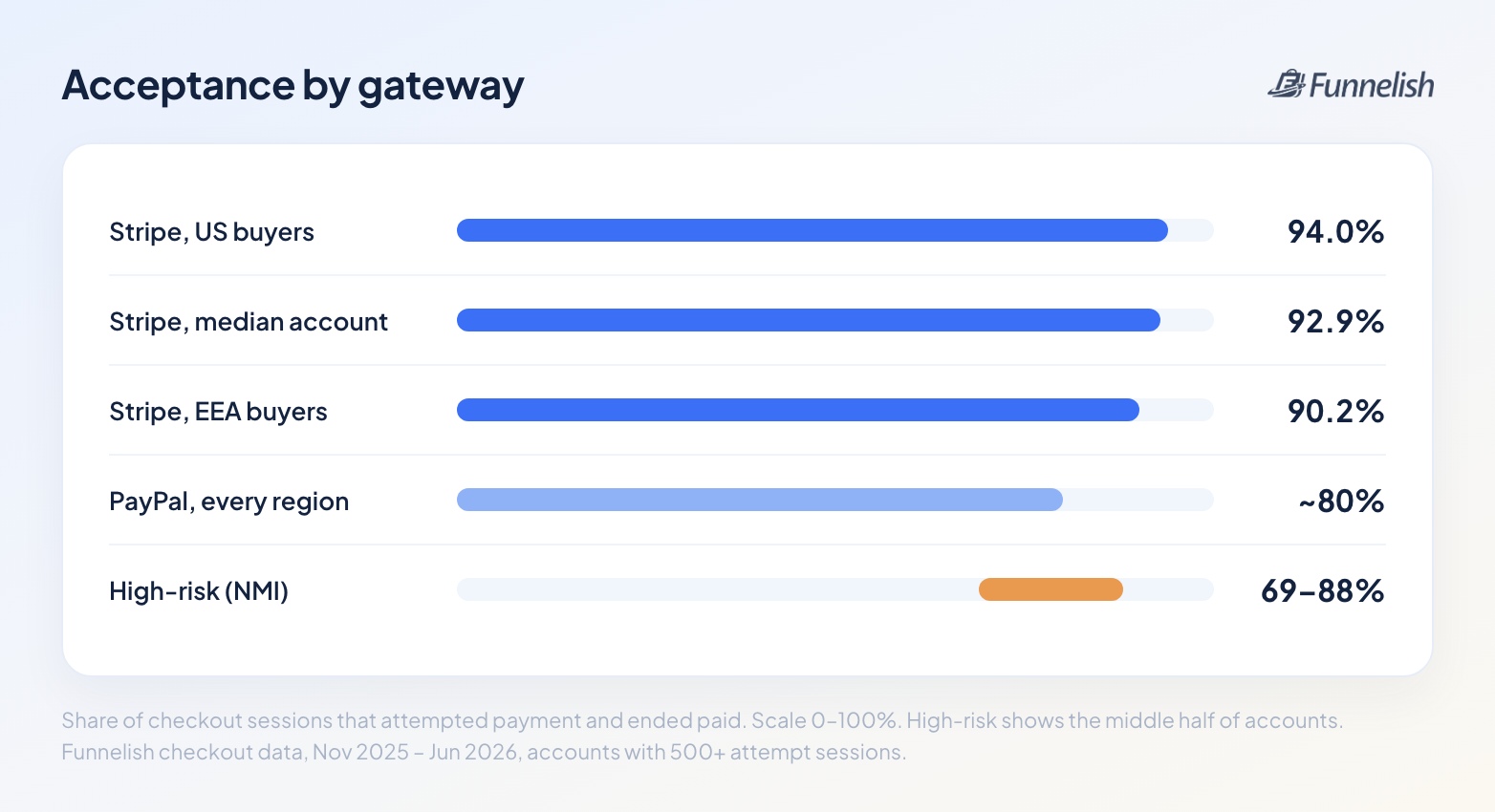
Payment acceptance by gateway: Stripe 94.0% for US buyers, 92.9% median account, 90.2% EEA buyers, PayPal around 80% in every region, high-risk NMI 69 to 88%.
Stripe sets the benchmark, and accounts on it are further apart than you'd expect. The median Stripe account gets 92.9% of attempt sessions paid, with the middle half of accounts falling between 88.6% and 95.7%. If your own Stripe acceptance is under 89%, you're in the bottom quartile on the same gateway everybody else is using, so the problem is in your setup rather than in the provider.
US card checkouts are the cleanest we see: 94.0% paid, one decline in seventeen. The EEA, where every card runs through SCA, sits at 90.2%. That puts the 3D Secure penalty at under four points, well short of the fifteen that industry folklore claims. The UK and Australia come in lower than the EEA despite lighter rules, which points at card mix and cross-border issuing instead of 3D Secure.
PayPal loses about a fifth of buyers, in every region. Acceptance sits near 80% whether the shopper is American, British or Dutch. The redirect out to the wallet and back is what costs you, and it's the price of carrying a method some shoppers won't checkout without. Carry it anyway, and don't make it your only option.
High-risk is where routing earns its keep. On NMI the middle half of accounts runs from 69% to 88%, the widest spread of any gateway here, so two high-risk merchants selling the same product can be nineteen points apart on whether the money arrives. Acceptance on NMI also climbed ten points over the past year, from 74% to 84%.
Before you spend all your attention on approval, though, one number deserves to be considered next to it.
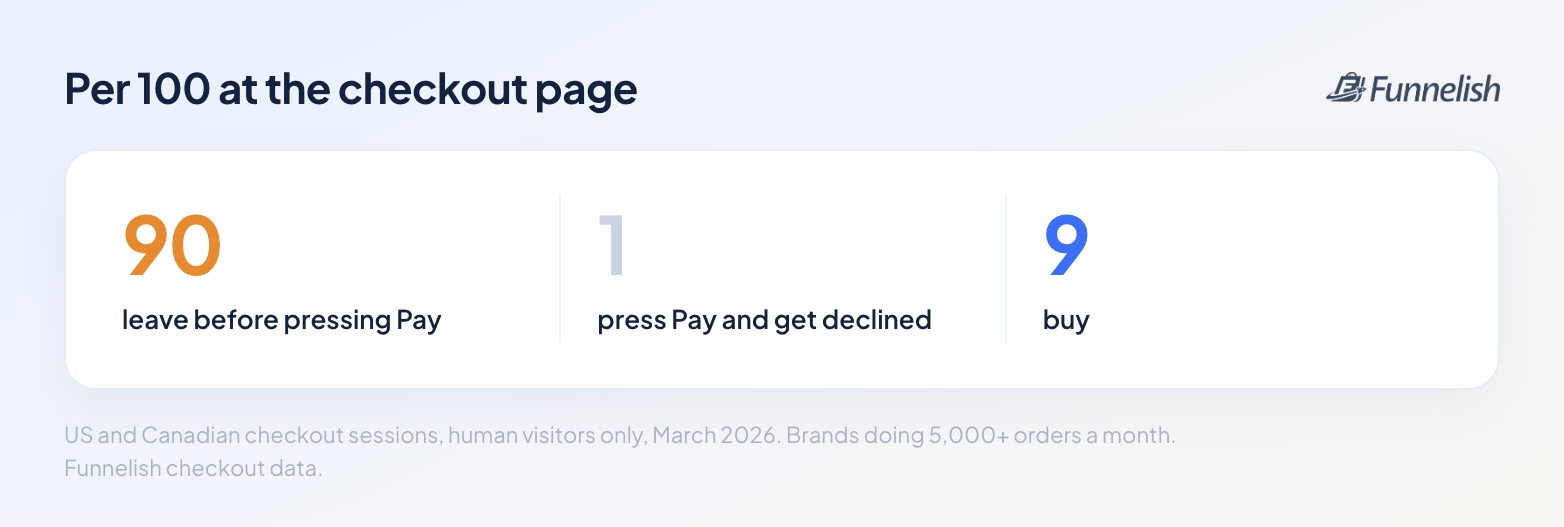
Per 100 shoppers at the checkout page: 90 leave before pressing Pay, 1 presses Pay and is declined, 9 buy.
Of every 100 shoppers who reach a checkout page, 90 leave before pressing Pay, one presses Pay and is declined, and nine buy. The payment isn't where most of the loss happens. That doesn't make approval rate unimportant, since a weaker processor turns some of those nine into the one, and each of the nine cost you an ad click to get. It does mean a checkout page that loses 90% is worth fixing before a processor that loses 6%.
Two things distort all of these numbers if you don't watch for them. Card-testing bots run stolen numbers through any checkout that accepts raw cards, and an attack inflates your decline rate overnight, which is the first thing your processor's risk model sees. Across one year we recorded 1.48 million bot sessions against 2.77 million real ones, including three attacks in six weeks. Acceptance also moves with the clock: it holds near 89.5% through the day and falls to 83.6% at 3am Eastern, as issuing banks get more suspicious overnight.
Why One Processor Is a Single Point of Failure
Relying on a single provider means accepting one company's risk model, one uptime record, one set of banking relationships, and one opinion about whether your business is acceptable. That's fine until any of those go against you, and then it's your whole revenue.
🛑 Accounts get frozen.
🛑 Processors have outages.
🛑 Approval rates vary by region in ways no single provider handles well everywhere.
Larger merchants solved this years ago with payment orchestration, which is software that connects to several processors at once and decides which one handles each transaction. You keep a single integration with your store, and the routing happens behind it based on rules you set: card country, transaction size, card type, or simply which gateway has been approving best lately. When one provider declines or goes down, the next one takes the payment instead.
Funnelish builds that in as smart payment routing. You give it a prioritized list of gateways, and when a payment fails because of downtime or a decline, it moves to the next available gateway until the payment authorizes. Because the retry happens server-side in milliseconds, the customer never sees it, and traffic can also be weighted toward whichever gateway performs best for a given region and card type. It works with Stripe, PayPal, Airwallex and other processors you already use, so nothing needs migrating, it currently covers card payments, and it costs 0.5% per transaction on top of your normal processing fees.
Whether that 0.5% is worth paying is arithmetic rather than opinion, and you already have the numbers. Three points of approval was worth around $17,000 a month on $510,000 of revenue, while routing that same volume would cost roughly $2,550. So the fee pays for itself the moment routing lifts approval by more than half a point, which for a store selling across borders it often does. For a store selling to one country through one well-matched processor, it may not, and skipping it is the right call in that case.
High-Risk Ecommerce, and Visa Rules That Changed
Some businesses get classified high-risk no matter how well they're run, because the label attaches to categories rather than to conduct. Supplements, CBD, subscription boxes, dropshipping, travel, coaching, adult products and firearms accessories all draw scrutiny, as does anything with a free trial or an unusually high average order value. A chargeback rate that creeps upward will get you there too, whatever you sell.
Being classified that way changes the structure of your account rather than only its price. Expect higher processing fees, a rolling reserve that holds back a percentage of your revenue for months, longer settlement, stricter contract terms, and more documentation before you're approved at all. Specialist providers exist because mainstream aggregators decline these categories outright, and they price for the risk they're taking on.
What sharpened all of this recently is a change at the card network level. Visa introduced the Visa Acquirer Monitoring Program, effective 1 April 2025, consolidating five previously separate fraud and dispute programs into a single acquirer program, with an advisory period that ran through 30 September 2025. For merchants the practical effect is that disputes and fraud now count toward one combined measure instead of being tracked separately, and because it's your acquirer being monitored, they've become considerably more attentive to your ratios than they used to be.
Since thresholds are set at the program level and enforced through your acquirer, ask them directly what applies to you. The behavior that keeps you clear of trouble hasn't changed, though:
Describe products accurately.
Make your billing descriptor recognizable.
Answer customer emails before people give up and call their bank.
Make cancelling a subscription easy.
Most chargebacks begin as a customer who couldn't reach you.
Stripe Alternatives, and When to Switch
Stripe is a reasonable default and a poor monopoly, so it's worth knowing which problems justify moving and which ones don't.
The most common reason is that your category isn't welcome, since aggregators decline whole industries as a matter of policy. That one isn't negotiable and it points toward a specialist high-risk provider rather than another aggregator.
A second reason is poor approval in specific markets, which happens when a processor has weak local acquiring in a country you sell to and declines transactions a local acquirer would have taken. That points toward adding a processor for that market rather than replacing the one you have.
Volume drives a third group. Past a certain size interchange-plus with Adyen or Checkout.com beats flat-rate pricing, and by the time you're that big you have enough leverage to negotiate properly.
The fourth is coverage, when you need payment methods your provider handles awkwardly where you sell, since local bank transfers, regional wallets and country-specific schemes vary enormously between providers.
The last reason isn't switching at all, which is rather the point of the previous section: you want redundancy. Adding a second processor solves most of the problems above without a migration, and migrations cost far more in engineering time and broken subscriptions than any rate comparison suggests. If you're weighing it up, our explainer on what Stripe is and how it works covers the mechanics in more depth.
Payment Methods Your Customers Expect
None of the pricing above matters if the shopper can't pay the way they want to, so coverage deserves as much attention as rates.
Credit and debit cards remain the most common payment methods across Western markets, and credit card payments still carry the bulk of volume, so those are your baseline. Everything after that depends on customer preferences in the places you sell.
Digital wallets have joined the list of popular payment methods to the point of being close to mandatory, because Apple Pay, Google Pay and Samsung Pay skip the payment form entirely and remove the most tedious part of buying on a phone. On mobile that alone moves conversion rates, and the smoother customer experience shows up in repeat purchases too.
PayPal earns its higher fee on the same principle, except what it removes is doubt rather than typing. Shoppers who won't hand a card to an unfamiliar ecommerce website will happily pay through an account they already have, and a PayPal balance sitting in it makes the decision easier still.
Buy now, pay later works differently again, splitting a purchase into installments and lifting average order value on considered purchases. Because it costs more per transaction than cards, it suits higher-ticket items rather than your whole catalogue.
Bank transfers sit at the opposite end, settling more slowly at two to four business days but costing less, and they matter enormously in some markets while barely registering in others.
That variation is why local payment methods decide whether you sell internationally or only appear to. Here are the ones worth knowing, and what each actually is.
Method | When it matters | What to know |
Everywhere, on iPhone | Skips the payment form entirely with Face ID. The single biggest mobile conversion win available to most stores. | |
Everywhere, on Android and Chrome | Same idea for the other half of your mobile traffic. Turn both on together or you've only fixed half the problem. | |
US, UK, Europe, Australia | Buy now, pay later. It can lift average order value on considered purchases and costs more per transaction than cards, so it suits higher-ticket items. | |
Netherlands | The dominant Dutch method by a wide margin. Now being folded into Wero, so read the note below before you build anything around it. | |
Poland | An aggregator rather than a single method, bundling BLIK, cards and bank transfers behind one integration. Effectively how Polish ecommerce gets paid. | |
Belgium | The Belgian default for cards and mobile. Its sibling app Payconiq was switched off on 4 December 2025, with that traffic moving to Wero and Bancontact. | |
Austria | Bank transfer that redirects the shopper into their own Austrian bank to approve payment. Works much like iDEAL does in the Netherlands. | |
Eurozone | Pulls euro payments straight from a bank account. Cheap and slow, which makes it a natural fit for subscriptions rather than one-off checkout. | |
Cash on delivery | Parts of Southeast Asia, MENA, India, Italy | The customer pays the courier. Still essential in low card-trust markets, and it brings refused parcels and tied-up stock, so price the failure rate in. |
One change deserves flagging because it has a deadline attached. iDEAL is being absorbed into Wero, the European Payments Initiative wallet. The migration began on 1 January 2026, all Dutch issuing banks connect during October 2026, merchant rollout starts in the fourth quarter, and iDEAL is due to be decommissioned on 31 December 2027. Wero already launched ecommerce checkout in Belgium in March 2026 and has taken over Payconiq. If you sell into the Netherlands or Belgium through Stripe, Adyen or a similar provider, they are building Wero support into what you already use, so the work is mostly checking rather than rebuilding. If you integrated iDEAL directly, it goes on the roadmap now.
Subscriptions add one more wrinkle, because recurring payments fail for reasons nobody chose. Expired cards and routine bank declines turn into lost revenue unless something retries them, so retry logic, card updater services and dunning emails recover a meaningful share. Our guide to the ecommerce subscription model covers that side in full, and Funnelish handles subscription management natively if you'd rather not add another tool.
Integrations
A payment processor never works alone, because it has to hand information to the other systems you run, and how well it does that decides how much manual reconciliation lands on you every month.
Three connections are worth checking before you commit.
The first is whether it covers all your sales channels, so a store, a marketplace listing and any in person sales arrive in one place instead of three.
The second is whether it writes cleanly into your accounting software, since payouts arrive as batched deposits that somebody has to match back to individual orders.
The third is whether it talks to your inventory management, because a refund or a failed capture that doesn't sync will leave your stock counts wrong.
Good payment processing solutions make all of that boring, which is the goal. Get them wrong and month end turns into a spreadsheet exercise, at a cost that shows up in your time rather than on your fee schedule. Being able to manage payments, refunds and disputes from the same place you manage orders is worth more than a tenth of a point on your rate.
Security and Compliance
Any provider you consider has to be PCI DSS compliant, and the PCI Security Standards Council publishes what that involves. The most useful decision you can make here is to use a hosted payment form or provider-supplied fields, because keeping card data off your own servers reduces your compliance burden dramatically.
Past that baseline, the differences worth comparing are practical ones. Look at what fraud protection comes included rather than sold separately, whether 3D Secure gets applied intelligently or blanket-applied in a way that costs you sales, and how disputes are handled day to day. Some providers make submitting evidence straightforward and others make it tedious enough that merchants give up, which is a real cost dressed up as a process.
How to Choose
Work out what disqualifies providers before you think about what attracts you, because the constraints usually decide most of it. A restricted category settles the question immediately. Selling in markets that need local payment methods narrows the field further. From whatever's left, choose the ecommerce payment solution with the best coverage for where your customers are, integrate it properly (or use Funnelish with ready integrations), then measure your approval rate on real online transactions from day one. Track it monthly next to conversion rate, and split it by card country if you sell across borders, because your analytics should show declines as clearly as it shows sales. A decline is a lost sale you already paid to acquire.
Then add a second processor once you have volume worth protecting. Not because the first one turned out to be bad, but because a payment setup with one point of failure is a business decision, and it's better made on purpose than by default.
Table of contents
Boost your eCommerce
sales today

24/7 support
No credit card required
Cancel anytime
24/7 support
No credit card required
Cancel anytime
