

Agentic AI for Ecommerce: How It Works and What to Do in 2026
21 October 2026
Anna P.
12 minutes
Agentic AI for ecommerce means software that completes shopping tasks for a person: searching, comparing, filling a cart, and in some cases paying. It isn't a chatbot that answers questions. It takes actions.
Most articles on agentic AI and ecommerce still describe buying inside ChatGPT. That stopped in March 2026. Here's what each platform runs today, what the numbers say, and what to change on your store.
TL;DR
ChatGPT stopped taking payments. Copilot didn't. OpenAI shelved in-chat checkout and moved ChatGPT to product discovery on 24 March 2026. Shoppers find products there and pay on your site. Microsoft Copilot still completes the purchase in the chat.
Your product feed is the new storefront. ChatGPT, Microsoft Copilot and Google AI Mode all read structured product data. If your price, stock and shipping times aren't in text, you're not in the results.
Four protocols are in play, and they do different jobs. OpenAI's Agentic Commerce Protocol carries product feeds. Google's Agent Payments Protocol signs permission to spend. Visa's Trusted Agent Protocol tells real agents apart from bots. Google's Universal Commerce Protocol runs checkout in AI Mode.
People research with agents. They rarely hand over the purchase. Shopify's 2026 holiday report found 65% of shoppers will use AI for a shopping task, and only a third trust an agent to buy for them.
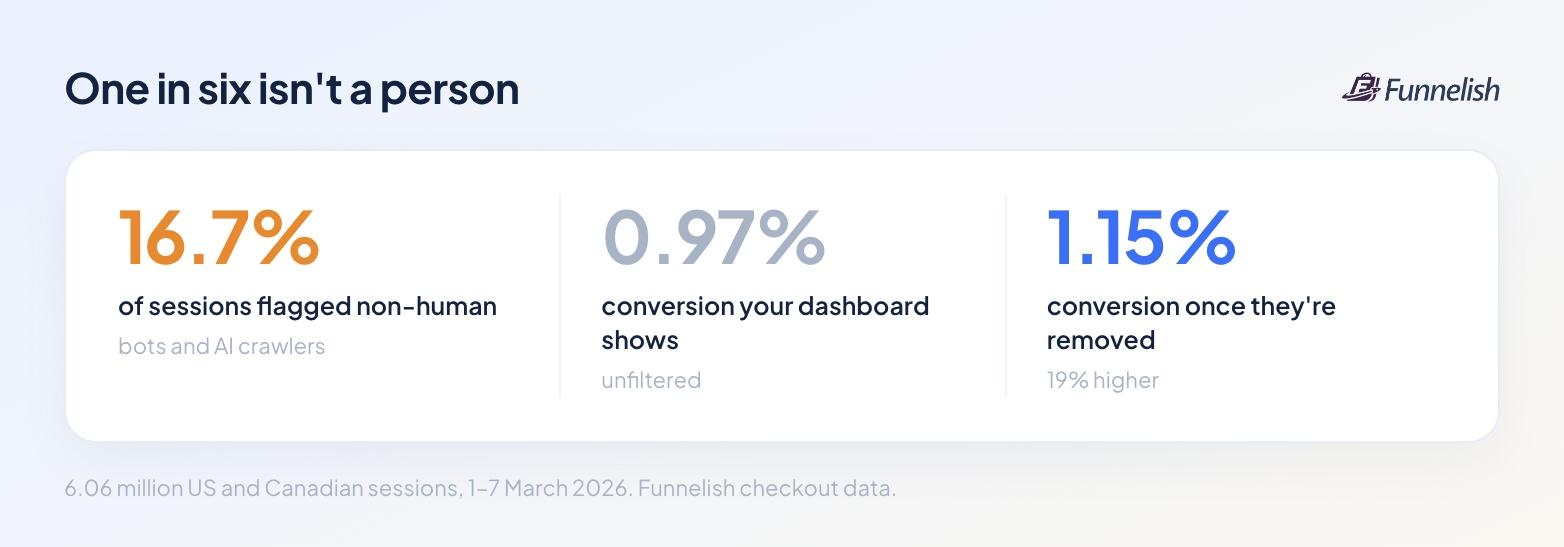
Agents are already in your analytics. Up to one in six sessions on a direct-to-consumer checkout is a bot or AI crawler. Filter them out and your real conversion rate is 19% higher than your dashboard says.
What Is Agentic AI in Ecommerce?
An agent is a model with tools and permission to use them. In ecommerce that's four capabilities, in rising order of risk:
Read. Pull your product data, reviews, stock and shipping times.
Reason. Compare options against a stated budget and constraint.
Act. Fill a cart, apply a code, start a return, open a support ticket.
Pay. Complete a transaction with the shopper's money.
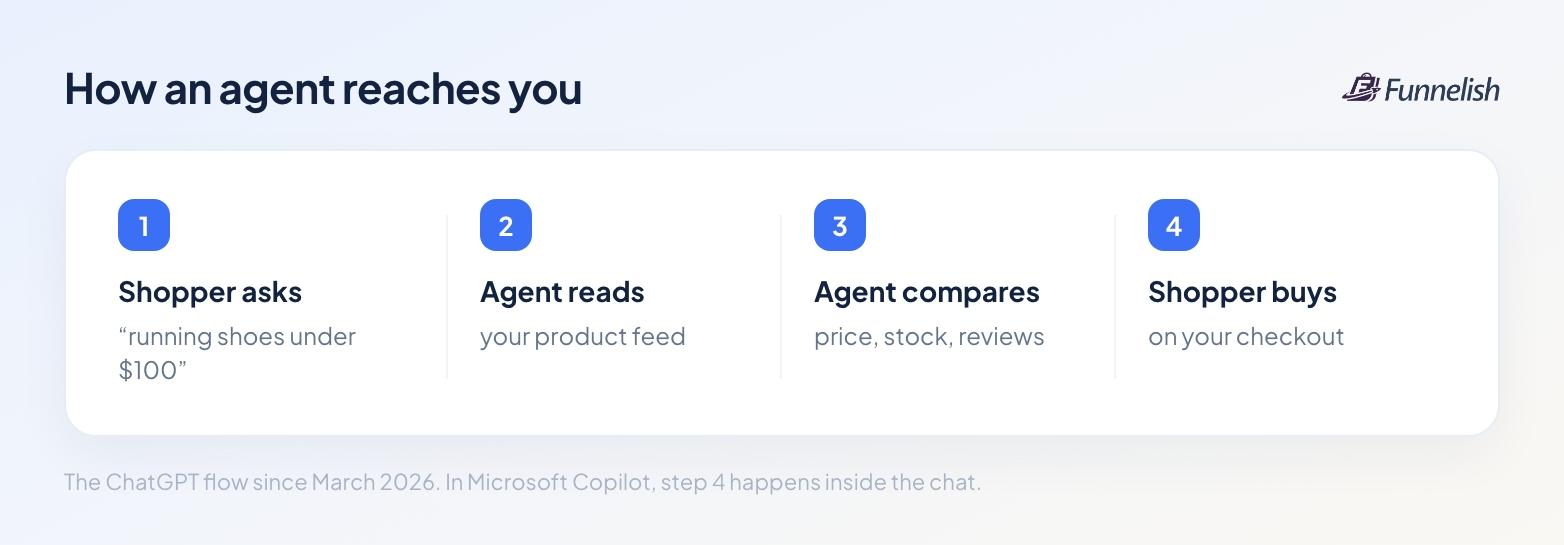
Today most agents stop at step three. Step four needs a payment credential the merchant will accept, plus a record proving the shopper authorized that exact purchase. The new protocols exist to supply both.
Agentic Commerce vs Traditional AI in Ecommerce
Traditional AI in ecommerce predicts and recommends. Agentic AI executes. The difference shows up in where the software runs and who it answers to.
Traditional AI | Agentic AI | |
What it does | Scores, ranks, recommends, predicts | Completes a multi-step task |
Who runs it | You, on your own site | The shopper, on a platform you don't control |
Where it runs | Inside your store | ChatGPT, Copilot, Gemini, Alexa |
What it needs from you | Your own data | A machine-readable product feed |
Example | A recommendation block on a product page | "Find me running shoes under $100 and compare three" |
How you measure it | On-site conversion lift | Referral traffic and orders from an AI source |
Main risk | A bad recommendation | Being absent from the comparison |
Put plainly: traditional AI improves the session you already have. Agentic AI decides whether you get the session at all.
How Is Agentic AI Used in Ecommerce Today?
Here's what's live, by platform, as of October 2026.
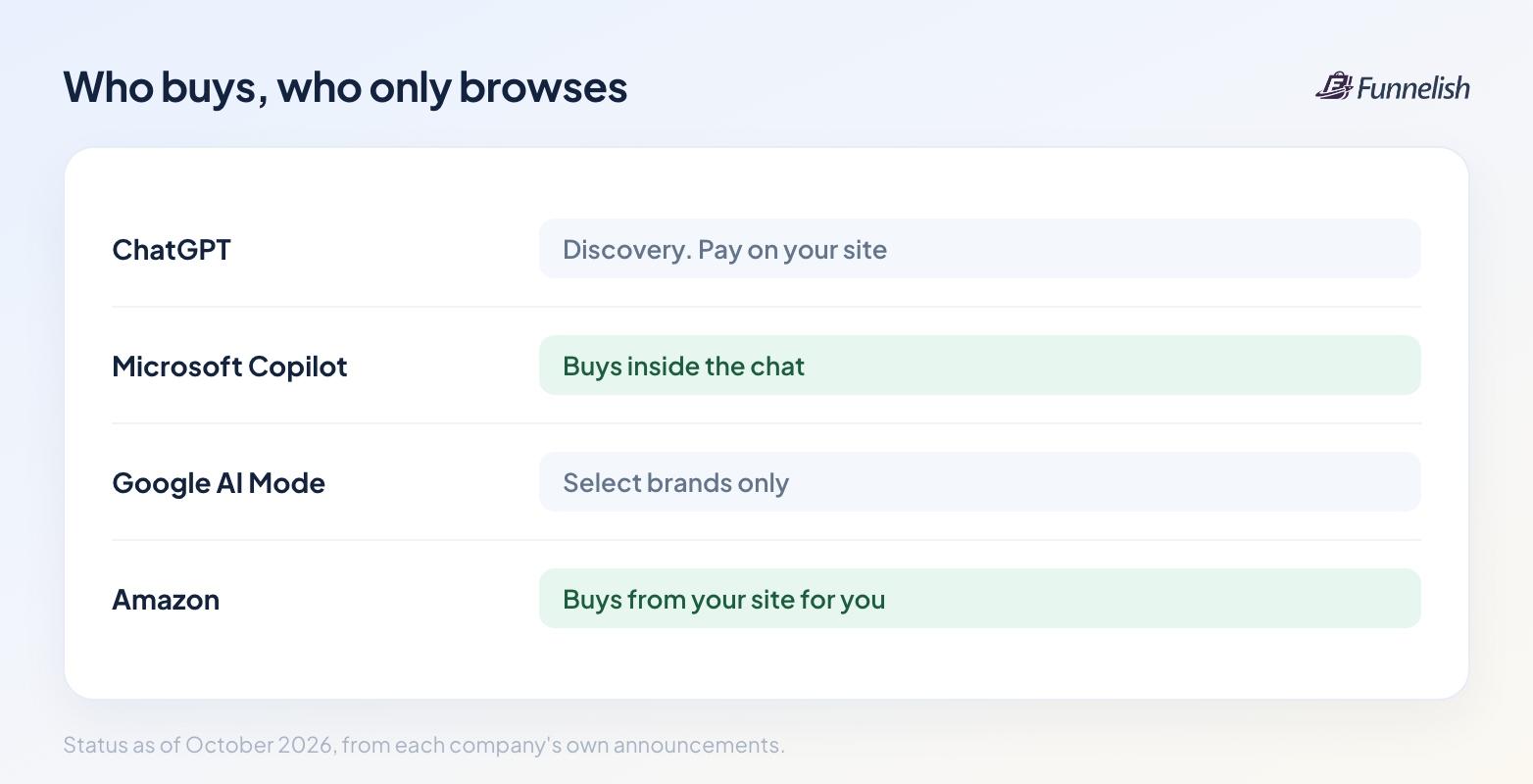
ChatGPT: discovery, with checkout on your site. OpenAI launched Instant Checkout with Etsy sellers on 29 September 2025, then changed direction. Since March 2026 ChatGPT shows products visually, compares them side by side, and sends the shopper to the merchant to pay. Target, Sephora, Nordstrom, Lowe's, Best Buy, The Home Depot and Wayfair feed it directly.
Microsoft Copilot: checkout inside the chat. Microsoft launched Copilot Checkout on 8 January 2026. Merchants stay merchant of record, and Microsoft takes no commission on those transactions. Eligibility is English-language merchants selling to US buyers in USD, with a Merchant Center account.
Google AI Mode and Gemini: select brands only. Native checkout runs on the Universal Commerce Protocol, with a wider rollout in progress.
Amazon: the most autonomous of the group. Amazon's shopping assistant, renamed Alexa for Shopping in May 2026, can buy from brand websites outside Amazon through Buy for Me. Eligible products there have grown from about 65,000 at launch to over 500,000. It also auto-buys items at a price you set. Amazon says more than 250 million customers used the assistant this year.
Shopify Catalog: the distribution layer. Shopify merchants are in ChatGPT by default through Agentic Storefronts, with no app, no feed and no extra transaction fee. Brands on other platforms can join Shopify Catalog through the Agentic plan.
Agentic AI Ecommerce News: 2025 to 2026 Timeline
Five things happened in thirteen months, and the order matters.
29 April 2025. Mastercard announces Agent Pay, which binds a card credential to a specific agent and consent policy through what it calls Agentic Tokens.
16 September 2025. Google publishes the Agent Payments Protocol with more than 60 partners, including American Express, Etsy, Mastercard, PayPal and Salesforce.
29 September 2025. OpenAI launches Instant Checkout and open-sources the Agentic Commerce Protocol.
14 October 2025. Visa launches the Trusted Agent Protocol, built with Cloudflare, which lets merchants tell legitimate agents apart from bots.
8 January 2026. Microsoft launches Copilot Checkout, with Shopify among its launch partners.
24 March 2026. OpenAI drops in-chat checkout and repoints its protocol at discovery. Shopify opens ChatGPT to millions of merchants the same day.
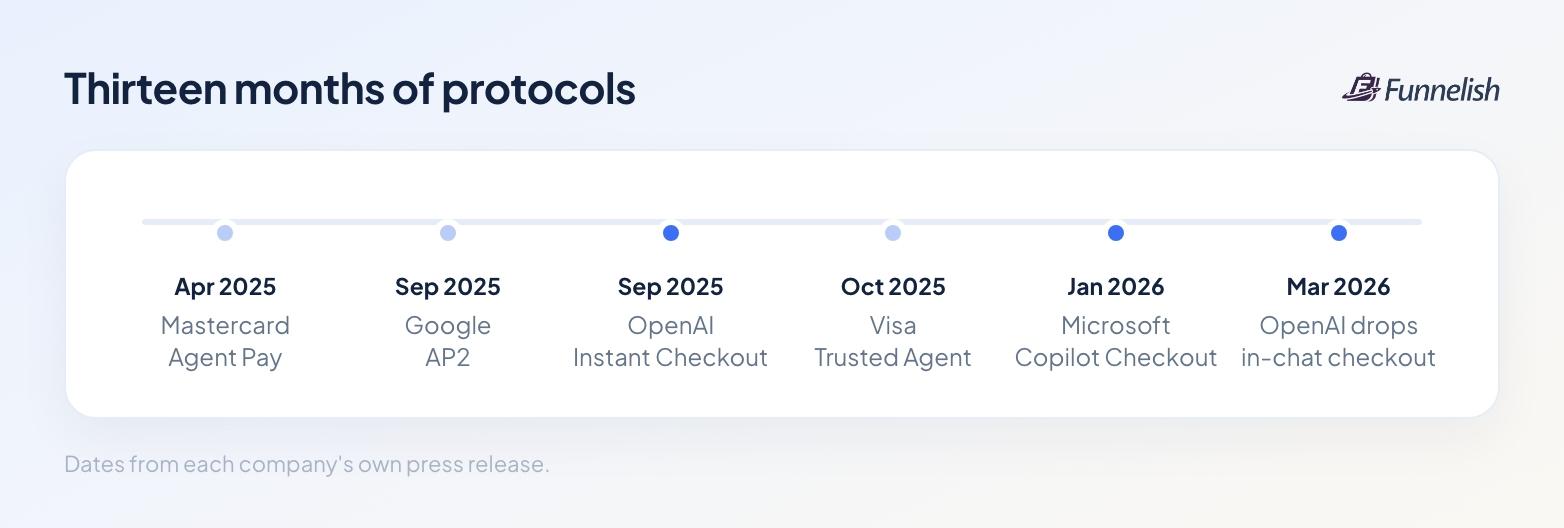
That's where agentic AI ecommerce 2026 stands: discovery scaled, payment didn't. OpenAI gave no public figure for how many merchants ever ran in-chat checkout, and its March announcement talks only about what replaced it.
Which Agentic AI Company in Ecommerce Matters to You
You don't need a relationship with all of them. You need to be readable by whichever ones your buyers use.
If you sell on Shopify in the US: you're already in ChatGPT. Check the ChatGPT referral attribution in your admin before you spend on anything else. A Shopify sync keeps your catalog and your funnel pages on the same product data.
If you run your own stack: submit a product feed to OpenAI and to Microsoft Merchant Center. Both are free, and both are US-first.
If you sell high-consideration products: discovery is where the money is. Shoppers use agents to narrow a shortlist, then buy on your site.
If you sell consumables: Amazon's Auto-Buy and reorder features are the competitive threat, because they remove the decision.
Skip the agentic AI platform vendors until your feed is correct. Buying more software won't fix a feed with wrong prices in it.
Agentic AI Ecommerce Automation in 2026: What to Automate Now
Four automations pay off before any agent integration does.
Product data that answers questions
Every attribute a shopper asks about belongs in text on the page: price, sizes, materials, shipping time, return window, what's in the box. A model reading your page should be able to answer "does this fit a 15-inch laptop" without guessing.
Feed hygiene on a schedule
OpenAI's product spec wants one row per purchasable variant, each with nine required fields:
Field | What goes in it |
item_id | A stable unique ID per item or variant. Don't reuse it. |
title | Product name, with the variant named when relevant |
description | Factual description of this specific item |
url | Product page for the item, with the variant preselected |
brand | Brand, as shown on the product page |
seller_name | Who's selling it |
image_url | Direct link to the main image of this variant |
availability | in_stock, out_of_stock, pre_order, backorder or unknown |
price | Regular price in major units, with a currency code |
Variants share a group_id and carry their own price, stock and URL. Nothing schedules itself. A sale that starts, or an item that sells out, has to be pushed. Stale stock data gets your product shown and then your order cancelled. That's worse than not appearing at all. Pull the feed from the same source as your store, through integrations instead of a spreadsheet somebody updates by hand.
Page speed
Agents and crawlers hit your pages far more than people do, and slow pages get dropped from the crawl. Page speed is a distribution problem now, as much as a conversion one.
Order handling that accepts inbound orders
If an agent sends an order, something has to accept it, check stock, and confirm. Order fulfillment that already runs on rules handles agent orders without a separate build.
Agentic AI for Ecommerce Enterprises in the US Market
Everything live right now is US-first. ChatGPT discovery, Copilot Checkout, Google's native checkout and Amazon's Buy for Me all launched in the US before anywhere else, and Microsoft's eligibility rules still name US buyers and USD.
For an enterprise selling into several markets, that means three things.
Your US catalog needs its own feed quality standard, because it's the one being read. Localized sites can follow once the protocols expand.
Attribution has to be set up before the traffic arrives. Orders from AI channels land as referrals, and if your analytics buckets them as direct, you'll conclude the channel does nothing.
A US-first rollout also tends to need its own pages and offers. Geo-targeted funnels let you serve a US-specific offer without duplicating the rest of the store.
Agentic AI and Customer Retention in Ecommerce
Agentic AI customer retention in ecommerce gets less attention than acquisition, and it's the side that changes more.
If an agent chooses for your customer, your retention doesn't run through their inbox any more. It runs through whether the agent still recommends you next time. Email still works, but now it competes with a system that remembers the last purchase and can repeat it in one step.
Three things hold up under that.
Reorder has to be one action. Amazon's reorder and Auto-Buy features set the standard here. A customer portal where past orders, tracking, subscriptions and a repeat button live behind one login is the direct equivalent
A subscription beats being remembered. A scheduled renewal doesn't depend on an agent recommending you again.
Your reasons to be chosen have to be in text. The same Shopify report found that 71% of regular AI users are likelier to choose an indie brand this year than last. Another 81% say they're choosing products that feel intentional. An agent can only relay what it can read. If your sourcing, your warranty or your return policy lives in a brand video, it doesn't reach the comparison.
What Agents Are Already Doing to Your Numbers
Funnelish checkout data covers 4.4 billion events and 64 million orders from 11,930 brands since 2022. Let's look at the main findings.
One in six sessions isn't a person
Across 6.06 million US and Canadian sessions in March 2026, 16.7% tripped at least one non-human rule. The rules cover declared bots, scraper and AI-crawler user agents, unlabelled webviews, and IPs opening more than 30 sessions a day. Those sessions carry 1.2% of orders. Filter them out and real conversion is 1.15% against the 0.97% an unfiltered dashboard reports, a 19% difference.
Buyers are fast, and agents make them faster
Half of US buyers go from first pageview to paid in under 6.4 minutes. Four in five finish inside 15 minutes. Only 4.5% take more than an hour. Someone arriving from an agent has already done the comparison, and a checkout that asks for an account and three screens spends time they haven't budgeted.
Checkout page is still where you lose them
Of every 100 shoppers who reach a checkout page, 90 leave before pressing Pay, one is declined, and nine buy. Better agent distribution sends more people to the same leak.
The spread this creates is wide. The median direct-to-consumer brand earns $2.02 per visitor; the best funnels earn $12 to $16, and the single best cleared $15.63 in March 2026 at 24% checkout conversion. Same traffic sources, same devices.
Checklist: Making Your Store Agent-Ready
Work through these in order. The first four are free.
Put every product attribute in page text. Price, availability, variants, shipping time, return window, materials.
Add Product, Offer and AggregateRating structured data, then validate it.
Submit a product feed to OpenAI and Microsoft Merchant Center, and refresh it daily. Shopify merchants are enrolled in both already.
Check your robots.txt isn't blocking the crawlers you want reading you.
Filter bot traffic out of your analytics before you judge any channel's conversion rate.
Set up referral attribution for AI sources, to keep those orders out of the direct bucket.
Cut your checkout to one screen on mobile, where 85% of checkout sessions happen.
Answer the comparison question on your own page. "How does this compare to X" is what people ask agents.
Publish your policies in text. Images and PDFs don't count.
Test it. Ask ChatGPT and Copilot for your own product category and see whether you appear.
Agentic AI Ecommerce FAQ
What is agentic AI in ecommerce?
Software that completes shopping tasks for a person: searching, comparing, adding to cart, and sometimes paying. It takes actions instead of only answering questions.
Can AI agents buy from my store right now?
In Microsoft Copilot, yes, if you're eligible and enrolled. In ChatGPT, the agent sends the shopper to your checkout. Amazon's assistant can buy from third-party stores through Buy for Me.
What's the difference between agentic commerce and traditional AI in ecommerce?
Traditional AI recommends inside your store. Agentic AI acts on a platform you don't control, and it reads your product feed instead of your site design.
Do I need to join a protocol?
Not directly. Shopify merchants are in ChatGPT by default. Everyone else submits a product feed. That's the practical entry point.
How much does it cost?
Shopify charges no transaction fee beyond standard processing for ChatGPT. Microsoft takes no commission on Copilot Checkout. Feeds are free to submit.
Is agentic AI driving real sales yet?
Some. Shopify published merchant figures for the 2026 season showing AI-referred sales up 276% year over year at one brand and roughly tripled at another. Those are individual brands. They aren't an average.
Do shoppers let agents buy for them?
Mostly not. About a third say they trust an agent to complete a purchase, against 65% who'll use AI somewhere in the shopping process.
How do I track AI traffic?
Set referral attribution for the AI sources, then filter bots. Both matter: one in six sessions isn't human, and counting those as lost customers makes every channel look worse than it is.
Will agents hurt my brand or my margin?
They compress comparison. A shopper who'd have visited five sites now sees five products side by side, which raises the weight on price, reviews and clear information.
What should an enterprise do first?
Fix the US feed, set up attribution, then measure. The protocols are US-first and that order hasn't changed.
Start With the Feed
The work that matters here is unglamorous. Accurate product data in text, refreshed daily, on pages that load fast, behind a checkout that doesn't lose nine of every ten visitors. That's the same list whether your next shopper arrives from an ad, a search result or an agent.
Funnelish covers the back half of it: fast funnel pages, a one-screen mobile checkout, order handling that accepts inbound orders, and analytics that separate real visitors from crawlers. See how it works, or start a free trial and build one agent-ready product funnel this week.
Table of contents
Boost your eCommerce
sales today

24/7 support
No credit card required
Cancel anytime
24/7 support
No credit card required
Cancel anytime
