

Black Friday Marketing Strategy for 2026: Plan, Offers, and Timing
19 October 2026
Anna P.
13 minutes
Black Friday is 27 November 2026. Cyber Monday is 30 November. That's about five weeks from now, which is enough time to build offers and sequences, and not enough to rebuild your store.
This is what the 2025 numbers actually showed, and what to do with the weeks you have.
TL;DR
The weekend is bigger and later. Cyber Monday 2025 hit $14.25 billion in US online sales and beat Black Friday by $2.45 billion. Adobe expects Cyber Monday 2026 to pass $15 billion.
Don't discount deeper than your category. Adobe's 2026 peaks: 30% on electronics, 29% toys, 23% apparel, 18% furniture. Going past that buys you volume you can't afford.
Raise the order instead. A post-purchase upsell adds 18% to the order on Funnelish checkouts, and it runs after payment, so it can't cost you the sale.
AI search is now a real channel. Traffic to US retail sites from AI tools grew 693.4% over November and December 2025. Those visitors converted 38% better than everyone else on Black Friday.
Mobile is the whole game. Salesforce put mobile at 70% of global orders during Cyber Week 2025.
Plan for the night shift. Payment acceptance drops from about 89.5% in the day to 83.6% at 3am Eastern, and card-testing bots pick holiday weekends.
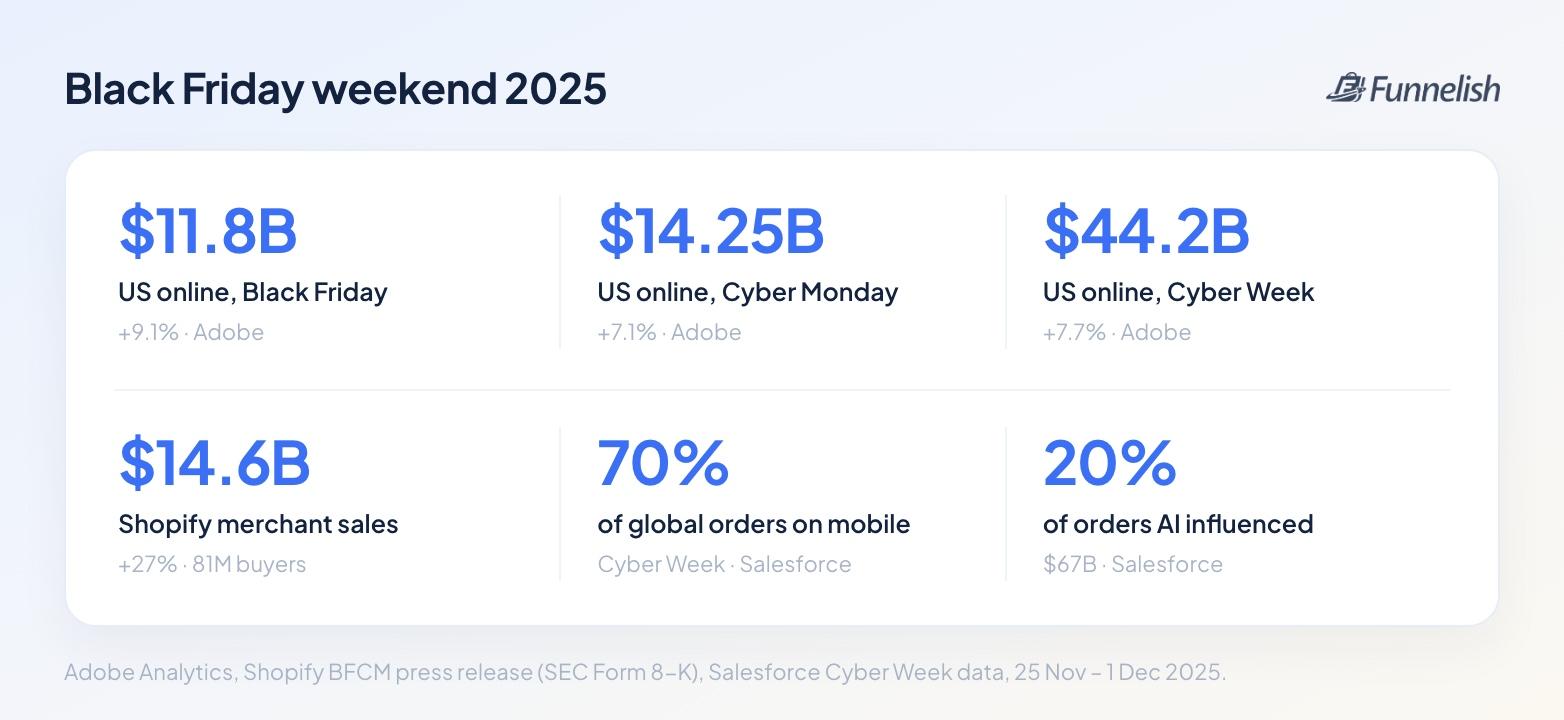
Black Friday weekend 2025, from Adobe, Shopify and Salesforce.
What the 2025 Numbers Showed
Adobe, Shopify and Salesforce all published numbers on last year's weekend, and they agree on direction.
Adobe's Cyber Monday recap put US online spending at $11.8 billion on Black Friday, up 9.1%. Cyber Monday came in at $14.25 billion, up 7.1%, the biggest online shopping day ever recorded in the US. The full Cyber Week came to $44.2 billion.
Shopify merchants did $14.6 billion over the weekend, up 27% year over year, from more than 81 million buyers. Their BFCM press release puts the average cart at $114.70 and the peak at $5.1 million a minute at 12:01pm Eastern on Black Friday. Shop Pay took 32% of orders.
Salesforce's Cyber Week data puts global spending at $336.6 billion, up 7%, with the US at $79.6 billion. Two numbers from them matter more than the headline: mobile drove 70% of orders worldwide, and AI and agents influenced $67 billion of sales, about 20% of global orders.
Adobe's 2026 forecast expects $275.1 billion for the full November to December season, up 6.7%, with Cyber Week at $47.5 billion. The 2025 season finished at $257.8 billion.
Black Friday Marketing Strategy: Short Version
If you read nothing else, this is the plan.
Pick your discount from your category's peak, and go no deeper.
Build one hero offer, not twelve. Bundles and quantity breaks beat sitewide percentages.
Open early November with a warm-up offer, hold your real deal for the weekend.
Put a post-purchase upsell behind every order.
Send fewer, better emails, and segment by what people browsed.
Test your checkout under load this week, not on the day.
Black Friday Ecommerce Strategy: Start in Early November
The season no longer starts on Black Friday. Adobe forecasts $95.8 billion of US online spending in October 2026 alone, and Prime Big Deal Days on 6 and 7 October already pulled a projected $9.9 billion out of the month.
Adobe's forecast has discounts ramping through the season, and your calendar should match:
Early November: up to 14% off. Warm-up offers, email list building, retargeting pools.
Just before Thanksgiving: up to 21%. Early access for subscribers.
Cyber Week: up to 30%. Your real offer.
December: 10% to 15%, for the shipping-deadline crowd.
Launching your deepest discount in early November means spending five weeks of traffic on a price you can't improve on later.
Black Friday Deals Marketing Strategy: How Deep to Discount
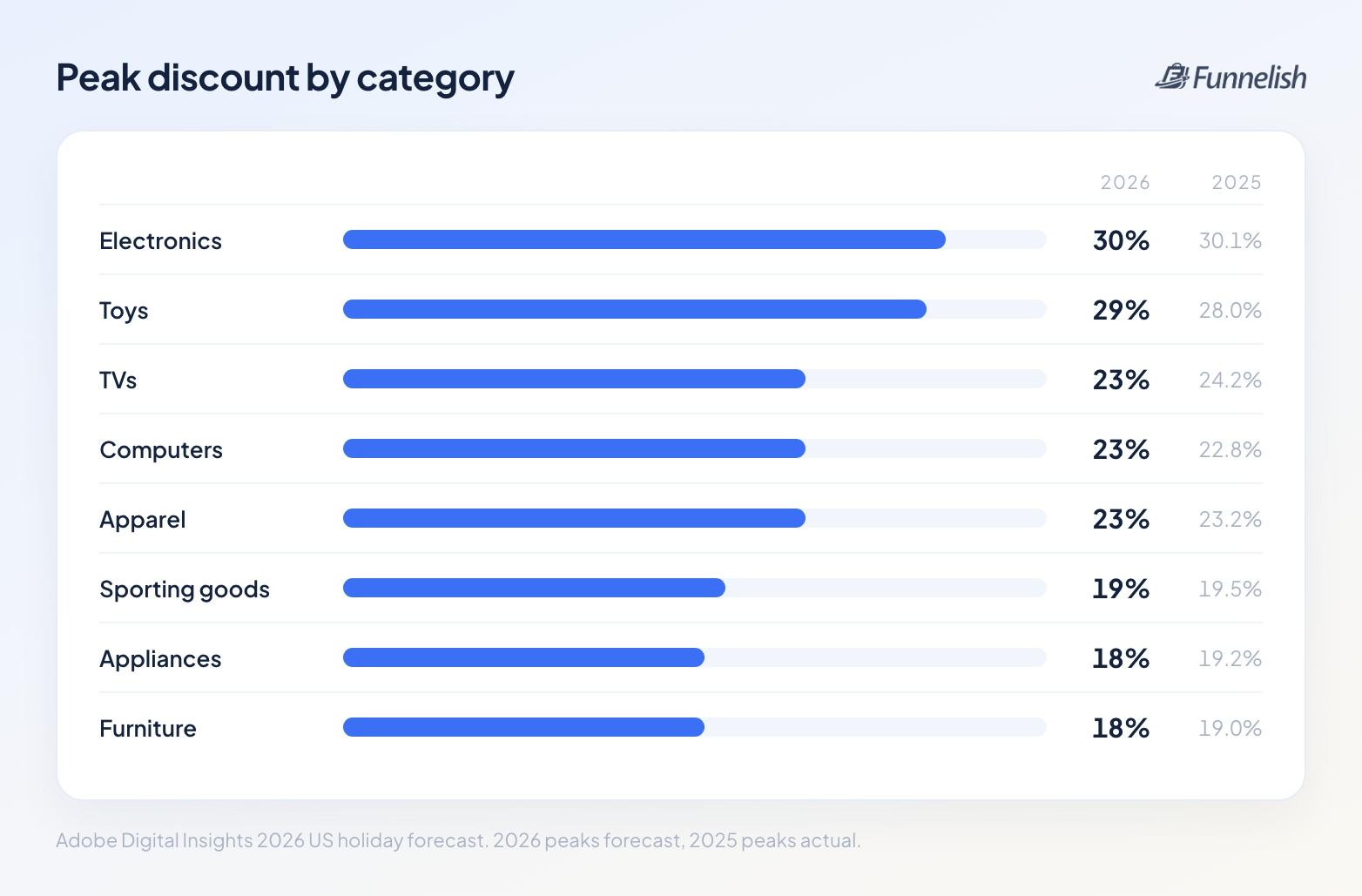
Adobe's peak discount forecasts for 2026 give you the number your competitors will land on.
Electronics peaks at 30%, toys at 29%, TVs at 23%, computers at 23%, apparel at 23%, sporting goods at 19%, appliances at 18%, furniture at 18%.
Match your category and stop. A 40% sitewide discount in a 23% category doesn't win the comparison, it just moves your margin to the customer. And the damage runs past the weekend, because a shopper who bought at 40% waits for 40% next time.
A better move is to raise what the order is worth instead of cutting what it costs. Product bundles let you show a real saving on a basket the shopper wouldn't have built. The headline discount on the bundle can sit well above your single-item discount without touching your margin per unit.
Black Friday Email Strategy
Email is still the channel you own, and the mistake to avoid is volume.
Send a pre-sale email to subscribers 48 hours before the public deal goes live, and give them something the public doesn't get: early access, a bigger bundle, free shipping. It costs nothing to make, and it gives your warmest list a reason to buy before the discount is everywhere.
Over the weekend, send on three triggers rather than on a schedule:
Browse abandonment. Someone viewed a product and left. Send the product.
Cart and checkout abandonment. Nine of every ten shoppers who reach a checkout page leave before pressing Pay. An abandoned cart sequence is worth setting up before the weekend, because that's where the volume is.
Post-purchase. Thank them, then offer the thing that goes with what they bought.
Segment by behavior, not by list. Someone who bought in the last 30 days needs a different email from someone who hasn't opened anything since July.
Black Friday Paid Ads Strategy
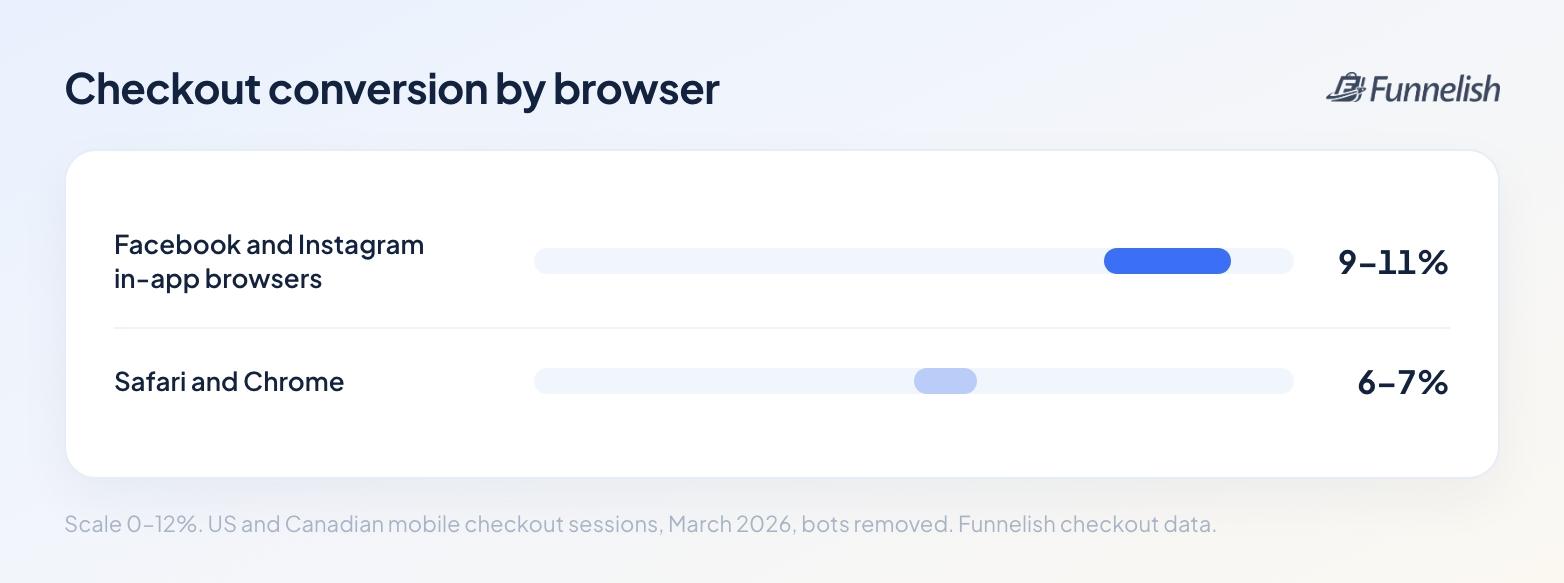
Your paid traffic on Black Friday arrives on a phone, inside a social app, with a credit card already saved. That's a different shopper from the one who typed your URL.
Funnelish checkout data shows it clearly. 85% of checkout sessions are on a phone and 42% arrive inside a social app's built-in browser. The Facebook and Instagram in-app browsers convert at 9 to 11%, against 6 to 7% for native Safari and Chrome. The shopper who just tapped your ad is further along than one arriving from a bookmark.
Three things follow from that.
Send ad traffic to a page built for the offer, not to your homepage. A dedicated funnel for the Black Friday deal removes every click between the ad and the order form.
Budget for the hours that convert. Across Funnelish data, 10am Eastern is the peak hour at 7% of the day's orders, and 8am to 2pm carries 36% of them. The only dead zone is 1am to 5am.
Watch your conversion rate against filtered traffic. One in six visits to a direct-to-consumer checkout is a bot or crawler, which makes your dashboard conversion rate look worse than your real one.
Black Friday Social Media Campaign Strategy
Salesforce counted social as 15% of global retail traffic during Cyber Week 2025, and 16% in the US. Adobe, measuring a different panel, put social at 3.6% of Cyber Monday revenue, up from 2.3% a year earlier.
The two don't line up exactly, but the shape is the same: social brings a lot of visits and closes few of them directly. Use it to fill the retargeting pool. Run discovery content through November, then retarget everyone who engaged with the actual offer during the weekend.
Post the offer itself instead of a teaser. Shoppers comparing deals in a feed need the price and the product in the first frame.
Black Friday AI Overviews Strategy
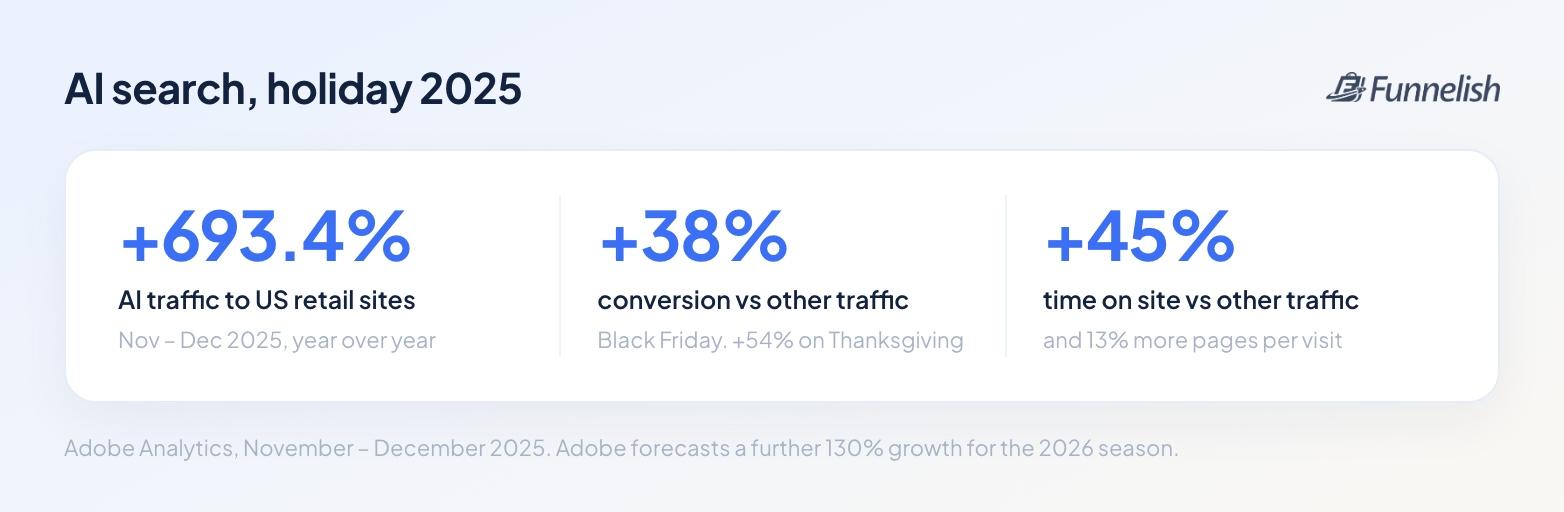
This is what changed most between 2024 and 2026.
Traffic to US retail sites from generative AI tools grew 693.4% across November and December 2025, and retail grew faster than any other industry at 769% in November. Adobe's data shows those visitors behaved better than average too: 45% more time on site, 13% more pages per visit, 33% less likely to bounce straight off. They converted 31% better than other traffic across the season, 54% better on Thanksgiving and 38% better on Black Friday. Adobe expects another 130% growth this year.
That's a visitor arriving with the question already formed. Your product page is being read by a model before a person sees it, and the person lands expecting an answer.
What that means in practice:
Put specifications in text. Price, sizes, materials, shipping times, return window. Text on the page is far more reliable to extract than text baked into an image.
Answer the comparison question on your own page. "How does X compare to Y" is what people ask assistants. If your page answers it, you get cited.
Keep your deal terms machine-readable. Dates, discount percentage, exclusions, in plain text near the offer.
Use structured data. Product, offer, price and availability markup is what gets pulled.
Treat your top ten product pages as the ones that need this. You won't finish the catalog in five weeks.
Black Friday PR and SEO Combined Strategy
Both channels need lead time you've mostly spent, so use them for the one thing they do quickly.
Publish your Black Friday deal page now and keep the same URL every year. It accumulates links and history, so by next November it has something behind it that a page published on the day doesn't.
For PR, gift guides and deal roundups are built in October and early November. The ones still open this late are the smaller newsletters and niche publications in your category, and they're worth the outreach because their audiences buy. Pitch the product and the price, don't pitch the brand story.
Black Friday Countdown Timer Strategy
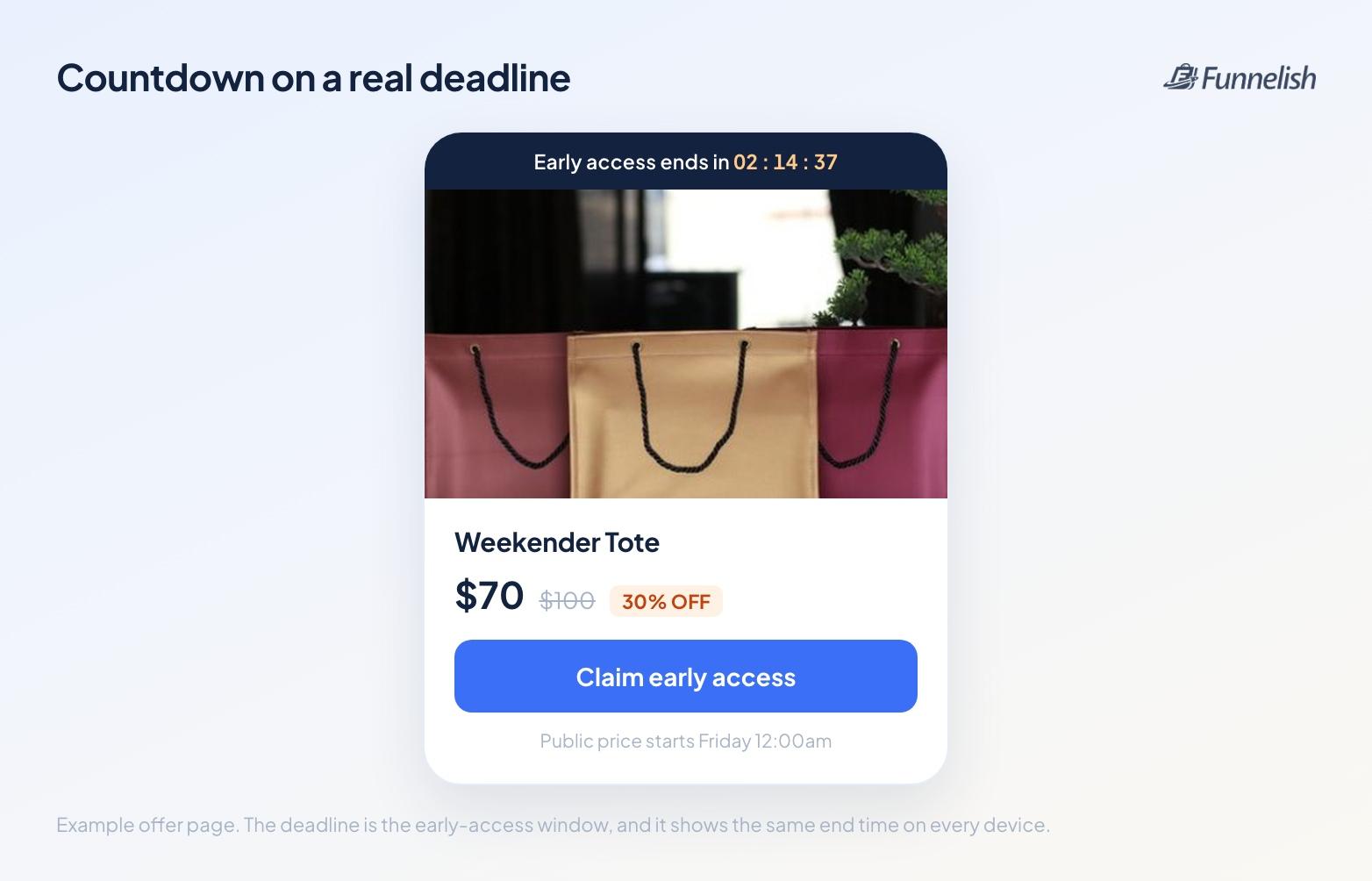
A countdown works when the deadline is real and shows the same end time on every device.
Countdown timers work when the deadline is real, and they cost you trust when it isn't.
Use one for an offer that genuinely ends: the early-access window closing, the bundle ending at midnight, free shipping cut-off before the shipping deadline. Put it on the offer page and in the email, with the same end time in both.
Don't use a rolling timer that resets per visitor on an offer that runs all weekend. Shoppers compare across devices during this week, and a timer showing 14 minutes on a phone and 22 minutes on a laptop is the kind of thing that gets screenshotted.
A real deadline also solves your Cyber Monday problem. If Black Friday pricing ends Saturday and Cyber Monday pricing starts Sunday night, both days have a reason to exist.
Amazon Black Friday Strategy and Pricing
If you sell on Amazon as well as direct, the two need different pricing logic.
On Amazon you're competing inside a comparison page, so your price has to be defensible against the other results in that grid. Lightning deals and coupons move units, and you'll be bidding against every other seller for the same placements.
On your own store you're not in a grid, which means the comparison is yours to frame. Bundle, add a gift, extend a warranty, or offer a subscription price the marketplace listing doesn't have.
One pricing rule crosses both: don't let your own store undercut your Amazon listing by more than your Amazon fee. You'll lose the Buy Box, and the traffic you win direct rarely covers what you lose in marketplace rank.
Shopify Black Friday Strategy
Shopify merchants did $14.6 billion last year, and the numbers inside that release point at what to fix.
Shop Pay took 32% of orders and grew 39% year over year. If you haven't enabled accelerated checkout, it's an hour of work against a third of orders.
Cross-border was 16% of global orders. Check that your international shipping rates and duties are set before the weekend, because a surprise charge at checkout on Black Friday is a cart you don't get back.
The average cart was $114.70. If yours sits well below that, the fastest fix isn't traffic, it's what you offer after the first item goes in. A Shopify sync that lets you run funnel pages and upsells against your existing catalog gets you there without a replatform.
Black Friday Cyber Monday Strategy: The Weekend Itself
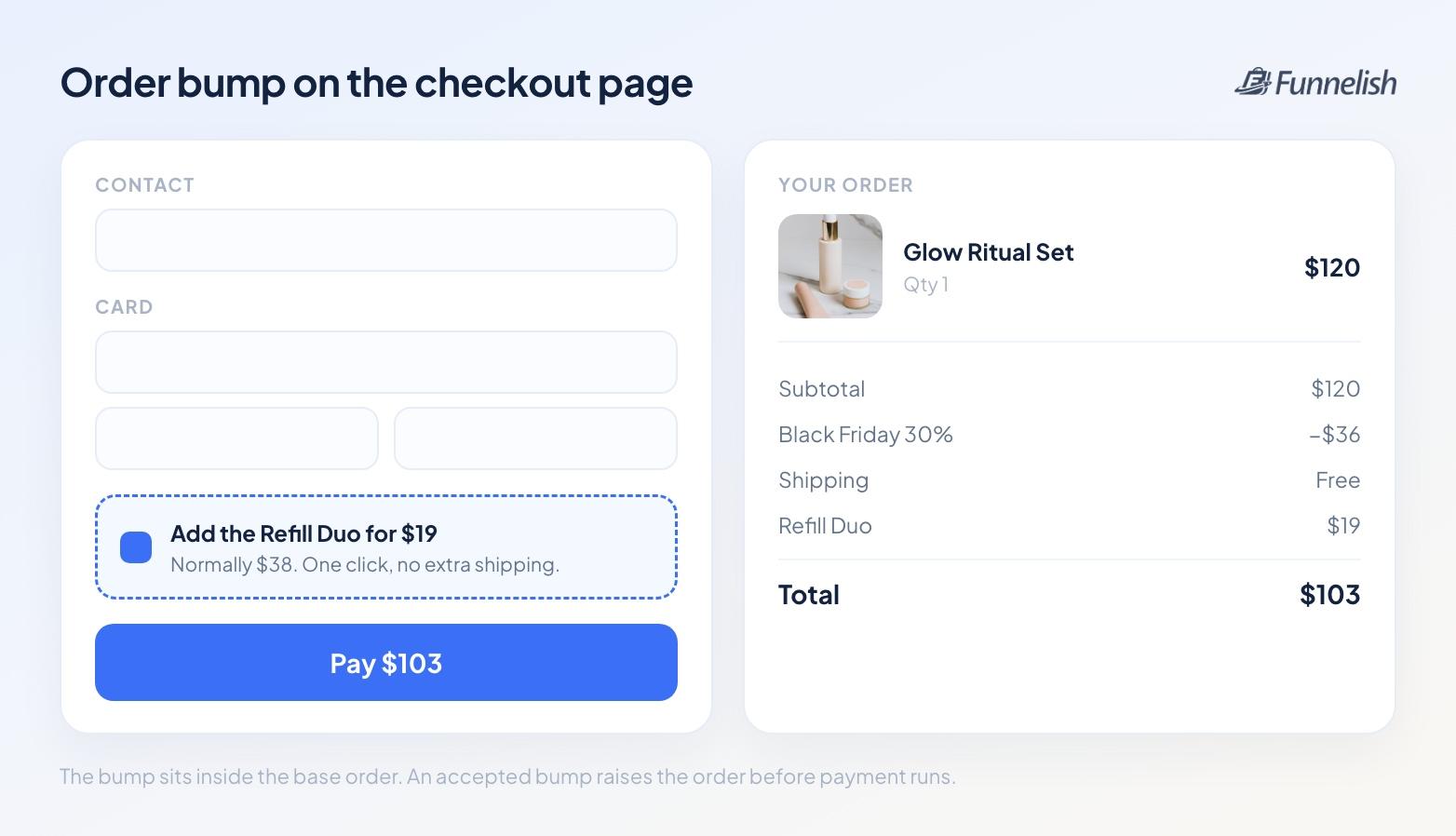
The offer is decided by now. What's left is whether the money arrives.
Put a post-purchase upsell behind every order
On Funnelish checkouts, 21.6% of US buyers accept one, and it adds 18% to the order. The best quartile of funnels gets 30% acceptance and adds 33%. The offer runs after payment has gone through, so a declined upsell can't cost you the original order. Our guide to upsell techniques covers the offer design.
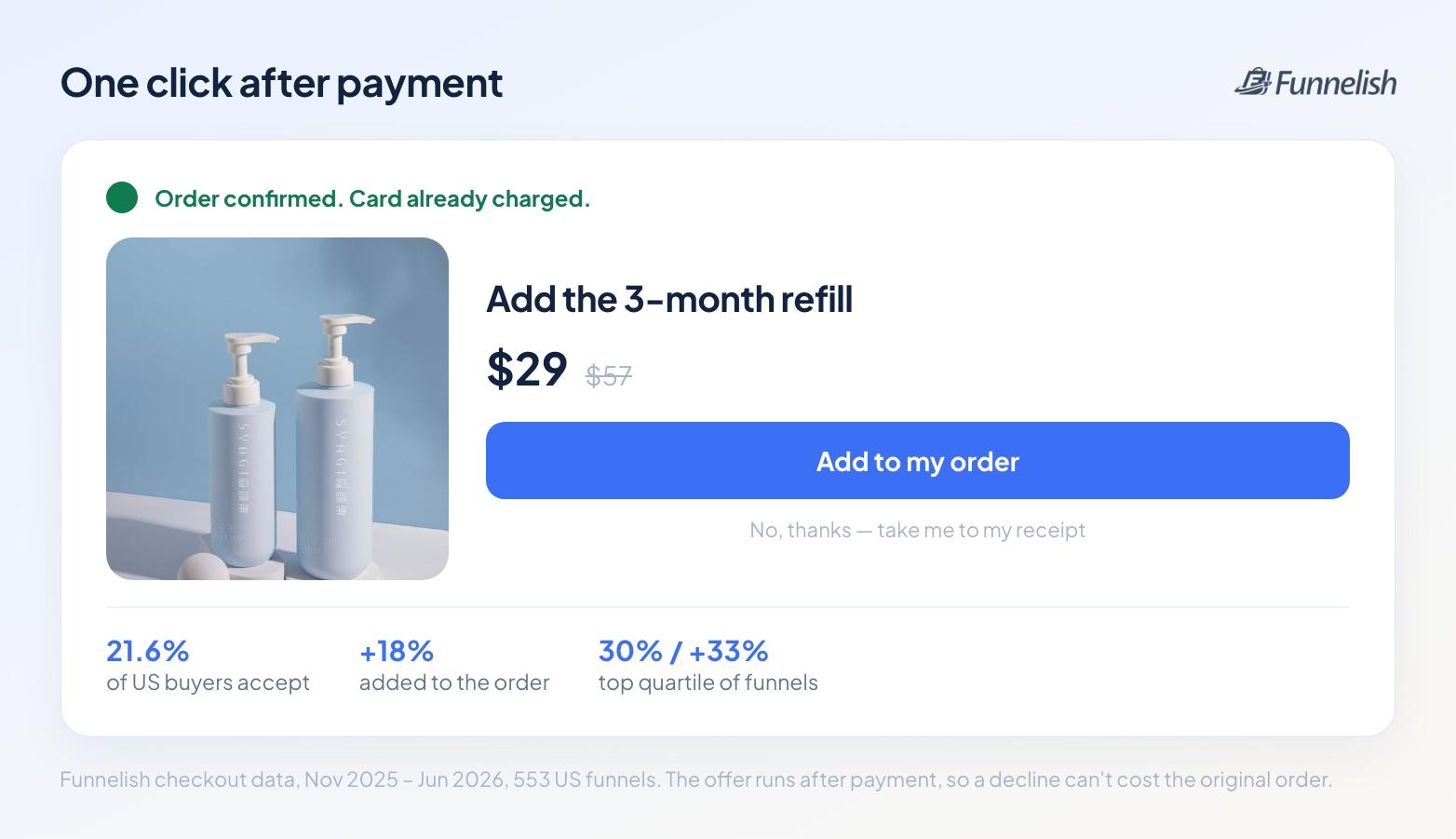
The one-click upsell runs after payment has gone through.
Fix the checkout page before you buy more traffic
Of every 100 shoppers who reach a checkout page, 90 leave before pressing Pay, one is declined, and nine buy. (Funnelish data) The payment isn't where you're losing them.
Plan for declines at night
Payment acceptance holds near 89.5% through the day and falls to 83.6% at 3am Eastern, because issuing banks get more suspicious overnight. (Funnelish data) On a weekend where people shop at 2am, that's real money. Payment routing sends a declined charge to a second gateway instead of letting it fail.
Expect card testing
Any checkout that accepts raw cards gets attacked, and holiday weekends are when it happens. An attack inflates your decline rate overnight, which is the first thing your processor's risk model sees. Velocity rules before the weekend, not after.
Watch four numbers on the day, and nothing else
Orders, conversion rate on the checkout page, payment acceptance, and upsell take rate. Analytics that breaks those out separately is what lets you fix something at 2pm instead of finding out on Monday.
Customer Retention Strategy for Black Friday
Black Friday buyers are a hard cohort to keep, and that's fine as long as you plan for it.
They came for a price, and a discount-led first order tells you nothing about whether they'll pay full price later. Three things move that:
Make the second order easy to place. A customer portal where order history, tracking and reordering live in one place stops the second purchase depending on whether they opened a campaign email.
Put consumables on subscription at checkout. A subscription offer presented with the first order reaches them while they're already buying.
Start the follow-up in December, not in February. The window where a Black Friday buyer still remembers you is short, and a January reactivation campaign is already late.
Black Friday Marketing Strategy FAQ
When is Black Friday 2026?
Friday 27 November 2026. Cyber Monday is 30 November.
What's the best Black Friday marketing strategy for a small store?
One hero offer, a pre-sale email to your list, a post-purchase upsell, and a checkout you've tested. 90 of every 100 shoppers who reach a checkout page leave before pressing Pay, so test that page first.
How much should I discount on Black Friday?
Match your category's peak and stop. Adobe forecasts 30% on electronics, 29% toys, 23% apparel and 18% furniture for 2026.
When should I send Black Friday emails?
A pre-sale email 48 hours before the public deal, then trigger-based sends over the weekend for browse abandonment, cart abandonment and post-purchase.
Is Black Friday or Cyber Monday bigger?
Cyber Monday. It did $14.25 billion in US online sales in 2025 against Black Friday's $11.8 billion.
Does AI search matter for Black Friday?
Yes. AI-referred traffic to US retail sites grew 693.4% across November and December 2025, and converted 38% better than other traffic on Black Friday.
What's a good Black Friday conversion rate?
Compare against your own filtered traffic. Up to one in six checkout visits is a bot, so your dashboard number is lower than your real one.
Should I use a countdown timer?
Only on a deadline that's real and identical across devices. A rolling per-visitor timer on an all-weekend offer costs trust.
How do I keep Black Friday customers?
Make reordering easy, offer a subscription at checkout on consumables, and start the follow-up in December.
What breaks most often on Black Friday? Payment acceptance at night, checkout page speed under load, and international shipping rates that weren't set.
Black Friday Checklist
Work backwards from 27 November.
Now. Pick your category's peak discount and build one bundle at that price. Publish the deal page at the URL you'll reuse every year, with the dates, the discount and the exclusions written out in text.
Four weeks out. Build the post-purchase upsell and the order bump. Price the upsell near the base order, which is where the Funnelish median sits.
Three weeks out. Connect a second gateway and push a declined card through it to check the routing works. Set velocity rules while you're in there.
Two weeks out. Open your own ad on a phone, inside the Instagram browser, and buy something. Time every step.
One week out. Load-test the checkout page. Set international shipping rates and duties.
48 hours out. Send the pre-sale email to your list.
On the day. Watch orders, checkout conversion, payment acceptance and upsell take rate. Nothing else.
Funnelish covers the funnel pages, the one-click upsells and the gateway routing in one place, and it syncs with your Shopify catalog, so nothing needs replatforming this close to the weekend. Start a free trial and get your Black Friday funnel live this week.
Table of contents
Boost your eCommerce
sales today

24/7 support
No credit card required
Cancel anytime
24/7 support
No credit card required
Cancel anytime
