

Ecommerce Advertising in 2026: Platforms, Creative, Budgets and What Changed
25 October 2026
Anna P.
20 minutes
Ecommerce advertising is paid placement that sends people to a page where they can buy. That's the whole definition. Everything else is a choice you're making about where you pay, what you show, and where you send the click.
Below: what each platform changed in 2026, which creative DTC brands are running, what to budget, and why two brands can buy the same clicks and keep very different amounts.
TL;DR
US digital ad spend hit $294.6 billion in 2025, up 13.9%. Social grew fastest at 32.6%.
The platforms are automating delivery, and giving back switches. Google is migrating Shopping and Dynamic Search Ads into AI Max. Meta reports a 24% lift in incremental conversions from its new attribution model. TikTok's Smart+ now lets you switch automation on and off per module.
Ad traffic converts better than it gets credit for. On Funnelish checkout data, Facebook and Instagram in-app traffic converts at 9% to 11% against 6% to 7% for Safari and Chrome.
You'll gain more by fixing your funnel than your targeting. The median DTC brand earns $2.02 per visitor. The top 10% earn $5.70 on the same device mix and the same approval rates.
Half of US buyers decide in under 6.4 minutes. Four in five finish inside 15.
What Is Ecommerce Advertising?
Ecommerce advertising is buying attention and sending it to a page that sells something. You'll pay per click, per thousand impressions, or per order, depending on the platform and the objective you pick.
It splits into four buckets:
Search. Someone types what they want. You bid to appear. This is ecommerce PPC advertising in its original form.
Social. Nobody asked to see your ad. You interrupt, and the ad has to hold someone who was scrolling past.
Retail and commerce media. You pay a retailer to show your product on their site.
Programmatic. You buy inventory across the open web through an auction, using your own data to decide who sees it.
Paid advertising for ecommerce differs from brand advertising in one way that matters: you can measure the order. That's true across ecommerce digital advertising, and it's why online advertising ecommerce budgets get reviewed weekly while brand budgets get reviewed once a year. Online advertising reporting runs on that cadence. You see the result in days. That changes what you optimize and how fast you move.
How Ecommerce Advertising Works
Here's how ecommerce advertising works, in the four things that happen between your budget and an order.
You define who to reach. On most platforms in 2026 you define this loosely and let the system find people.
You submit creative. Images, video, product feed, or all three.
The auction runs. Your bid, your predicted click-through and your landing page experience decide whether you win the impression and what you pay.
The click lands. Everything after this point is yours, and it's where the money is won or lost.
Ecommerce Advertising Trends 2026
Five things changed this year, and they all push the same way: toward the feed and away from the targeting panel.
Google is folding manual controls into AI Max. Shopping campaigns can upgrade to AI Max in one click, with product targeting and bidding carried over. Dynamic Search Ads are being migrated into it. The system reads your Merchant Center feed and generates ads for conversational queries you didn't add as keywords.
Meta is spending its gains on ranking models. Its January 2026 post reports a 24% lift in incremental conversions from a new attribution model. Doubling the GPUs used for training lifted Facebook ad clicks 3.5%, and its video generation products reached a $10 billion run-rate.
TikTok gave control back. Smart+ now lets you turn automation on or off per module: targeting, budget, placements, catalog. TikTok reports a 29% CPA improvement against manual campaigns in testing. That's TikTok's own number from its own tests.
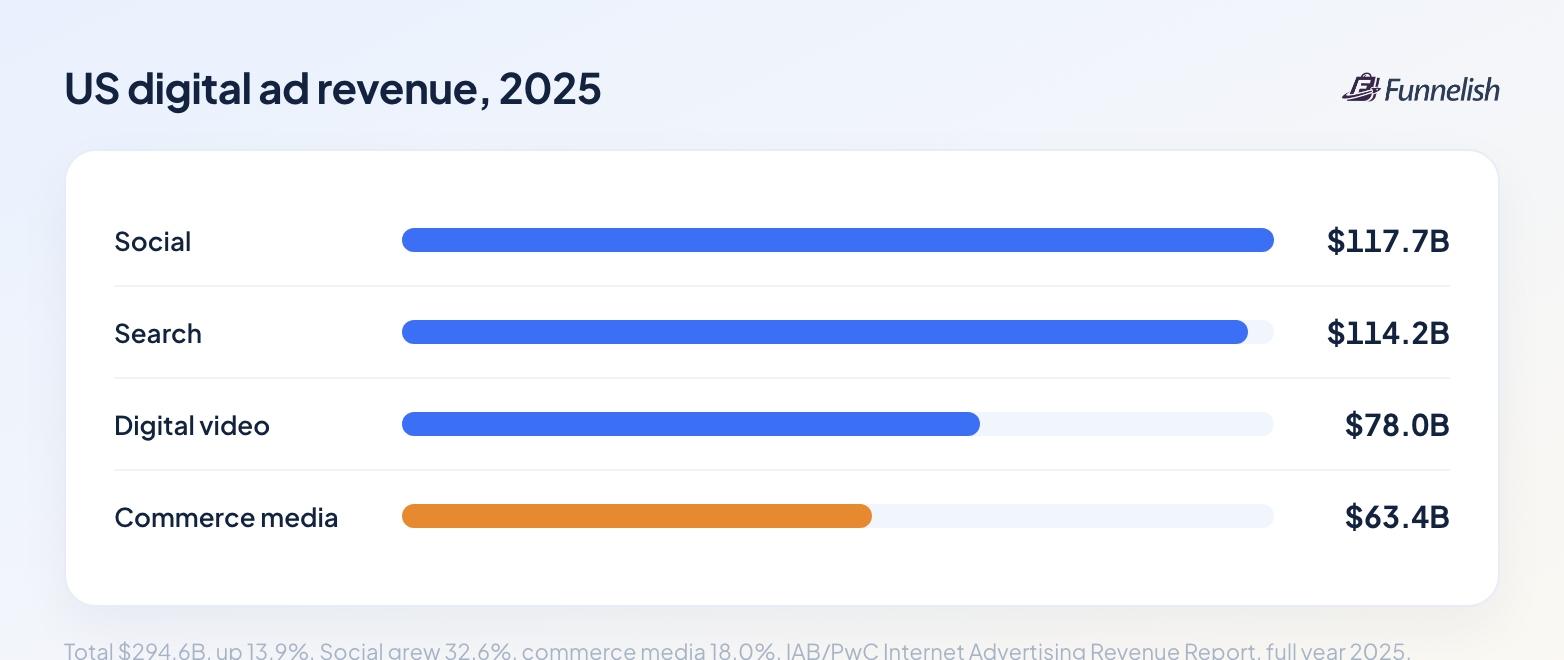
Commerce media became a channel you can't skip. It reached $63.4 billion in the US in 2025, up 18.0%.
Feeds got more important than targeting. Every one of the above reads a product feed. Your prices, stock and attributes now decide what gets shown. That's a different job from writing ad copy.
Read more: Google Ads for Ecommerce in 2026: Strategy Guide
Ecommerce Advertising News Worth Acting On
A lot of ecommerce advertising news is a feature announcement you can ignore. The five above aren't. Google's migration and Meta's model changes happen to your account whether you act or not. The other three are decisions you have to make.
Best Advertising Platforms for Ecommerce
There's no single answer here. The ecommerce advertising platforms below each do one thing well.
Win one before you add a second. Revisit your choice of advertising platform for ecommerce once a year. Quarterly churn teaches you nothing.
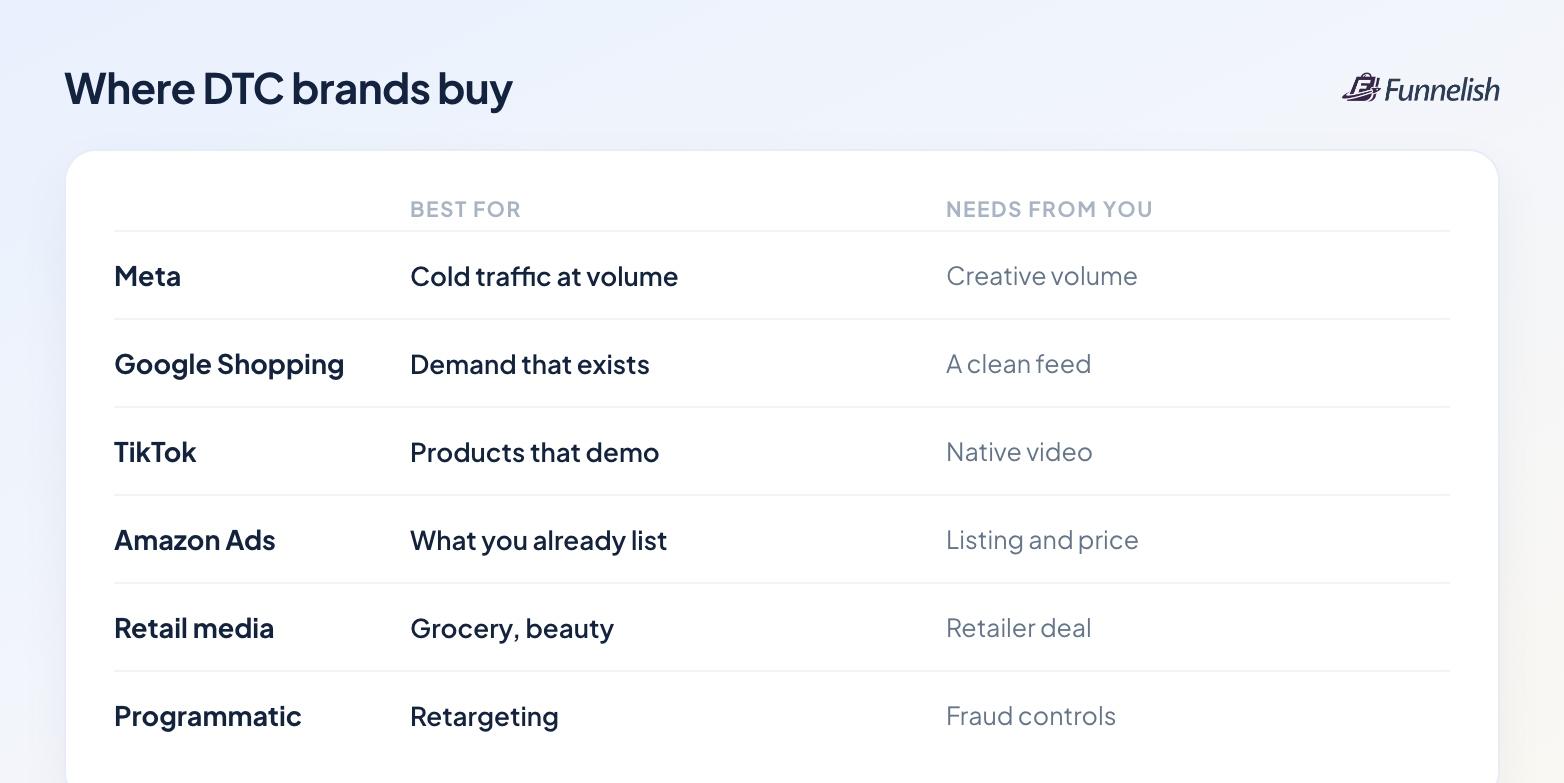
What each platform is for, and what it wants from you.
Platform | Best for | What it needs from you |
Meta | Cold traffic at volume, DTC products under $150 | Volume of creative, a fast mobile page |
Google Search and Shopping | Demand that already exists | A clean product feed, bidding patience |
TikTok | Products that demo well on video | Native video shot for the feed |
Amazon Ads | Products you already sell on Amazon | Listing quality, competitive price |
Retail media networks | Brands in grocery, beauty, household | Retailer relationship, separate creative |
Programmatic DSPs | Retargeting, and reach outside Meta and Google | First-party data, fraud controls |
Pinterest and Reddit | Niche categories with strong intent | Patience, lower volume |
No single one of those is the best advertising for ecommerce. Choose by what you sell, and add a second platform only once the first one pays.
Shortlist two of those ecommerce advertising platforms, no more. You'll learn more from beating one than from sampling four.
Ecommerce PPC Advertising
Run the campaign types in this order, because each one needs the last one working.
Brand search. You bid on your own name. It's cheap, it converts high, and it stops competitors buying clicks off your reputation. Judge it on cost per order, and expect the cheapest in the account.
Shopping or Performance Max. Product images against people already searching for what you sell. This runs on your Merchant Center feed. Get your stock wrong or leave GTINs out and you cap what you can spend before the creative matters.
Non-brand search. This is the expensive one. Category terms cost more and convert worse than brand terms, and you still need them, because brand search only captures demand somebody else created.
Get two things right before you scale ecommerce PPC advertising. Add negative keywords and you stop paying for “free”, “DIY” and competitor-repair searches. Then split your campaigns by margin tier, because a $25 product and a $220 product can’t share a target cost per order.
Ecommerce Social Media Advertising
Pick the sales objective and give the system three things: a conversions API feed, a product catalog, and more creative than feels reasonable.
Keep the structure simple. One campaign, broad targeting, many ad variants inside it. Split into eight tight audiences and you starve each one of the conversions the delivery model needs to learn. You also end up paying for the same person four times over.
Plan for the measurement problem. The platform counts view-through and assisted conversions your other channels would have closed anyway. Run a holdout or a geo test once a quarter and compare what the platform claims against what your order count did. Every ecommerce social media advertising report is built to flatter itself.
Build the page for the browser it will open in. On Funnelish checkout data, 42% of sessions arrive inside a social app’s built-in browser.
Read more: TikTok Ecommerce Strategy 2026: Turn Discovery Into Sales
Ecommerce Video Advertising
Get the specifications right first. Video fails on these before anyone judges the idea.
Shoot vertical, 9:16. It fills the phone screen. A letterboxed landscape cut wastes two thirds of it.
Keep it under 20 seconds for cold traffic. 15 is a safe default.
Burn in the captions. Assume nobody has the sound on.
Show the product by second two. Your logo and the lifestyle shot can come later.
Ecommerce video advertising belongs on cold traffic, where you still have to explain something. For retargeting, a static image with the price tends to beat a video, because the viewer already knows what the product is and needs a reason to go back.
Shoot three variants of the same offer instead of one polished film: a demo, a customer talking, and a straight product shot with the price on screen. You're making test material here, and the platform picks the winner.
Programmatic Advertising for Ecommerce
US programmatic revenue reached $162.4 billion in 2025, up 20.5%. That's the biggest single slice of online advertising ecommerce brands can buy into.
For a DTC brand, programmatic advertising for ecommerce does two jobs. It retargets people who left your site, and it reaches them on sites Meta and Google don't own.
Set up four things before you spend:
A suppression list. Drop anyone who bought in the last 30 days. You pay to chase your own customers otherwise.
A frequency cap. Three to five impressions per person per week. Past that you're annoying people you already paid to reach.
An inventory allowlist. Name the sites you'll buy. An open exchange will happily sell you made-for-advertising pages that nobody reads.
A separate conversion window. Programmatic claims credit on view-throughs. Judge it on last-click or on a geo holdout, and expect the two numbers to disagree.
Good programmatic advertising strategies for ecommerce start with those four before they touch reach. Skip them and the cheap CPM you found turns out to be bot traffic or a page where your ad loaded below three others.
Don't start here on a small budget. Retargeting needs volume to work, and if you're sending under 50,000 visitors a month you'll spend more on the DSP fee than you recover.
Best Direct Mail Advertising for Ecommerce
The best direct mail advertising for ecommerce is a postcard to your own buyer list, triggered by something the customer did. Everything else is worse on the numbers.
Start with postage, because it sets the floor. Since 12 July 2026 a domestic postcard costs 65 cents, a First-Class stamp 82 cents and a metered one-ounce letter 78 cents. USPS Marketing Mail letters start around 44 cents. Add printing and list handling and you're well over a dollar a piece delivered.
At that price, mailing strangers rarely works for a DTC brand. Mailing your own buyers does, because you already have the address and you already know what they bought.
Three triggers worth building:
A buyer who hasn't ordered in 90 days. Send a postcard with one product and one code on it.
A checkout abandoner whose address you captured. Mail lands two or three days later and reaches people who ignored the email.
A lapsed subscription. The person already liked the product enough to schedule it.
Measure it as a cohort instead of a channel. Hold back 10% of the list as a control, put a unique code or URL on the piece, and compare orders across both groups over 60 days. Attribution software won't see a postcard. The holdout is your only honest read.
AI-Driven Ecommerce Advertising
Three different things get called AI in advertising, and mixing them up leads to bad decisions.
Bidding and delivery AI. This is what Google, Meta and TikTok mean. It decides who sees your ad and what you pay. You can't opt out of it in 2026, and it works.
Creative generation AI. It writes scripts, cuts variations and swaps backgrounds. You get volume quickly, and volume is what social platforms need. Quality is still on you.
Catalog and feed AI. This is where platform companies are investing. BigCommerce, now trading as Commerce, hasn't built an ad network. Its AI work goes into catalog syndication, pushing merchant products into AI shopping surfaces through partner integrations. That's the pattern across platforms: they feed the ad systems instead of competing with them. Anyone searching for BigCommerce AI-driven ecommerce advertising is asking about catalog syndication, and that's the right thing to ask about.
AI driven ecommerce advertising mostly means the first kind, and you're already using it whether you chose it or not.
When a vendor uses the phrase, ask which of the three they mean. The second kind is where the tools compete with each other.
The honest answer to what the best AI is for ecommerce advertising: the one built into the platform you're already buying from. External tools help with creative volume and reporting. They don't beat the platform's own delivery model.
Best Ecommerce Advertising Strategies for DTC Brands
Six ecommerce advertising strategies that are working right now.
Feed the algorithm more creative. Targeting is automated now. Creative volume is the lever you still control. Brands winning on Meta ship dozens of variants a month, where a struggling brand ships three and wonders why delivery stalled.
Make the first frame do the work. On a phone, you get one frame before the thumb moves. Put the product and the offer in it. 85% of checkout sessions on DTC funnels happen on a phone.
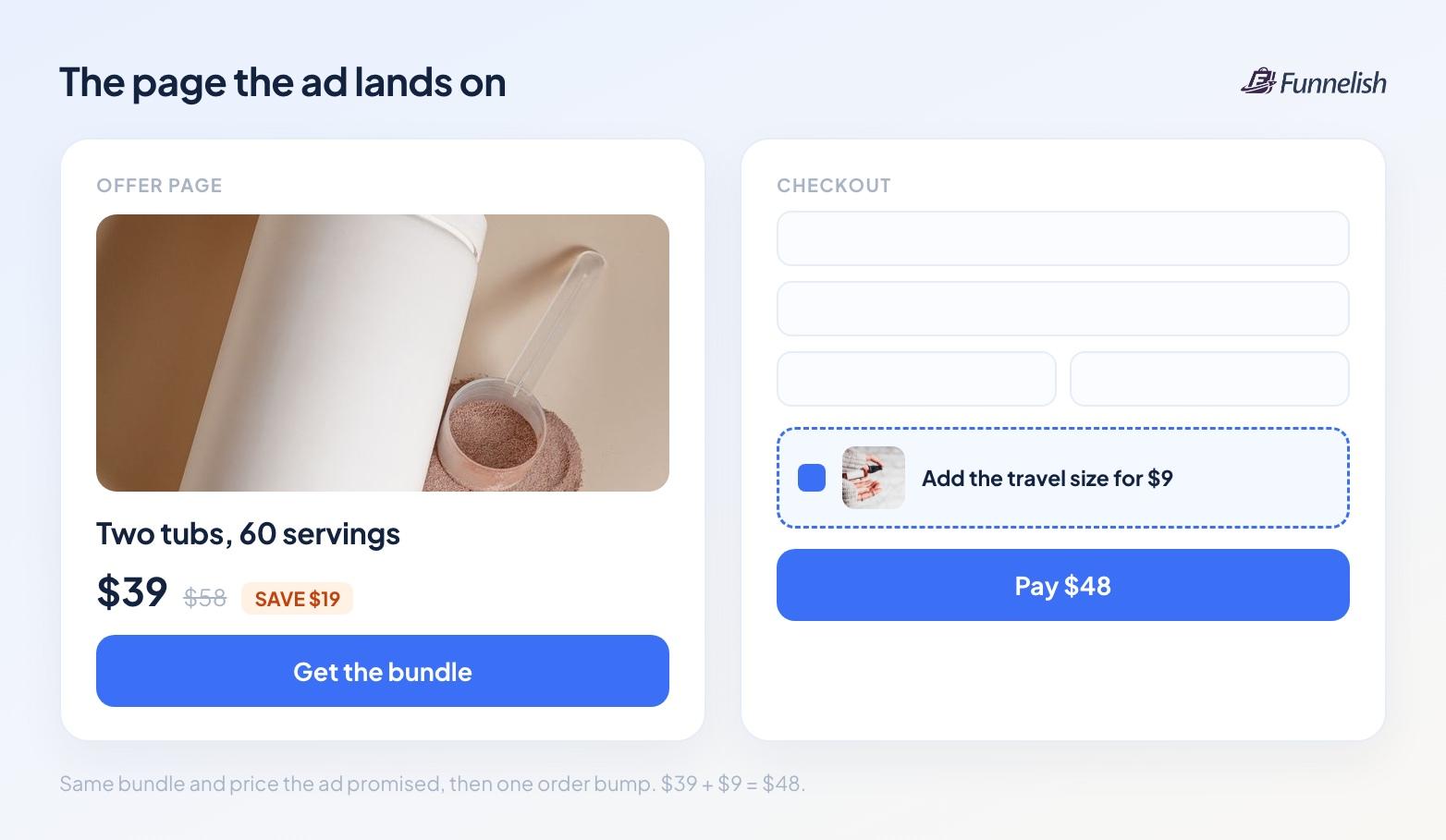
The page opens on the bundle the ad promised, then offers one bump.
Match the page to the ad. If the ad shows a bundle at 30% off, the page has to open on that bundle at that price. Sending that click to a homepage wastes it. The rule for advertising ecommerce website pages is simple: one ad, one offer, one page.
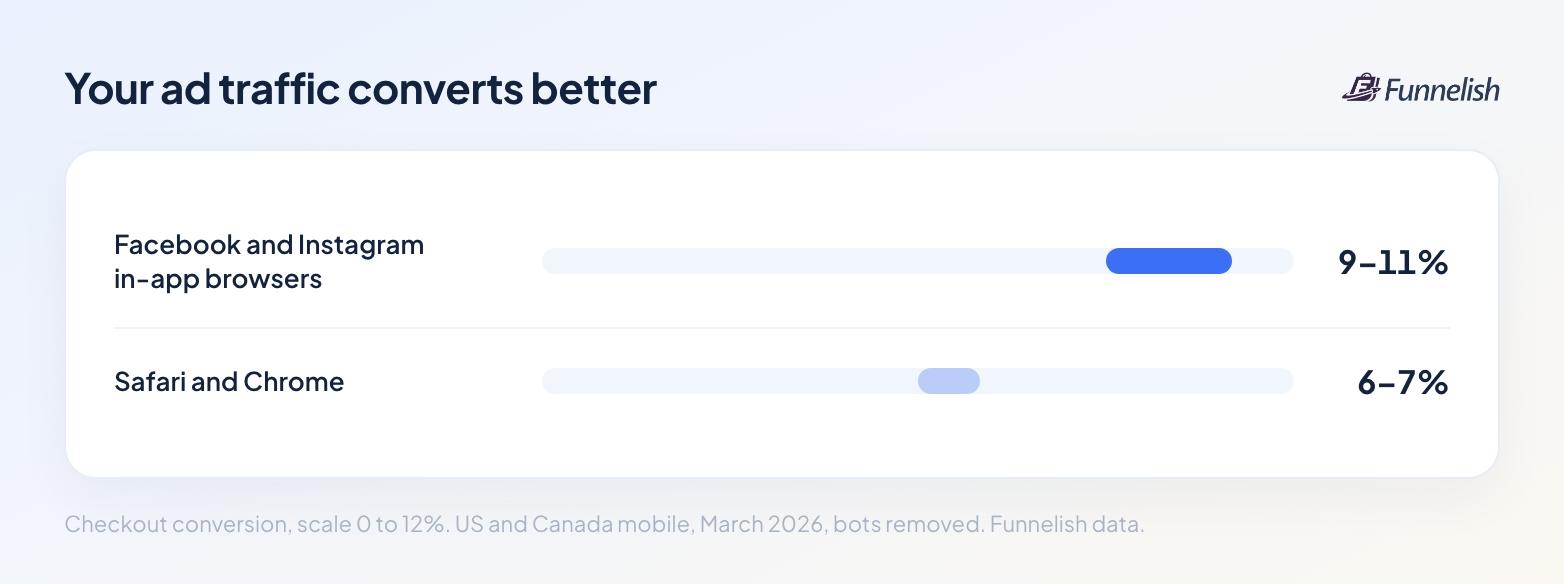
The traffic you paid for converts better than the traffic that came on its own.
Build for the in-app browser. 42% of checkout sessions arrive inside a social app's built-in browser. Test your page there before you test it in desktop Chrome, and check how your checkout pages render inside it.
Sell more per order instead of buying more clicks. 21.6% of US buyers accept a one-click upsell, and it adds 18% to the order. That's revenue on traffic you already paid for. Our guide to upsell techniques covers the offer design.
Most advertising for ecommerce comes down to those first five. The sixth protects what they earn you.
Run offers instead of discounts. A bundle, a quantity break or a free add-on protects margin better than a sitewide percentage. Product bundles give you a bigger headline saving on a basket the shopper wouldn't have built.
Creative That Works in 2026
DTC brands are running four formats more than any others right now.
Founder or customer talking to camera
You shoot it on a phone with no studio. It works because it doesn't look like an ad until the viewer is already listening.
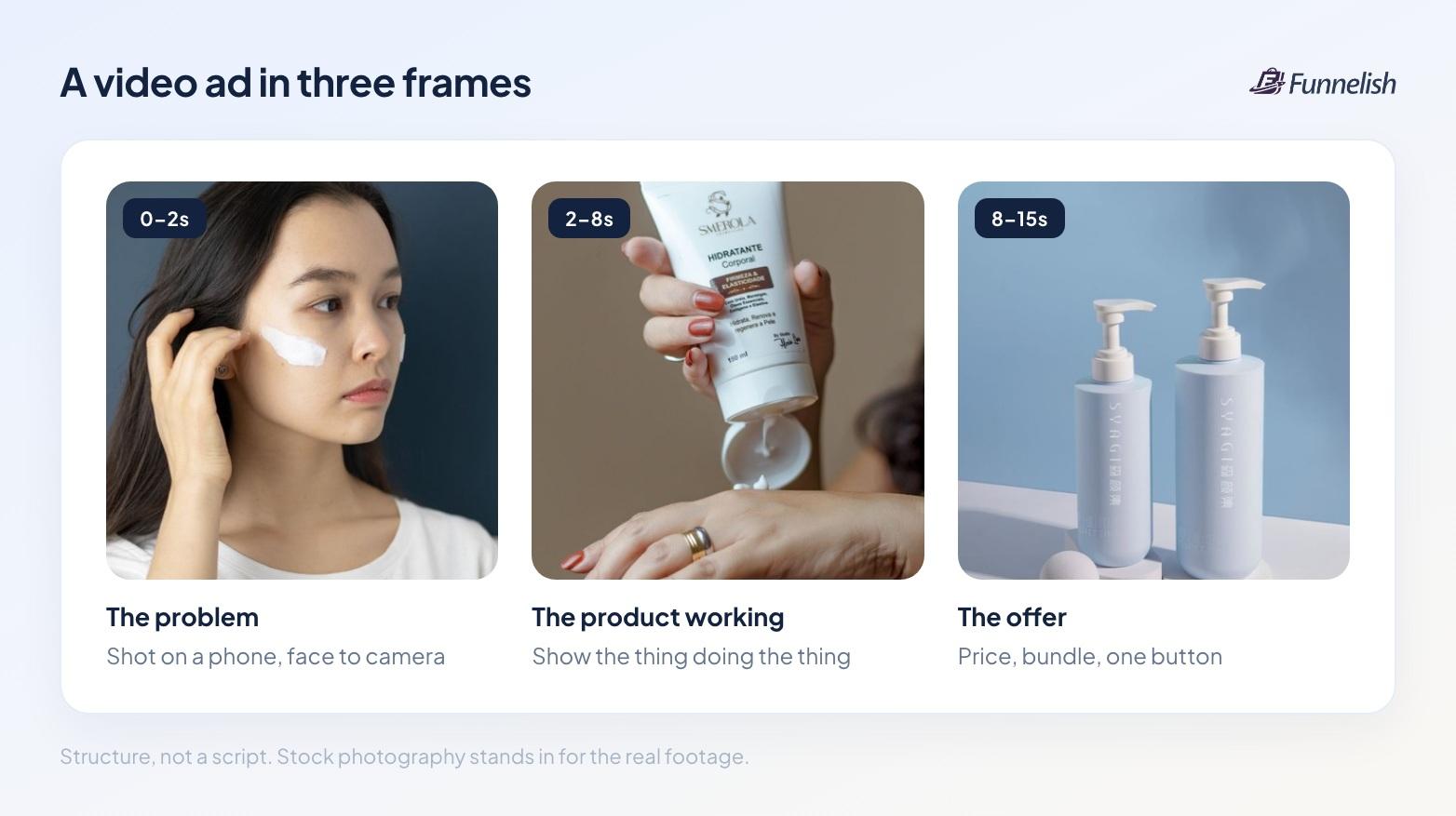
Problem demo
Show the annoying thing, then the product solving it, in under five seconds.
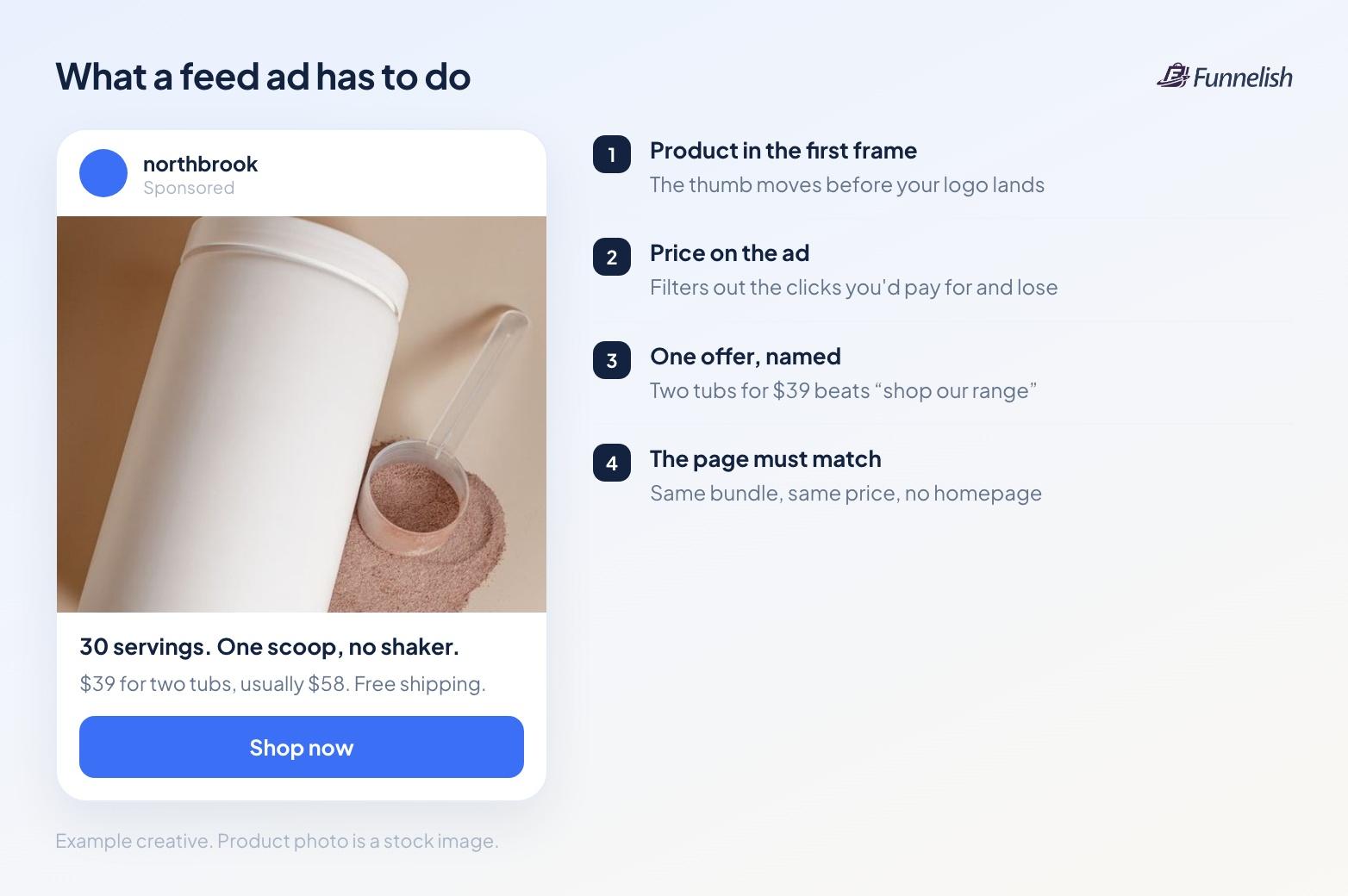
Static with a price
It's the cheapest format to produce and still one of the most reliable for retargeting. You build it once in a page builder, with the product, price, offer and button, then recut it per offer.
Side-by-side comparison
You put your product next to the obvious alternative and label the difference. This works because it answers the question the shopper was going to ask anyway.
What stopped working: polished brand films with no product in the first three seconds, carousels that need swiping to make sense, and text-heavy images that fail on a small screen. In ecommerce video advertising, the first frame decides whether anyone sees the second.
Ecommerce CRO Advertising: Fix the Page Before the Bids
Ecommerce CRO advertising means treating the page as part of the campaign. You'll gain more here than from bid changes, and none of the work happens in the ad account.
Funnelish checkout data covers 4.4 billion events and 64 million orders from 11,930 brands. Rank US DTC brands by revenue per visitor and they spread out further than targeting can explain.
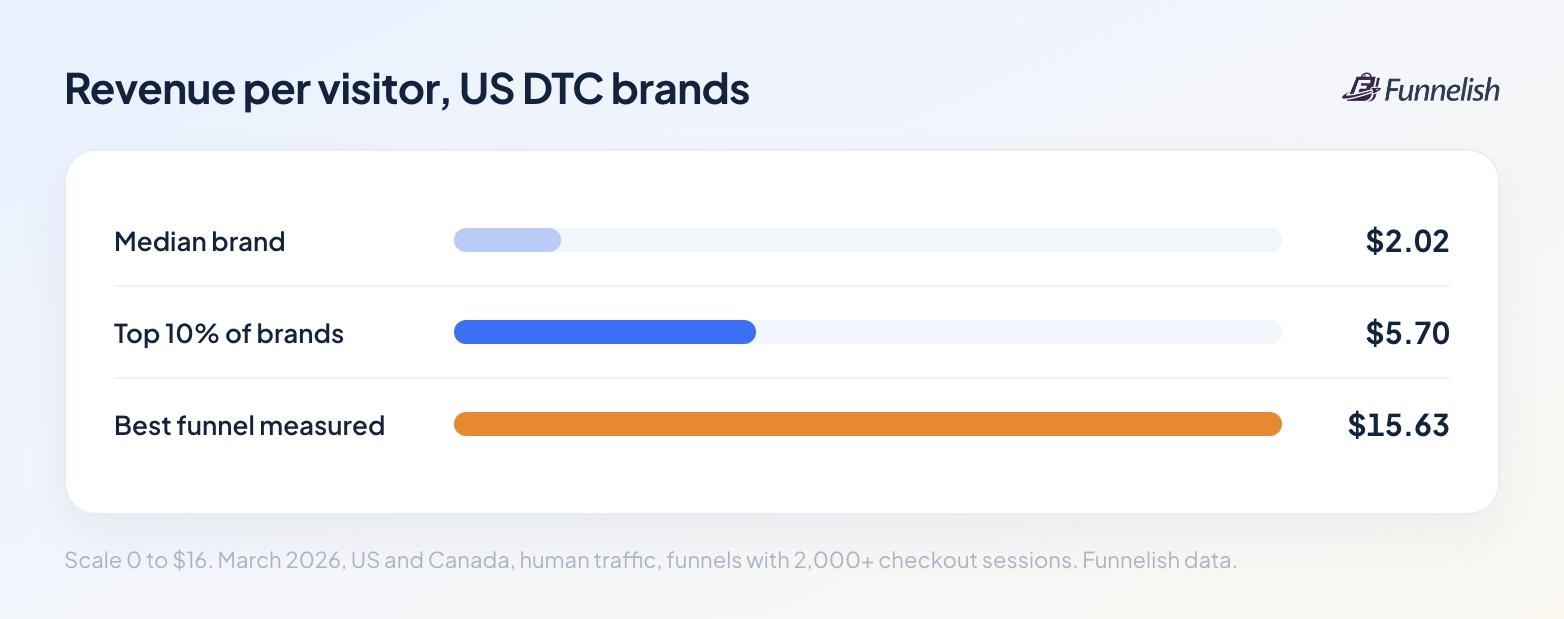
These brands buy the same traffic and keep different amounts of it.
The median brand earns $2.02 per visitor. The top 10% earn $5.70. The best single funnel measured earned $15.63, converting 24% of the people who reached its checkout page.
The device mix and the payment approval rates are the same across all those tiers. What's different is the funnel. The top 10% get 37.2% of visitors to the checkout page against 22.1% for the middle, and close 12.2% of them against 8.7%. They sell a $122.33 order against $89.94, and get an upsell 29.4% of the time against 20.0%.
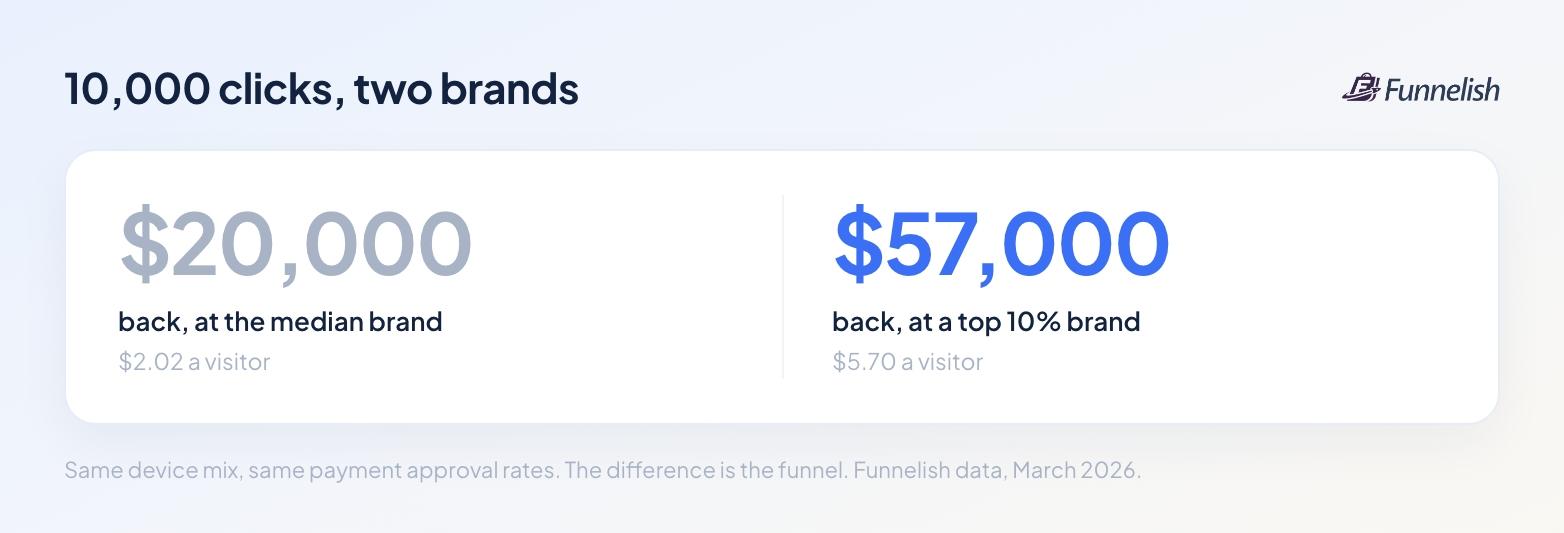
What the same 10,000 clicks are worth at two brands.
Put that in ad terms. Send 10,000 clicks to the median brand and you get about $20,000 back. Send the same 10,000 clicks to a top-10% brand and you get about $57,000. They're running the same ads on the same phones.
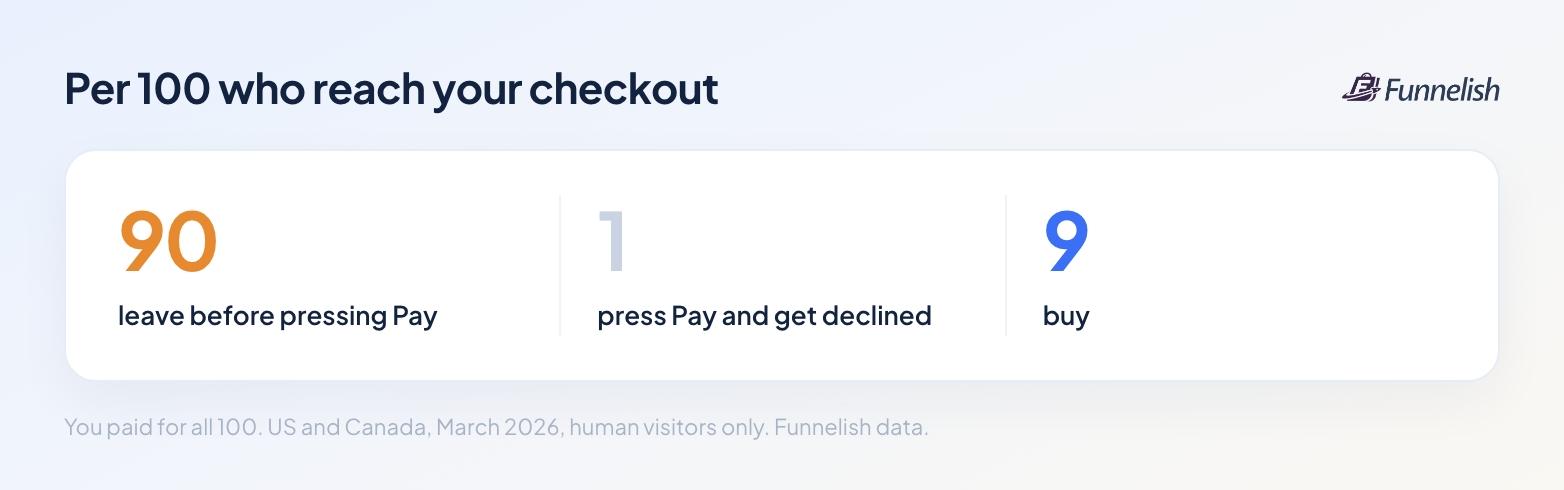
You paid for all 100 of them.
And here's where you lose them: of every 100 shoppers who reach a checkout page, 90 leave before pressing Pay, one is declined, and nine buy. Fixing that page returns more than a bid adjustment will. A funnel builder that lets you ship a dedicated page per offer is how brands close that gap.
Two more facts that should change how you buy:
Half of US buyers decide in under 6.4 minutes. Four in five finish inside 15 minutes, and 4.5% take more than an hour. A checkout that asks for an account and three screens is asking for time 95% of your buyers won't give you.
The in-app browser outperforms the native one. Facebook and Instagram in-app traffic converts at 9% to 11%, against 6% to 7% for Safari and Chrome. The person who tapped your ad a second ago is further along than someone arriving from a bookmark. Your page speed inside that browser matters more than your desktop score.
Ecommerce Advertising Budget: How Much and Where
There's no universal percentage. A paid advertising for ecommerce budget works backwards from the order instead.
Start with your unique order value and your margin, because that's the ceiling. The median US order session on Funnelish checkouts is $71.57. At a 60% margin that's about $43 of gross profit. That's the most you can pay for an order before the first purchase loses money.
Then decide what you're buying: the first order, or the relationship. If you have repeat purchase data, you can pay more than $43. If you don't, don't pretend you do. A subscription offer on the first order is one way to earn that permission early.
A workable split for a DTC brand buying cold traffic:
60% to 70% to the channel that already works. That's Meta or Google for a DTC brand, rarely both equally.
20% to 30% to testing. Try new creative, a second platform, or retargeting.
10% to retention. Spend it on email, SMS, and winning back lapsed buyers.
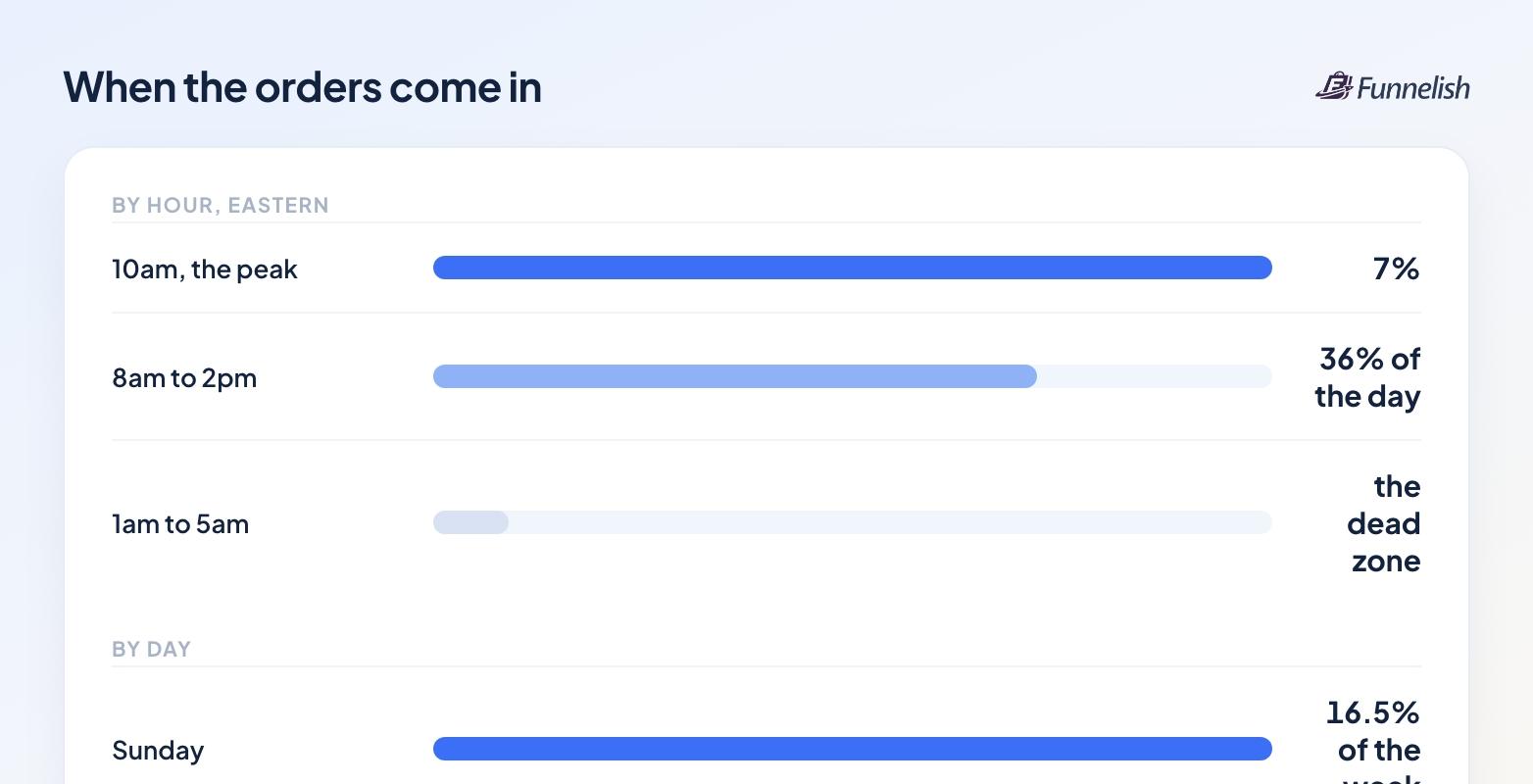
When US orders land.
You're also paying for hours that don't convert. Across Funnelish data, 10am Eastern is the peak hour at 7% of the day's orders, 8am to 2pm carries 36%, and the only dead window is 1am to 5am. Sunday is the biggest day at 16.5% of the week; Thursday the quietest at 13.0%.
One correction before you judge any channel: one in six sessions on a DTC checkout is a bot or an AI crawler. Filter them and your real conversion rate is easily 19% higher than your dashboard reports.
How to Build an Ecommerce Advertising Plan
Follow these seven steps in order. That's how to build an ecommerce advertising plan that survives its first month.
Set the order economics. Work out your unique order value, your margin, and the maximum you'll pay per order.
Pick one platform to win first. Split a small budget across four platforms and you learn nothing about any of them.
Build the offer before the ad. Pick a bundle, a quantity break, or a lead product with an upsell behind it.
Build the page before the creative. The ad has to match something.
Ship creative in batches. Make five to ten variants of the same offer from different angles.
Give it two weeks and enough conversions. Judging a campaign on 11 orders isn't a result, it's noise.
Cut, then scale. Kill what's below your cost per order, and raise budget on what's above it.
Ecommerce Advertising Agency, Services and Management
You have three options, and the right one depends on spend.
In-house. Works under roughly $50,000 a month, when one person can own creative and buying. Cheapest, and the feedback loop is tightest.
Freelancer or contractor. Hire one to fill a specific gap, like creative production or a single platform. They're cheap to try and easy to stop.
An ecommerce advertising agency. Worth it above a certain spend, when the work is more than one person's job. They earn the fee on creative volume and testing discipline. Nobody has secret targeting.
Check what kind of shop you're hiring
An ecommerce social media advertising agency builds for the feed, a search shop builds for the auction, and few are strong at both. Ask which one they staff, then ask how many creative variants they shipped last month. That number predicts your results better than the case studies on their site.
Buy the work and keep the assets
Ecommerce advertising services cover creative production, media buying and reporting. Your ad accounts, your pixel and conversions API, and your landing pages stay in your name, because agencies change and those can't leave with them.
Month to month, ecommerce advertising management is creative production and testing discipline. Somebody writes the briefs, somebody ships the variants, somebody kills what's losing on Friday. If a proposal doesn't name who does each of those, you're buying a reporting contract.
Treat any ecommerce advertising solutions that promise targeting secrets as a warning sign. The platforms removed those controls years ago, and anyone still selling them is selling you a dashboard.
Ecommerce Advertising FAQ
What is ecommerce advertising?
Paid placement that sends people to a page where they can buy. It covers search, social, retail media, programmatic and video.
How does online advertising ecommerce reporting differ from brand reporting?
You judge it on orders, weekly. Brand reporting waits for a lift study or a yearly review.
How does ecommerce advertising work?
You set an objective and a budget, submit creative and a product feed, and the platform's auction decides who sees your ad and what you pay. The click lands on your page, and your page decides whether it becomes an order.
What are the best advertising platforms for ecommerce?
Meta for cold traffic at volume, Google Search and Shopping for existing demand, TikTok for products that demo on video, Amazon if you sell there. Size is the wrong tiebreak. Win one before you add a second.
What's a reasonable ecommerce advertising budget?
Work backwards from gross profit per order. At a $71.57 order and 60% margin, you have about $43 to spend before the first order loses money.
Is AI driven ecommerce advertising worth paying extra for?
Not as a separate product. You already get the delivery model inside the platform, and that's the part that moves results.
What's the best AI for ecommerce advertising?
The delivery AI inside the platform you already buy from. External tools help with creative volume and reporting. They don't win auctions for you.
Does programmatic advertising work for ecommerce?
For retargeting and reach outside Meta and Google, it does. For cold acquisition on a small budget, it rarely pays.
Is direct mail worth it?
It works for reactivating past customers. For cold acquisition it rarely does.
How many creative variants should I run?
Enough that the platform has something to choose between. Five to ten per offer is a working floor on social.
Does advertising ecommerce website traffic differ from marketplace ads?
Yes. On your own site you control the page, the offer and the upsell. On a marketplace you control the listing and the price, and nothing after the click.
Why are my ad results worse than my dashboard suggests?
Two common reasons: bots inflating your session count, and attribution counting assisted conversions you'd have had anyway.
Which advertising platform for ecommerce should I start with?
Start where your buyers already scroll or search. For most physical products that's Meta or Google, and you only need one of them to work first.
What's the best advertising for ecommerce?
Depends what you sell. Impulse products under $50 do best on social. Considered purchases do better on search. Anything you already list on Amazon belongs in Amazon Ads.
How is ecommerce digital advertising different from retail media?
It covers everything you buy online. Retail media is one slice of it, where you pay a retailer to show your product on their site.
What are the best ecommerce advertising strategies on a small budget?
Run one platform, one offer, one page built for it, and five to ten creative variants. Spread $3,000 across four advertising platforms and you learn nothing about any of them.
Do I need ecommerce advertising solutions beyond the ad platforms?
You need a page builder and clean analytics. Beyond that, most of the spend belongs in creative.
What does ecommerce advertising management involve?
Budget pacing, creative production, testing and reporting. Most of the hours go into creative.
What are good programmatic advertising strategies for ecommerce?
Retarget cart abandoners, suppress recent buyers, cap frequency, and check your inventory quality before scaling spend.
Does ecommerce video advertising need a studio?
No. The formats working right now are shot on phones.
Is direct mail advertising for ecommerce measurable?
You can measure it as a cohort. Mail a list, hold back a control group, and compare orders over the next 60 days.
Should I hire an ecommerce advertising agency?
Above roughly $50,000 a month, hire one. Below that, one good in-house person works faster and costs you less.
Start With the Page
The ecommerce advertising strategies above all assume one thing: that the page works.
Your ad account isn't where your results are decided. Two brands buying the same clicks on the same platform return $20,000 and $57,000 on 10,000 visits, and the difference is everything between the click and the receipt.
Funnelish builds that half: a dedicated page per offer, a one-screen mobile checkout, one-click upsells after payment, and analytics that separate real visitors from crawlers. See how it works, or start a free trial and put your next campaign behind a page built for it.
Table of contents
Boost your eCommerce
sales today

24/7 support
No credit card required
Cancel anytime
24/7 support
No credit card required
Cancel anytime
