

Advanced Shopify CRO for Media Buyers
01 May 2026
Anna P.
9 minutes
If you are spending $5,000 a day on Meta, Google, or TikTok ads, you are in the arbitrage business. You are buying clicks at a premium and attempting to sell physical goods for a margin. The delta between your ad spend and your gross margin is your survival.
Yet, many media buyers operate under the delusion that driving massive volume to their web pages is the hardest part of the job. It isn't. Driving clicks is only half the battle.
If your ecommerce conversion rate sits at the industry average of 1.5%, you are bleeding cash. Let’s look at the numbers:
If you are buying traffic at $1.50 per click, a 1.5% conversion rate means your Cost Per Acquisition is $100.
If you are selling a $75 product, your economics as a business owner are fundamentally broken. You are losing $25 on every single front-end sale.
Amateur marketers try to fix this by hacking the ad account — testing a hundred new creatives hoping the algorithm drops the CPC to $1.00.
Others fix this with rigorous conversion rate optimization. If you implement advanced Shopify CRO strategies and push that 1.5% conversion rate to a 3.0% average conversion rate, your CPA drops from $100 to $50. You just turned a massive daily loss into a $25 profit margin per sale — without touching a single setting in your ad account.
However, true conversion optimization is not about blindly changing button colors from red to green to get more sales. It is about systematically engineering lower customer acquisition costs and skyrocketing your average order value. It is a rigorous, ongoing process of data analysis, matching user intent, and optimizing the entire user journey.
Let’s break down the numbers-backed CRO strategies that boost conversions today, how to decode user behavior, and why relying on native Shopify architecture is capping your scale.
Phase 1: Decoding Intent and Customer Journey
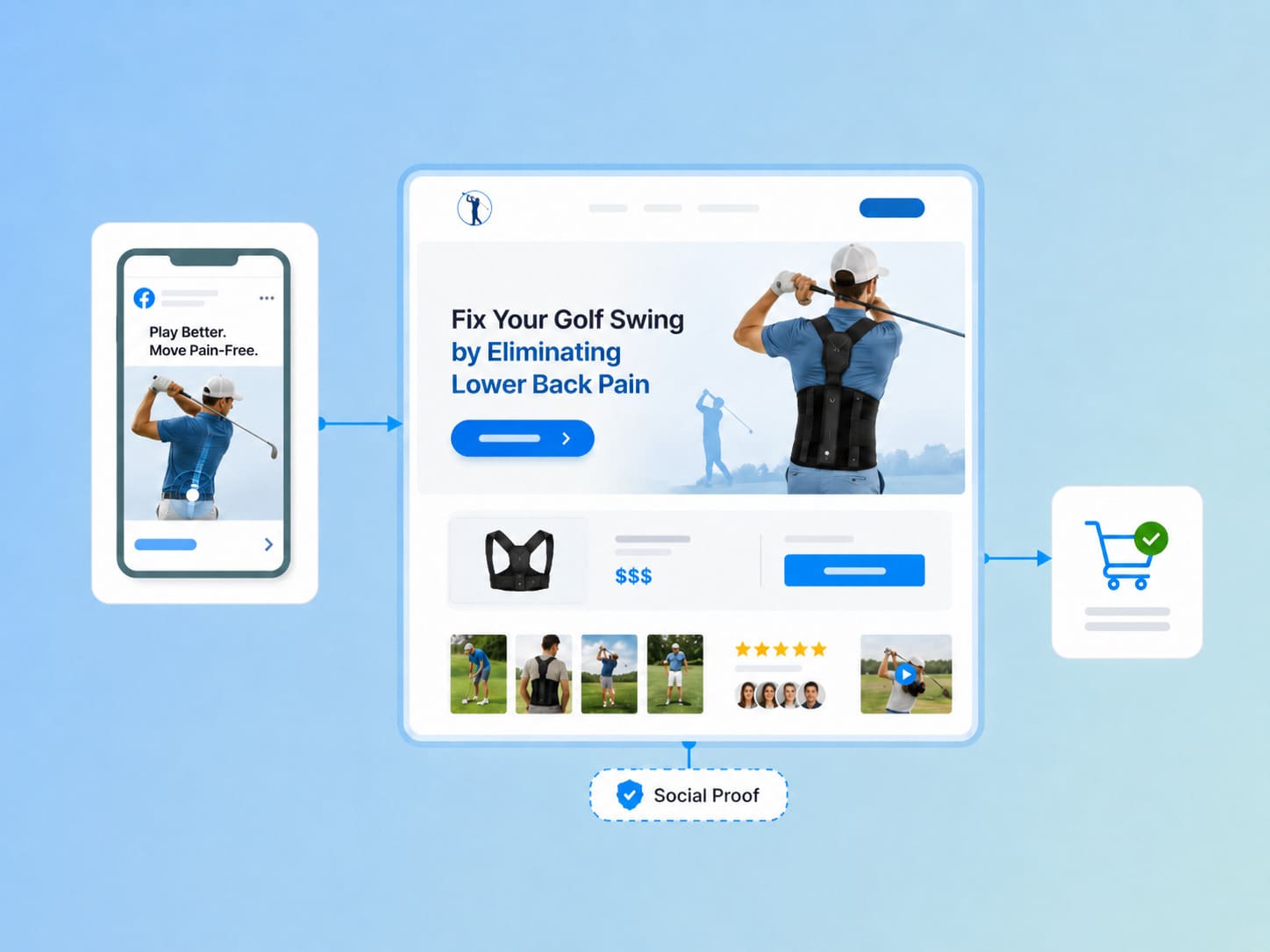
To increase Shopify conversions, you must stop treating your website like a digital brochure. Every click you buy has a specific intent, and your site must act as a frictionless conduit for that intent.
Moving Beyond Generic Product Pages
Shopify brands often fail because their product pages read like a manufacturer’s catalog rather than a high-converting landing page.
When website visitors arrive via a top-of-funnel ad, their skepticism is at an all-time high. Extensive user research and heat mapping consistently show that when users scroll down your page, they are actively ignoring your polished marketing copy.
They are hunting for trust building elements.
They want to see user-generated content, raw customer photos, and unedited social proof.
Fix
If you run an ad targeting "Back Pain Relief for Golfers" and send that click to a generic product page that just says "Posture Corrector - $39.99," you are destroying your ROAS. Paid traffic requires exact message matching.
If the ad targets golfers, the headline of your landing page must say, "Fix Your Golf Swing by Eliminating Lower Back Pain." Your high-quality images must show a golfer using the product. You must pull customer photos out of the footer and place them directly below the price. When you align your page with the psychological trigger that made the user click, conversions happen.
Mastering Mobile Divide
It is a statistical fact that the vast majority of global web traffic coming to your store originates from mobile devices. Yet, many Shopify store owners still design their sites on large desktop monitors.
Having a basic mobile-friendly website with standard responsive design is the bare minimum for any online retailer. True mobile optimization means designing for the thumb zone.
Fix
Mobile users do not want to hunt for a search bar hidden behind a complex hamburger menu. They do not want to pinch and zoom to read your return policy. Ensure your sticky Add to Cart buttons are easily reachable at the bottom of the screen at all times. Make your search engine interface prominent so high-intent buyers can find exactly what they want instantly.
If your site isn't hyper-optimized for thumbs, you will never successfully convert visitors at scale. Furthermore, Google’s mobile-first indexing means a sluggish mobile experience will tank your search engine rankings.
Read more: Shopify SEO: 30 Hacks to Rank Higher and Drive More Organic Traffic
Phase 2: Eliminating Cart and Checkout Friction
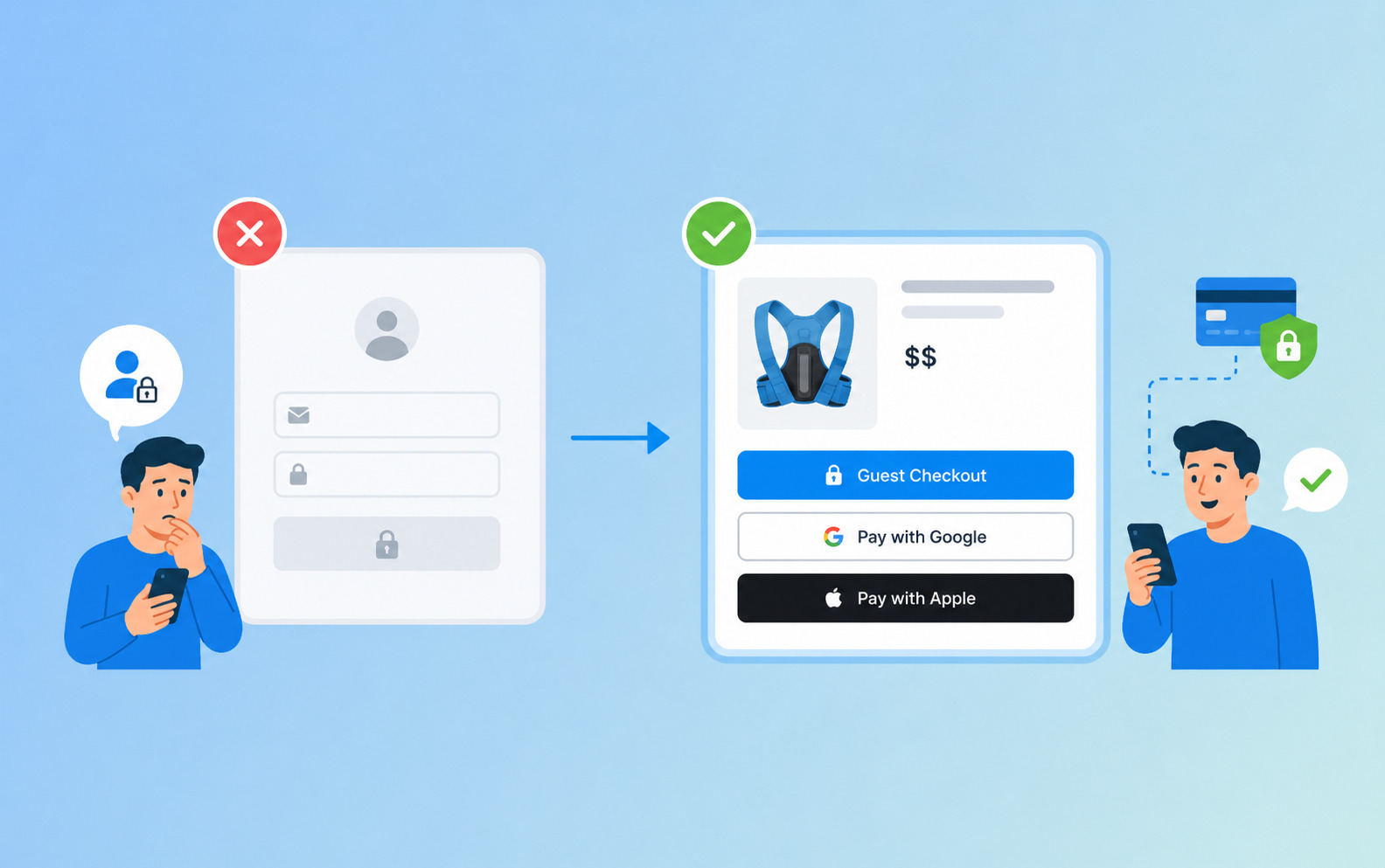
Getting potential customers to your cart or checkout page is an incredibly expensive milestone. Do not lose them to clerical friction at the finish line.
Death of Forced Registration
Forcing users to create customer accounts before they can give you money is conversion gamble in modern digital marketing. When a user is ready to buy, any roadblock creates anxiety and leads to cart abandonment.
Fix
You must offer a prominent guest checkout. The goal is to collect the payment first and ask for a password later. Once the transaction is complete and you have secured paying customers, then you can invite them to create an account on the thank-you page to track their order.
Read more: Shopify Checkout Optimization: How to Bypass the Default and Save Your ROAS
Implementing Express Wallets
Typing a 16-digit credit card number, an expiration date, a CVV, and a billing address onto a glass smartphone screen is another known miserable customer experience.
Fix
You must offer multiple payment methods and express wallets at the very top of the checkout page. When you activate Shop Pay, Apple Pay, and Google Pay, buyers can complete their purchase with a single biometric tap (like FaceID).
Psychology of Shipping and Fees
Unexpected fees are the number one cause of cart abandonment globally. If a user clicks an ad for a $50 product and reaches the final checkout step only to see $15 in shipping and taxes added, they will bounce.
Fix
You must be transparent, or you must leverage the cost. Use a dynamic cart slider to encourage buyers to add more items to unlock a perk. Displaying a progress bar that says "You are $12 away from free shipping!" is a proven mathematical way to offer free shipping while protecting your margins and boosting your AOV. If you are going to offer a coupon code, ensure the input box is easy to find, but don't make it so prominent that users leave your site to go search Google for discount codes.
Phase 3: Native App Bloat Problem
Any good Shopify agency will tell you that to execute advanced conversion rate optimization (CRO), you need to manipulate the site architecture to test new hypotheses.
Traditionally, small businesses do this by installing a dozen different Shopify apps — one for countdown timers, one for post-purchase upsells, one for A/B testing, one for a sticky cart, and another for a promotional pop-up.
The result: Your site code becomes a bloated, conflicting mess.
Your page speed tanks.
The DOM size becomes massive.
The time-to-interactive metric spikes.
You end up actively hurting your average conversion rate in the pursuit of trying to optimize it.
To achieve elite conversion rates from paid traffic without destroying your infrastructure, you need to step outside the limitations of native theme apps.
Phase 4: Bypassing Limitations with Funnelish
If your goal is to drastically lower acquisition costs, you must separate your organic browsing traffic from your paid, high-intent traffic. Funnelish is an all-in-one tool cherished by performance marketers that helps you fix all these at once to see your Shopify CRO effort work.
Instead of sending an expensive ad click to a distracting, slow-loading Shopify product page, you send them to a lightning-fast Funnelish sales funnel. It works alongside your Shopify backend, syncing all inventory and fulfillment data, but it provides a radically optimized, distraction-free frontend.
Post-Purchase AOV Multiplier
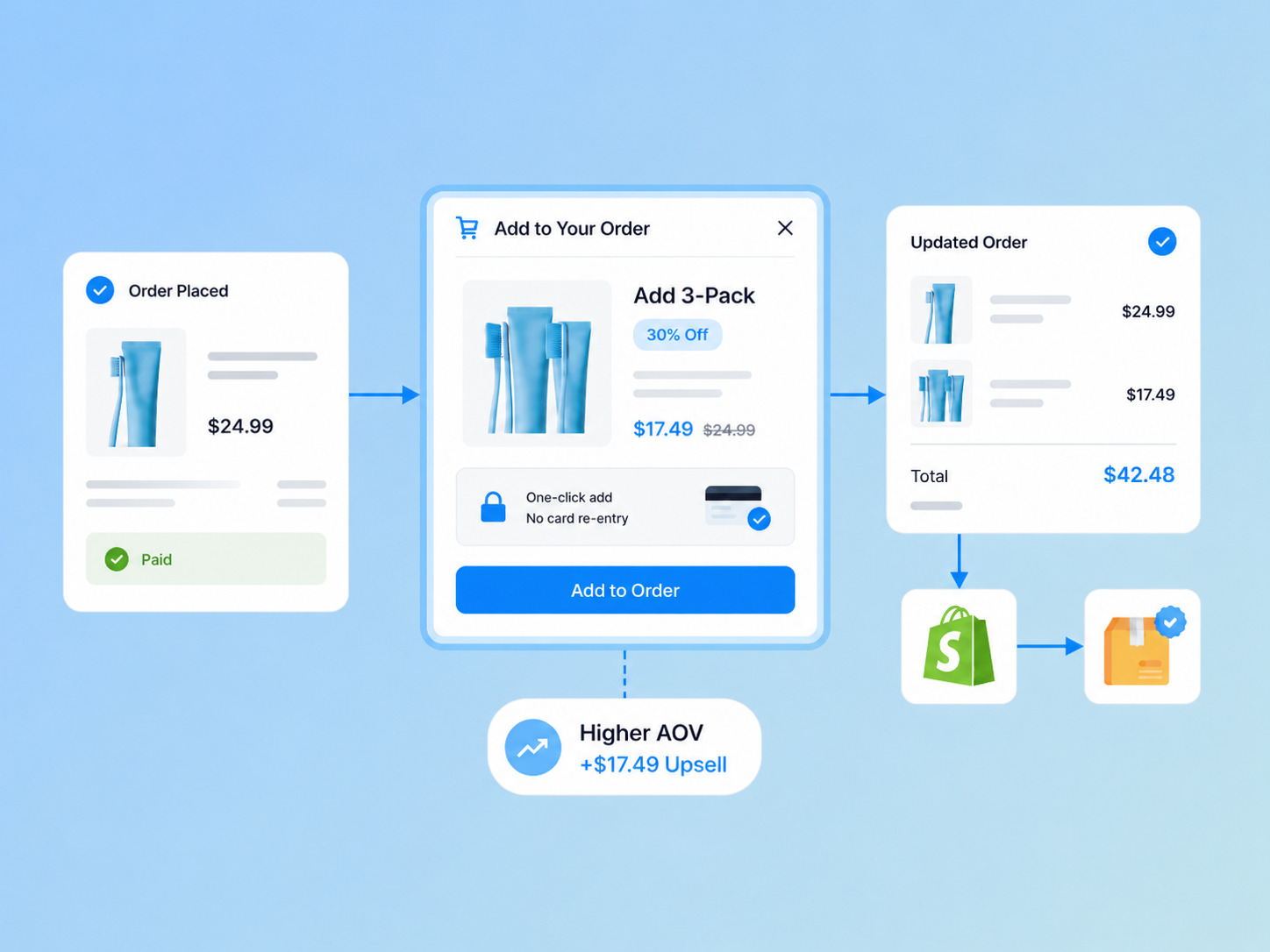
One of the biggest mistakes you can make is treating the initial transaction as the end of the line. Purchase intent is at its absolute peak immediately after the credit card clears.
If you are selling a consumable product, driving new customers to a standard cart yields your baseline AOV. But with Funnelish, you can introduce post-purchase one-click upsells.
Immediately after the buyer completes their purchase, but before they see the order confirmation page, Funnelish presents a highly targeted upsell (e.g., "Add a 3-pack of this exact item for 40% off"). Because Funnelish has already tokenized the payment, the customer does not have to re-enter their credit card. They simply click Add to Order, and Funnelish updates the total and pushes the data to Shopify.
If you have a 20% take rate on a $50 upsell, you are extracting significantly more value from every single transaction. This delta is pure profit that subsidizes your ad spend, allowing you to outbid your competitors.
Native A/B Testing Without the Bloat
Funnelish allows for native A/B testing of your headlines, pricing structures, and offers on the fly. Because the testing engine is built into the server-side architecture of the funnel, it does not require clunky JavaScript apps that slow down the page for your site visitors. You get clean data on what drives the highest revenue per visitor.
Geo-Routing for Global Arbitrage
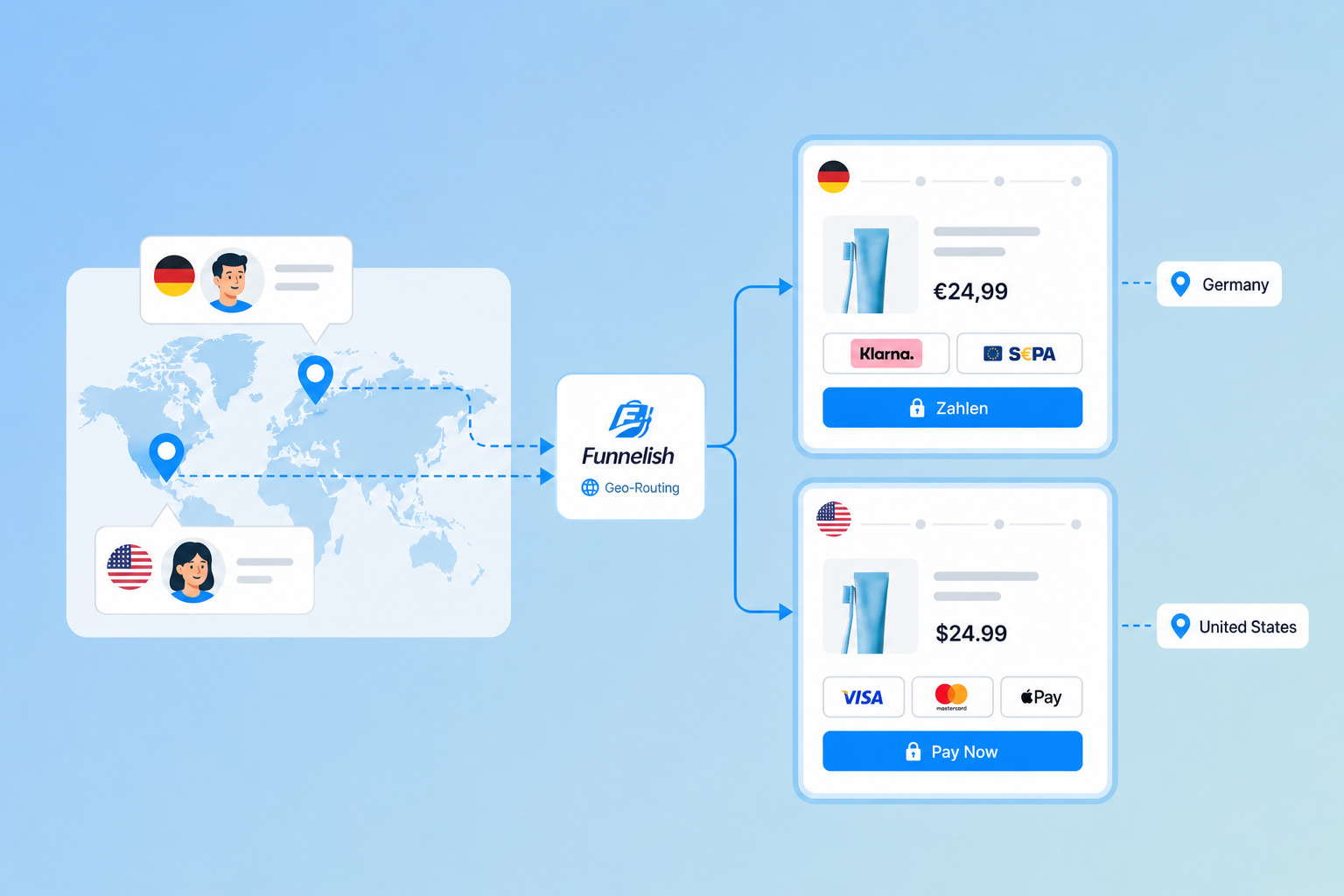
If you are scaling a D2C brand, global web traffic is a massive opportunity, but a conversion nightmare if handled poorly.
A buyer in Germany does not want to see USD, and they prefer using Klarna or SEPA over a standard Visa form. If you force international traffic into a US-centric checkout, your abandonment rate will skyrocket.
Funnelish gives you geo-funnels. The system automatically reads the user's IP address in real time. If they are in Germany, Funnelish routes them to a German-language variant, displays pricing in Euros, and automatically loads local European payment gateways on the checkout page. It provides a feels-like-home experience tailored to their location, turning wasted international clicks into highly profitable revenue streams.
Read more: How to Build High-Converting Sales Funnels for Shopify
Phase 5: Retention, LTV, and Backend
The most sophisticated CRO strategies have nothing to do with acquiring new users. They have everything to do with monetizing existing customers.
If you want to build true customer loyalty and dramatically increase your customer lifetime value, you must optimize for retention, too. Driving an initial sale is expensive; driving a second sale is practically free.
Monetizing Customer Loyalty
Once a buyer is in your ecosystem, you must use their customer data and purchase history to run highly targeted campaigns.
Replenishment flows: If a customer buys a 30-day supply of a supplement, your email marketing system should trigger an automated message on Day 24 offering them a seamless way to restock, perhaps with a 15% discount for subscribing.
VIP segmentation: Identify the top 10% of your buyers who spend the most money. Send them exclusive early access to new product drops before you announce them to the public.
Win-back campaigns: Use data analysis to find users who haven't purchased in 90 days, and hit them with an aggressive, time-sensitive offer to bring them back into the fold.
When you prioritize customer satisfaction and turn one-time buyers into loyal customers making consistent repeat purchases, you effectively amortize your initial ad spend over multiple transactions over the course of years. This is exactly how massive e-commerce empires are built.
Read more: 20+ Ways to Boost Conversions + Tools
Bottom Line on Shopify Conversion Rate Optimization (CRO)
Traffic is expensive. Attention is fleeting.
If you want to successfully scale an ecommerce brand in 2026, you have to look far beyond surface-level tweaks. You must dive deep into user research, eliminate friction for mobile buyers, and stop forcing high-intent ad traffic through bloated, multi-step checkouts.
By upgrading your paid traffic infrastructure with high-performance Shopify funnels on Funnelish, you take absolute control of your economics. You lower your CPA through frictionless checkouts, and you skyrocket your AOV through one-click post-purchase upsells.
Master the math, understand the psychology of your users, and engineer an experience that naturally pulls them toward the sale. When you optimize the journey, the revenue takes care of itself.
Table of contents
Boost your eCommerce
sales today

24/7 support
No credit card required
Cancel anytime
24/7 support
No credit card required
Cancel anytime
