Brand Teardown: How e.l.f. Turns a $15 Product Into a $52 Basket
e.l.f. grew e-commerce 129% in a single quarter selling $15 makeup. We walked the funnel, priced every step of the basket, and pulled the rest from its SEC filings.
On this page11 sections
- 01What do e.l.f.'s numbers look like?
- 02Why does a $15 product need a $50 threshold?
- 03What does e.l.f.'s site run on?
- 04What happens on the product page?
- 05How does the basket climb from $15 to $52?
- 06What does the subscription do?
- 07What does that free gift cost e.l.f.?
- 08What would I test next?
- 095 things you can steal from e.l.f.'s funnel
- 10Bottom line
- 11What we couldn't check
Here's the problem e.l.f. Beauty has to solve every single day. Its hero products cost $11 to $16. Shipping a small box across the US costs real money. Paid social costs the same for e.l.f. as it does for a brand selling $280 running shoes.
How do you make that work? You stop trying to sell one product.
We walked the whole funnel, wrote down every price and every threshold, and checked the business numbers against what e.l.f. files with the SEC. The short version: almost nothing on the site is trying to sell you the thing you came for. It's trying to get your basket up a ladder.
What do e.l.f.'s numbers look like?
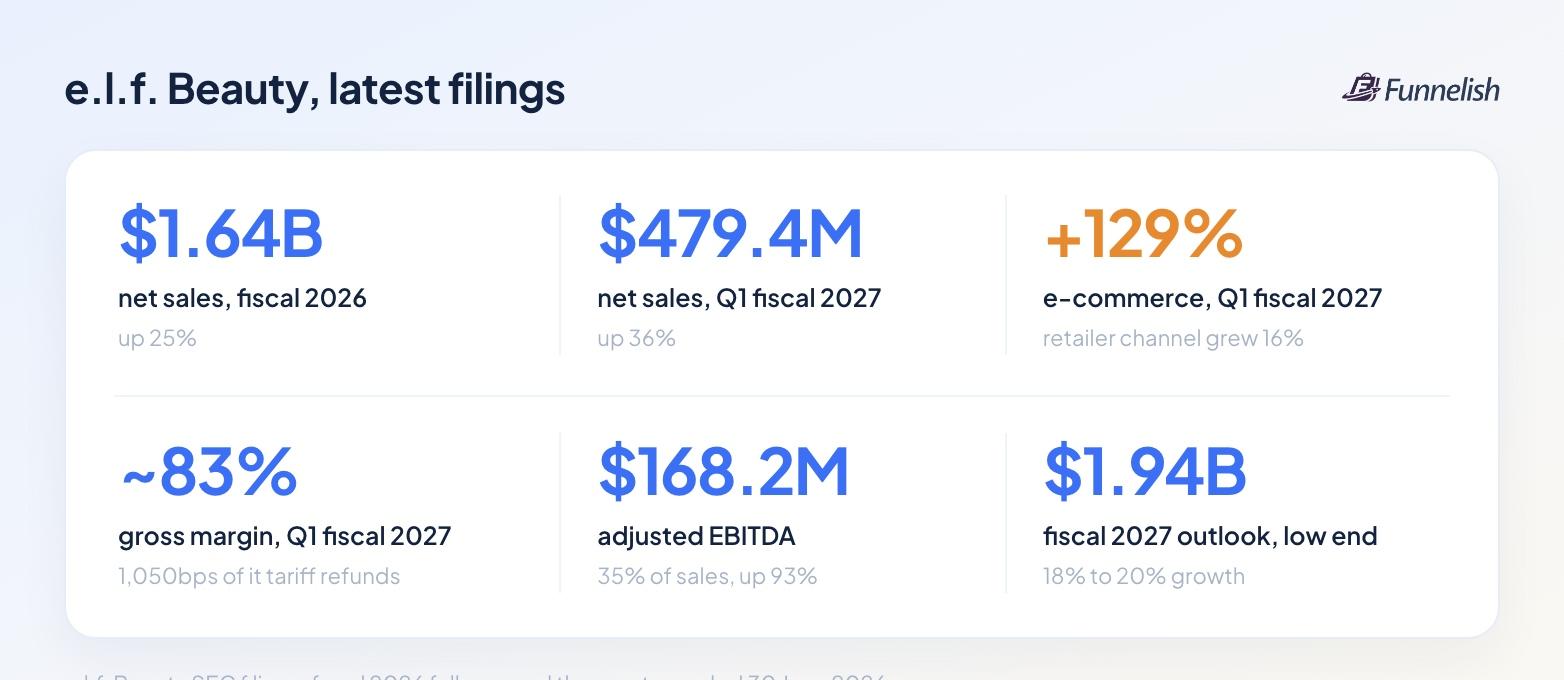
| Measure | Latest reported |
|---|---|
Net sales, fiscal 2026 | $1,636.5M, up 25% |
Net sales, Q1 fiscal 2027 | $479.4M, up 36% |
E-commerce, Q1 fiscal 2027 | up $80.0M, or 129% |
Retailer channel, Q1 fiscal 2027 | up $45.6M, or 16% |
Gross margin, Q1 fiscal 2027 | about 83% |
Adjusted EBITDA, Q1 fiscal 2027 | $168.2M, 35% of sales |
Full-year fiscal 2027 outlook | $1,938M to $1,968M |
Two of those rows deserve a second look.
The first is 129%. In the quarter ended 30 June 2026, e-commerce grew more than eight times faster than the retailer channel. That's a company whose own website has stopped being a brand showcase and started being the growth engine.
The second is 83% gross margin, which comes from the quarterly filing and needs an asterisk. Roughly 1,050 basis points of it came from one-off tariff refunds. Strip those out and you're at about 72.5%. The same quarter a year earlier came in at 69%, and the full fiscal 2026 year landed near 71%. On a $15 product, that's about $11 of gross profit to pay for everything else.
Eleven dollars won't buy you a customer on Meta. It isn't close. Which is exactly why the funnel looks the way it does.
Why does a $15 product need a $50 threshold?
Run the math yourself and the strategy writes itself.
If a single order is $15 and you keep $11 of it, you can't pay $30 to acquire the buyer. If the order is $52 and you keep around $37, suddenly you can. Same customer, same ad, same click. The only variable e.l.f. controls after the click is how much lands in the bag.
The site is built around two numbers you'll see on every page:
- $35 gets you free shipping
- $50 gets you a free full-size product
You clear $35 with about two more cheap items, and $50 with one more after that.
What does e.l.f.'s site run on?
Nothing exotic here, and that's the interesting part.
The storefront runs on Shopify. Page tests run through Builder.io, and the hero section you see may differ from the one your friend sees. Consent is handled by DataGrail, attribution by AppsFlyer, accessibility by UsableNet.
There's no custom platform here and no nine-figure replatform story. e.l.f. is doing this on software you can rent, and that makes the mechanics below copyable instead of merely admirable.
That's worth sitting with for a second. A brand growing e-commerce 129% in a quarter is running the same checkout thousands of smaller stores run. If you're already on Shopify, the same funnel pages are available to you this afternoon.
What happens on the product page?
We used the Halo Glow Liquid Filter, a $15 complexion booster with over 9,600 reviews and a 4.6 rating. Here's everything the page does before you ever reach a cart.

- It shows the price twice, at two different numbers. One-time purchase is $15. Directly underneath, Subscribe & Save shows $15 struck through and $12.75 beside it, up to 15% off. The cheaper number is the one with a commitment attached.
- It tells you how far you've got to go from the gift. A line runs under the add-to-bag button: pick one eyeshadow at checkout, free, with orders $50+. You're $35 short, and the page makes sure you know it.
- It gives you a delivery date. Not a shipping window, an actual date. We saw "estimated to arrive by Tue, Nov 3" against the ZIP we entered. Specific beats vague every time.
- It removes the reason you'd hesitate. Buying foundation online means guessing your shade. e.l.f. put a shade finder and a virtual try-on next to each other, then backed both with a Shade Match Guarantee and a 30-day refund. Three separate answers to one objection.
- It hands you the next item. A "Pairs Well With" block appears halfway down the page with an $11 primer and an add-to-bag button of its own. No navigation required.
That last one is the whole funnel in miniature. You came for one thing, and the page is already selling you the second.
How does the basket climb from $15 to $52?
Follow the ladder with the real prices from the site.
| What's in the bag | Total | What you unlock |
|---|---|---|
Halo Glow Liquid Filter | $15 | Nothing yet |
Add the $11 primer from "Pairs Well With" | $26 | Still paying shipping |
Add one more $11 item | $37 | Free shipping |
Add one more $15 item | $52 | Free full-size gift |

Four items, and the customer reckons they've got two things free. e.l.f. gave away shipping and a sample-cost product to more than triple the order.
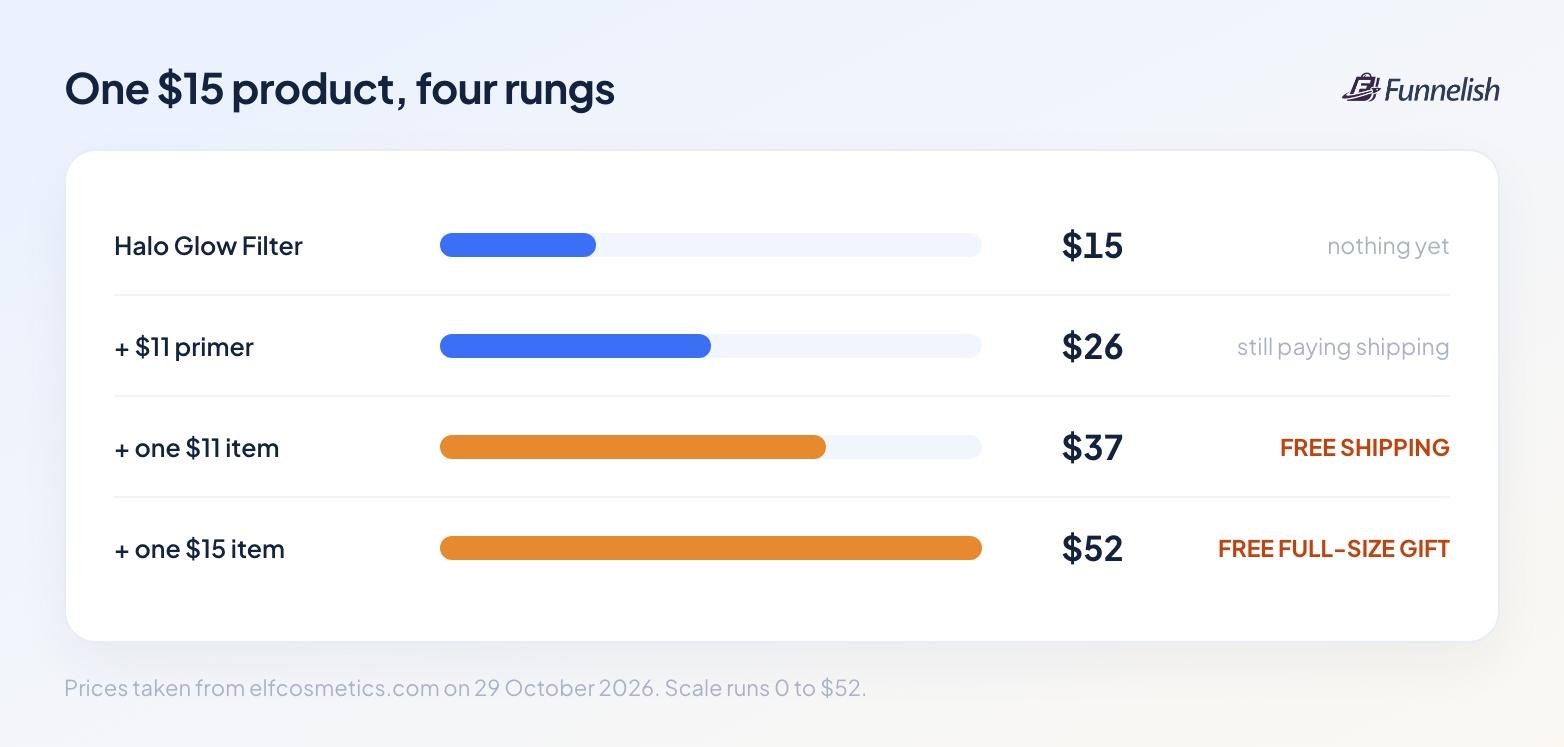
Here's what makes it work: every rung is one cheap item away from the next. A brand selling $120 products can't build this ladder, because every step is a real financial decision. At $11 to $15 a step, it's barely a decision at all.
What does the subscription do?
Subscribe & Save takes 15% off and throws in free shipping, which quietly solves the $35 threshold forever.
Look at what e.l.f. is buying with that discount. A $15 one-time buyer might come back in four months. They might not come back at all. A $12.75 subscriber has a calendar entry. On a consumable product people run out of, that trade is worth making, and it turns a single $11 of gross profit into a predictable stream of it.
If you sell anything people finish, this is the single highest-leverage thing on this page. Subscription offers convert far better attached to a first order than emailed to someone three months later.
Read more: Ecommerce Subscription Model Is the Last Unfair Advantage in D2C — Build One That Sticks
What does that free gift cost e.l.f.?
Let's price it, because the answer is why this works.
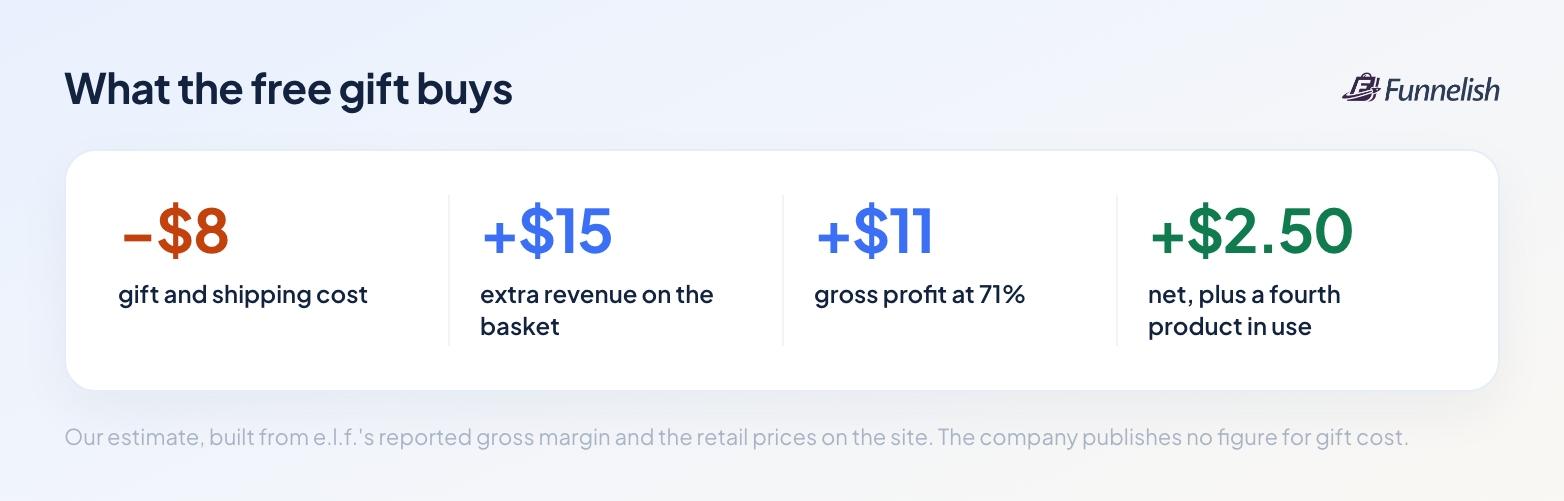
e.l.f. reported roughly 71% gross margin across fiscal 2026. Its eyeshadows run $4 to $15 on the site, clustering near $7. A full-size one costs the company somewhere around $2 to make. Call the free shipping $6 on a small domestic box.
The brand spends about $8 to move a basket from $37 to $52.
That $15 of extra revenue carries roughly $11 of gross profit. Net, e.l.f. is up roughly $2.50 on the rung, plus it put a fourth product in the hands of someone who'll run out of it. The gift isn't generosity. It's the cheapest incremental order the company can buy, and it beats paying Meta for a second customer by a wide margin.
Run this math on your own numbers before you copy the mechanic. If your margin is 40% and your gift costs $12, the rung loses money.
What would I test next?
Four things I'd want to see data on if this were my account.
- The gift threshold against order value. $50 is a round number. Is it the right one? A brand with a $26 two-item basket might find $45 pulls more people over the line than $50 does, at a lower gift cost.
- Bundling the ladder. Right now the shopper's assembling their own basket one item at a time. A pre-built set at $52 does the same job in one click, and product bundles tend to beat a DIY basket on both conversion and order value.
- An order bump at checkout. The page sells you a second item before the cart. Nothing sells you a third one inside the checkout itself, where the decision is smallest.
- A post-purchase upsell. The offer runs after payment has cleared, and a decline costs you nothing. Our guide to upselling techniques covers how to price one.
5 things you can steal from e.l.f.'s funnel
- Set your free-shipping threshold where one more cheap item clears it. If buyers land at $26, $35 works and $60 doesn't. Nobody chases a line they can't see themselves reaching.
- Put the gift above the shipping threshold. Two rungs beat one. The second gives people who already cleared the first a reason to keep going.
- Show both prices on the product page. One-time and subscription, side by side, with the saving spelled out. Make the recurring option the obvious one.
- Put the cross-sell on the product page as well as the cart. e.l.f. hands you the next item while you're still reading about the first.
- Answer the objection three ways. Shade finder, try-on and a guarantee all solve the same fear. Pick your one big objection and attack it from every angle.
Bottom line
e.l.f. doesn't have a pricing advantage. It has a basket advantage.
A $15 product and a 71% margin give you about $11 to work with, and $11 won't buy a customer anywhere. Every element on that page exists to turn one cheap item into four, and each rung of the ladder costs almost nothing to climb.
You don't need Shopify Plus or an in-house team to copy this. You need a page that shows the second product before the cart, a threshold people can reach, and a subscription offer attached to the first order. Give those three an afternoon in the Funnelish funnel builder and your own basket number will tell you the rest.
What we couldn't check
We didn't complete a purchase, which leaves us unable to tell you what the checkout itself looks like past the bag, or whether an upsell appears after payment. Everything above comes from the public funnel and the filings.
And e.l.f. doesn't break out average order value anywhere in its reporting. We built the $52 ladder from the prices on the site, because the company publishes no figure of its own. Your own analytics will tell you what your own ladder looks like. That's the only version that matters.
Written by
Anna P.
Writes for the Funnelish blog: playbooks on funnels, checkout, payments and growth for DTC brands.