

Ecommerce Marketing in 2026: 12 Strategies That Work (and 3 That Don't)
27 July 2026
Anna P.
21 minutes
Quick answer: Ecommerce marketing is how you drive traffic to an online store, convert that traffic into paying customers, and keep those customers buying. In 2026 the highest-leverage ecommerce marketing strategies are making your store machine-readable for AI assistants, SEO, email marketing, prospecting-weighted paid ads, social commerce, creator partnerships, content, social proof, checkout and AOV optimization, retention, affiliates, and incrementality testing. Three long-standing tactics are now underperforming their reputation: retargeting-heavy budgets, hyper-personalization, and last-click attribution. Start with the marketing channels you own — email, SMS, and your own site — because they don't reprice every quarter.
Ecommerce is no longer a niche of retail. It accounted for 16.9% of total US retail sales in Q1 2026, and it grew 9.8% year over year while total retail grew just 3.9%, . The channel is compounding roughly two and a half times faster than the market it sits inside.
That growth pulls in competitors, which bids up customer acquisition cost, which is why e-commerce marketing strategies that printed money in 2022 feel expensive now. Below are the twelve ecommerce marketing tactics that hold up — ordered roughly by how much leverage they give you per dollar of marketing spend — plus the three that the evidence no longer supports.
What is ecommerce marketing?
Ecommerce marketing is the practice of using digital marketing channels to attract customers to an online store, convert them into buyers, and turn them into repeat business. It spans search engine optimization, paid advertising, email marketing, social media marketing, content marketing, influencer marketing, and customer retention programs.
The distinction from traditional marketing is measurement, not medium. Traditional marketing targets broad audiences through TV and print and builds brand awareness over years. Ecommerce marketing tracks click-through rates, conversion rates, customer acquisition cost, and customer lifetime value in something close to real time — which means a marketing campaign can be launched, measured, and killed inside a single week.
It also meets shoppers where they already start. Discovery now begins on a screen far more often than in a store — and increasingly inside an AI assistant rather than a search box, as the next section shows. Your ecommerce website is rarely the last step in the customer journey. It's frequently the first.
That real-time feedback loop is the whole advantage. Many online stores waste it by measuring the wrong things, which we'll come back to.
2026 shift: your store now has two front doors
For twenty years, ecommerce marketing had one discovery surface that mattered: search engines. That changed fast.
AI-referred traffic to US retail sites grew 138% year over year in May 2026 and is up 1,324% since October 2024, based on covering more than a trillion visits to US retail sites. More importantly, the quality flipped. AI-referred traffic now converts 54% better than non-AI traffic. In March 2025, the same channel converted 38% worse.
Shoppers arriving from an AI assistant also spend 53% more time on site and browse 23% more pages per visit. That makes sense: the assistant has already done the comparison shopping, so the person landing on your product pages is late in the customer journey, not early. This is high-intent traffic that behaves like it already trusts you.
Here's the part almost nobody has acted on. found the average retail product page scores just 66 out of 100 on machine readability — the weakest page type on the average ecommerce site, behind homepages at 75 and category pages at 74. On Adobe's scale, that means roughly a third of the average product page can't be parsed by the systems now sending your highest-converting traffic.
That's the single largest arbitrage in ecommerce marketing right now: a fast-growing, high-intent channel that most ecommerce brands are structurally invisible to.
Read more: AI in Ecommerce: How It Stopped Being a Tool and Became a Channel
1. Make your store machine-readable
Treat this as SEO's new sibling. Search engines index pages; AI assistants extract facts. If your product data only exists inside a JavaScript-rendered image carousel, you don't exist to them.
Do this:
Put price, availability, SKU, dimensions, materials, and shipping timelines in the HTML text of the web page, not baked into images or loaded client-side after paint.
Implement Product, Offer, AggregateRating, and FAQPage structured data on every product page.
Write specification tables. Assistants lift tables cleanly; they parse marketing prose badly.
Answer comparison questions directly on the page ("How does this compare to X?"), because that's exactly what shoppers ask assistants.
Keep server-rendered content and — crawlers time out where humans would wait.
The ecommerce brands that fix this in 2026 get a channel that converts better than Google at close to zero marginal cost. The ones that don't will spend two years wondering where their organic traffic went.
Read more: Benefits of Artificial Intelligence in Ecommerce
2. SEO is still the only channel that compounds
Search engine optimization remains the highest-return long-term play in ecommerce marketing because it's the only acquisition channel where the cost curve bends down over time. Paid ads reprice every quarter. A category page that ranks keeps earning.
SEO involves optimizing product pages, category pages, headers, URLs, and internal links around the relevant keywords your target audience actually searches — then earning the technical signals that let search engines trust the result. Fast load times and mobile responsiveness aren't ranking bonuses anymore; they're entry requirements.
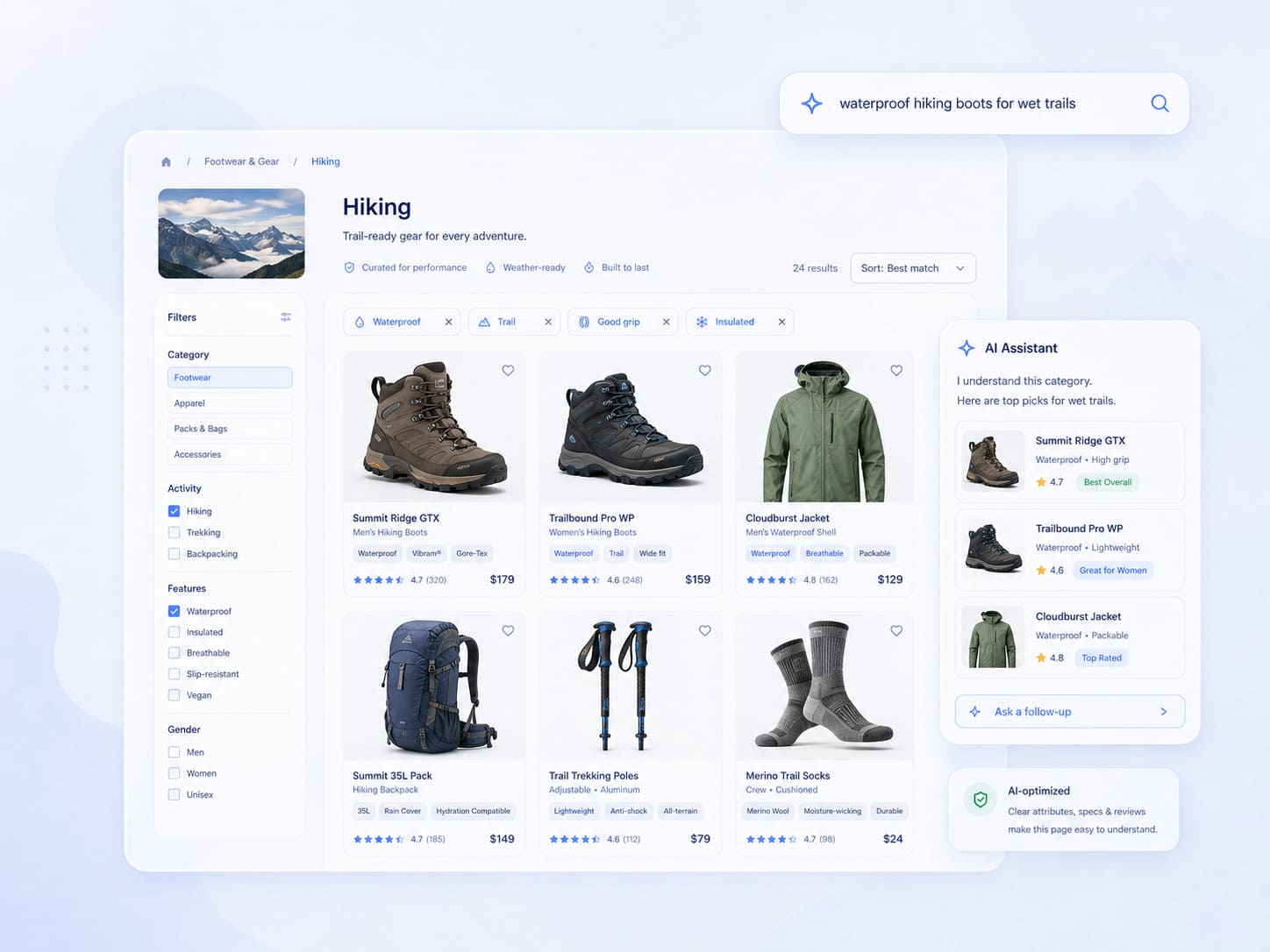
The payoff is steep because attention on a results page is steep. Top-ranking pages capture click-through rates many multiples higher than results further down — the gap between position one and position ten is routinely an order of magnitude. Ranking third instead of thirteenth isn't a 10-place improvement; it's a different business.
Prioritize in this order:
Category pages — highest commercial intent, most underoptimized on most ecommerce sites.
Product pages — unique descriptions, real specs, reviews rendered as text.
Comparison and buying guides — captures research-stage demand and feeds AI assistants.
Technical hygiene — crawl budget, canonicals, page speed.
The mistake almost every online business makes is writing blog posts before fixing category pages. Fix the pages that already carry purchase intent first. Our walks the full technical checklist.
Done right, SEO drives website traffic long after the work is paid for — which is why it quietly beats paid advertising on lifetime economics even when it loses on speed.
3. Email marketing: the channel you actually own
Every other marketing channel is rented. Algorithms change, ad auctions reprice, platforms deprecate targeting. Your email list doesn't. Reach was never the constraint with email — relevance is.
An email marketing strategy drives revenue through sequences, not broadcasts. The four that matter most:
Sequence | Trigger | What it's worth |
Welcome | Signup | Highest engagement you'll ever see; sets purchase expectations |
Abandoned cart | Cart exit | Recovers demand you already paid to acquire |
Post-purchase | Order confirmed | Drives the second order, which predicts lifetime value |
Winback | 60–90 days inactive | Cheapest reactivation available |
Engagement benchmarks here are healthier than in most digital marketing channels, because you're writing to people who asked to hear from you. Compare a maintained list against organic social reach and it's obvious why owned channels deserve a larger share of marketing efforts than they usually get.
Abandoned cart deserves specific attention. Baymard Institute's puts the average cart abandonment rate at 70.22%. Their research also identifies why people leave. About 42% were simply browsing and never intended to buy — that share is largely unwinnable. Among the rest, the reasons are fixable:
extra costs too high (40%)
delivery too slow (20%)
didn't trust the site with card details (19%)
forced account creation (18%)
a checkout that's too long or complicated (17%)
Read that list again. Almost none of those are marketing problems — they're checkout problems that marketing gets blamed for. Fix the checkout before you write the recovery email. Then write the recovery email.
Set up so these run without you and see our for sequence templates.
4. Paid ads: shift budget toward prospecting
This is where the evidence gets genuinely uncomfortable for the industry.
Paid advertising — also known as pay-per-click, or PPC — lets you buy website traffic instead of earning it organically, across platforms like Google Ads and Meta. Standard practice for a decade has been to weight budget heavily toward retargeting, on the logic that warm audiences convert cheapest.
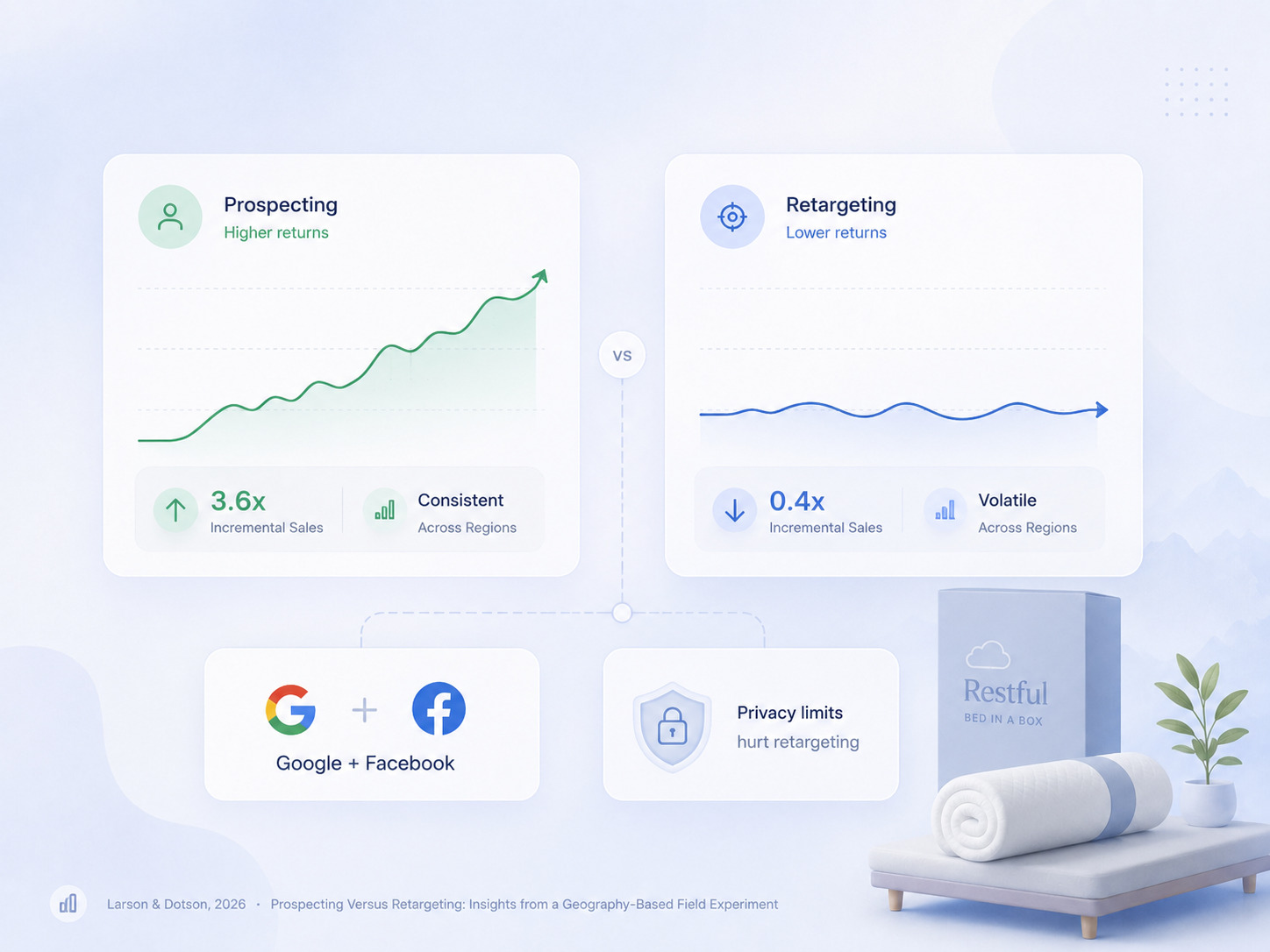
A 2026 field experiment published in the Journal of Interactive Marketing tested that assumption properly. Jeffrey S. Larson and Jeffrey P. Dotson ran a large-scale, geography-based experiment across the Google and Facebook ad networks for a major bed-in-a-box brand. : large and consistent returns on prospecting ads across both networks, while retargeting ads yielded significantly lower returns.
Why this happens is straightforward once you see it. Retargeting reports beautiful ROAS because it takes credit for customers who were already going to buy. Geographic holdout testing measures incremental sales — what actually happened because of the ad — and the retargeting advantage largely evaporates.
What to do with this:
Stop treating platform-reported retargeting ROAS as truth. It's a correlation dressed as a causal claim.
Rebalance toward prospecting and creative testing, where the incremental lift lives.
Keep retargeting for genuinely high-value moments — abandoned cart, high-AOV product views — not as a default budget line.
Use the platforms' AI bidding to optimize ad spend and audience targeting in real time, but judge it on holdout results rather than its own dashboard.
Run geographic holdout tests before you scale anything. See section 12.
Our guides on and cover campaign structure in detail. If you sell across borders, is the cheapest way to stop wasting spend on regions you can't ship to profitably.
5. Social media marketing and social commerce
Social media marketing showcases products, collaborates with creators, and builds the brand awareness that makes every other channel cheaper. Facebook and Instagram remain the default paid-reach engines for many ecommerce brands, while TikTok has become the discovery and native-commerce engine.
Social media platforms serve two distinct jobs, and conflating them wastes money. One is cheap reach to potential customers who've never heard of you. The other is closing.
The strategic shift in 2026 is that social increasingly does both. In-app checkout means the customer journey can start and end without ever touching your ecommerce site — good for conversion, bad for your customer data, since you lose the relationship to the platform.
Use social commerce for velocity, reviews, and reach. Drive high-intent buyers to your own store, where you keep the email address and control the . Our breaks down the platform mechanics.
6. Influencer and creator marketing
Influencer marketing works because it arrives as recommendation rather than advertising, and it disproportionately reaches younger buyers who discover products through people rather than search boxes. For those cohorts, creators function as a primary discovery channel.
Follow two rules to keep this from becoming expensive theater:
Buy audiences, not follower counts. A creator with 15,000 engaged followers in your exact category will outperform one with 500,000 general followers, at a fraction of the cost.
License the content. The durable value in a creator deal is often the creative asset, not the post. Good creator content becomes your best-performing paid ad, which loops straight back into section 4 — this is prospecting fuel.
You'll see a widely quoted claim that influencer marketing returns $18 for every $1 spent. Treat that number with the same suspicion as any other self-reported channel ROI — see section 12 for why. Pay on performance where you can, which leads directly to affiliates.
7. Affiliate marketing
Running an affiliate program is the only acquisition channel where you pay strictly after the sale. Your cost is variable, capped, and denominated in revenue you've already booked — which makes it the safest line item in a marketing plan and the one most stores never get around to launching.
Who's actually worth recruiting? Not "anyone with a link." Three groups drive nearly all the volume:
Review and comparison publishers already ranking for your category keywords. You're renting their SEO and buying placement in the research-stage moment where shoppers compare options. These are the affiliates that bring genuinely new customers.
Creators with a real audience in your niche — the same people from section 6, moved onto performance pay instead of flat fees.
Your own happy customers. The cheapest affiliate list you'll ever build is an invitation in a post-purchase email to people who already reorder.
Set commission from contribution margin
A 20% commission on a product carrying a 35% margin after shipping and returns leaves you 15 points — before the cost of everything else in this article. Work out what you can pay for a new customer, then price the commission under it. Higher rates for first-time buyers than for repeat ones is usually the right shape, because that's where the incremental value is.
What quietly drains programs
Affiliate networks pay on last click, so any party that touches the final click gets paid — including coupon and cashback browser extensions that activate at checkout, after the customer already decided to buy. You end up paying a commission on a sale you'd have made anyway, which is the same over-attribution problem that inflates retargeting in section 4, just with an invoice attached.
Four rules that fix most of it:
Ban branded-keyword bidding in your program terms, and enforce it. Affiliates buying ads on your own brand name are reselling you traffic you already had.
Shorten the cookie window. Thirty days rewards interception; seven or fourteen rewards discovery.
Pay a new-customer bounty rather than blanket last-click commission, so the program is measured on customers you didn't already have.
De-duplicate against your other channels — if email and an affiliate both claim the same order, decide the rule in advance and track it in rather than the network's dashboard.
Then hold the channel to the same standard as everything else here: run a holdout, and judge it on incremental orders rather than the commission report.
8. Content marketing that answers real questions
Content marketing attracts customers by answering the questions they're already asking, which reduces doubt in the customer journey and builds the topical authority that both search engines and AI assistants use to decide whom to cite. It's how you build lasting customer relationships with people who aren't ready to buy yet.
It also matches how buyers research: reading and watching well before they're ready to buy, often across several sessions. That's not a blog-versus-video argument — it's an instruction to publish the same answer in both formats.
The 2026 version of this discipline is narrower than the old "publish weekly blog posts" advice:
Buying guides and comparisons — capture research-stage demand, and get lifted verbatim by AI assistants.
Sizing, fit, compatibility, and care content — reduces returns, which is margin.
Short product video — the preferred discovery format, and it keeps people on page.
Write for the question, not the keyword. Assistants reward pages that answer a question cleanly in the first two sentences — which is also, conveniently, exactly what human shoppers want.
9. Social proof and user-generated content
Reviews are not a trust widget. They're conversion infrastructure — and they're SEO and AI-visibility infrastructure too, because review text is the richest source of long-tail language about your product that you'll never write yourself. User-generated content boosts social proof and shapes purchase decisions at the exact moment shoppers hesitate.
Practical priorities:
Get review volume on your top 20 products before worrying about the rest.
Render reviews as crawlable HTML text, not inside a third-party iframe — an iframe is invisible to the systems in section 1.
Ask for photos. UGC outperforms studio photography on conversion in many categories.
Answer negative reviews publicly. It converts better than having none, because it shows how you respond when something goes wrong.
10. Checkout, conversion rate, and average order value
You do not need more traffic. You need more of the traffic you already pay for to convert.
Raising conversion rate and average order value increases sales without raising customer acquisition cost at all — which makes it the cheapest growth available to any online store. A store converting at 1.4% that reaches 2.1% has effectively cut its CAC by a third without touching a single marketing campaign. Every cent of AOV gained drops against acquisition costs you have already paid.
So, what you can take advantage of:
Page speed and mobile optimization — mobile users generate the majority of ecommerce sessions, and mobile is where speed penalties bite hardest.
Checkout simplification — guest checkout, fewer fields, visible total cost early. Baymard's data above says forced account creation alone costs you 18% of abandoners.
Upfront shipping cost — the single largest documented reason for cart abandonment.
— pure AOV lift at the moment of highest intent.
— raises AOV while moving slower inventory.
Our guides on , , and go deeper on each. If you're building the flow itself, Funnelish's handles one-click upsells natively. Use it and don't build the infrastructure from scratch.
11. Retention, repeat business, and customer loyalty
Acquisition gets the budget. Retention gets the profit.
The foundational number here is genuinely old and genuinely solid: , published in Harvard Business Review, found that a 5% increase in customer retention raises profits by 25% to 95%, depending on sector. Thirty years of ecommerce has not repealed it. Acquiring new customers still costs multiples of what it costs to keep existing ones.
A customer loyalty program's real job isn't discounting — it's raising purchase frequency and generating the first-party customer data you can use now that third-party tracking has degraded. Effective programs reward repeat purchases with loyalty rewards, early access, or status rather than pure markdowns, and they capture customer behavior data as a byproduct. Shoppers stay for perceived value rather than the size of the discount, which argues for perks that feel earned rather than couponed.
Where most loyalty programs fail is engagement. Signing members up is easy; keeping them earning and redeeming past the first two months is the entire game. So, design for a second redemption — that's what fosters customer loyalty rather than renting it.
Subscriptions are the strongest retention mechanic available if your category supports them — see our and .
12. Measure incrementality, not attribution
This is the discipline that makes every section above work, and it's the one many stores skip.
Platform attribution answers "Which ad was the customer near before buying?" Incrementality answers "Would this customer have bought anyway?" Only the second question is worth money.
Consider the most-repeated statistic in this entire industry: email marketing returns $42 for every $1 spent. It appears in virtually every ecommerce marketing guide online. It comes from surveys commissioned by email software vendors, it's self-reported by marketers, and it's calculated by dividing email-attributed revenue by email spend — using exactly the last-click logic this section is about to dismantle. Email is genuinely excellent, but it is not 42:1, because a large share of that "email-attributed" revenue belongs to customers who were going to reorder regardless. The same caution applies to the $18-per-$1 influencer figure in section 6.
This isn't pedantry. If you believe email returns 42:1 and prospecting returns 3:1, you will systematically underfund the channel that creates demand and overfund the one that harvests it.
How to test properly without a research budget:
Geographic holdouts. Turn a channel off in matched regions for 3–4 weeks. Compare total revenue, not platform-reported conversions.
Scaled holdouts. Withhold a campaign from a random 10% of your list or audience and measure the gap.
Post-purchase survey. Ask "How did you hear about us?" at checkout. It's crude and biased, but it catches channels your pixel can't see — which now includes most AI-assistant traffic.
Track CAC, contribution margin after shipping and returns, and customer lifetime value by acquisition cohort. Run on the changes you make, and watch the numbers in your own analytics rather than the ad platform's self-graded report card.
3 ecommerce marketing tactics that quietly stopped working
1. Retargeting-heavy budgets
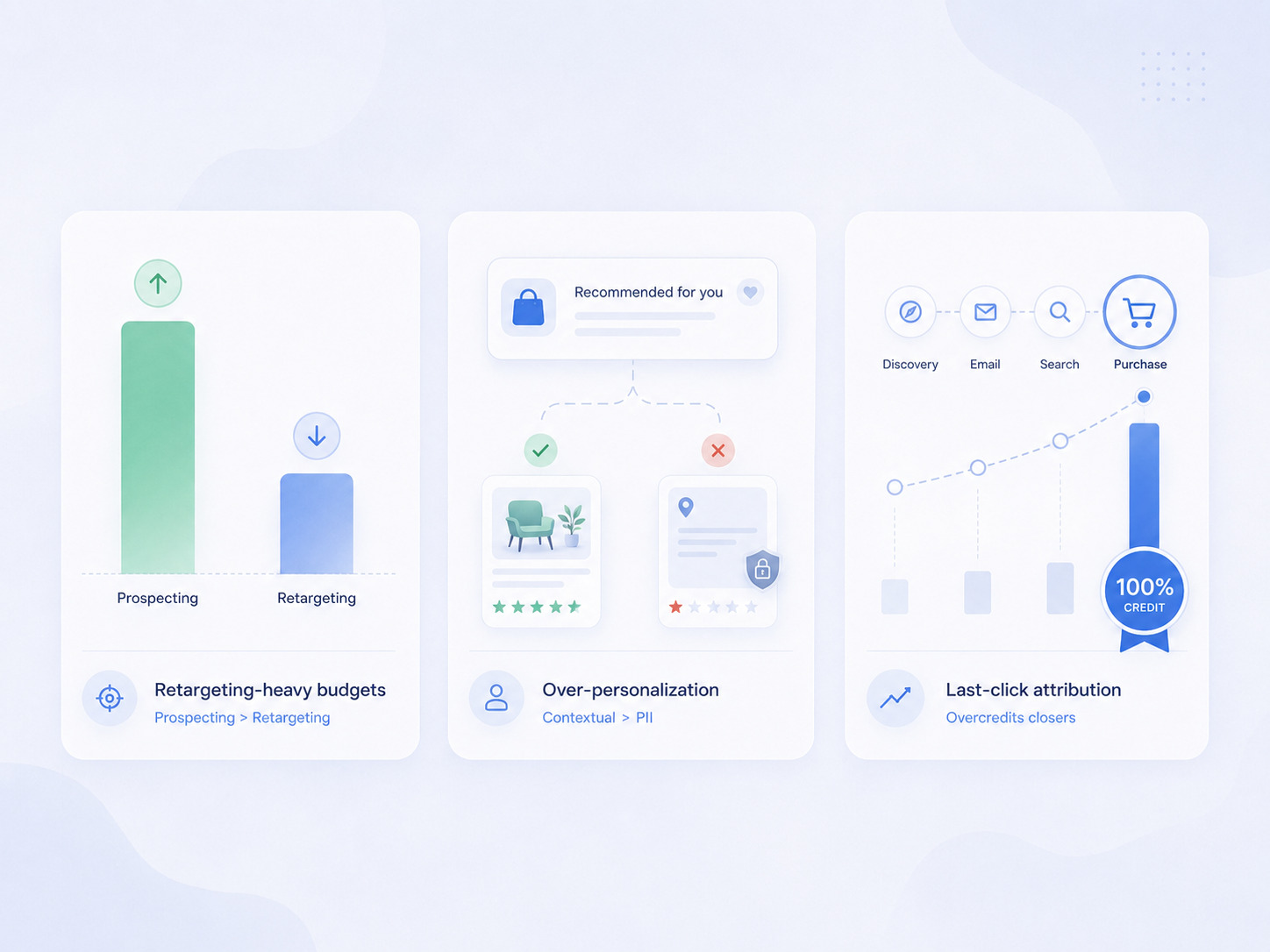
Covered in section 4. The 2026 Journal of Interactive Marketing field experiment found prospecting delivered large, consistent returns across both major ad networks while retargeting returns were significantly lower. Privacy changes including Apple's iOS 14 and GDPR have compounded this. If retargeting is more than a modest slice of your paid budget, test it with a geographic holdout before you renew it.
2. Hyper-personalization as a default
High-performing marketers personalize, so the industry has taken that correlation as a mandate: more customer data, more tailoring, more revenue. The research disagrees, in a specific and useful way.
A 2026 study in the Journal of Interactive Marketing by John J. Yi and Caleb Warren, found that personalization backfires when it embarrasses the customer. In one study, shoppers responded less favorably to a personalized experience when buying a stigmatized product (weight-loss medication) but not a neutral one (headache medicine). A second study replicated the effect with music recommendations tied to identities people preferred not to have surfaced.
Separately, by Hyeongseok Kim and Seunghee Han tested three levels of message personalization (generic, contextual/location-based, and PII-based using name and purchase history) against experimentally induced privacy concern. When privacy concern was activated, PII-based personalization performed no better than the generic control and was directionally worse than contextual personalization. When privacy concern was low, both tiers beat generic — but the incremental gain from PII-based over contextual was minimal.
Worth noting the limits honestly: that second study is a 360-participant lab experiment with South Korean respondents, not a field test of live store revenue. It's suggestive, not decisive. The Yi and Warren findings are the stronger evidence.
The translation: contextual personalization captures most of the value at a fraction of the risk. Recommend based on what's in the cart and what category the shopper is browsing. Be deliberately less personal in sensitive categories — health, body, finance, anything identity-adjacent. "We noticed you looked at this" is a liability in more categories than marketers assume, and customer expectations around data use are tightening.
3. Last-click attribution
Last-click doesn't measure marketing. It measures which channel was standing closest to the purchase. It systematically overcredits retargeting, branded search, and email — the channels that intercept demand — and undercredits everything that created it. If you optimize toward it, you will defund your own growth and the dashboard will congratulate you the whole way down.
How to build a successful ecommerce marketing plan in 90 days
Days 1–30 — fix the leaks. Audit checkout against the Baymard abandonment reasons. Show shipping costs early. Enable guest checkout. Fix mobile page speed. Add structured data so specs and reviews render as crawlable text. None of this costs media dollars, and all of it multiplies every dollar you spend later.
Days 31–60 — build the owned channels. Ship welcome, abandoned cart, post-purchase, and winback email campaigns. Get reviews on your top 20 products. Publish comparison and buying guides for your three highest-intent categories.
Days 61–90 — buy growth and measure it honestly. Weight paid budget toward prospecting. Run one geographic holdout on your largest channel. Launch affiliates. Set up cohort reporting for CAC and customer lifetime value.
Then repeat, with one structural rule: 70% of marketing spend in channels you've proven incrementally, 30% in tests. The 30% is what finds next year's core channel.
Set ecommerce marketing goals in those terms — contribution margin and payback window. Traffic is an input. Marketing success is measured in profit per acquired customer.
Bottom line
Most ecommerce marketing advice is a list of 2022 channels with no theory of which ones caused a sale. Three things make 2026 very different from 2022:
AI assistants became a high-converting acquisition channel, and roughly a third of the average product page is invisible to them. Fix that first — it's the cheapest revenue on this list.
Prospecting beats retargeting under proper experimental measurement, which means most paid budgets are misallocated.
More personalization isn't better personalization. Contextual captures the value; personal-data-driven adds risk without reliable lift.
Everything else — SEO, email, social media, content, reviews, retention — still works, and works considerably better once you stop measuring it with last-click.
If you want the conversion infrastructure that makes this traffic pay, Funnelish for ecommerce gives you a fast page builder, native one-click upsells, subscriptions, and analytics that report revenue instead of vanity metrics.
Frequently asked questions
What is ecommerce marketing?
Ecommerce marketing is the practice of using digital marketing channels — SEO, email, paid ads, social media, content, influencers, and retention programs — to drive traffic to an online store, convert visitors into paying customers, and encourage repeat business. Unlike traditional marketing, results are tracked in real time through metrics like conversion rate, customer acquisition cost, and customer lifetime value.
What are the most effective ecommerce marketing strategies in 2026?
The highest-leverage strategies are making your store machine-readable for AI shopping assistants, SEO on category and product pages, email and SMS automation, prospecting-weighted paid advertising, social commerce, creator partnerships, content that answers buying questions, reviews and user-generated content, checkout and AOV optimization, loyalty and retention programs, affiliate marketing, and incrementality testing.
How much should I spend on ecommerce marketing?
Work backward from contribution margin rather than picking a percentage of revenue. Calculate what you can pay to acquire a customer while staying profitable on the first order — or across the first 90 days if you have strong repeat purchase rates — then allocate roughly 70% of marketing spend to channels you've validated with holdout tests and 30% to experiments.
Is retargeting still worth it in 2026?
Less than the industry assumes. A 2026 field experiment in the Journal of Interactive Marketing found prospecting ads delivered large, consistent returns across Google and Facebook while retargeting returns were significantly lower. Retargeting still earns its place for abandoned carts and high-value products, but test it with a geographic holdout before allocating major budget to it.
How do I get my online store to show up in AI shopping assistants?
Make your product data machine-readable. Put price, availability, specifications, and shipping timelines in HTML text rather than images or client-side JavaScript, implement Product and FAQ structured data, use specification tables, render reviews as crawlable text, and answer comparison questions directly on the page. Adobe found the average retail product page scores only 66 out of 100 on machine readability, so most competitors haven't done this yet.
What is a good ecommerce conversion rate?
Most online stores convert between 1% and 3%. Rather than chasing a benchmark, find where your funnel leaks — product page, cart, or checkout — and fix that. Cart abandonment averages 70.22% per Baymard Institute, and the leading fixable causes are unexpected extra costs, slow delivery, forced account creation, and complicated checkout.
Which ecommerce marketing channel has the best ROI?
Email typically shows the strongest reported return because you own the audience and pay no media cost per send — though the famous 42:1 figure is vendor-surveyed and last-click attributed, so treat it as directional. SEO has the best long-term economics because it compounds. For measured incremental return on paid spend, prospecting campaigns currently outperform retargeting.
How do I foster customer loyalty and increase repeat business?
Build a loyalty program around perceived value rather than discounts, and design it so members reach a second redemption. Bain research published in Harvard Business Review found a 5% lift in customer retention raises profits by 25% to 95%. Post-purchase email sequences, subscriptions, and genuinely useful ownership content do more for retention than points balances.
Table of contents
Boost your eCommerce
sales today

24/7 support
No credit card required
Cancel anytime
24/7 support
No credit card required
Cancel anytime
